Mental Wellness: A Complete 2026 Guide to a Healthier Mind
Published: September 1, 2026 Last Updated: September 3, 2026 There’s a particular kind of tired that sleep doesn’t fix.

There’s a particular kind of tired that sleep doesn’t fix. You’ve eaten well, you’ve technically rested, and you’re still running on fumes by 11 a.m. That’s usually not a body problem — it’s a mental wellness problem. And you’re far from alone in it: global surveys consistently show that a majority of adults in both the US and India report feeling “somewhat” or “very” stressed on a regular basis.
Mental wellness is your vigilance in regulating your thoughts, feelings, stress reactivity, and daily interactions so you can do well in life, bounce back from failures, and truly enjoy your life not merely get through it. No one solution. It‘s a combination of multiple smaller, achievable habitudes: how you deal with anxiousness, how mindful you are, how you sleep, your diet, your movement, and what percentage of the day you are glued to a device.
This is your first stop: a comprehensive overview of the mental wellness terrain. Each is broken out below with its key concept, high-impact tips to try immediately, and a link to an in-depth, dedicated guide if you want to explore further in that category. Think of the cluster guides as a quarter-miles of psychological muscle; they delve into the topic.
What Is Mental Wellness? (Definition and Why It Matters)
Mental wellness is the everyday ability to think clearly, feel your feelings but not be overpowered by them, handle your stress, and enjoy good relationships. It‘s life-active and ever-changing — more like a workout than a quick fix.
Unlike a medical diagnosis, mental wellness is not black or white. You don‘t “have” it or “not have” it. It exists on a scale, and fluctuates according to your sleep, your workload, your relationships, even your hormones for that particular week.
Key takeaways:
- Mental health isn‘t an end result; it‘s a process.
- Even robs you physically too – high cortisol levels lead to sleep, digestion, immune system.
- Small regular habits are important rather than the idea of doing one great thing to counteract a month of burnout (one spa day won‘t cancel out a month of burnout).
Practical example: While waiting for a “wellness weekend,” the true mental health go-getter integrates five-minute reset breaks into his her schedules throughout the week a quick walk after lunch, a full lunch hour off his her computer, a two-minute breathing exercise before a stressful meeting.
Mini summary: Mental wellness is daily maintenance of your mind not an after hours band-aid for a bad day.
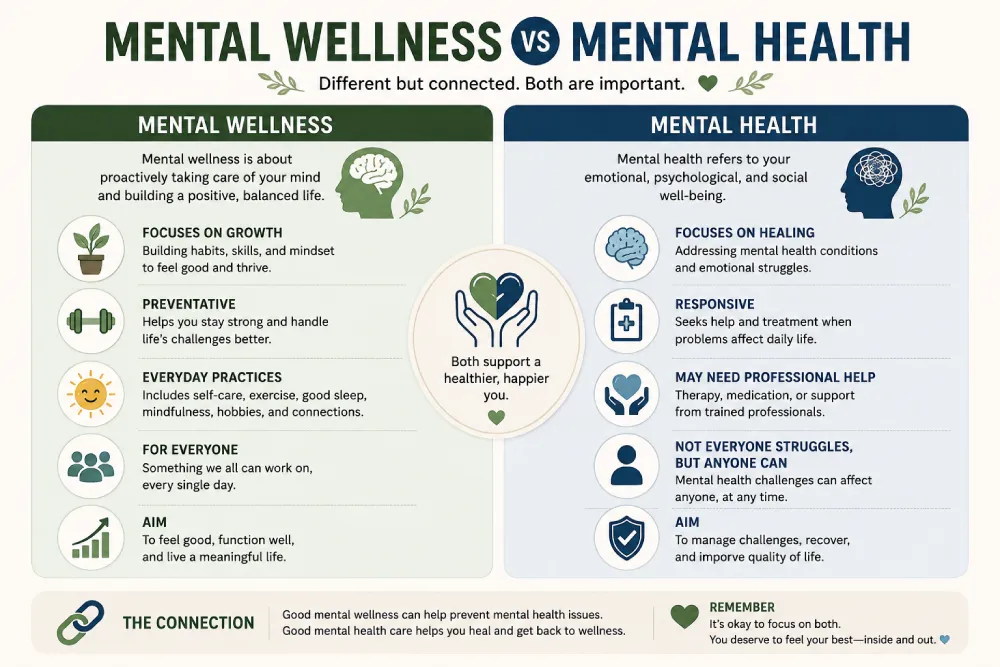
Mental Wellness vs. Mental Health — What’s the Difference?
These two concepts are often used as synonyms, but they are not synonymous: distinguishing already helps you to find the proper tools.
- Mental health is the larger clinical umbrella while it‘s not the same as “having” something you can diagnose (like an anxiety disorder, depression, or PTSD), everyone “has” mental health (whether it‘s good or poor), just as everyone “has” physical health.
- What do we mean by mental wellness? Spending time and effort on a proactive, daily basis to protect and enhance your mental health your habits, routines and strategies.
You can have a diagnosed mental health condition, and use specific mental wellness practices to support you in managing that well. You can also have no diagnosis, and use poor mental wellness practices that leave you burntout, reactive, and disconnected.
Key takeaways:
- Mental health= the state. mental well-being=the ongoing activity that sustains that state.
- Wellness behaviors are not meant to substitute for when using clinical treatment is indicated (more on this soon).
- Both and they do.
Mini summary: If you consider mental health as the engine of your car, then mental wellness would be the regular tune-up and servicing of the engine.
Signs of Good vs. Poor Mental Wellness
Being aware of your position is the first genuine step. The following is a quick, informal way to assess for oneself.
| Good Mental Wellness | Poor Mental Wellness |
|---|---|
| Within hours, not weeks. You get over a bad day:’ | Minor setbacks carry an unnecessarily heavy toll |
| You can identify what you‘re feeling. | The emotions seem like a fog grumpy, “off,” but not entirely sure why |
| Getting you through the day is only possible if you have energy for those people you love. | You ignore the calls and messages from even your best friends. |
| Pretty much every night it feels like sleep is (at least somewhat) restorative. | Despite sleeping 7–8 hours, you wake feeling tired. |
| You may choose to sit with boredom or silence; | You grab your phone in the second there‘s a gap |
Practical tip: do this once a week rather than every day, as mental wellness fluctuates naturally the important thing is whether over many weeks you can see an upward trend rather than a bad day here and there.
Mini sum up: If more and more on the right column seem familiar over the past month, should move actively to the remedies below instead of counting on it passing alone.
One important part of maintaining mental wellness is building emotional resilience, which helps you recover and adapt after stressful situations and setbacks.
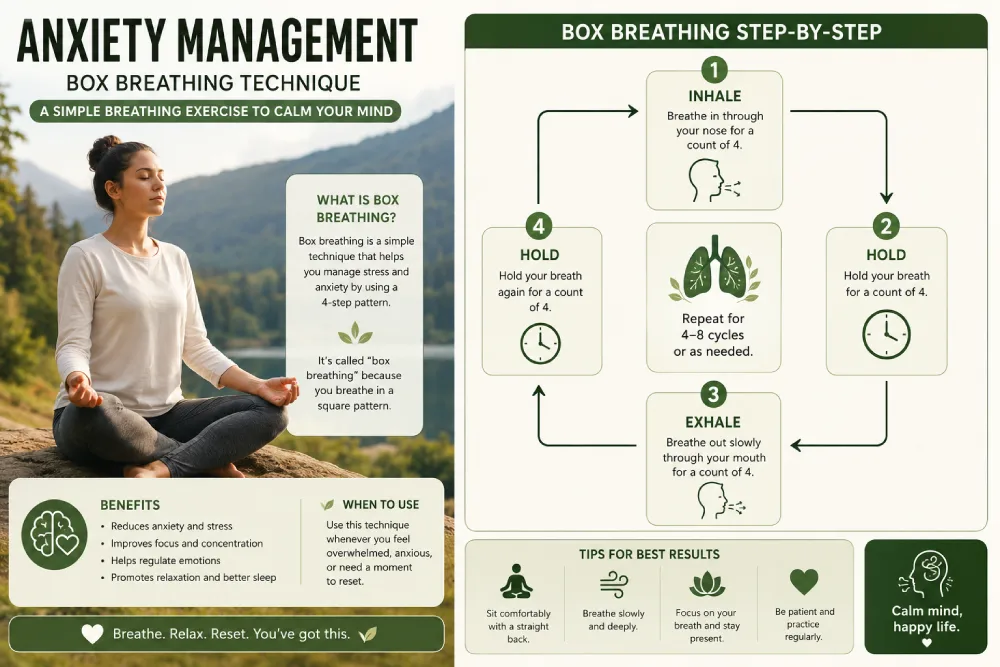
Anxiety Management — Everyday Techniques That Work
Anxiety is not simply “worrying too much”. It is the state of your nervous system in the stress response, a response which can be “persevered” in. Good management by definition is a process of first working with the body and then with the mind.
Quick, body-first techniques:
- Box breathing: in 4 seconds, hold 4, out 4, hold 4. Repeat for two minutes. This signals your nervous system to shift away from the fight-or-flight response.
- 5-4-3-2-1 grounding: Can you list 5 things you see,4 you can touch, 3 you hear, 2 you smell, 1 you taste. This gently forces your brain to pull away from the spiraling thoughts and into the present.
- Worry window: Allocate 10 minutes per day where you habitually will worry intentionally. During all other times, politely “bump” concerns aside to the worry period.
Key takeaways:
- Anxiety needs body reset more than being “talked out of it”.
- Caffeine and lack of sleep make anxiety worse they‘re not separate problems.
- If experiencing ongoing, daily anxiety that causes problems at work or in relationships, consider consulting a professional; do not try relying solely on self-help methods.
Read More: Complete Anxiety Management Guide — breathing techniques, workplace anxiety, and a 7-day anxiety-reset plan.
Mindfulness Practice for a Calmer Mind
Mindfulness is just paying attention, on purpose, in the present moment and without judgment. Seems easy enough, but this is actually one of the hardest disciplines to establish it‘s counterintuitive to how our brains are evolutionarily wired: to plan, predict, and dwell rather than be.
Where to start:
- 2-min breath awareness: Find a comfortable place to sit, close eyes, and observe your breath just as it is. Return attention to your breath when you mind begins to wander (which it will).
- Mindful shifts: Practice mindfulness in the small everyday activities you already do (brushing your teeth, your morning java, the walk back to your car) rather than trying to add one more thing to your day.
- Single-task: Focus on one thing at a time for just ten minutes. It is effective in restoring a diminished attention span from chronic multitasking.
Key takeaways:
- Mindfulness is not a “personality” trait you “either have or you don‘t,” it‘s a trainable skill. Just like you can develop muscles so you can develop mindfulness.
- You don‘t need to stay on the cushion for thirty minutes; two to five minutes daily, consistently, is better than one long session a week.
- Given the links between a chronic negative thought cycle and both low mood and anxiety, mindfulness has proved to be a popular candidate for decreasing rumination.
Read More: Mindfulness Practices for Better Mental Health and Wellness — a full meditation for beginner guide.
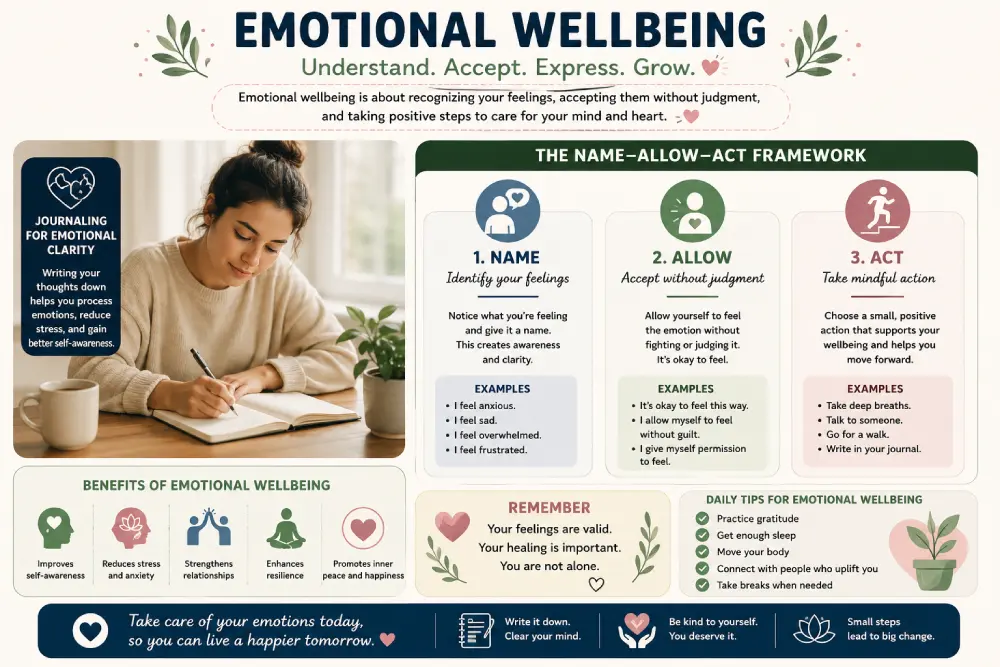
Emotional Wellbeing — Understanding and Managing Your Emotions
Having emotional wellbeing isn‘t about feeling happy all the time, as this will never happen, and trying to make it happen can have the opposite effect. Managing emotional wellbeing is about being free to experience whatever feeling you are experiencing, without feeling controlled or overwhelmed by it.
A straightforward formula: Identify, provide, follow up (or don‘t).
- Name it “I‘m feeling anxious,” not “I‘m fine” or “I don‘t know.” When you give a name to an emotion, you can quantify how much it lessens the emotion.
- Allow it Give yourself 60 – 90 seconds to pass the feeling through your body before pulling your attention away from the feeling.
- Perform (or not) Identify whether the emotion requires an action (a difficult conversation, a boundary) or simply required to be experienced and released.
Key takeaways:
- Not letting your feelings out doesn‘t mean you‘ll get rid of them. It means they will come out maybe later as crankiness, lethargy, or muscle tightness.
- Journaling is without a doubt one of the most readily available methods of experiencing the power of reflecting on one‘s emotion.
- Emotional health gets easier – you’re not trying to get rid of the problem, just get better at coming back from feeling that way.
Practical application for acknowledgment: A quick two-liner journal entry, such as ‘I am irritated because X occurred and I wasn‘t heard’ can head off a partner‘s reaction before it escalates into a fight.
Read More: Complete Emotional Wellbeing Guide — the naming-allowing-acting framework in depth, plus journaling prompts.
Sleep and Mental Recovery
Sleep is where your brain takes care of its emotional housecleaning. In deep sleep and REM sleep your brain works to process the accumulated stress of the day, and to solidify memory–fail to do so, and the unresolved stress accumulates.
Quick wins:
- If you go to bed at varying times throughout the week, but wake at the same time every day (including weekends), your circadian rhythm is better regulated than it is by maintaining a “fixed bedtime” throughout the week.
- A natural 30-minute wind-down with glowing lights and no screens also indicates melatonin production.
- Relaxed caffeine cutoff time by early afternoon should be no problem. Caffeine‘s half-life is quite long so it will break up your sleep even if you are able to initially fall asleep well.
Key takeaways:
- Poor sleep is a cause and symptom of poor mental health it‘s a two way relationship.
- One bad night isn’ a crisis and a chronic pattern is defined as under 6 hours, in which mood, concentration and anxiety symptoms are significantly worse.
- Any naps over 20 minutes are beneficial, although especially long naps in the late afternoon tend to disrupt night sleep.
Read More: Complete Sleep and Recovery Guide — sleep hygiene checklist and natural remedies for insomnia.
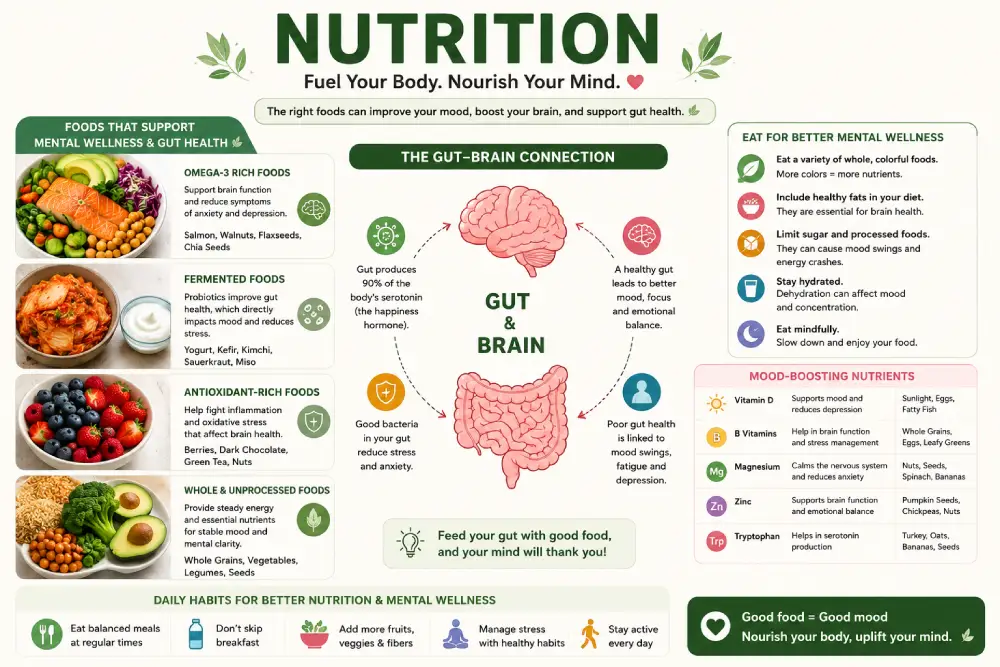
Nutrition and the Gut-Brain Connection
Most of the body’s serotonin is generated in your gut, and the vagus nerve functions as a direct, two way pathway between your gut and your brain. Your diet truly impacts your mood not simply your ability to wear that sexy little black dress.
Quick wins:
- Balance bloodsugar to prevent the infamous ‘sugar crash’ that occurs when blood ‘sugar’ levels shoot up we will show you how to combine carbohydrates with protein or fat at meal times.
- Add fermented foods — include items like yogurt, curd, kimchi and other foods that contain probiotics to promote a healthy gut that impacts mood.
- Don’t skip meals when feeling anxious skipping meals when anxious can worsen feelings of anxiety as blood sugar levels drop.
Key takeaways:
- Foods which are high in omega 3 (fish, walnuts, flaxseed) are similarly negatively associated with the prevalence of mood problems.
- High intake of sugar and ultra-processed foods are associated with increased self-reported anxiety and low mood.
- It‘s not about restrictive dieting here mental health nutrition is something that can be added on, not taken away from.
Read More: Food and Mental Wellness: The Gut-Brain Connection Guide — full meal frameworks for both US and Indian diets.
Movement for Mental Health
Working out is one of the most better-proven tools for mental wellness; not for what it does to your body but for what it does to your brain chemicals. It flushes endorphins and BDNF (a protein that has been connected to mood control and brain health) into your system and empties out anxious energy.
Quick wins:
- A 10-minute walk following a stressful event has been demonstrated to significantly reduce cortisol levels.
- Any activity is good dancing around your kitchen, going for a walk, taking a short bike ride. Regular activity is better for your mental health than a one-off intense session.
- Being outdoors for exercise provides an extra benefit: exposure to natural light can help regulate sleep and regulate mood.
Key takeaways:
- No gym required. No hour a day necessary you can get effective mood benefits from light, consistent movement.
- Movement is especially wonderful for anxiety, since it rids the body of excess stress hormones.
- Choose a movement you can handle without fear. Engagement is more important than “best” workout.
Read More: Exercise and Mental Health: The Complete Guide — low-effort routines for busy schedules.
Digital Detox and Screen Time Balance
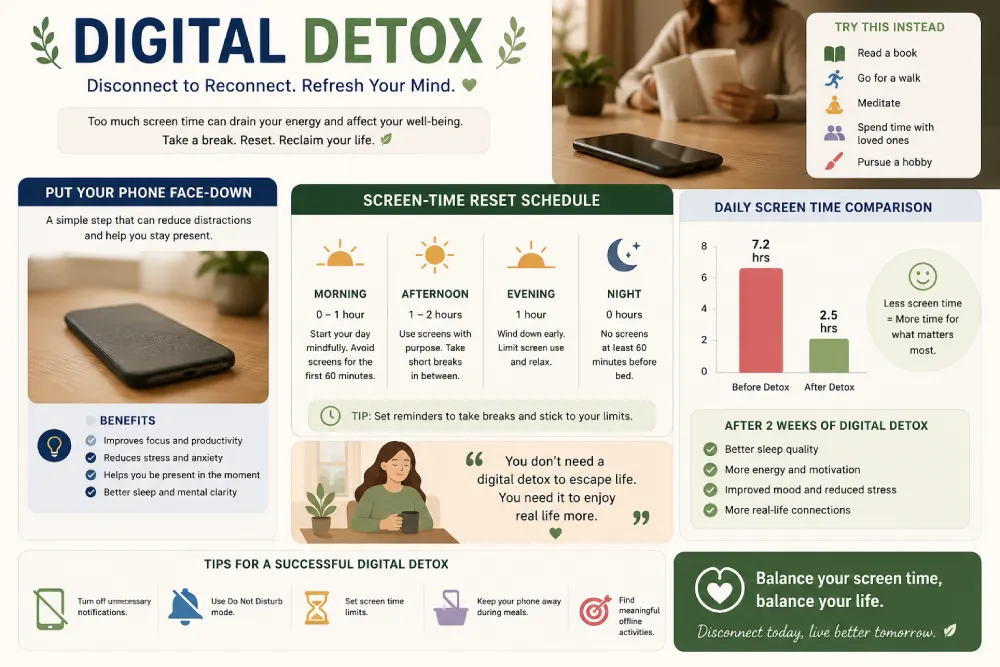
Today, it’s common for the average adult to spend several hours a day on their phone. More and more studies find that the more you passively engage with social media in other words, scrolling and comparing the more anxiety and dissatisfaction with life you report, especially among young people.
Quick wins:
- No-phone first hour: Do not answer your phone during the first 30 60 minutes of your day. It completely alters the tone of your morning.
- Batch Notifications: Turn off all unimportant notifications and by check your messages in certain windows rather than reactively checking them all over the day.
- Curate, not consume: unfollow the accounts you stalk that always make you feel more drained after a little Instagram session.
Key takeaways:
- It‘s not the screen time (passively scopeless/unsoulful if all you do is compare yourself to everybody) it‘s the passive use of screen time versus the active use of screen time (making a call, learning something).
- A digital detox doesn‘t mean just getting rid of your phone; even a few planned hours every day start to make a real difference.
- Having rooms without phones are shown to be very beneficial to both sleeping habits and morning mood.
Read More: Digital Detox: A Practical Screen-Time Reset Guide — social media and mental health, plus a family screen-time framework.
Building a Daily Mental Wellness Routine
All of the methods mentioned above are meant to be used repeatedly, daily, as part of a flexible rhythm. They are not an unbreakable schedule, which will only cause additional frustration.
A simple starter framework (adjust to your life):
| Time | Habit | Why |
|---|---|---|
| Morning | No-cellphone, first 30 minutes then sunlight | Regulate circadian rhythm, establish a more hositile environment |
| Midday | 10-minute walking or break for movement . | Reset hormone levels in the morning to get through the afternoon slump. |
| Evening | Journaling or naming your emotions for 2 minutes. | Spends the daytime instead of taking it to bed |
| Night | Screen-free wind-down, regular sleep schedule | Protects the deep sleep and recovery process |
Key takeaways:
- Here‘s where to begin: with one habit, rather than five at the same time — overwhelming oneself with too many new habits at once is the leading cause of failing in self care within two weeks.
- Link new habits to things you already do (“after I brush my teeth, I‘ll journal for 2 minutes”), it drastically increases consistency.
- Remember to TRACK weekly, not daily- a 5/7 week is still a good week.
Read More: Best Self-Care Habits for a Balanced and Healthy Life — a full daily and weekly self-care habit tracker.
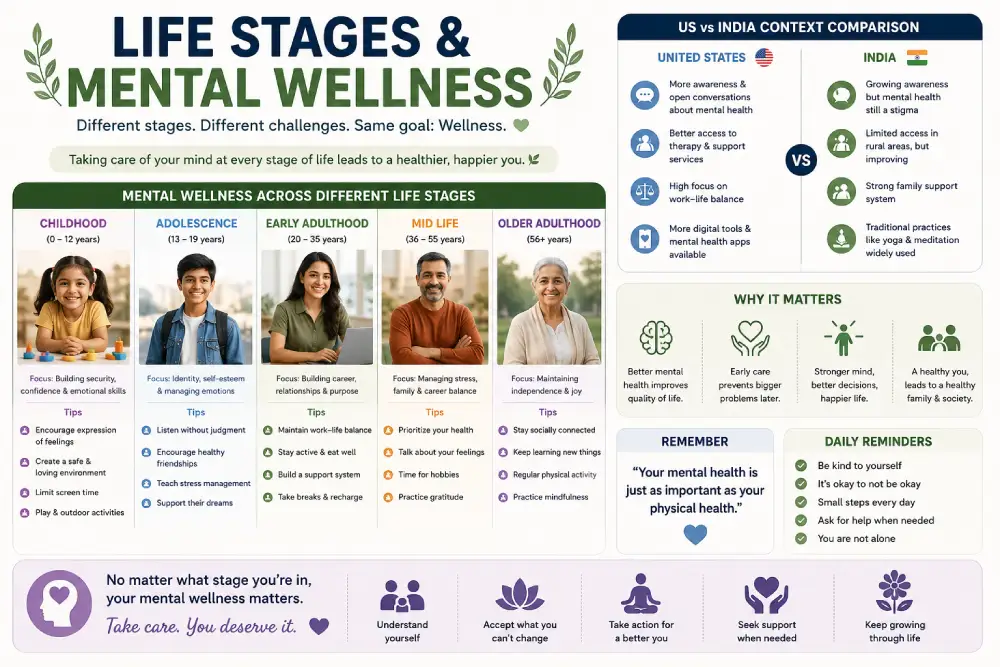
Mental Wellness Across Life Stages (Students, Professionals, Parents — US & India)
The nature of needs for mental wellness varies according to life-stage but also with the different cultural settings.
Students (US & India): pressure to perform academics is a top stress point in both countries, but in India there is especially high pressure during board examinations and hostile entrance exams. They will respond to scheduled breaks scheduled, sleep protection around high-stakes exam time, and normalization of family talk about stress more than to any single “study hack.”
Working professionals: burnout – chronic, unmanaged workplace stress – has become an official recognized occupational phenomenon. In the US it manifests itself as an “always-on” culture of email; in India long commutes (and hybrid work arrangements that blur the lines between work and home) are often a contributing factor. The key: a well-defined boundary (a real end-of-workday ritual) is more important than any one productivity tool.
Parents & Caregivers: Caregiver stress is one of the most unaddressed chronic problems. Initially, parents neglect their own mental health issues altogether and this usually bites them in the @$$ exhausted parents are less patient than rested ones. Protecting ten minutes of personal time each day will significantly improve this.
Key takeaways:
- There‘s not a one size fits all mentality health routine the principles are there, but it should be tailored to your own life stage.
- In India alone, stigma regarding mental health treatment is slowly decreasing but still very much is a true obstacle, and taking mental health wellness practices is a more easily practicable first step.
- In US, the barriers are quite often less about the stigma and more about the cost and availability of therapists – teletherapy has been a real success there.
Mini summary: Re-user the same core toolkit (breath, movement, sleep, connection) in a way that works to your specific pressures rather than copying someone else‘s daily practice wholesale.
Myth vs. Fact: Common Mental Wellness Misconceptions
| Myth | Fact |
|---|---|
| Mental wellness is ‘being happy all the time’. | It means being able to bounce back from negative emotions not suppressing them. |
| This is a myth if you say that a person with a diagnosed condition should be working on their mental wellness. | Mental wellness habits can be beneficial to everyone regardless of the diagnosis. |
| “The word meditation really is meant to describe this act of emptying one‘s mind.” | Mindfulness that I am talking about is the art of observation, of noticing and vanishing and then noticing again, of not being able to get a grip. |
| Talking about stress exacerbates it. | Naming and expressing the emotion usually makes the emotion less intense, not more. |
| Considered to be indulgent or selfish, self-care. | Sustainable self-care has the effect of enhancing your ability to show up for people, rather than away from them. |
When to Seek Professional Help
Self-help habits do work, but they have their limits. It‘s time to see a professional therapist, counselor or psychiatrist when:
- Throughout most days lasting over two weeks anxiety sadness or stress
- Sleeping, hungry, or having energy has changed a lot and is not getting any better.
- You‘ve become quite uninterested in the group activities you normally take pleasure in.
- Relationships or job performance are always on the decline
- Have you ever thought about or planned ways to kill yourself?
In the US: Teletherapy services and EAPs through employers have greatly improved access and/or reduced the cost substantially compared to in-person therapy.
In India: Access is growing fast via teletherapy apps and helplines, and more workplaces are providing EAP-like support but advisable to verify credentials; the profession is not as officially regulated as in the US.
If you are having a crisis and/or suicidal thoughts, please contact your local emergency services and/or a crisis helpline in your country now. Don‘t try to deal with it by yourself.
Understanding the difference between professional support and personal strategies can help you choose the right approach. Explore our guide on therapy vs self-help.
The Future of Mental Wellness in 2026 and Beyond
A few shifts worth watching:
- AI-supported wellness applications emotional journaling apps and mood trackers are starting to use AI to detect things that you might not notice on your own, although they‘re meant to complement mental health services, not replace them.
- Workplace mental wellness as policy, not perk more and more organisations embed recovery time and mental health days in standard policy rather than offering them optionally.
- Preventive mental wellness– a move from “treat when broken” to having routine mental wellness check-ins, like physical health checkups.
- Group-based well-being community meditation classes, peer support groups, and group exercise programs are making inroads as a lower-cost, relationship-based adjunct to traditional psychotherapy.
FAQs
What is mental wellness? Mental wellness means taking care of your thoughts, feelings and stress in a way that allows you to perform at your best and bounce back from adversity. It‘s a maintenance system.
What are some natural ways to improve my mental health?Commit to one new habit at a time: regular sleeping time, a brief walk everyday, two minutes mindfulness breathing, naming your feelings in a journal. Little and often beats once-in-a-while.
What is the distinction between mental health and mental wellness? Mental health is the clinical state (with diagnoses, conditions, listening, support, very broad). Mental wellness is the every-day culture of health in and of itself.
Does mindfulness actually help lower anxiety? It does as there is a lot of research surrounding mindfulness measures and reducing rumination and the stress response. However, it should be used in conjunction with other strategies such as movement, sleep and in extreme cases seeking professional help.
When do I need to see a therapist rather than help myself? Often the reason for someone needing to see a therapist is that their low mood, anxiety or stress is ongoing for most days, for a period of more than two weeks, or has been affecting their sleep, work or relationships.
Can diet influence mental health? Absolutely It has been estimated that the gut is responsible for the majority of our serotonin production and irregular blood sugar levels from missed/too many carbs, has been associated with negative effects on mood and anxiety.
Final Thoughts
Mental health isn’t one activity you become good at and then that’s it it’s a rolling list of a few activities that you go back to, particularly during those weeks when you would rather not…take time out. Take each box one at a time. Don’t try and do everything on this page right now. Choose one part of the section that relates most to you at this moment in time be it anxiety, sleep, mindfulness or emotional health and begin there. The rest of the hub will be waiting for you when you‘re ready.