How to Remove Oil Stains from Clothes: Step-by-Step
Published: September 27, 2026 Last Updated: September 27, 2026 Quick Summary: Getting oil stains out of clothes works best
Quick Summary:
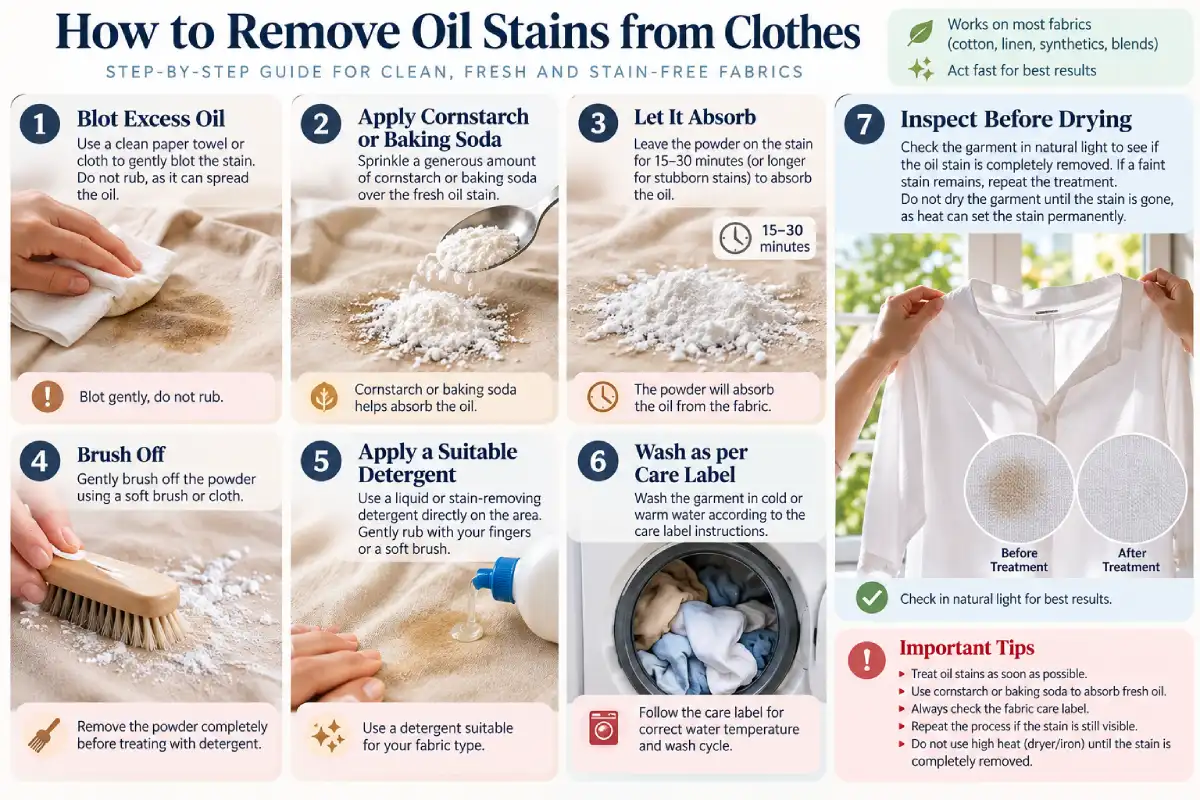
Getting oil stains out of clothes works best when you act fast: blot the spill immediately (never rub), cover it with an absorbent powder like cornstarch or baking soda to draw oil out of the fibers, then work in a small amount of dish soap before washing according to the care label. Always check that the stain is fully gone before the garment goes in the dryer, since heat can set any remaining oil permanently. Older, set-in oil stains and delicate fabrics like silk or wool need a gentler approach — and a professional cleaner is worth considering when a valuable or delicate item doesn’t respond to home treatment.
Oil stains are one of the more frustrating laundry problems because they don’t behave like other stains — oil repels water, which means a normal wash cycle alone often isn’t enough to lift it, and heat from a dryer can lock a stain in permanently before you even realize it’s still there. Getting oil stains out of clothes reliably comes down to a specific order of steps, adjusted slightly for how fresh the stain is and what fabric you’re dealing with.
Check the Fabric and Treat a Fresh Oil Stain Promptly
With oil, time becomes even more critical than with most other stains. The fresher the stain, the more of it is held mostly on top of the fabric. This stain will, in time, work itself deep into the fiber the longer you wait.
The moment you notice a fresh stain:
- Don‘t rub. Rubbing tends to work the oil further into the weave of the fabric and may disperse it over an area larger than the spill itself.
- To quickly pick up the excess oil, should be scraped or, even better, with a clean cloth soaked, for easier removal in the case of a thicker oil spill edge of a spoon.
- Know what you‘re working on. Always read the care label first. Fine fibers such as silk, wool or tosh on that tag marked ‘dry-clean only’ require a more gentle cleaning process than robust cotton, so having the information to hand saves any accidental damage and a difficult treatment reversal.
Do not use more direct heat at this point such as the blow dryer or a hot water, as heat is what makes the stains linger on rather than assisting to lift it.
Blot and Pre-Treat Using a Suitable Product
Once the excess oil is dealt with, the goal is to draw the remaining oil out of the fabric before it sets any further.
For most fabrics, an absorbent powder works well as a first step. Sprinkle cornstarch, baking soda, or talcum powder generously over the stain and let it sit for 15 to 30 minutes. These powders draw oil out of the fibers through simple absorption — brush or gently vacuum the powder away once it’s done its work, and you’ll often see the stain has already lightened.
Follow with a mild dish soap treatment for sturdier fabrics. Dish soap is formulated specifically to break down grease, which makes it effective on cotton, linen, and most everyday synthetics. Apply a small amount directly to the stain, work it in gently with your fingers, and let it sit for 5 to 10 minutes before rinsing with cold water.
For delicate fabrics — silk, wool, and anything dry-clean-only — skip the dish soap step and stick with the gentler absorbent-powder method, followed by a cold water rinse only if the care label allows hand-washing. Dish soap and vigorous rubbing can damage or discolor these fabrics even when the oil itself comes out.
Always test any product on a hidden inside seam first if you’re unsure how a fabric will react — a small test avoids discovering a problem on a visible part of the garment.
Wash According to the Care Label
Pre-treat the stain before laundering by using a wash cycle recommended on the care label. The pre-treatment has the difficult part taken care of, and an ordinary wash cycle will rinse away the oil and any leftover soap.
There are a few modifications that are good just for oil stains: a cold or cool wash is of course kinder on the fabric and color and it allows the oil to stay the same temperature for longer while being treated so it’s easier to wash out, washing alone or with only a few other items keeps the dirty water and detergent concentrated on the spot instead of diluted throughout a full load.
Inspect Before Drying and Repeat When Appropriate
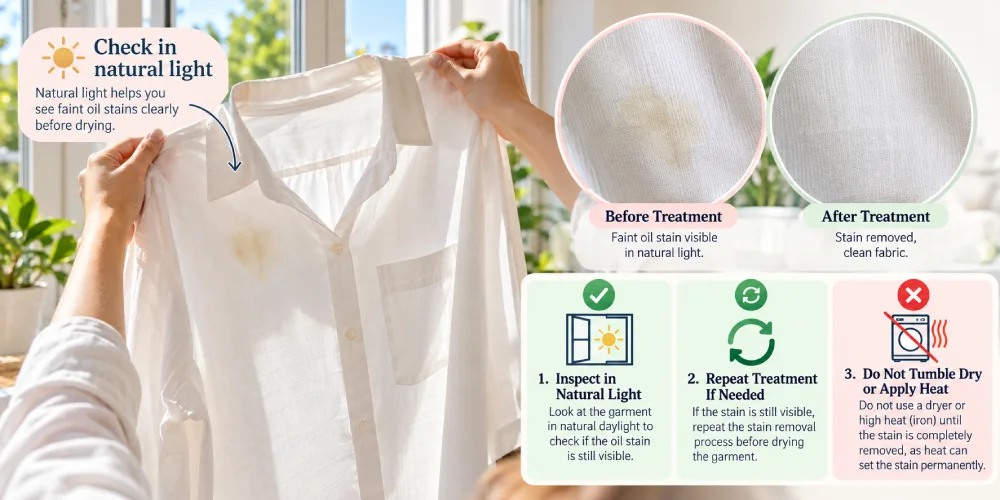
This is the step that determines whether an oil stain disappears for good or becomes a permanent mark — and it’s the one step most guides skip entirely.
Before the garment goes anywhere near a dryer, hold it up to natural light and check the treated area closely. A stain that looks gone in artificial light can still show as a faint, slightly darker patch in daylight. If any trace remains, do not dry the garment — heat will set that residual oil into the fabric almost immediately, and at that point it usually becomes a permanent stain rather than a treatable one.
If a trace remains, repeat the pre-treatment and wash steps rather than moving on. It’s common for a stubborn oil stain to need two or even three treatment cycles, particularly if the stain wasn’t caught immediately. Air-drying the garment while you continue checking is the safer choice until you’re confident the stain is fully gone.
Older Stains, Delicates and When to Use a Professional
Oil stains discovered after a wash — rather than caught fresh — need a slightly different starting point. If a stain has already been through a dryer cycle, it’s likely partially or fully set, and the standard fresh-stain method may only partially lift it. In this case, repeat the absorbent-powder and dish-soap treatment, but expect to need more than one cycle, and avoid the dryer entirely until you’re sure the mark is gone.
Older, set-in oil stains respond best to patience rather than a stronger product. Soaking the stained area in a mix of dish soap and warm water for 30 minutes to an hour before the usual treatment steps gives the soap more time to break down oil that’s had time to bond with the fabric.
Delicate fabrics that don’t respond to gentle home treatment, or any garment where you’re not confident about treating it yourself — a valuable silk item, tailored workwear, or anything dry-clean-only — are worth taking to a professional cleaner rather than risking further damage with a stronger home method. A professional cleaner has access to solvents and techniques that are simply safer for delicate fabric than anything typically available at home.
FAQs
What’s the best household item for removing oil stains from clothes?
Given most appliances use common household textiles, an absorbent agent (cornstarch, baking soda or talcum powder) overlaid with a little dish soap (which is designed to cut grease) will treat most oil stains. The powder will pull the oil from the fabric, while the soap will remove the grease prior to wash.
Can I still remove an oil stain if it’s already been through the dryer?
It may be more difficult, but it is still possible. The heat from the dryer can set the stain partially. Therefore, you should repeat the wash cycle and pre-treatment multiple times, and not put the item in the dryer again until the stain is checked in natural light.
Is it safe to use dish soap on silk or wool?
Not in the generic old-school way, it isn‘t. Heavy-duty rubbing or dish soap can damage or stain the more delicate fibers even as they remove the oil. Silk and wool tend to do better with a ‘mild’ course of the absorbent-power and a cool-water rinse, if hand-wash is permitted by the label.
Why does an oil stain sometimes look gone but then reappear?
For it seems that all that had been removed was the adhesion of the oil but 09 which was actually present remained. visible under the lighting you checked it in. Checking a treated stain in natural daylight, rather than indoor lighting, gives a more reliable read before the garment goes into the dryer.
When should I take an oil-stained garment to a professional cleaner instead of treating it at home?
If a delicate or valuable garment doesn’t respond to gentle home treatment after one or two attempts, or if you’re unsure how a fabric will react to any home method, a professional cleaner is generally the safer choice — pushing a stronger home treatment on delicate fabric risks damaging it further.
FINAL CONCLUSION
Getting oil stains out of clothes reliably is less about finding the one perfect product and more about following the sequence in the right order: blot immediately, draw the oil out with an absorbent powder, treat with dish soap on sturdy fabrics, wash according to the label, and — most importantly — confirm the stain is fully gone before it ever meets a dryer’s heat. Older stains and delicate fabrics just need more patience, or in some cases, a professional’s help. For the rest of your clothing care routine — washing, drying, and storage — the full Clothing Care Guide covers each stage in one place.