Mindfulness for Beginners: A Simple 2026 Guide That Works
Published: September 3, 2026 Last Updated: September 17, 2026 If you‘ve ever tried to “be mindful” and found yourself
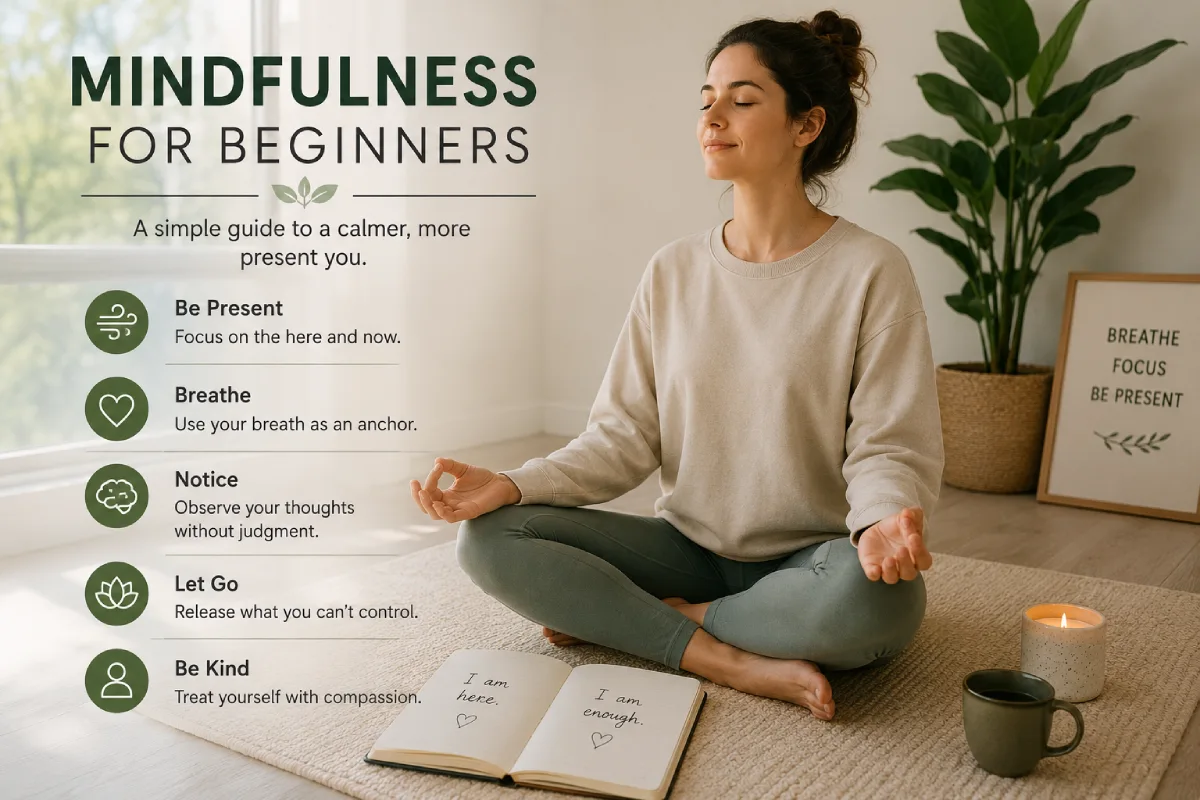
If you‘ve ever tried to “be mindful” and found yourself more angry or anxious than at ease, you‘re not alone, you were just given the wrong directions. Mindfulness for beginners isn‘t about clearing your mind. It‘s about paying attention and looking where your attention is pointed your breath, your body, the chai or coffee in your hand without immediately judging it, wanting to change it.
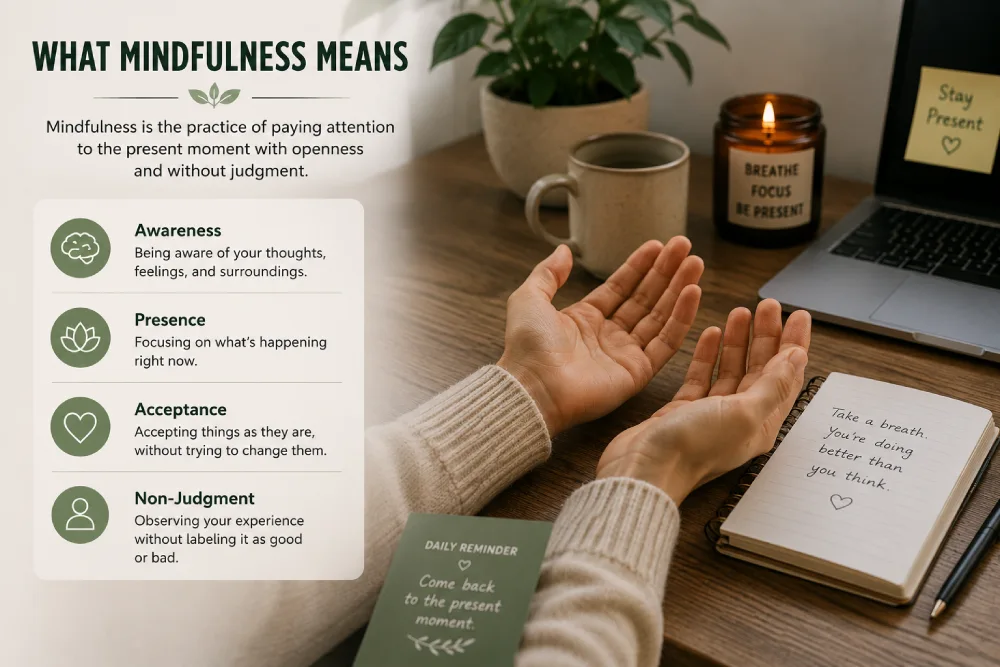
What Mindfulness Actually Means
“Mindfulness paying attention, on purpose, in the present moment. Without judgment. That‘s it.” You don‘t need incense. The default setting of your brain is to plan, ruminate and fret mindfulness is just the practice of breaking that cycle and returning to the present.
Why It’s Worth Learning
- Lessens reactivity. Just a few minutes of daily practice teaches your nervous system to take a break before it goes into a panic.
- Improves focus. Single-tasking with attention even for ten minutes rebuilds an attention span pounded away by multitasking.
- Supports mental wellness as a whole. Mindfulness is part of a broader perspective that includes sleep, exercise, and emotional control – there‘s a comprehensive mental wellness outline here.
How to Be Mindful: Start Small, Not Perfect
There is no requirement for thirty minutes on a cushion. The need is for two minutes, over and over, of attached-to-something you already do.
- Choose an anchor habit. After you brush your teeth. Before you turn on your laptop. Once you sit down for lunch.
- Set a timer for two minutes. Not 15. Two.
- Notice one thing completely your breathe, the flavor of your meal, the noise which surround you.
- Allow your mind to roam; then bring it back. That bringing back is the practice. That is not the lapsing.
Mindfulness Exercises for Beginners
- Mindful Breath: Simply sit, close your eyes and pay attention to the incoming and outgoing breath without trying to influence it in any way. If the attention strays (which will happen! ), then gently bring the attention back. Start with two minutes.
- 5-4-3-2-1 grounding: Name 5 things you see, 4 you can feel, 3 you can hear, 2 you can smell, 1 you can taste. Works well in moments of anxiousness or absent mindedness.
- Mindful eating: Eat one meal a day without your phone. Focus on texture, temperature, taste.
- Being mindful during your walk: Carry out your daily walk and pay attention to how your feet feel on the ground and your skin on the air instead of going over conversations in your mind.
Present Moment Awareness in Daily Life
There‘s no need to ‘add’ mindfulness to your day. It can be integrated into existing activities. Your morning coffee, your drive, even your walk from your car to your desk these are all opportunities to practice being present without anynew tools to learn.
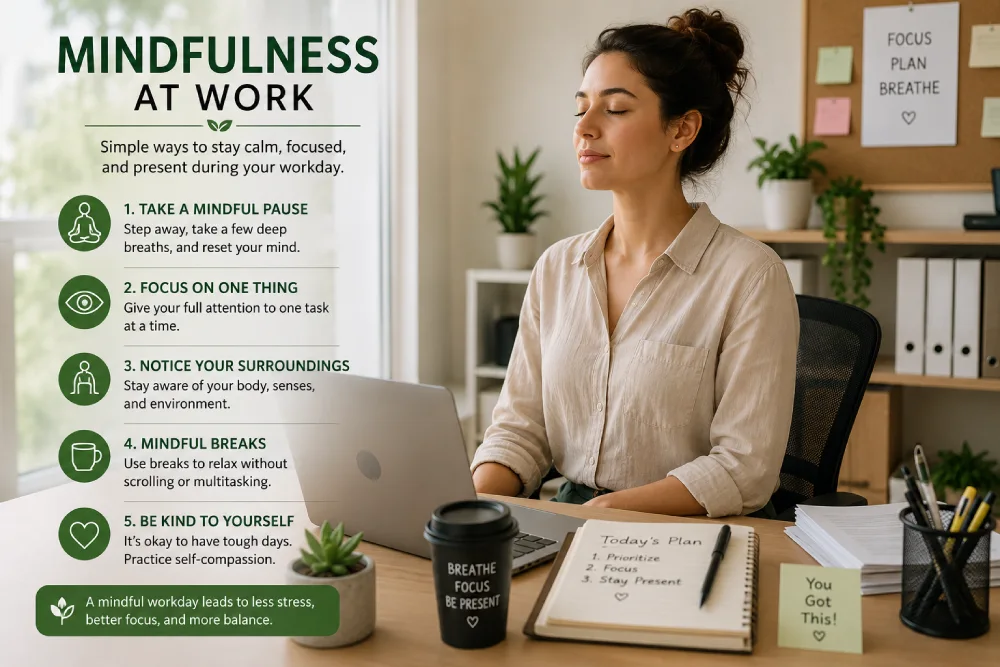
Mindfulness at Work
Work is where we often need to be mindful but where we‘re least likely to be mindful.
- Pause for 60 seconds pre meeting and breathe and center vs. walking midway through a scroll.
- Single task for 10 minutes rather than attempting to work on five different tabs at the same time.
- Use your lunch hour to truly put your computer down five minutes free of distraction can refresh your mind so you’re ready for the rest of your day.
Common Mistakes Beginners Make
- Attempting to “empty” out the mind. No, that‘s not what I‘m trying to do. It‘s just to notice and come back.
- If you walk away after one tough training session. The mind drifting is not failing, that‘s training.
- Too much, too fast. Half an hour on the first day? Usually results in quitting by the third or fourth day. Two minutes every day? Short, daily sessions are 10 times more effective than one half-hour session a week.
Myth vs. Fact
| Myth | Fact |
|---|---|
| Mindfulness: means no thinking ‘set your mind’ ‘why think about anything’ ‘think of nothing’ | It is being aware of your thought processes without being engulfed by each of the thoughts. |
| In order for it to measure you; it needs to take 30+ minutes. | Two to five consistent minutes daily trains the skill faster than occasional long sessions |
| It‘s only for people under pressure | It‘s preventive maintenance, for all stressed out or not. |
A Simple 7-Day Starter Plan
Day 1&2: Wake up & practice 2 minutes of mindful breathing. Day 3&4: Introduce 1 mindful meal, keep phone away. Day 5&6: Practice 5-4-3-2-1 grounding technique in response to a stressor. Day 7: Walk Mindfully for 5 minutes noticing 5 new things/ details on the path you are walking.
To complete the picture of mindfulness practice in conjunction with sleep, movement, and emotional check-ins, see our self-care habits guide and our anxiety management guide for the times that mindfulness alone will not do.
Briefly, Basic mindfulness for beginners is about one thing: awake, gently, back, again. You will mess it up a lot that‘s not the point. Just do two minutes today, connect it to something you already do and see how the practice grows from there.
FAQs
Mindfulness for beginners is what? Mindfulness in beginners is defined as noting the present moment – breathing, senses, environment deliberately and non-judgmentally, normally at the outset it takes just a few minutes a day.
How do I begin to be aware if I‘ve never meditated? Simply begin by two minutes of mindful breathing incorporated with an existing practical, e.g. right after teeth brushing. One has to begin chronic over time that (therapy) makes a difference.
Which Mindfulness exercises are best for newbies? Mindful breathing, the 5-4-3-2-1 grounding exercise, eating mindfully and mindful walking are all suitable exercises for a newcomer, they don‘t require anything other than yourself.
Is mindfulness useful for anxiety? Yes. Mindfulness research has shown that it is associated with less rumination and a more relaxed stress response, although mindfulness alone is most effective when used in combination with other strategies such as exercise, sleep, and professional help when indicated.
MS Office OnlineHow do I practice mindfulness at work? Before meetings, take a 60-second mindful breath, single-task in brief blocks, and dedicate a few minutes of your lunch hour to be totally present without a computer. Short, repeated moments tend to be more effective than one lengthy one.
When will I start to feel the benefits of mindfulness? For most novices, improvements such as becoming aware of the mind‘s wandering much sooner begin to emerge within a period of two to three weeks of just two to five minutes of daily practice.
Final Conclusion
Mindfulness for beginners isn’t about perfect stillness — it’s a small, repeatable habit of noticing the present moment and gently returning to it. Start with two minutes today, build from there, and let it become one part of a bigger mental wellness routine that also includes sleep, movement, and emotional care.