Journaling for Mental Health: Prompts & Benefits (2026)
Published: September 3, 2026 Last Updated: September 3, 2026 Sometimes a blank page is more daunting than encouraging still,

Sometimes a blank page is more daunting than encouraging still, that‘s likely one reason journaling gets the “you really ought to do this but somehow almost never do” reputation it has. But journaling for mental health is actually one of the easiest and most studied ways of handling stress not because writing down the emotion is some sort of sorcery, but because the act of verbalizing the emotion alters the way your mind holds onto it.
Why Journaling Actually Helps
- It slows rumination. Thoughts spin through your head and never seem to stop; writing gives them an end and a beginning.
- It cultivates emotional awareness. Being able to put a name to your experience “anxious” rather than simply “off” is associated with depleting the power of that emotion.
- It shows you what has been happening. One diary entry just makes you feel aware. A whole month of entries can give you a clear picture of what is using up your energy.
- It‘s a private place to think without editing yourself. Which is different from speaking to another person and especially to a therapist.
Journaling complements other mental health practices quite nicely if spiraling anxious thoughts keep landing you in the journal, our guide to managing anxiety includes techniques to implement concurrently.
Gratitude Journaling: The Easiest Starting Point
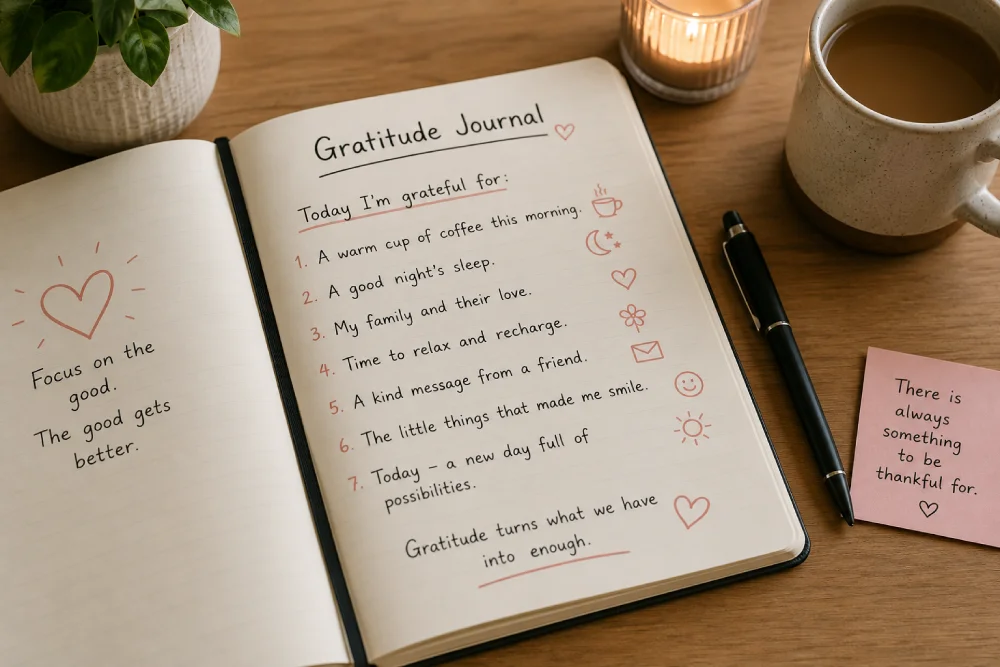
In journaling, it‘s just writing a few specific things you are thankful for each day and is one of the most simple styles as there is no “wrong” answer.
Here‘s an idea: Every night write down three things and be specific. Don‘t put “my family” but write down “my sister called just to check in.“Making it specific is what will make your gratitude journaling actually change your mood, instead of just feeling like a boring to do list.
Journal Prompts for Anxiety
When anxiety is very loud, but find open-ended prompts (“how do I feel today?”) too wide-based. Structured prompts are (more) effective:
- What am I worriedabout exactly at this moment in time?
- What is the worst scenario, and how probable is it? Be realistic with yourself.
- What is something that I have control over today?
- What is it that I would say to a friend like this?
These are effective prompts when used along with grounding methods check out our ultimate guide to managing anxietyeffective techniques to use at the moment to pair with them.
Morning Pages Journaling
Morning pages provide a particular discipline: three long pages of unedited stream of consciousness scribbling, performed first thing in the morning, prior to the mind-voices kicking in. You are not working for an audience- this includes future you. The aim is not necessarily getting to some insight, but emptying one‘s mind of all the bits that clutter it. Most beginners find their true thoughts take until page two or three, after the surface bitching has been exhausted.
Shadow Work Journal Prompts
Shadow work journaling is about exploring all those unwanted aspects of ourselves, those ingrained patterns, triggers, reactions that seem disproportionate to the situation…without condemnation, with genuine curiosity.
- Under what circumstances have I recently reacted in a way that felt “overdone”?
- What am I judging in others of which I may be blind to in myself?
- Do I notice any pattern in my friendships or even my work?
Remember to proceed cautiously with this style, and if the journal entries evoke something overwhelming or unresolved, that may indicate a need to process it in a discussion with a therapist rather than in this journal.
Therapy Journal Ideas
These prompts reflect what the likes of many therapists do to help clients ideate between sessions:
- Is there one thing I didn‘t do today and why?
- What feeling is it that I find hardest to sit with at the moment?
- What would be considered enough for me this week?
- What boundary must I establish, and where?
If you’re currently working with a therapist, a therapy journal can also be a useful record to bring into sessions — patterns are much easier to spot in writing than in memory. If you’re still weighing whether journaling alone is enough or it’s time to bring in professional support, our therapy vs self help guide breaks down when each one fits best.
Common Mistakes People Make With Journaling
- Waiting for the “right” mood to write. The more irregular and incoherent the entries, the more useful they tend to be.
- Attempting to write every single day from day one. Three times per week, regular, for ever, is better than trying every day until the end of a week.
- Rereading and evaluating past entries. This is not a performance. Jokes belong to the course, but journals are records and not polished product.
Myth vs. Fact
| Myth | Fact |
|---|---|
| Has to be a daily commitment to produce a minimum of pages a day for it to register. | A few honest lines, three times a week, still builds the habit |
| Journaling is just bitching onto paper | Putting a feeling into words has a quantifiable effect. |
| Doing shadow work journaling is only appropriate if you are in crisis | It‘s just reflective writing about patterns — good for anyone, at any time. |
A Simple Way to Start
- Choose one of the above styles according to your spirits thankfulness for a relaxed beginning, nerves-driven cries for a tough day.
- Set a timer for 2 minutes. When the alarm sounds, stop even if you haven‘t finished the sentence.
- Integrate it into an established routine instantly following your first cup of coffee in the morning or bedtime.
- Count your track weeks, not days. Keeping a journal three times a week for a month is more effective then keeping a daily streak on a job for five days.
For a more extensive daily practice combining journaling with sleeping, moving and mindfulness, you‘ll want our self-care routines as well as the complete mental health resource.
For a broader daily routine that pairs journaling with sleep, movement, and mindfulness, see our mental wellness guide.
FAQs
Is journaling beneficial for mental health? Indeed it is. The act of putting emotions down on paper minimizes the tendency to dwell, and also diminishes the strength of those emotions because it provides routes into which unfocused, repetitive thoughts can flow.
What do I say in a gratitude journal? Be specific no generalities (“my body,” “my dog,” “my food”) think of a particular time (“A beautiful walk this morning,” “My girlfriend just told me she loves me”) instead.
What journal prompts are helpful for anxiety? prompts that are focused and concrete seem to be most helpful: pinpointing exactly what you‘re worried about, assessing how likely the worst case really is, and figuring out one thing you can do to help.
So what is morning pages journaling? Morning pages is three pages (no chopping up or editing later) of stream of consciousness writing as soon as you wake up.
Is shadow work journaling safe to do by yourself? For the most part, yes for any reflective questions. But if journal entries and responses bring up something intense or unresolved, consider examining it with a therapist rather than alone.
How frequent do I need to journal for it to be beneficial? Three times a week, holding consistently is easier to build a sustainable habit than an overly ambitious daily drought.
Final Conclusion
When it comes to journaling for mental health, it doesn‘t have to be a grand gesture or a flawless daily routine sometimes a quick minute with a gratitude list, an anxiety prompt, or a page of unedited morning musings can work wonders. Use one approach for today, and weave it into a broader mental well-being regimen.