Therapy vs Self Help: Which Actually Works in 2026?
Published: September 3, 2026 Last Updated: September 7, 2026 Pitting therapy vs self help as a binary choice is
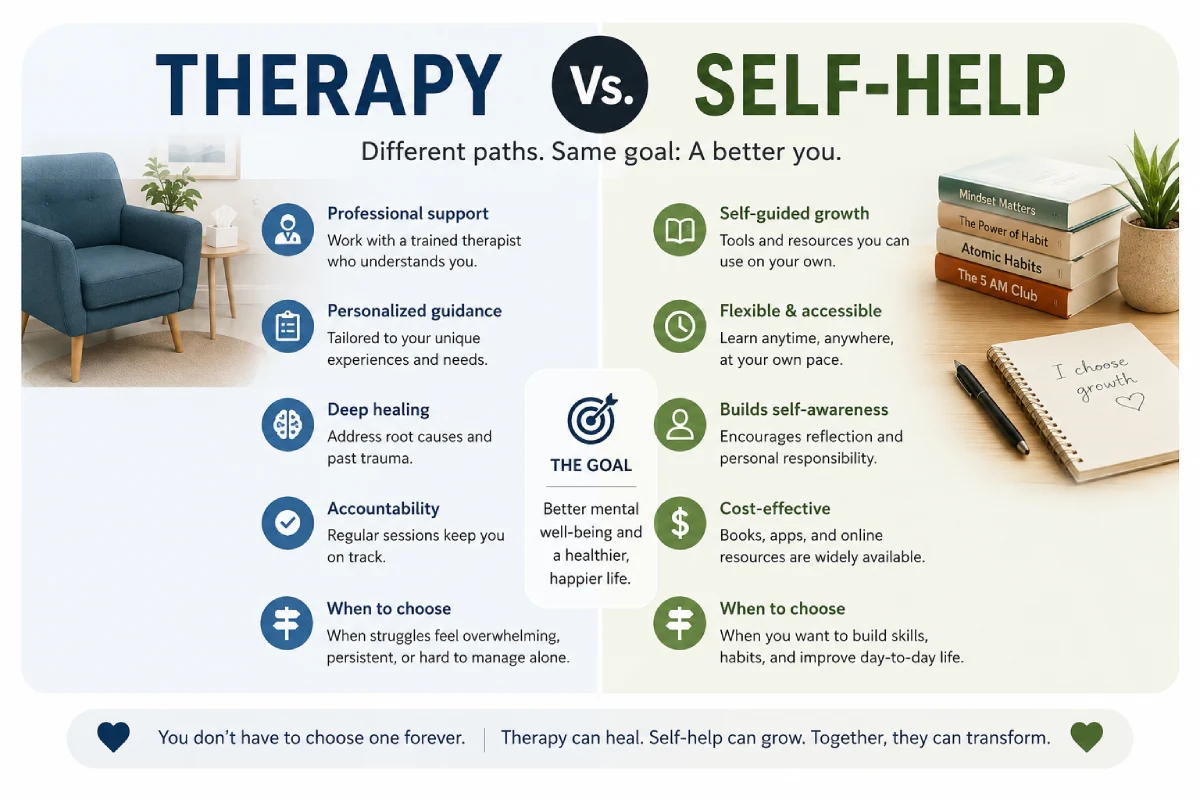
Pitting therapy vs self help as a binary choice is a bit like asking if a bandage or a doctor is “better,” – there really isn‘t an either/or here. Self help is highly useful for the subtle but persistent nuisances of everyday life, for maintaining an edge and for managing brief or chronic stress. Therapy is for issues that aren‘t fully addressable by self help alone: for deeper, more entrenched patterns or unresolved history or symptoms.
What Self-Help Actually Does Well
Self-help journaling, breathing techniques, mindfulness, structured routines works best for:
- Minor stress and anxiety that aren‘t severe enough to interfere with daily life.
- Developing sustainable routines (e.g., improved sleep, movement, emotional check-ins).
- Achieving and maintaining change once therapy has resolved the underlying problem
- Prevention that is, preventing stress from becoming chronic1.
If you‘re just beginning you we recommend our journaling for mental health guide and mindfulness for beginners guide as both would be effective.
A Real CBT Self-Help Exercise You Can Try
Cognitive Behavioral Therapy (CBT) is the most “self-help friendly” style of therapy, since much of it is designed around straightforward, simple exercises. Give this thought record a shot the next time your mind catches on a worried or negative thought:
- Express the cognition. “I am about to cost this presentation.”
- The 0–100% scale in the following experiment asked you to rate how true you thought a statement was.
- List the evidence for and against it. Be precise what really happened last time?
- Make a more balanced thought. “I‘m nervous, but I have prepared and handled many presentations before.”
- Re-evaluate how much you believe the initial idea. Often, it reduces.
This alone is the core of CBT-self help, and can work really well in conjunction with grounding and breathing techniques which we have used in our anxiety management booklet.
Where Self-Help Hits Its Limits
Self-help struggles when:
- But the same old painful dynamic continues to recur in every relationship or employment, and you fail to understand why.
- Anxiety or depression are ongoing. Not context dependant.
- A trauma or a particular event from the past repeatedly occurring.
- You have been using certain self-help methods for weeks without experiencing any significant change.
This is notfailure of will power – it‘s just beyond the scope of what self directed tools are built to unravel by themselves.
Types of Therapy, Explained Simply
- Cognitive-behavioral treatment (CBT): Focuses on the relation between negative thoughts, negative feelings, and behavior. Practical and usually short term.
- DBT (Dialectical Behavior Therapy): Teaches skills to cope with extremely intense emotions; initially developed to treat intense emotional reactivity.
- Psychodynamic therapy: Addresses how our previous encounters, primarily through our interactions, influence our present behavior.
- Talk therapy / counseling: Support, space and time to talk about what is happening, in a more general way (e.g. not following a particular method).
- Couples or family therapy: Concentrated on relationships rather than on one person at a time.
You need not be sure which type you want before beginning generally a good therapist will be able to recommend the best type for you after an initial session or two.
When to See a Therapist
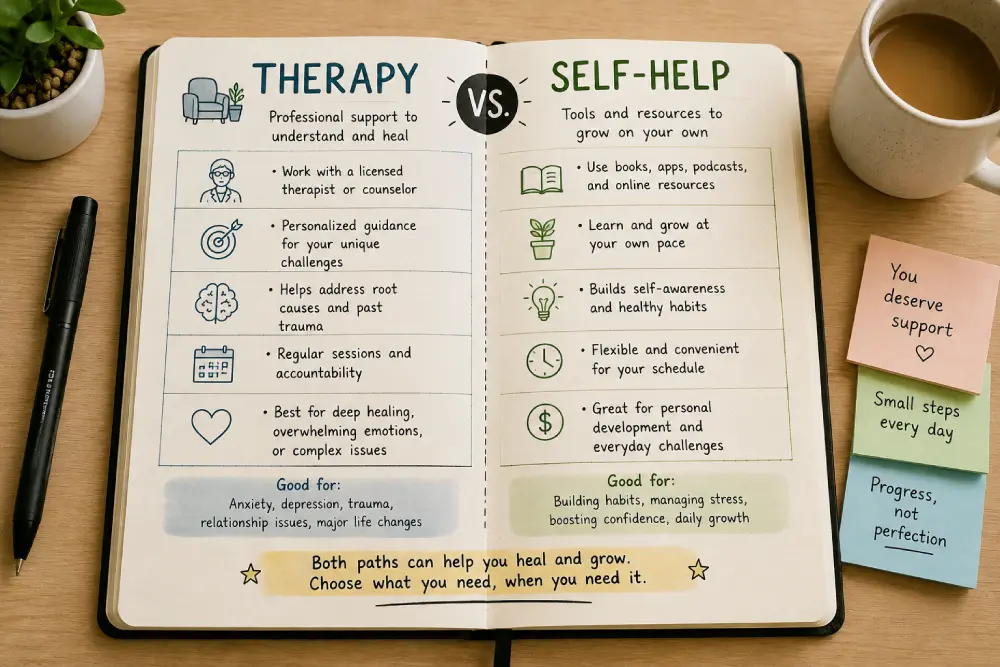
Consider therapy, rather than relying on self-help alone, if:
- Anxiety, sadness, or stress shows up most days for more than two weeks
- Sleep, appetite, or energy has noticeably changed and isn’t improving
- You’ve lost interest in things you used to enjoy
- Relationships or work performance keep declining
- You’ve had thoughts of self-harm — this warrants immediate professional support, not self-help alone
If you’re in crisis or having thoughts of self-harm, please contact a crisis helpline or emergency services in your country right away rather than waiting.
Mental Health Apps: Where They Fit
Mental health apps — mood trackers, guided CBT exercises, meditation timers — sit closer to self-help than therapy. They’re useful for:
- Building consistency with journaling, breathing, or mindfulness
- Tracking mood patterns over time to bring into a therapy session
- Learning basic CBT or grounding techniques between sessions
They’re a genuinely useful complement to therapy, not a substitute for it when deeper support is needed.
Myth vs. Fact
| Myth | Fact |
|---|---|
| Self-help means you’re not “sick enough” for therapy | Self-help is simply a different tool, suited to different problems, not a lesser one |
| Therapy is only for major crises | Many people go to therapy for everyday clarity, not just crisis moments |
| Mental health apps can fully replace therapy | Apps support consistency and skill-building, but can’t address deeper or complex patterns |
Online Therapy Options in 2026
Access to therapy has changed significantly, in both the US and India:
- In the US: Teletherapy platforms and employer-provided EAPs (Employee Assistance Programs) have made therapy more affordable and easier to start, often with same-week availability.
- In India: Teletherapy apps and dedicated helplines are growing quickly, and more workplaces now offer EAP-style support. It’s still worth verifying a therapist’s credentials directly, since regulation is less standardized than in the US.
Whichever option you choose, a short introductory call before committing is a reasonable and normal step — it’s fine to “interview” a therapist before starting.
How to Combine Both
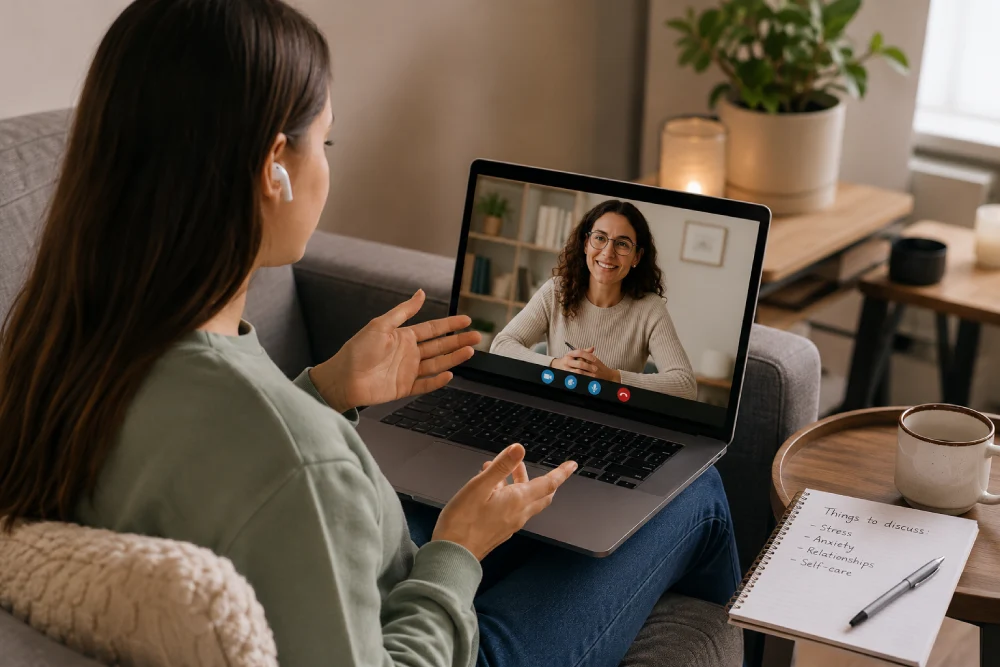
So for most folks the true answer to therapy vs self help is really both…at different moments. Self help practices – journaling, breathing, mindfulness, etc keep you held at a stable place on a day to day basis. Therapy is where you go to work on the deeper, more tangled patterns particularly the ones you haven‘t been able to break with self help modalities. People often begin with self help, see where it doesn‘t go, then bring that knowledge into therapy as a jumping off point.
For the full picture of how these pieces — sleep, movement, mindfulness, and emotional care — work together, see our complete mental wellness guide.
FAQs
Is therapy “better” than self-help? Neither is “better” than the other. Self-help strategies work well with everyday problems and with establishing new routines, whereas therapy is for patterns that are chronic, deeply ingrained, or complex that self-directed methods may not get to.
Can CBT self help work without a therapist? Yes it can work for some peoples daily nagging thoughts. One very simple thought record can make a big difference to how much you believe an anxious thought. With a therapist it can go a lot further.
When should I seek a therapist if I can self help? If you have low mood, anxiety or stress nearly every day for two weeks or more and this affects your sleep or close personal relationships or is associated with ideas of self harm this is the time to see someone.
What are the various types of therapy? The usual categorization is below types of therapy: CBT (focused on thoughts and behaviors), DBT (focused on building emotional skills), psychodynamic therapy (focused on past patterns), talk therapy in general, couples and family therapy.
Can online therapy be as effective as face to face therapy, for most people it can and now technology based therapy has opened so many doors by making therapy cheaper, more accessible (mainly in US and India where it is still expanding, check credentials).
Can mental health apps replace therapy? Hell no, but the extra tools of doing journaling/breathing/selecting your mood/updating your mood, etc. are a nice supplementary tool to therapy.
Final Conclusion
The point is not therapy vs self help it‘s whether you need a hammer or screwdriver, depending on what you have to loosen. Self-help practices will manage common life irritation and therapy is there to gets at those tricky recurring issues which elude them: for most, the best response is to blunder through with both, when needed.