Jewelry Guide: Types, Materials, Styling and Care
Published: September 23, 2026 Last Updated: September 24, 2026 Quick Summary: Jewellery falls under a few umbrella categories –
Quick Summary:
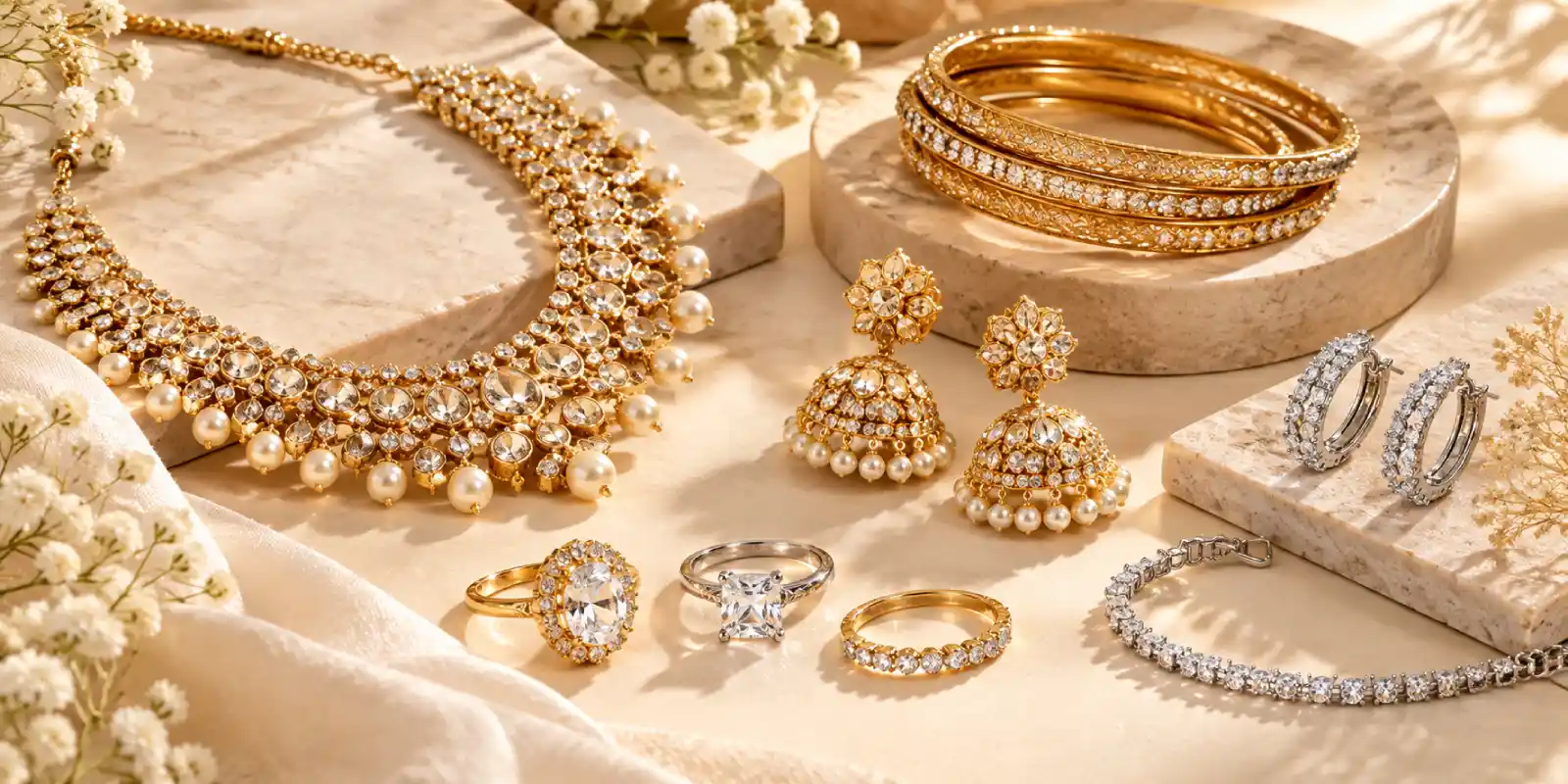
Jewellery falls under a few umbrella categories – rings, necklaces, earrings, bracelets and bangles, anklets and body jewellery – crafted from precious metals (silver, gold, platinum), alternative metals and often enhanced with gemstones or simulants. How to find what works best for you comes down to three factors: what it’s made from; how it fits your life and your skin; and whether to treat yourself to fine jewellery (the investment piece, hallmarked, designed to last a lifetime) or settle for fashion jewellery (buy one for the trend, afford to replace it for the next). This guide covers all that at a practical, decisional level, and directs you to more specialized guides for cleaning silver, recognizing fakes, stacking, caring for everyday jewellery, menswear and fashion, and choosing the right necklace for your neckline.
Jewelry is one of those categories: Everyone has purchased something from the category, but few of us ever truly feel like we know it inside and out. Browse through a jewelry store on the internet or in person, and you‘ll see words like 22K, hallmark, vermeil, cubic zirconia, fine vs. fashion, and it‘s almost impossible to keep up
It’s designed to cure that. We’ll go through the sorts of jewelry you’ll come across, the materials they’re made of, how fine jewelry differs from fashion jewelry, and how to pick and wear jewelry that fits your life not just the store window. If a topic requires more than can be covered in a hub page (cleaning silver, identifying a fake, stacking tips, and more), you’ll get that topic’s essentials, and a link to an extensive how-to from us.
At the end of this course you will be able to walk in a jewelry store (or shop online) and get the questions you need to know.
Types of Jewelry: A Complete Overview
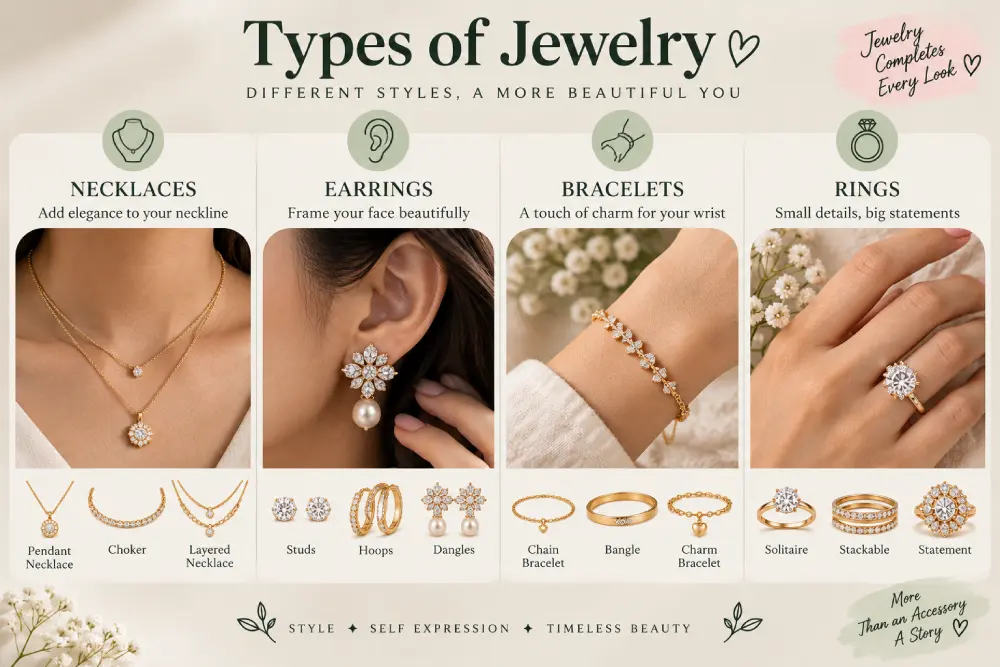
There are essentially four broad categories of wearing styles for almost all jewelry. Getting a handle on what these wearing styles are and how to identify them will help you get the most out of the rest of what you‘re reading in this guide whether it be the how-to-s, the buying guides, the specific materials.
Jewelry for the neck/chest
Based on the types of jewelry, the range of jewelry for the neck area can be categorized into certain styles including necklace, chain, pendant, choker, and locket. Depending upon length of the necklace, this is one of the major influences on how a jewelry piece looks with different types of neck lines; more on that in the dedicated section below. In the Indian tradition, this category also includes other culturally specific pieces like the mangalsutra, a marriage-related item, temple necklaces which are worn in layered patterns during religious ceremonies, weddings and celebrations.
Jewelry For the ears
The definition covers studs, hoops, danglers, and jhumkas (traditional bell-shaped earrings). Ear jewelry is often the first type of jewelry that one collects, as it is affordable, easy to care for, and appropriate for both casual and formal attires.
Jewellery for the hands and wrists
This grouping includes rings and bracelets and the extremely popular bangles, which are a staple feature in everyday life in India for most women and are also a crucial element in the accessorizing of weddings and celebrations. Rings vary from delicate band rings delicate chains to chunky cuffs.
Jewelry for the feet and body
Anklets (payal) and toe rings are traditional in India and remain popular for both daily wear and occasion dressing. Body chains and brooches are less common day-to-day but appear regularly in bridal and fashion-forward styling.
A useful way to think about your own collection is not “how many pieces do I own” but “do I have at least one reliable option in each category for both everyday wear and a special occasion?” That framing does more for your day-to-day styling than chasing trend pieces.
Jewelry Materials Explained: Metals, Gemstones and Simulants
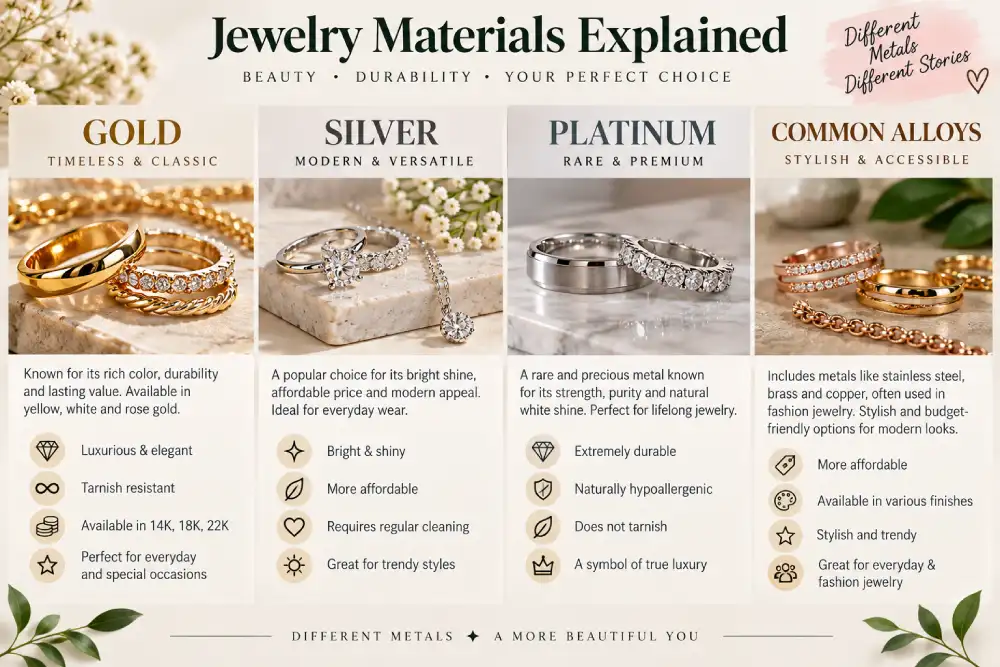
What a piece is made of influences its cost, how it ages, how it feels to the touch and how to care for it. Generally speaking, jewelry making materials are categorized into three types: precious metals, alternative/everyday metals and stones or their simulants.
Precious Metals gold, silver and platinum
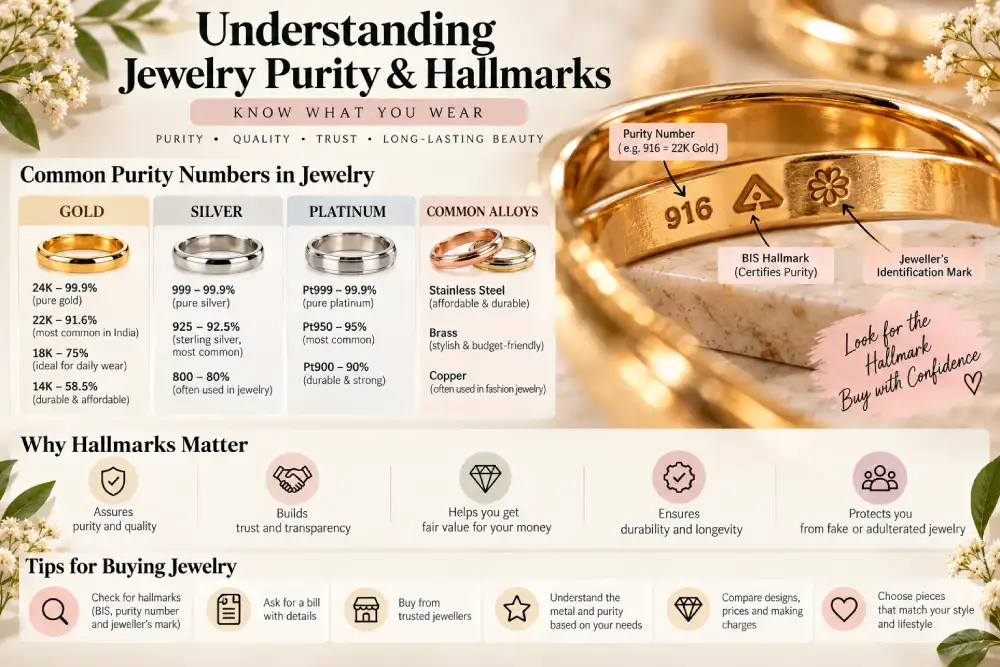
Gold is the most well-known metal in Indian fine jewelry and is guaranteed for its grade and integrity in gold jewelry by its weight in carats. A karat is a unit of measurement that indicates a jewelry item‘s percentage of pure gold, with 24K gold being the purest and frequently used in jewelry (most clubs don’t allow pure gold for practicality), and traditional Indian gold jewelry normally 22K (91.6% pure gold). Western fine jewelry is more frequently 18K (75% pure gold), which is more durable but slightly less rich in tone. Silver, typically in 92.5% alloy (marked “925”), is a more affordable consideration for silver jewelry since pure silver is too soft to hold its shape. Platinum, denser and more hypoallergenic (less reactive to skin), is an ideal choice for jewelry intended to be worn daily and passed down through generations, like wedding bands.
Alternative and everyday metals
Stainless steel and titanium are both hardwearing, inexpensive, mostly hypoallergenic metals that are often used for everyday-wear jewelry and men’s jewelry. Brass and copper are used in more “fashion-y” artisan jewelry they’re inexpensive, and can be very attractive with a good finish, but they tarnish more quickly, and can also cause skin irritation in some people, especially with longer-term skin contact or in more humid environments. Gold-plated, gold-vermeil (a thicker layer of gold on top of sterling silver, which offers a similar look) and gold-filled: The base metal is coated with a layer of gold of varying thickness the thicker and higher-karat the layer, the longer it will last before it wears through.
Gemstones, diamonds and simulants.
The core precious gemstones diamonds, rubies, sapphires, emeralds are prized on the basis of cut, clarity, color and carat weight. Bougie and semi-precious stones such as turquoise, garnets, amethysts and others round out the spectrum of gear that‘s available at a slightly more affordable price point. Simulants such as high-quality zirconia and sapphire are engineered to create the same sparkle factor as natural gemstones without the cost, and are ubiquitous in fashion jewelry for their ability to imitate rare stones as a designer choice. There‘s nothing inherently “fake” about opting for something like this intentionally for a trend piece; the trick is to understand which you are getting so you can value it appropriately.
Understanding purity and hallmarking in India
In India most gold sold in a jewellery retail shop will require a BIS (Bureau of Indian Standards) hallmark displaying a purity grade which is often ‘stamped’ as 916 (22 K), 750 (18 K) or 585 (14 K) and shows the amount of the weight in gold. This is one of the best things to check before buying a piece of jewellery in India and is more explained in the section ‘Buying Jewellery in India’ below.
Fine Jewelry vs Fashion Jewelry: What’s the Real Difference?
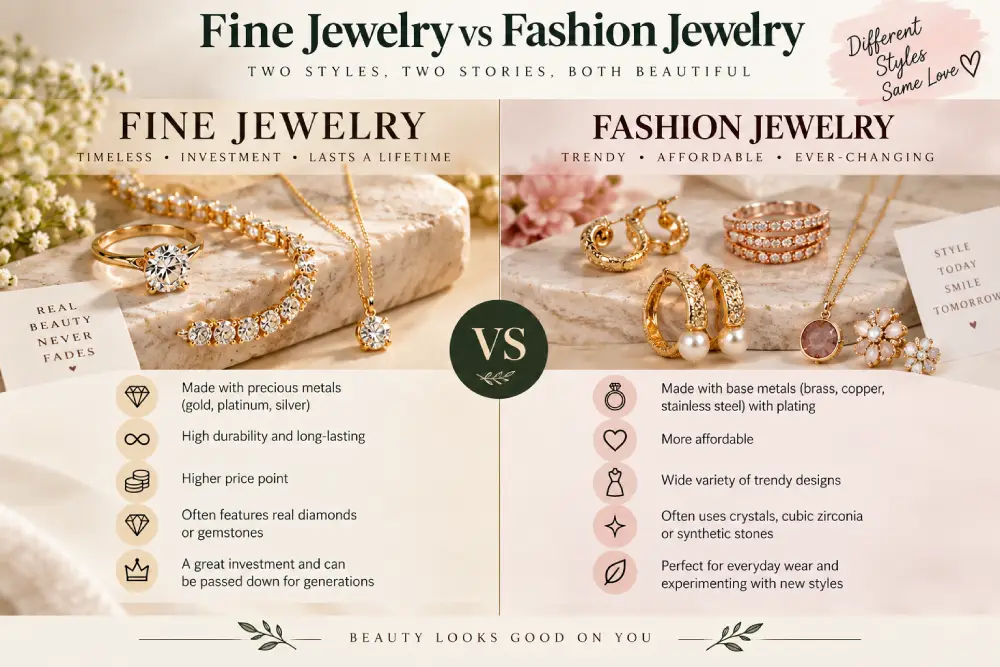
This is probably the most frequently asked question about jewelry, and it does make a difference because it has an impact on your cost, how long a piece will last, and how you will need to care for it.
| Fine Jewelry | Fashion Jewelry | |
|---|---|---|
| Materials | Genuine gemstones consisting of gold, silver, platinum and other precious metals | Base metals, often plated, with simulants such as cubic zirconia or crystal |
| Common Price Range | Higher the cost of the materials used and the workmanship. | lower accessible and fashionable pricing |
| Lifespan | Constructed to last half a century, mostly handed down | Short style cycle; wear of plating and finish. |
| Maintenance | Periodic professional cleaning; Daily maintenance is typically minimal |
Lower — accessible, trend-driven pricing |
| Certification | Usually hallmarked/certified for purity | More or less uncertified value is in design not material. |
| Ideal for | Investment pieces, milestone gifts, everyday staples for the ages | Experimenting with trends Occasion wear statement garments Both affordable variety |
Neither category is “better” they are simply different. A good jewelry wardrobe will typically have a few staple pieces of higher-priced jewelry that you wear often for years, and a selection of costume jewelry to play around with without wearing it constantly.
How to Choose Jewelry for Your Lifestyle and Budget
Match your jewelry to your actual lifestyle. If you work with your hands, take your jewelry to the gym, or tend to forget you are wearing it, stability of jewelry will be more important than the practicality of maintaining it on a daily basis 17-18k. gold jewelry with secure settings and tough materials such as stainless steel and titanium will outperform fine jewelry in softer metals and delicate chains and rings. If you‘re primarily wearing jewelry in social situations, then you can focus more on aesthetics than practicality.
Set a sensible category budget rather than a piece or item budget. Instead of planning, for example: “I‘ll spend X rupees on each piece of jewelry,” make a categorized plan: a small budget for everyday jewelry in hardwearing metals and fabrics, and then a different, uncertain budget for whatever item of the moment to wear to parties, etc. It‘s a mistake to spend too much on a fashion piece, that is unlikely to last, while putting less-than-enough budget into longer-term essentials.
Think of skin reactions and metal allergies. Nickel often causes skin reactions and can be in lower quality alloys and plated jewelry. If you have had jewelry that causes itching and redness or changes color of your skin, then seek out jewelry labeled as being nickel free, hypoallergenic, surgical steel or titanium or higher-karat gold (which has less alloy to react with your skin).
Jewelry Styling Basics: Building a Look That Works
The best jewelry styling is usually three simple (‘rules’ is a dirty word!) basics: balance, a dominant feature, and suitability for the occasion.
Balance means not having too much of everything at any one time – if your earrings are a statement piece, then keep your necklace and rings subtle, and vice versa. Having a focus point involves selecting a single accessory as the main attraction in your look (large necklace, heavy ring, layered bangles) and placing everything else in harmony rather than contrast. Suitability to occasion means wearing less on a daily basis and more if you‘re attending a specific function; in daily India, this often points to smaller, more easily cared for, lower-maintenance accessories whereas India is also traditionally fond of heavily layered jewelry at fête and wedding events.
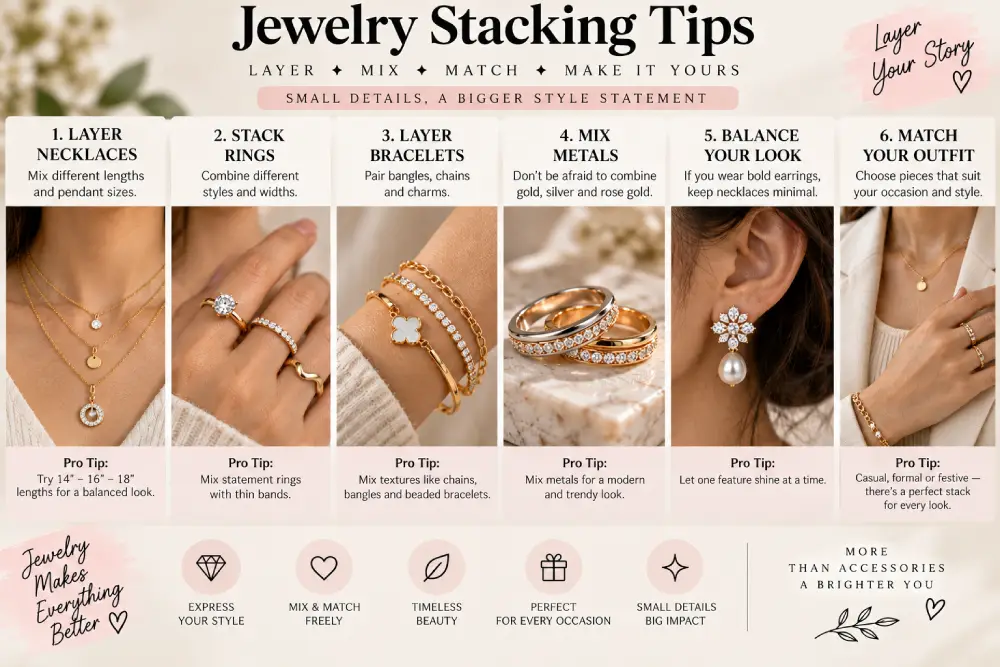
Another technique that is getting more and more popular that I am sure you will want to master is layering and stacking. This means to place several necklaces, rings, or bangles of different widths, lengths, shapes, and textures together to create an intentional, styled look instead of a disorganized one. Since stacking requires its own special techniques and is prone to a few errors, there is a complete guide to it below.
How to Clean Silver Jewelry at Home (Quick Overview)
Silver tarnishes this is just normal chemical reactions with the air and moisture in the atmosphere, it doesn‘t mean the jewelry is of bad quality and this is one of the top questions people go looking for on these sorts of things. The general rule is that all tarnishing that takes place can be cleansed at home with a delicate washing in a mild soap and warm water for light tarnish or a polishing cloth specific to silver for more silver looking dullness followed by a good dry before storing. Use of abrasive or abrasive kitchen chemicals should be avoided to prevent scratching or harming the silver.
That covers the basics, but silver cleaning has enough nuance — different techniques for gemstone-set pieces, oxidised/antique-finish silver, and heavily tarnished items — that it deserves its own dedicated walkthrough.
Read the full guide: How to Clean Silver Jewelry
How to Spot Fake Jewelry: Key Warning Signs
If you are purchasing secondhand, from a new merchant or just to check a gift, understanding what to look for in a fake or mix advertised item can be a factor in protecting your investment, not to mention your health (some Asian silver plate, for instance, more often than not is known to cause more irritation than the ‘authentic’ plating). For the very basics, it is important to know that for India, your authentic precious-metal jewelry will have a hallmark and purity stamp, that any discoloration, flaking or marking your jewelry puts on the skin is a red-flag and that if an item labelled as ‘branded’ or ‘certified’ is being sold at a significant discount with respect to the market value, then this too is a concern
Verifying jewelry properly involves specific checks — magnet tests, acid tests, hallmark verification, and more — that go well beyond what belongs on a hub page.
Read the full guide: How to Spot Fake Jewelry
Jewelry Stacking Tips: Layering Necklaces, Rings and Bangles
Stacking is by far the most popular styling request today and a logical follow on from the ‘focal point and balance’ styles we discussed earlier in this guide. When thoughtfully executed, stacking creates the impression of a deliberate style choice while doing a good job of mixing up some fairly basic items; when chaotic and poorly executed, it can appear to be plonking a few general pieces onto your hands and wrists. The key idea is pretty simple mix up length, width and texture, avoiding trends for only one or the other, but there are more specific order and grouping strategies at play.
Read the full guide: Jewelry Stacking Tips
Jewelry Care Tips: Keeping Every Piece in Good Condition
Aside from the specifics of cleaning, a handful of overall tips can help keep a jewelry collection in good condition: keeping individual pieces separated so they don‘t scratch each other, removing jewelry prior to swimming, showering or applying perfume and lotion (chemicals and moisture are usual suspects in early tarnish and plating loss) and alternating jewelry to lessen the wear on clasps, prongs and finishes.
These are general-purpose habits that apply across gold, silver, fashion jewelry, and gemstone pieces alike — the deeper, day-to-day maintenance routine, including storage solutions and how often to have pieces professionally checked, is covered in full separately.
Read the full guide: Jewelry Care Tips
Jewelry Trends for Men: What’s Changing
Male jewellery are actually currently well past the wedding ceremony style and also the chance of the occasional cufflink. Necklaces, wristlets, signet bands and even one-standard jewelry are available, along with the elements nudging into that change stainless-steel, titanium, oxidised silver meet on the outward skin as well as the practical need of every single day wear. The same “long-lasting and lifestyle match” rationale covered earlier on in this info pertains to utilizing jewellery collection all at once when beginning.
What’s actually trending, how to start a collection from zero, and how to wear men’s jewelry without it looking like an afterthought is covered in full detail elsewhere.
Read the full guide: Jewelry Trends for Men
How to Choose a Necklace for Your Neckline
The relationship between necklace length and style and neckline is one that can potentially be game-changing the dimension of a choker can compete with or crowd out a collar, a long pendant can disappear beneath a plunge V. A guiding rule: if a neckline is more high-necked, a slightly longer necklace that drops below the collar bone would be a good choice, while open necklines (V, sweetheart, off-shoulder) can usually support shorter-to-mid-length necklaces that complement or echo the line of the neckline rather than contend with it.
That’s the underlying logic — matching each specific neckline type (boat neck, halter, strapless, collared, and more) to the necklace lengths and styles that flatter it is covered thoroughly, with visual references, in its own guide.
Read the full guide: How to Choose a Necklace for Your Neckline
Common Jewelry Buying Mistakes to Avoid
A few mistakes come up repeatedly, across both fine and fashion jewelry purchases:
- Buying by look alone. Sometimes you can‘t tell just by the look alone. For example, a photo of a piece of gold may look the same whether it is in solid gold or gold-plated brass. Always double check material and purity before paying a fine-jewelry price.
- Not checking for hallmark or assay on precious-metal items. This is by far the biggest reason that people buy misrepresented jewelry and end up paying too much.
- Underestimating fashion jewelry maintenance. Fashion jewelry requires more, not less, care than fine jewelry plating wears away through contact with water, friction, perfume.
- Purchasing purely on trend, which ‘Don‘t fit your lifestyle’ Sorry, this delicate ring must be taken off for every task. It‘s not what you want to wear every day, even if so photogenic!
- Was not asked about return or exchange policy. In the case of online jewellery shopping in India, a clear written return and exchange policy can provide the much needed protection.
Buying Jewelry in India: What to Check Before You Pay
India, with the largest jewelry market in the world, 26 gold jewelry especially having a significant cultural and financial value making a safe purchase all the more important.
BIS hallmarking & purity marks. Check for the BIS hallmark on gold jewelry, and the purity grade stamped as 916 (22K), 750 (18K) or 585 (14K). Good jewellers will have no trouble revealing the mark and if they won‘t, or dodge the issue you may want to buy elsewhere.
Bills, certification and return policies. Always take a detailed bill that separately states weight, purity and making charges, as the latter vary widely for comparable items from different vendors. For gemstone jewelry, clarify if stones are natural or lab-grown/synthetic, if any certification is available and obtain this if possible. Request a recording of the return/exchange/buy-back policy in writing before you part with your money. Established Indian jewellers usually have some sort of buy-back / exchange policy; comparing these is worth your while.
Frequently Asked Questions
What is the difference between fine jewelry and fashion jewelry?
Fine jewelry is crafted from precious metals (gold, silver, platinum) and genuine stones, is hallmarked or accompanied by certification, and is intended to withstand years or decades of use. Fashion jewelry utilizes base metals, plating and simulants such as cubic zirconia, is less expensive, and is constructed with a shorter lifespan and trendier aesthetic in mind.
How can I tell if gold jewelry is real in India?
If possible, look for a BIS hallmark and the purity stamp 916 for 22 K, 750 for 18K and 585 for 14K gold. Good jewellers will tell you what the hallmark means, and give you a bill showing separate calculations of the value of the gold and the making charges.
Is fashion jewelry bad for sensitive skin?
Not exactly. Some lower-priced metals or alloys used in fashion jewelry also could contain some nickel or other metals that will produce a reaction in a sensitive individual. Seek jewelry that is nickel-free or labeled hypoallergenic, or wear surgical steel or titanium.
How often should I clean my jewelry?
Generally speaking, it depends on the material and how often you don it, but a light clean every few weeks for anything you wear constantly, and a proper clean before you pack anything away long-term, is a good rule of thumb. Silver especially benefits from more frequent attention, since it tarnishes faster than gold or platinum.
What jewelry should I buy first if I’m starting a collection?
Make sure you have a few of the simple, robust, go-everywhere essentials such as small stud earrings, a fine chain, and a robust everyday ring in a hardy material before investing in the more show-stopping or dress-up only items.
Can I mix gold and silver jewelry together?
Yes – the overall effect of mixed-metal jewelry styles is getting far more attention and used more often than the single-metal approach. A deliberate use of mixing (Repeating whichever metal several times across the look rather than accents of one), tends to make the look appear more thoughtfully coordinated than a one-note, single-metal theme.
Conclusion
Jewelry doesn’t have to be confusing once you understand the handful of decisions that actually matter: what type suits how you’ll wear it, what it’s made from, whether fine or fashion jewelry fits your goal for that piece, and how to check it’s genuinely what it claims to be, especially with India’s hallmarking system. This jewelry guide is meant to be the page you come back to as a starting point — and from here, the focused guides on cleaning silver, spotting fakes, stacking, everyday care, men’s trends, and matching a necklace to your neckline will take you deeper into whichever decision you’re facing next.