Jewelry Trends for Men in 2026: Styles and How to Wear Them
Published: September 23, 2026 Last Updated: September 23, 2026 TL;DR Men’s jewelry in 2026 is trending toward chains worn

TL;DR
Men’s jewelry in 2026 is trending toward chains worn with intention (one well-chosen piece rather than a pile of accessories), a strong signet and statement-ring revival, bracelets styled thoughtfully alongside a watch rather than fighting with it, and confident, deliberate metal-mixing instead of matching every piece to one tone. None of this requires starting from scratch — the easiest way in is to build around one piece you already wear regularly, like a chain, watch, or ring, rather than buying a whole new collection at once.
Men’s jewelry has moved well past the occasional wedding band or cufflink set. Based on current trend coverage from jewelry retailers and stylists, jewelry trends for men in 2026 center on a few clear directions: chains worn with intention, a strong signet ring revival, bracelets styled to work with a watch instead of against it, and confident, deliberate metal-mixing. Here’s what that actually looks like day to day, and how to try it without overhauling your whole wardrobe at once.
1. Which Men’s Jewelry Styles Are Being Highlighted in 2026?
A few directions come up consistently across current jewelry trend coverage:
Chains remain central, but the emphasis has shifted from wearing one thin chain as an afterthought to choosing a chain with real presence — Cuban link, curb, figaro, or rope styles in a moderate width (roughly 5–8mm is commonly referenced as a wearable everyday range) rather than either very delicate or maximalist.
Signet and statement rings are having a clear comeback, often with a more modern, minimal take than the traditional heavy signet — think a flat matte top with simple engraving rather than an ornate crest.
Bracelets have become a genuine category on their own, not just something added as an afterthought, with chain-link bracelets in particular styled to coordinate with a watch rather than compete with it.
Mixed-metal styling is increasingly accepted, with white and yellow gold, or gold and oxidized silver, worn together deliberately rather than avoided in favor of a single matching metal.
Culturally rooted pieces are being reinterpreted with cleaner lines. In India specifically, this shows up as more refined kadas, minimal pendant styles with religious or personal significance, and simpler chain designs that read as contemporary rather than purely traditional or purely Western.
Trend coverage should be read as a general direction, not a rulebook — the goal is finding what fits your own style and daily life, not replicating a specific look piece for piece.
2. How to Wear Chains and Pendants with Everyday Clothes
A chain works best when it has one clear job: either it’s the main piece of the look, or it’s a quiet detail under a shirt — trying to do both at once tends to look cluttered.
For everyday wear over a T-shirt or open collar, a medium-weight chain (roughly 4–6mm) sits well without feeling heavy, and works whether you keep it solo or add a pendant with actual meaning to you rather than a purely decorative charm.
For office or more tailored settings, a slimmer chain worn under a shirt, just visible at the collar, adds a small amount of detail without reading as a statement piece — useful if your workplace leans conservative but you still want to wear something daily.
If you already wear a chain regularly, the easiest upgrade is swapping in a version with a pendant that means something to you, rather than adding an entirely separate piece. This keeps your daily look consistent while still refreshing it.
Layering two chains of different lengths and slightly different textures — a smooth curb chain with a textured rope chain, for example — is a common way to add depth without needing new pieces beyond a second chain.
3. Signet and Statement Rings: Choosing a Starting Point
If you’re new to rings, a signet ring is one of the more forgiving places to start, since it reads as classic and versatile across both casual and slightly dressed-up outfits.
For daily wear, a slimmer band width with a flat, matte top tends to be the most comfortable and the easiest to pair with other rings later if you want to build a stack. For an occasional statement piece, a wider band or a design with a subtle engraved detail or an inset stone adds more presence without tipping into costume territory.
A practical starting rule: wear one ring at first and see how it fits into your daily routine — comfort during typing, gym sessions, or manual tasks — before adding a second piece. This also mirrors general ring-stacking guidance: build outward from one well-chosen anchor piece rather than starting with a full stack.
4. Bracelets, Watches and Mixed-Metal Combinations
The biggest practical question with men’s bracelets is how to wear one alongside a watch without the two competing for space or scratching each other.
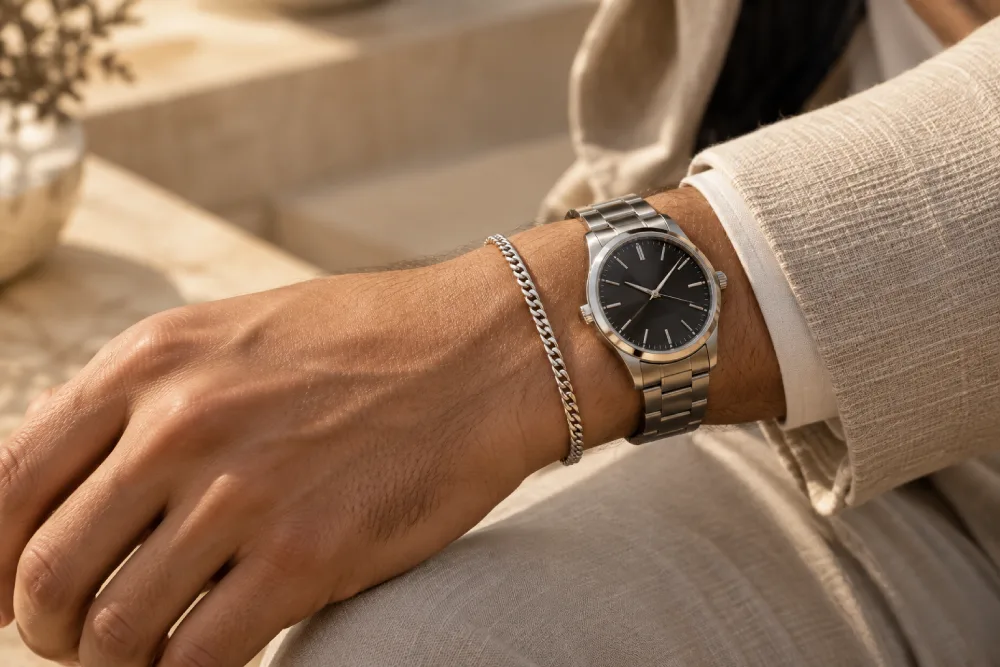
Put the watch on first, then add the bracelet on the same wrist if you’re keeping it minimal — a single slim chain-link or leather bracelet sitting between the watch face and your hand generally works well. If you want a bolder bracelet, moving it to your opposite wrist avoids crowding the watch case entirely and lets each piece stand on its own.
For mixed metals, the same principle that applies to jewelry stacking generally holds here: repeat each metal tone at least once rather than using a single odd piece in a different color. A white-gold-toned watch paired with an all-yellow-gold bracelet and chain can look intentional if you add one more white-toned detail (a ring, or a bracelet clasp) — without that repetition, the mismatch can look accidental instead.
5. How to Try a Trend Using Pieces You Already Own
You don’t need to buy an entirely new collection to test whether a current trend actually suits you. A few low-commitment starting points:
- Already wear a watch? Add one slim bracelet on the same wrist before considering a bigger stack.
- Already wear a simple chain? Try swapping the pendant for something with more meaning, or add a second, thinner chain in a slightly different length rather than replacing what you have.
- Curious about rings but not ready to commit? Start with one ring worn consistently for a few weeks before deciding whether to add a second.
- Interested in mixed metals? Start small — a two-tone watch or a single mixed-metal bracelet — before combining multiple separate pieces in different tones.
This approach lets you find out what actually feels like you before spending on a full new set, and it’s a far more practical way to engage with a trend than trying to replicate an entire look at once.
The Bottom Line
Current jewelry trends for men point toward wearing fewer, more considered pieces — a chain with real presence, a signet ring as a starting point, a bracelet that works with your watch instead of against it, and mixed metals worn on purpose rather than by accident. None of it requires an overnight wardrobe change; building outward from one piece you already wear is the most realistic way to find out what actually fits your style.
For more on materials, durability, and general jewelry-buying guidance, see the complete Jewelry Guide.
FAQs
What’s the most popular men’s jewelry trend right now? Chains with real presence — moderate width, worn with intention rather than as an afterthought — along with a clear revival of signet and statement rings, come up most consistently across current trend coverage.
Is it okay to mix gold and silver jewelry as a man? Yes. Mixed-metal styling is increasingly accepted, and the easiest way to make it look intentional is to repeat each metal tone at least once across your pieces rather than using a single odd-toned item.
How do I wear a bracelet with a watch without it looking cluttered? Put the watch on first, then add one slim bracelet on the same wrist if you want a minimal look, positioned between the watch face and your hand. For a bolder bracelet, wear it on your opposite wrist instead.
What’s a good first piece of jewelry for a man who’s never worn any? A medium-weight chain or a simple signet ring are both commonly recommended starting points, since each works across casual and slightly dressed-up settings without requiring other pieces to complete the look.
Do I need to buy a whole new jewelry collection to follow current trends? No. Building around one piece you already wear regularly — adding a bracelet to a watch, or swapping a pendant on an existing chain — is a realistic way to test a trend before committing to more pieces.
Are traditional Indian men’s jewelry pieces still relevant alongside these trends? Yes. Current coverage shows culturally rooted pieces like kadas and pendant styles with personal or religious significance being reinterpreted with cleaner, more contemporary lines rather than being replaced by purely Western styles.