Natural Skincare Routine for Healthy and Clear Skin
Published: June 4, 2026 Last Updated: June 16, 2026 You don‘t need a complicated 12-step routine or 100 product
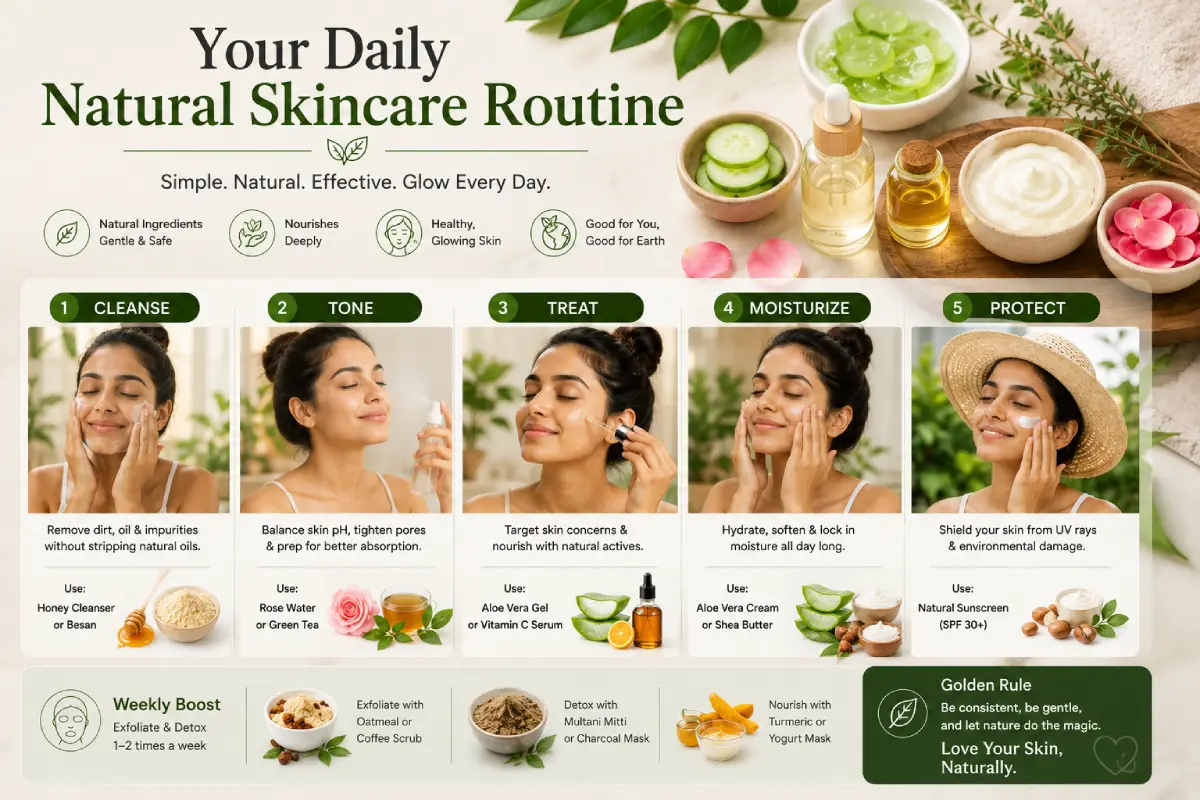
You don‘t need a complicated 12-step routine or 100 product long ingredient list for healthy, glowing skin. A simple natural skincare routine customized to work in harmony with your skin can be more effective than a harsh chemical regime over time. Be it dull winter UK skin or mask-induced breakouts during the Indian monsoon, apply the same principles: cleanse delicately, treat accordingly and protect.
This step-by-step starter kit explains how to do that using natural, herbal, and organic skincare formulas and techniques that are easy to do and really work.
What Is a Natural Skincare Routine?
A natural skincare routine revolves around the use of ingredients from plant, oils and botanicals rather than synthetic chemicals or artificial fragrances. Consider aloe vera rather than a chemical based gel, rosehip oil rather than a petrolatum derived moisturiser, neem or tea tree rather than chemicals for treating spots.
It‘s not about avoiding all science, it‘s about selecting ingredients which are recognizable, minimally processed and gentle on your skin barrier in the long run. It‘s consistency over complexity, every single time.
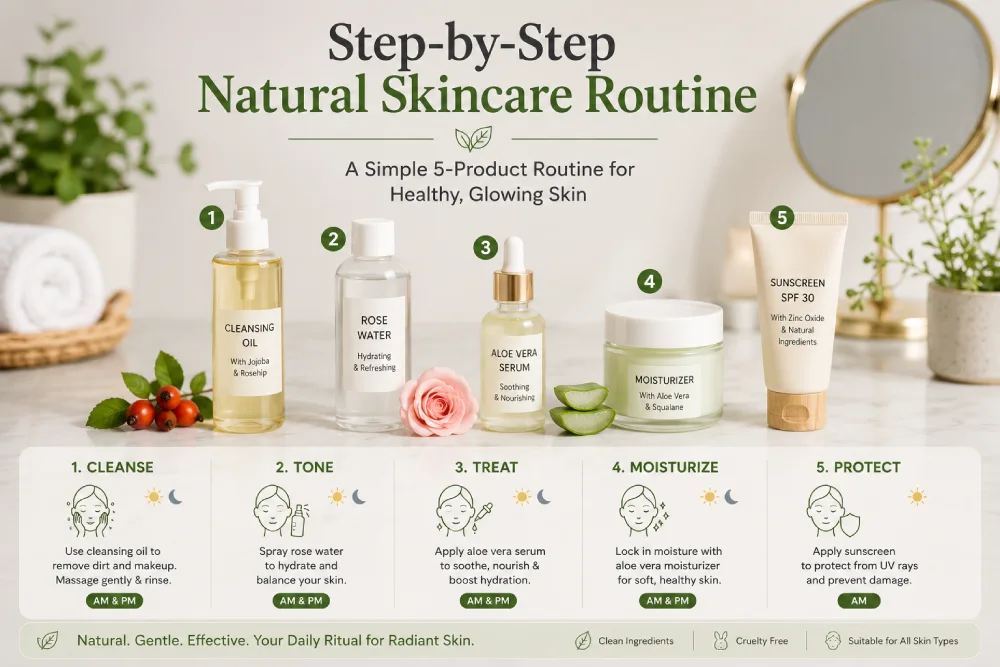
Step-by-Step Natural Skincare Routine
Step 1 Gentle cleansing is one of the most important parts of any morning skincare routine
A gentle cleanse forms the basis of any truly organic skincare regime. Select a plant-based, fragrance free formula that washes away dirt, sweat and pollution but leaves your skin‘s natural balance intact.
- Oily or blemished skin: a gel-based cleanser made with neem, tea tree or with fresh salicylic acid from willow bark.
- Dry or sensitive skin:a cleansing cream or oil containing chamomile, rose or oat extract
- Indian SKN tip: During humid summer and Monsoon season, washing twice in the evening will clean the pollen, pollution, sweat thoroughly
- UK skin tip: A nourishing cleanser works especially well as part of your night skincare routine when your skin is focused on repair and recovery.
2. Step 2 Tone (Optional but Recommended)
A natural toner can help restore the p H balance of your skin after cleansing. Stay away from alcohol-based ones. Try:
- Rose water – hydrating, anti-inflammatory, good for all skin types
- Green tea toner antioxidant, good for oily and acne prone skin. Studies shown on the effectiveness of green tea for acne and rosacea.
- DIY tip: compromise by diluting rosewater with filtered water in a spray bottle. Refreshes beautifully in the middle of the day when you most need it.
Step 3 TREAT (SERUM OR SPOT TREAMENT)
And so it begins. This is where you tell us YOUR number ONE skin concern. Not five, not ten. Select one specific target treatment and let it do its job for four to eight weeks.
- Hyperpigmentation (commonly seen in Indian skin): turmeric, licorice root extract or vitamin C from rosehip
- Acne and breakouts: neem oil, tea tree or diluted aloe vera gel as a spot treatment follow a dedicated skincare routine for acne-prone skin
- Dullness (common in UK skin for winter): vitamin C serum, rosehip oil or fermented botanical extracts
A 2025 Delphi consensus study published in the Journal of the American Academy of Dermatology reaffirmed that vitamin C is in the top tier of best brightening and antioxidant defense ingredients best of all, it is natural.
For a more detailed breakdown of which ingredients are most suited to varying skin problems, check out our detailed guide to skin care ingredients and beauty routines on Cultones.
Step 4 — Moisturise
All skin types require moisture, even oil skins. Dehydrated skins will try to compensate by producing more oil which in turn will cause blemishes. Use a moisturiser according to your skin type:
- Oily skin: aloe vera gel, light jojoba oil (mimics your skin‘s own sebum)
- Dry: shea butter or an oat based cream, rosehip oil.
- Holistic skincare for combination skin: a water-based gel moisturizer with natural hyaluronic acid
For application on the skin apply to BARELY moistened skin. Morning & evening no exceptions.
5. Protect with SPF (Morning Only)
This is not up for discussion. The rays of the sun induce pigmentation, accelerate ageing and damage the skin barrier. They do this through windows. SPF every day is the most effective use of time you can make in your skincare.
- Opt for a mineral sun cream, such as zinc oxide or titanium dioxide natural, chemical-free options, instead of chemical UV filters.
- UK SPF 30 minimum for daily wear. Indian skin, SPF 50+ as the long – term UV intensity is greater all year round.
Natural Beauty Remedies Worth Keeping in Your Routine
Some of the best herbal acne treatment solutions are right in your own kitchen and there is scientific evidence to support many of them.
- Turmeric + yoghurt brightening and anti-inflammatory. A house hold favourite for Indian skin type. Apply for 10 mins, wash with cool water.
- Aloe vera gel: Soothing for sun damage, redness and minor spot break outs use the raw gel from the leaf or go for an unfragranced store version.
- Colloidal oatmeal scientifically proven to provide relief from eczema and psoriasis. Ideal in a bath or as a soothing homemade face mask.
- Neem oil (diluted): antibacterial and anti-fungal. Apply as a spot treatment – never undiluted all over your face.
- Rosehip oil: contains plenty of natural vitamin C and fatty acids. Perfect for discolouration and dullness after acne in both UK and Indian climates.
National Institutes of Health (NIH) research library is an excellent resource if you are looking for peer-reviewed studies on the effects of plant-based ingredients on skin biology. They are constantly publishing new studies on active ingredients.
Homemade Skincare Tips That Actually Work
Homemade skin care products often get a bad reputation because they are inconsistent and maybe that is true. Here is how to make your homemade products:
- Always do a patch test on your inner wrist before applying anything new onto your face
- Never- ever use undiluted essential oils directly onto the skin. As they are so powerful they can cause chemical burns.
- Use freshly made DIY masks (turmeric, honey, oat) straight away and store in the refrigerator for no longer than 2–3 days.
- Skip lemon juice as toner too acidic damaging your barrier and making you photosensitive.
Combine your natural skincare with our wellness and lifestyle tips for a healthy skin from within. Who you are and what you do shows on your skin. How you eat and how you sleep.
Myth vs Fact: What People Get Wrong About Natural Skincare
Myth: Natural skincare is always suitable and safe for sensitive skin.
Fact: Natural doesn‘t mean hypoallergenic. Sensitive skin can react to anything from essential oils and citrus extracts to rose. Always do a patch test.
Myth: there‘s no need for SPF when using all natural products.
Fact: There is no natural alternative to mineral sunscreen when it comes to UV protection. Even when they are overcast in the UK, UV-A rays are still passing through the glass of our car windshields and breaking down our skin.
Myth: The more steps the better.
Fact: Even a simplified Korean skincare routine proves that consistency matters more than using dozens of products. The results for the skin are achieved only with daily, repeated use over weeks, not through application of more cosmetics.
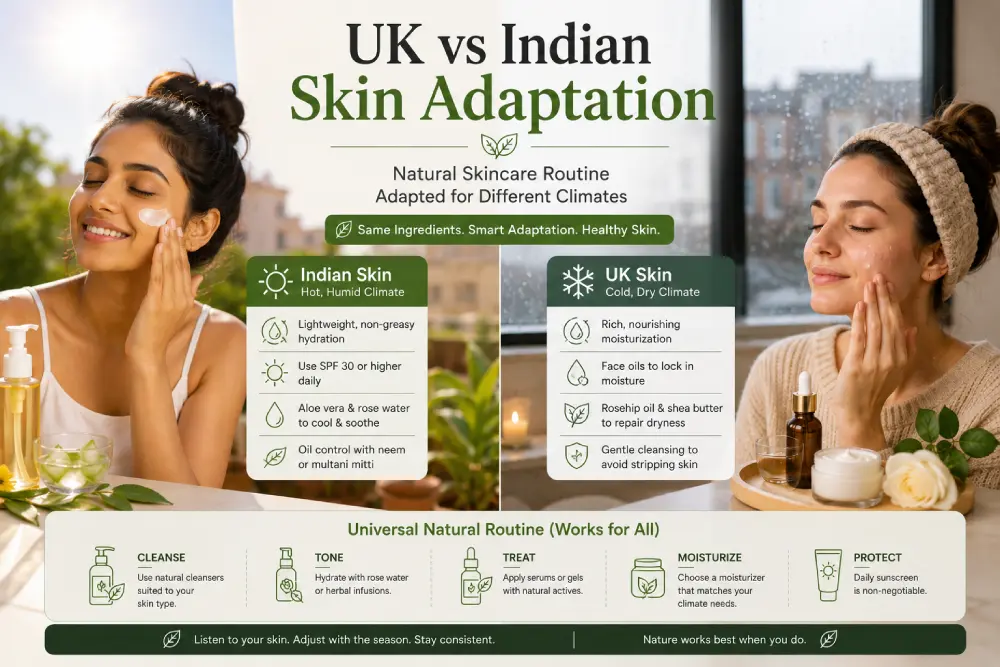
Adapting Your Routine: UK Skin vs Indian Skin
For the two Climatic Zones, each has their own unwanted business of their own. Which common routines do not kill?
For UK Skin
- Cold, damp winters dehydrate the moisture barrier wear a facial oil on top of your moisturiser through November to February
- In winter low UV is not null UV it is SPF 30 year-round really.
- Central heating indoors dehydrating skin quickly a humidifier is more use than slapping on extra moisturiser
For Indian Skin
- Another consideration is the increased humidity during monsoon season that leads to bacterial and fungal overgrowths double cleansing in the PM is preferable.
- High melanin offers some UV protection but will not block pigmentation or damage from the sun SPF50+ daily is essential.
- All of the above are traditional herbal remedies for the skin which do have true anti-inflammatory properties and also antibacterial value in the scientific literature: Turmeric, neem and sandalwood.
Seeking reliable product suggestions? Explore our expert rated natural skincare and beauty items all chosen for skin types in UK and India.
Conclusion
Building a natural skincare routine doesn’t require a cabinet full of products or a degree in cosmetic chemistry. It requires consistency, the right ingredients for your skin type, and an understanding of what your skin actually needs — not what marketing tells you it does. Whether you’re in the UK navigating dry winters or in India managing humidity and high sun exposure, the foundation stays the same: cleanse gently, treat one concern at a time, moisturize daily, and never skip SPF.
Start with the five steps above, commit to them for six to eight weeks, and let your skin tell you what’s working. That’s the real secret to a natural skincare routine that delivers.