Hyperpigmentation Treatment: How to Fade Dark Spots (2026)
Published: July 23, 2026 Last Updated: August 5, 2026 Dark patches that stay for months, splotchy patches that actually
Dark patches that stay for months, splotchy patches that actually get darker instead of lighter, scars that come up only after a pimple or zit hyperpigmentation treatments are a mess because not all dark spots are created equal. Some lighten up with a nice vitamin C serum. Others, such as melasma, require a much more careful approach. Here‘s how to actually match your condition with your treatment.
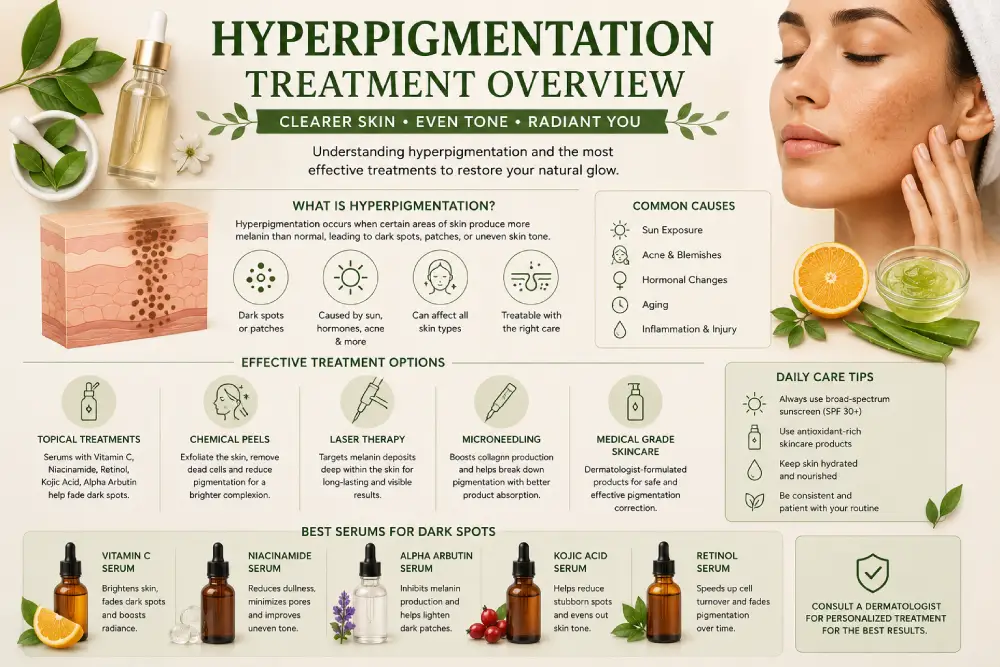
What Is Hyperpigmentation?
Hyperpigmentation is when there is an overproduction of melanin in specific areas of the skin resulting in areas of pigmentation which are darker than that of the individual’s base skin colour. This is not a specific disease but rather a feature that occurs in a number of dermatoses with varying responses to treatment.
Causes of Hyperpigmentation
Understanding your particular cause is way more relevant than any single ingredient as it will indicate the level of pigm entation in-transigence and its best intervention strategy.
- Sun exposure: Melanin is produced as a defense mechanism in reaction to UV light exposure which contributes to age spots and even tone.
- Post-inflammatory hyperpigmentation (PIH): spots of hyperpigmentation which follow inflammation, such as after acne, scratching or skin damage more common and conspicuous in darker skins.
- Underlying conditions: pregnancy, birth control, and hormonal fluctuations will activate melasma alone.
- Skin trauma and/or aggressive treatments: aggressive peels, waxing or some lasers, if performed aggressively will induce rebound hyperpigmentation.
Melasma vs. Hyperpigmentation: What’s the Difference?
Due to its unique characteristics and the way it presents, melasma is technically a form of hyperpigmentation but it is distinctive enough to warrant a separate treatment strategy.
| Feature | General Hyperpigmentation | Melasma |
|---|---|---|
| Main cause | Exposure to sunlight…presumably sun exposure causes pigmented marks on skin/face and scarring from acne and injury. | Hormonal triggers (pregnancy, contraception) |
| Pattern | Spots or patches, irregular in shape and often confined to one side of the face, for example. | Symmetrical patches (most common are cheeks, forehead, upper lip) |
| Response to therapy. The response to therapy has a reliable reproducibility. | Can often be managed successfully with regular maintenance | Chronic and relapsing; episodic improvement but tends to relapse back. |
| a) 5ccs (or half a 10cc) volume of the spur was at risk of worsenig. This resulted in the bystanders receiving several fractions of the 3ccs for each (about 10-20%) varying in respect to the initial glaucoma and direction of filming. | 2.6.9. Lower with standard treatment | The way it is worse, more to aggressive treatment can bring out flare-ups |
| Key management emphases | Fading of the current marks | Long-term control & strict sun protection |
Practical tip: If the pigmentation is symmetrical, present on both sides of the face and looks to be hormonal in origin, approach it as Melasma and be more gentle and patient right from the beginning.
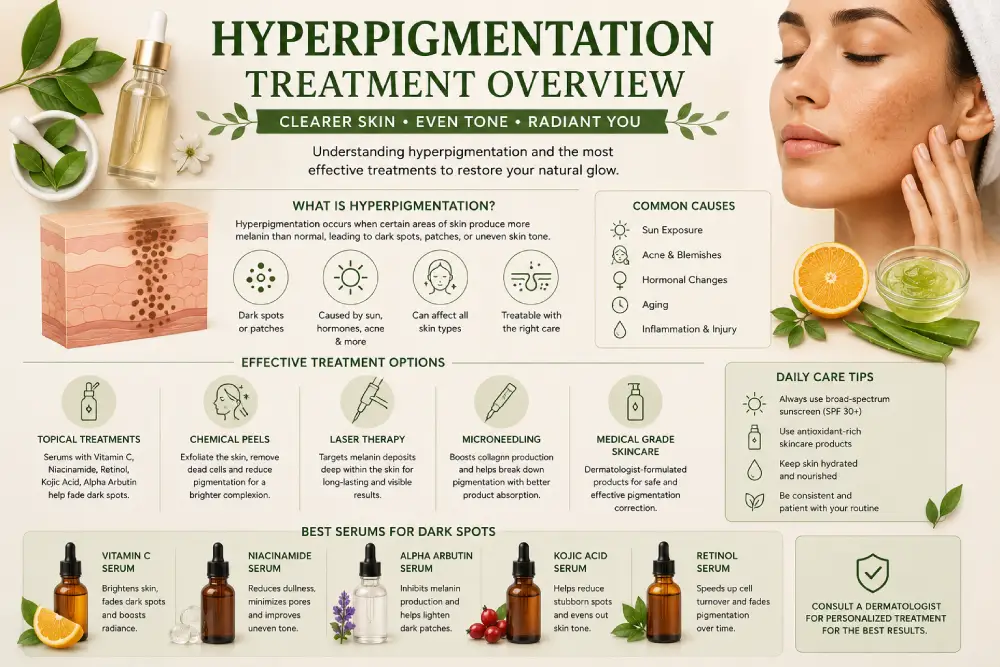
Best Serums for Dark Spots
Not all brightening ingredients are created equally so if you choose on the basis of your cause it really can make a difference.
- Vitamin C: an antioxidant that can break down melanin buildup and brighten overall tone; look for stable, well formulated forms.
- Niacinamide: smoothes and reduces pigment transfer to skin cells around it, tolerates like a goodie, even on sensitive skin.
- Azelaic acid: is mild frequently to be used and is especially useful for hyperpigmentation in acne.
- Tranexamic acid (traditionally used for bleeding): recent research showing benefit specifically for melasma in some patients. Frequently used with other brightening actives.
Placement of them: choose one or two power actives instead of layering everything together, and a second rule: sunscreens last no matter how many actives you put on unless your fading ingredients cancels themselves out..
Vitamin C for Hyperpigmentation: What to Expect
Vitamin C decreases excess melanin synthesis and additionally prevents oxidative damage to the skin, which can increase hyperpigmentation. It is considered a very safe and effective widely used topical treatment for all forms of hyperpigmentation.
Practical tips:
- Use in the A.M., then sunscreen afterwards, for optimal antioxidant protection.
- Must be administered 8–12 weeks continuously before evaluating its effects.
- Keep it. Vitamin C serums are very light and air sensitive; they will go bad very quickly if they are stored in light or in the open.
Chemical Peels for Pigmentation
A peel helps to get rid of stubborn pigmentation quickly; however one must select the appropriate peel for your skin type and tone.
- Superficial peels (e.g., mild glycolic or lactic acid): slightly less aggressive, best for overall dullness and mild pigmentation.
- TCA peels: more potent, used more for stubborn pigmentation, again under professional supervision.
- Risk to know: too vigorous a peel can cause post inflammatory hyperpigmentation, particularly in darker skinned individuals, so, more than most skincare choices, treatment should be under the supervision of a professional.
Myth vs. Fact: Hyperpigmentation
| Myth | Fact |
|---|---|
| The dark spots are naturally fading all by themselves. | A few do not clear up easily, but most require active intervention and sun screen to clear |
| Melasma is a curable disease. | The chronic condition that is treatable and can get better but will relapse without maintenance |
| More powerful products are always more efficient. | Excessive treatment will produce further pigmentation, particularly in the darker skins. |
| “Hyperpigmentation is only caused from exposure to sun” | Acne, hormones and skin injury are equally prevalent inducers |
| Melasma can be successfully treated with natural remedies. | The typical management of melasma involves a combination of actives, with sun protection, and a few procedures4 |
Common Mistakes in Hyperpigmentation Treatment
- If you forget to put sunscreen on in the morning it puts you back to square one even though you might have had a perfectly good serum.
- Contribution of several strong actives at once, leading to irritation with worsening pigmentation.
- Considering already having given up after a few weeks whereas all treatments realistically take 8–12 weeks.
- Using aggressive peels or lasers by a non professional especially on pigmented skin.
- For example, comparing it to sun spots or darkening which requires a softer, much sustained approach.
When to See a Dermatologist
If pigmentation feels like it is progressing and getting worse despite regular sunscreen use and actives or has not improved after several months of home treatment a review by a professional may be indicated. An assessment is particularly advised in the suspicion of melasma, an incorrect approach activating a further flare of pigmentation, and when considering peels, microneedling or laser treatment.
Final Take
Successfully combating hyperpigmentation depends on first identifying the true cause whether it‘s photo damage, post inflammatory hyperpigmentation from break outs or melasma, all require a slightly different solution. Daily use of sunscreen, one or two potent ingredients such as vitamin C or niacinamide, and a slow patience over time of several months, and most dark spots should lighten. For more stubborn or post hormonal pigmentation, a dermatologists anti-hyperpigmentation regime is well worth the investment, before heading for more aggressive measures.
FAQs
Q1. What is the quickest treatment for hyperpigmentation? While there isn‘t a truly immediate solution, the combination of daily sunscreen and actives such as vitamine C and niacinamide, in addition to in-office treatments for the most persistent hyperpigmentation is the quickest way to see results.
Q2: Is melasma a form of hyperpigmentation? Melasma is a type of hyperpigmentation, often hormonally induced, that can be more chronic in nature and necessitate a more gentle, prolonged approach to resolution.
Q3: What about hyperpigmentation (or dark spots) in general? Yes, vitamin C inhibits enzyme tyrosinase and has antioxidant activity so it is one of the better all-round solutions.
Q4: Will chemical peels be safe on any skin tone? Not to the same extent. Deeper peels will be more likely to induce additional pigmentation in the darker skin tones and therefore only carried out under the supervision of a trained professional.
Q5 Is it possible for hyperpigmentation to resolve naturally? Some minor solar hyperpigmentation may slowly fade away with rigorous sun protection, but in general, pigmentation becomes better quicker with active treatment.
Q6: How long does hyperpigmentation treatment take to work? Most topical treatments take 8–12 weeks of regular use before seeing results & melasma takes longer to clear, requiring ongoing maintenance.
Image Suggestions
| Section | Image Idea | SEO Filename | ALT Text |
|---|---|---|---|
| What Is Hyperpigmentation | Close-up of skin showing uneven pigmentation patches | hyperpigmentation-treatment-overview.webp |
Overview of hyperpigmentation on facial skin |
| Causes | Infographic of common hyperpigmentation causes (sun, acne, hormones) | causes-of-hyperpigmentation.webp |
Common causes of hyperpigmentation infographic |
| Melasma vs Hyperpigmentation | Side-by-side comparison graphic of melasma and general hyperpigmentation | melasma-vs-hyperpigmentation.webp |
Melasma versus hyperpigmentation visual comparison |
| Best Serums | Dropper bottles of vitamin C, niacinamide, and azelaic acid serums | best-serums-for-dark-spots.webp |
Best serums for treating dark spots |
| Vitamin C | Vitamin C serum applied to skin in the morning routine | vitamin-c-for-hyperpigmentation.webp |
Vitamin C serum for hyperpigmentation treatment |
| Chemical Peels | Dermatologist applying a chemical peel treatment | chemical-peels-for-pigmentation.webp |
Chemical peel treatment for pigmentation |