The Perfect Night Skincare Routine for Healthy, Glowing Skin
Published: June 1, 2026 Last Updated: September 17, 2026 Most people spend far more time on their morning routine

Most people spend far more time on their morning routine than their evening one. This is a mistake. Your night skincare routine is actually the more important one because that is when your skin is biologically programmed to recover.
You get the benefits of a skin treatment while you snooze: increased collagen, faster cell regeneration, skin repairs. If you give your skin the correct environment and products you‘ll wake up with a softer, clearer, brighter complexion. We tell you how to get it right.
Why Your Skin Works Harder at Night
Here‘s something most skincare tips omit completely: your skin has its own 24-hour clock known as the circadian rhythm.
Studies presented at the American Academy of Dermatology by No7 Beauty and the University of Manchester have shown that skin repair genes are most active between 2 and 4am. By evening, your skin barrier is more permeable it will absorb active ingredients much more than it would in the morning .
And this, then, is why the process you follow on the outside each night should be about more than simply removing the makeup.
Skip your night time routine, and you leave pollution, SPF residue, excess oil and daily oxidative stress sitting on your skin all night and completely blocking that incredible repair cycle.
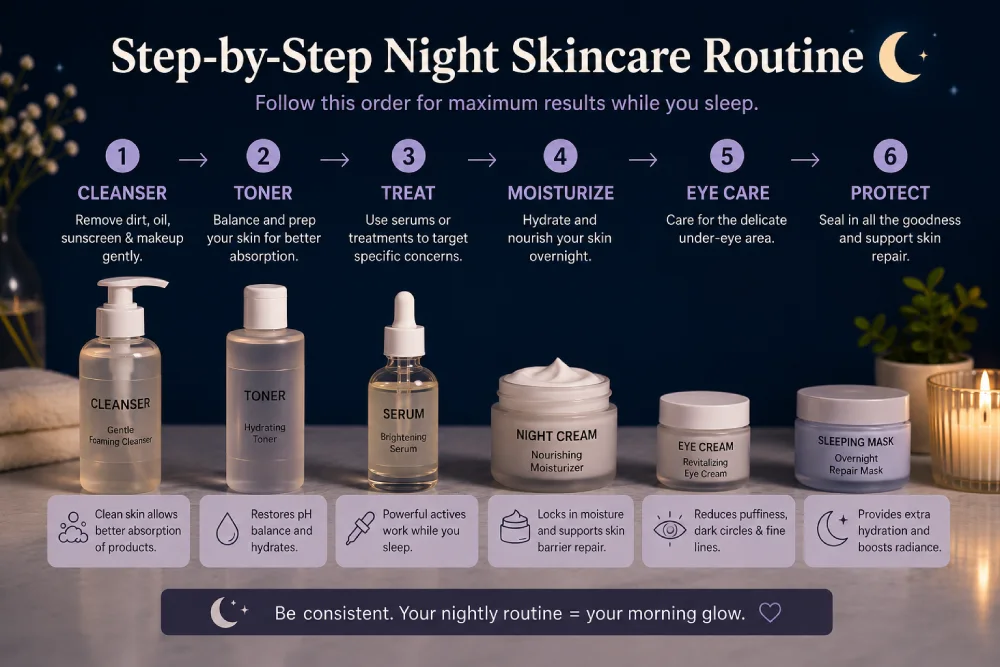
Step-by-Step Night Skincare Routine
Follow these steps in order moving from the lightest consistency to the heaviest. This is important. If you layer the in the incorrect order you will reduce the absorption of each product.
Step 1 Double Cleanse (Never Skip This)
Your first cleanse is just about clearing away any remaining top layer: sunscreen, makeup, excess oil, pollution. It is best to use a cleansing balm or oil-based to cleanse, apply to dry skin and massage in gently for 60 seconds. Rinse with warm water.
Your second cleanse is more thorough. Use a mild pH balanced water based cleanser to clear away sweat, leftover impurities and anything the first cleanse didn‘t clear away.
If you‘re someone who lives in London, Mumbai or Delhi then this two-step method is more than useful you‘ll be carrying a hefty load of particulate matter on your skin every evening.
Step 2 Toner (Optional but Very Useful)
A hydrating toner with hyaluronic acid or centella asiatica helps bring the pH of your face back down to an optimal level after cleansing and prepares your skin to absorb what‘s coming next. This step isn‘t necessary but will add some relief if your skin feels tight or sensitive after cleansing.
Do not use alcohol based toners. These will strip the barrier and cancel out all the goodness you are about to put on top of them.
Step 3 Treatment Serum (Your Targeted Repair Step)
This is where you describe your own skin issue. Select a single active per evening and change if necessary:
- Retinol or Retinoid the ultimate in anti-ageing, cell renewal and pigmentation. Use twice to three times a week to begin with and introduce it slowly if you‘re a beginner.
- Niacinamide addresses imperfections, irregular pigmentation and dullness; suited to Indian skin concerns such as PIH and for UK skin such as dehydration or congestion
- AHA/BHA exfoliating serum– smoothens texture, banishes dead skin and make pore appear less congested; only use 1-2 nights per week
Do not put retinol and acids together on the same night. That is a barrier-disruption waiting to happen.
Step 4 Eye Cream (If You Use One)
The skin around the eyes is the thinnest on the face with a reduced oil gland structure, so it dehydrates quicker and appears more tired looking. For dark circles, puffiness and thin lines in the eye area, an eyecream can make a visible difference with regular usage, applied with the ring finger (least pressure).
Step 5 Night Moisturiser or Sleeping Mask
Seal it all in. Your night cream should be a little thicker than your day moisturizer, so find a formulation that contains ceramides, peptides, squalane or hyaluronic acid. That‘s going to go to work repairing your moisture barrier while you sleep, not sit on top of it.
In the UK, during the winter when central heating and the cold air are stripping moisture from the skin, a richer overnight cream or weekly treatment sleeping pack will be noticeable by the morning.
For humid months in India, a gel based night moisturizer will generally suffice. During cooler, drier winters (particularly in North India), switch to something heavier.
Overnight Skincare Tips That Actually Make a Difference
Getting the steps right is important. So is the context they occur in.
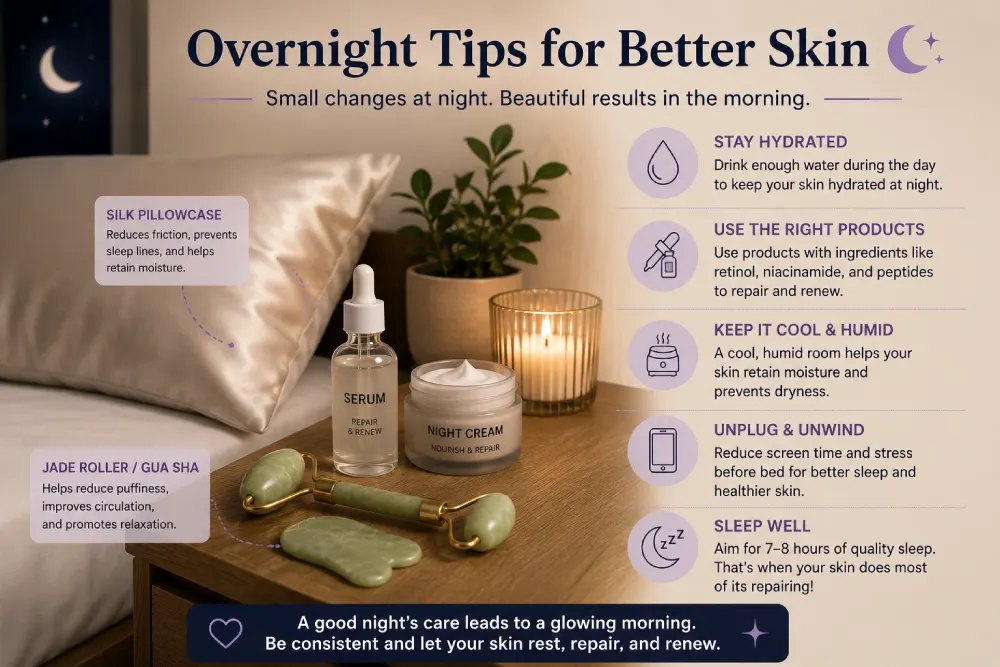
- Use your routine 20–30 minutes before bed – this allows your products to sink in before you rest your head on the pillow
- Use clean pillow cases bacteria, oil, and product build-up on fabric transfer right back onto skin while you sleep. Silk or satin pillowcases are easier on the skin and cause less friction.
- Apply retinol away from the eye area use your eyecream in this delicate place.
- Less is more with actives don‘t irritate your skin barrier every evening. Alternate nights of treatment with a cleanse-and-moisturise approach, particularly if you feel your skin is reactive.
Common Mistakes in a PM Skincare Routine
Sleeping in SPF or makeup Sunscreen is formulated to stay on top of the skin creating a film. Stuck on overnight the clog pores+ work against your skin‘s repair cycle.
Using too many actives together: Retinol + AHA + vitamin C in one evening is a barrier nightmare. You should alternate actives on separate nights, not in the same routine.
Incorrect sequence of products used applying thick creams before serums. The coverage of the absorbtion is blocked. Lightest to heaviest is toner, serum, eye cream, moisturiser.
Rushing through the routine If you’re tired and cramming everything in 90 seconds, your products aren’t absorbing. The double cleanse alone deserves a full minute of massage. Your bedtime skincare products work best when you’re not in a hurry.
Myth vs. Fact: Night Skincare Edition
| Myth | Fact |
|---|---|
| There‘s no need to moisturise if your skin is greasy. | Oily skin still needs moistening. Don‘t forgo moisturizing lack of it means even more oiliness. |
| Sleeping masks are for dry skin only. | Most sleeping masks are suitable for all skin types; gel-based, lightweight formula sleeping masks work for oily skin perfectly. |
| More products = better results | Your skin is capable of taking this far. Three lengthy steps are just as effective as eight quick ones. |
| You require a night cream the day cream is quite sufficient | Night Creams do not include SPF and tend to contain more nourishing repair ingredients. Night creams have a totally different purpose. |
Skin Repair Routine by Concern
| Skin Concern | Key Night Ingredient | Frequency |
|---|---|---|
| Pigmentation / dark spots | Niacinamide, Alpha Arbutin | Every night |
| Dullness / uneven texture | AHA (glycolic or lactic acid) | 2–3x per week |
| Fine lines / anti-ageing | Retinol, Peptides | 2–3x per week |
| Dehydration / tight skin | Hyaluronic acid, Ceramides | Every night |
| Breakouts / congestion | BHA (salicylic acid), Niacinamide | Every night, or every other night |
Conclusion
Most skincare progress doesn’t happen in the morning. They take place while you sleep. – Quietly. Regularly. Every single night.
Actually you don‘t really need ten products or a costly shelf of actives. What you want is a night skincare routine you will actually do. Double cleanse to get rid of the days muck, one treatment serum for your concern and a good moisturiser to lock all in while your skin is busy doing its thing.
Start tonight, cut down. Don‘t mess with it for six to eight weeks.
Healthy, glowing skin isn‘t built in the morning mirror; it‘s built on the five minutes before you shut your eyes.