Stress Management: The Complete 2026 Guide to a Calmer Life
Published: September 8, 2026 Last Updated: September 8, 2026 If your shoulders are somewhere near your ears right now,

If your shoulders are somewhere near your ears right now, you’re not alone. Stress management isn’t a luxury topic anymore — it’s a daily survival skill, whether you’re commuting through Mumbai traffic, juggling back-to-back Zoom calls in New York, or just trying to get through a Tuesday without snapping at someone you love.
This guide is designed to be your anchor. I won‘t drown you in theory. Rather, I will define stress, explain why it manifests in the way it does, and outline what stress reduction techniques are guaranteed to work with direct links to more-focused, in-depth guides on each method so you can delve as deep as you like.
By the end, you‘ll have a clear, customized starting place for integrating stress relief techniques into your actual life not the perfect-standardized one you see on Instagram.
What Is Stress, Really?
Stress your body‘s reaction to any pressure you feel that you don‘t believe you can handle deadlines, fights, traffic jams, or actual bear attacks. Stress itself isn‘t a problem in small doses it can increase your focus and reaction time. It‘s when the “off switch” is broken that the trouble begins.
Quick definition:Stress is the physiological and psychological state that you are in when your brain interprets an event as a threat that exceeds your resources for dealing with it.
Key takeaways:
- Stress is a warning, not a diagnosis. It is a warning sign.
- Prolonged fatigue (impairing performance).
- A work email creates the same response in your body as an actual emergency it just can‘t differentiate.
Mini summary: It‘s not stress that‘s the problem. But unmanaged, long-term stress is the real issue.
The Three Types of Stress You Should Know
If you haven‘t noticed, all stress is not created equal, and to treat chronic stress the same as a bad day (or vice versa) is where most people go wrong.
| Type | What It Feels Like | Typical Duration | Best First Step |
|---|---|---|---|
| Acute stress | Sudden spike near miss on the road, difficult conversation |
Minutes to hours |
Breathing exercises |
|
Episodic acute stress |
Regularly having to “put out fires” or constantly rushing | Recurs weekly | Regular + boundary modifications |
| Chronic stress | Ongoing tension, low mood, tiredness |
Weeks to years |
Structured recovery plan + possibly professional support |
Two each or othery things: If you get a shot of panic right before one huge presentation, you have an acute stress. If you get that shot of panic every single Monday for the last several months, you are experiencing episodic stress. That‘s creeping toward chronic.
Mini summary: Figuring out which kind you are will tell you whether you can get away with just a five-minute fix or whether you‘re going to have to turn your life upside down.

Common Causes of Stress in 2026 (US & India Context)
Stress triggers are more and more global the texture is local.
In the US, common drivers include:
- Work culture that merges into “always-on” mode of availability
- The cost-of-living squeeze and financial duress
- Long making a solo trip and no group bond; insufficient human/nature contact, too lonjhmaking a solo trip..
In India, common drivers include:
- The expectations of having a joint-family and being in a relationship piling onto the pressure from one‘s career
- The effects of early-onset academic and examination stress
- Crowded and noisy urban commuting/mistaken pollution stress
Shared modern triggers across both regions:
- An overload of notifications and overwhelming scrolling
- Confusion between “on“and“off“time job and hybrid-work directions
- A sleep debt adding on top of everything that else is going on (i.e., stress, illness).
Mini summary: Your stress is not beat by a matchless – it is molded by your surroundings as well as your character. Identification of the concrete origin is the initial significant move in the management.
Signs and Symptoms of Stress
Stress, generally speaking, doesn‘t alert you explicitly. It arrives not head-on, but alongside in your skin, your sleep, your patience.
| Category | Common Symptoms |
|---|---|
| Physical | Headaches, sore jaws/shoulders, tiredness, pimples, problems with digestion |
| Emotional | Irritability; anxious; “flat” feeling; overwhelmed |
| Behavioral | Procrastination, binge eating or not eating enough, doom scrolling, snapping at people |
| Cognitive | Brain fog, forgetfulness, racing thoughts, decision making |
Example from real life: an abrupt series of breakouts or persistent dullness in the skin tend to be one of the earliest physical indications of increasing cortisol even before the individual consciously thinks, “God I‘m stressed.”
Mini summary: So, if you notice these more than 2, 3 in combination: you already are giving your body the que for one. Time to get on a stress management plan, not another trip to read “The Willpower Book”.
Fast-Acting Stress Relief Techniques (For Right Now)
When you‘re under a stress spike, there‘s no time for an elaborate 45-minute self-care session you need to spend less than five minutes taking care of yourself.
Key takeaways:
- The best reset tools work directly on your nervous system, rather than just your mind.
- The reason that physical resets (cold water, movement, breath) seem to work more frequently than mental resets (“just calm down”) is that stress is a physical first response.
- Having one method done consistently beats one that‘s complicated once in a while.
Quick examples that work in the moment:
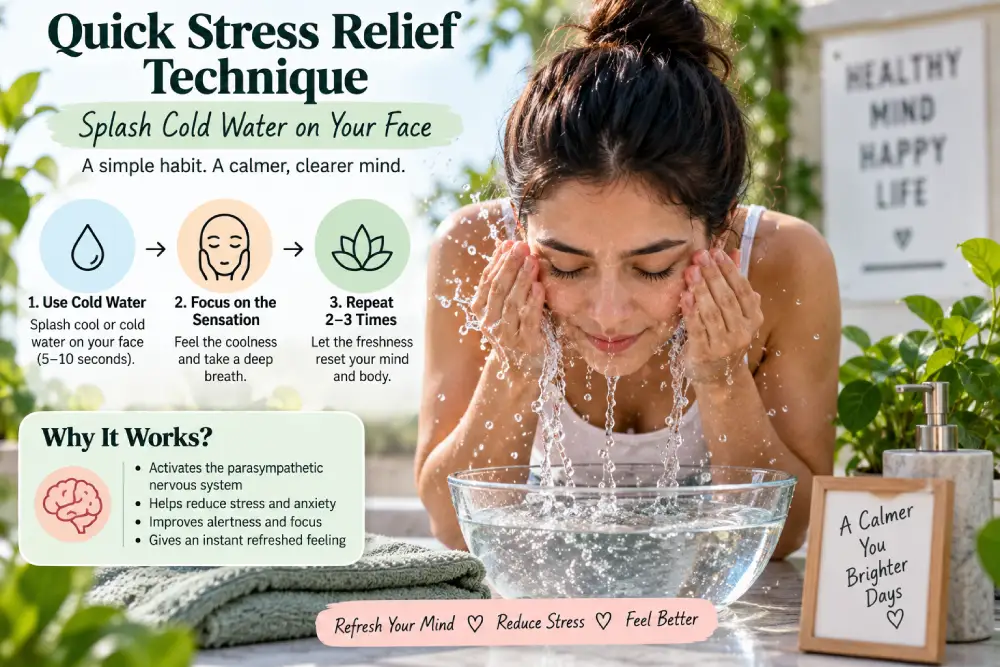
- Spraying cold water on your face or wrists to elicit the dive reflex.
- A brisk walk for about 90 seconds, even inside
- The ‘5-4-3-2-1’ grounding method with 5 senses
- Slow exhale focused breathing (details below)
Mini summary: These are your emergency-brake tools. For a full toolkit — including office-friendly and public-friendly options — see the complete breakdown.
Read More: Fast Stress Relief Techniques
Breathing Exercises for Instant Calm
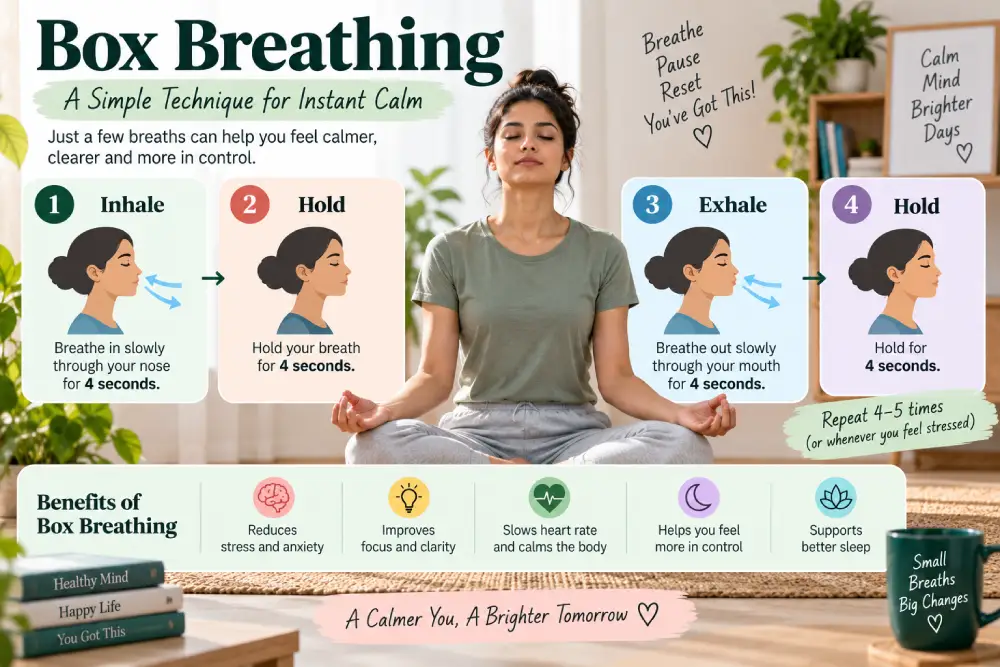
Among all these stress-relief techniques listed here, breathwork has the strongest support of any, as it tells yourvalgusnerve to transition you out of fight or flight.
Key takeaways:
- It‘s actually a slow long exhale (longer than your inhale) that is what really causes the relaxation “deep breathing” alone will not, regardless of what you‘ve heard.
- Two blocks of the most well-investigated and quickly effective formats are box breathing (4-4-4-4) and physiological sighs (double inhale, long exhale):
- You can practice breathing exercises anytime, no matter where you are. While in a meeting, on the subway, before a confrontation…anywhere.
Practical example: Try it now breathe in for 4 beats, hold 4, breathe out for 6, hold 2. Do this four times. Feel your shoulders drop by the third round.
Mini summary: Breathing is the number one most rapid lever you have control over for your nervous system. It should be looked into more deeply having clear, step-by-step patterns depending on the circumstance.
Read More: Breathing Exercises for Stress
Managing Work-Related Stress
In general, work provides one of the greatest drains on adult life of any daily concern not because work is too hard, but because some of the accepted boundaries between work and non-work have deludedly disappeared.
Key takeaways:
- One of the greater indicators of ongoing work-related tension is always ‘on’ availability, which in many cases exceeds the workload as an even greater indicator.
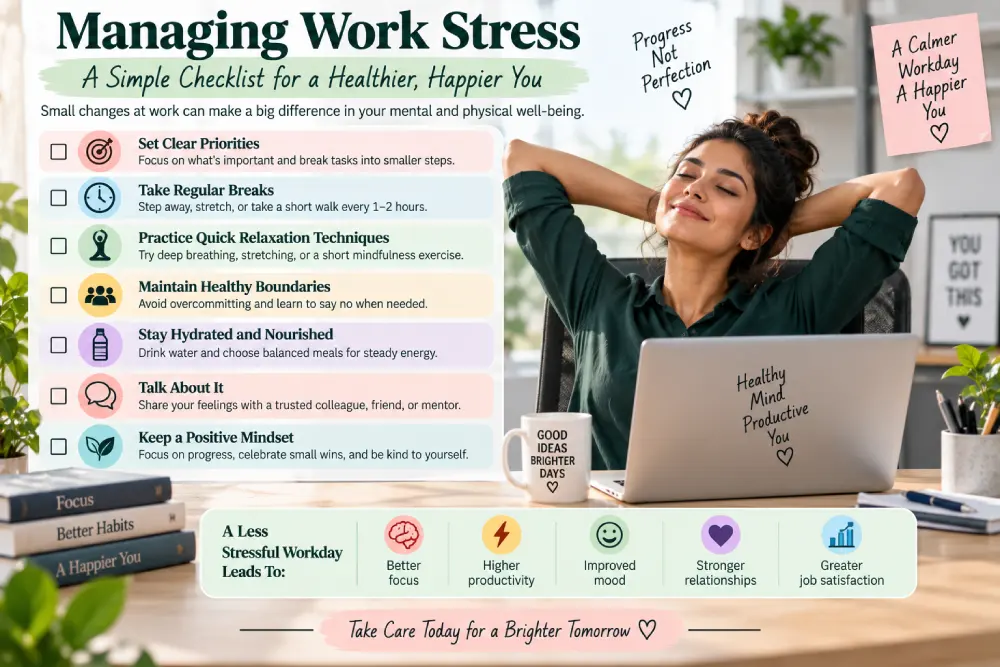
- Micro-boundaries (a hard stop time, muted after-hours notifications) are generally more effective than creating a big change.
- Burnout is most likely to result from unmanaged stress in the workplace.
Practical example: 15-minute buffers between consecutive meetings are shown to statistically significantly lower 5:00 pm stress scores in workplace wellness studies, even when they require starting the next meeting early.
Mini recap: Holding work stress is more about putting the edges of your day back, rather than changing how your job is performed.
Read More: Managing Work-Related Stress
Chronic Stress and Cortisol Management
Cortisol is your body‘s main stress hormone. It is excreted from the adrenal glands in response to the HPA (hypothalamic-pituitary-adrenal) axis. Is protective in small doses. Chronic stress is where it becomes problematical, as it is curently persistently excreted.
Key takeaways:
- Consistently elevated levels of cortisol have been associated with difficulties in falling asleep and staying asleep, as well as persistent weight gain (especially at the midsection), and a diminished ability to fight infection.
- Cortisol is naturally highest in the morning, and lowest in the evening. In chronically stressed individuals this curve becomes attenuated, or even inverted, and is usually responsible for stressed individuals’ experience of being ‘tired but wired’ in the evening.
- Regulating the levels of cortisol is not about reducing them to zero, but normalizing its rhythm.
Practical application: A person who is lethargic throughout the entire day but who “perks up” at 11 pm is often having a distorted cortisol curve and not just being unable to fall asleep.
Mini summary: Nearly every stress symptom shown on this page sleep, weight, skin and mood boils down to the regulation of cortisol.
Adaptogens and Natural Stress Relievers
The term adaptogens refers to herbs such as ashwagandha, rhodiola and holy basil (tulsi) that have been used traditionally for the purpose of enabling the body to “adapt” to stress.
Key takeaways:
- It takes couple of weeks to work. It doesn‘t work immediately the way breathing techniques work.
- However, not every adaptogen will be beneficial for every person. Some adaptogens are more stimulating, while others are more calming (e.g. rhodiola is more of a stimulant, while ashwagandha is more calming).
- At best, they are an adjunctive treatment with sleep, activity, and tools for the nervous system, not a single stand-alone treatment.
A practical example of this is Ashwagandha, which is perhaps one of the most well-researched adaptogens available, found to reduce perceived stress and cortisol levels in a healthier way when supplemented on a regular basis (6-8 weeks).
Short summary: Real natural remedies can certainly help, and as always, it is key which one, how much and when. These have been explored in detail in the detailed guide.
Read More: Adaptogens & Natural Stress Relievers
Sleep and Stress: Breaking the Cycle
Stress and lack of sleep can create a vicious cycle; stress causes sleep disturbance and the lack of sleep reduces your resilience to stress, making each day seem more demanding.
Key takeaways:
- High evening cortisol levels are one of the most ubiquitous, and perhaps one of the most easily treated, causes of stress related insomnia.
- The importance of thewind down period. Consistency trumps all other sleep “hacks.”
- Not only do pre-sleep screens push sleep back, but light exposure and activity keep cortisol high.
A real-life example is that substituting the last 30 minutes of scrolling for a dimmer, non-screen wind down (reading, stretching, journaling) is reliably associated with faster sleep onset and a reduced level of morning arousal.
Mini summary: You can‘t out-technique bad sleep. Sometimes changing the stress sleep loop is the one most effective change you can make in the entire guide.
Read More: How to Sleep Better Under Stress

Burnout: When Stress Goes Too Far
Burnout is not merely “really tired.“Burnout comes from the World Health Organization (WHO) who define it as an “occupational phenomenon occurring as a result of unmanaged chronic stress in the workplace” characterized by three dimensions; 1) feelings of exhaustion, 2) cynicism and 3) sense of reduced effectiveness.
Key takeaways:
- 1. Burnout Usually Has Signs Of Precursors Early symptoms are minimized as “just a busy time.”
- Burnout is different from normal tiredness in that most of the time, it won‘t just go away with a weekend off. It needs a structural change and then some time to recover.
- The most straightforward warning sign of burnout is apathy a feeling of emotional numbness or detachment from things you used to care about at work.
Real-life example: A person who were once passionate about work then suddenly had no enthusiasm for a project they would typically have been excited about. A classic early sign of burnout, not laziness.
Mini recap: once stress ceases to be about specific situations and becomes your normal state, it may be time to see if you‘ve entered burnout zone;
Read More: Burnout Recovery Guide
Myth vs. Fact: Stress Management
| Myth | Fact | |
|---|---|---|
| “Stress is all in your head” | Stress causes tangible, measurable changes in the body-release of hormones, changes in the heart, immune system function. | |
|
Using active nervous-system tools (breathing, movement) works even faster and more effectively than passive relaxation. | |
| “Adaptogens act immediately.” | They do not require daily use: ‘most require several weeks of ongoing daily use before real effects become apparent’ | |
| “Burn out, it‘s the same as being tired.” |
Burnout is a distinct state involving exhaustion, detachment, and reduced performance — rest alone often isn’t enough. |
|
| Only the ‘weak’ people find it hard to deal. | Tolerating Chronic Stress stresses out even the most resilient when demands continually outstrip resources. |
Common Mistakes People Make With Stress Management
- Waiting until they reach their limit, since most waiting until they have started to reach a burnout.
- I think being dependent on one tool–caffeine only, supplement only, “positive thinking” only, instead of layering what we do.
- Dealing with chronic stress as if it were acute: no five-minute breathing session will make up for months of lost sleep and working hard.
- Omitting physical symptoms denying that skin problems, headaches, or stomach changes are caused by or connected to stress.
- Every–so–often routines giving up an entire stress-relief activity for any period of time when a few days are missed, instead of just picking it up again.
Building a Personalized Stress Management Routine
- Here, you need to find what type of stress you are experiencing (acute, episodic, or chronic see table above).
- Choose an easy fast tool to use during an in-the-moment spike (breathe or ground).
- Choose a daily anchoring habit: winding down before bed, walking to work in the morning, or setting a regular sleeping time.
- Deal with the problem be it a work boundary, an unspoken conversation, or a schedule that should be adjusted.
- 7. Layer in support what will help you adaptogens, journaling, professional support if symptoms persist.
- Review weekly – what‘s the rfr? Lead changes and make adjustments. Managing stress is a process, not a quick fix.
The Future of Stress Management: Trends to Watch
- Cortisol is being integrated into wearables for customized monitoring.
- Specialized adaptogen single-herb formulations for various stress types (work vs. sleep) are giving way to specially formulated mixture combinations.
- Policy changes in the workplace more and its formalization of “no-meeting” recovery blocks (rather than individual boundary-setting)
- More integrative beauty-wellness programs are emerging, as awareness rises of the evident connection between stress, skin and sleep.
Conclusion
Stress management by 2026 is not about being Zen all the time a pipe dream chasing it only adds more stress. It‘s about coming up with a sustainable system: instant help for one-off stress, anchors to keep you safe every day, and truthful recognition of when you need to reach out and get real help, be it with sleep, herbal stress reducers, or admission to a skilled therapist.
Begin with one. Select just one method from this guide a breathing rhythm, establishing a boundary on the job, creating a wind-down routine and practice it faithfully for two weeks before incorporating another. That, right there, is how you build sustainable stress-reduction.
For deeper, science-backed context on how stress affects the body, the American Psychological Association’s Stress in America research and the Mayo Clinic’s overview of stress symptoms are excellent external references.
FAQs
What is the fastest way to relieve stress? Slow, extended-exhale breathing (like a 4-second inhale and 6-second exhale) is one of the fastest ways to calm your nervous system, often within a few minutes.
What’s the difference between stress and anxiety? Stress is typically a response to an external trigger (a deadline, a conflict) and tends to ease once the trigger passes. Anxiety can persist even without a clear external cause and often involves ongoing worry about future events.
Can stress really affect my skin? Yes. Elevated cortisol can increase oil production and inflammation, which is why breakouts, dullness, or flare-ups often appear during high-stress periods.
Do adaptogens actually work for stress? Many adaptogens, like ashwagandha, have research support for modestly lowering perceived stress and supporting healthier cortisol patterns, but they work gradually and aren’t a substitute for addressing root causes.
How do I know if I’m burned out instead of just stressed? Burnout typically includes three markers: persistent exhaustion, emotional detachment or cynicism about your work, and a noticeable drop in effectiveness — and it doesn’t fully resolve with a short break.
How long does it take to reduce cortisol naturally? Sleep-related cortisol shifts can improve within days of a consistent wind-down routine, while broader hormonal balance from lifestyle changes and adaptogens usually takes 4-8 weeks of consistency.