Best Face Wash for Every Skin Type: Complete Buying Guide
Published: September 10, 2026 Last Updated: September 10, 2026 If you‘ve ever been in front of a skincare shelf
If you‘ve ever been in front of a skincare shelf (or been googling fifty tabs on your phone) asking ‘which face wash is actually the ‘best’ for me?’, there‘s one truthful response: There isn‘t a ‘best face wash’. There is only the best face wash for your skin.
That one thing makes all the difference between skin that feels calm, balanced, and clear and skin that feels tight, oily by mid-day, or breaks out spontaneously for apparently no reason. The best cleanser isn‘t one with the most elegant packaging or the one with the highestprice it is the one whose formula, texture, and ingredients correspond to your skin‘s needs.
Here‘s exactly how to determine your skin type, what (and what not) to look for in a face wash, the differences between gel, foam and cream formulas and where to go from here depending on your problem oily, dry, tanned, broken out or whatever else.
This is the beginning. It‘s the chart each harbor‘s blueprints are only a click away.
Why Choosing the Right Face Wash Actually Matters
It‘s where we think we can get away with doing the least. it‘s the step in any skin care routine that in the end turns out to be the most skipped. However, your facial wash hits your skin twice a day, everyday. That means in a year it hits you about 730 times. If it‘s not the right formula for your skin type, not only are you wasting product, but you are fighting your skin barrier.
What goes wrong with the wrong face wash:
- Too harsh for oily skin→ strips natural oil→ overcompensate by actually producing more oil
- Too drying for dry skin->tight, flaky, uncomfortable all day.
- Too heavily perfumed for sensitive skin? / irritating: redness, stinging, reactivity
- Incorrect p H →results in May upset the skin‘s barrier, allowing bacteria and irritants to penetrate more easily.
Here‘s the most important lesson I learned: Face wash is not a “nice to have” step. It‘s the starting point for the subsequent steps (serums, moisturizers, SPF, etc.). If your face wash is wrong, everything else after will have to work twice as hard.
Understanding pH and Why It Matters
While good skin naturally maintains the pH of 4.7 5.5, which is mildly acid, most orthodox soap or even face washes are much too alkaline, with a pH of 9 10. Their regular use can compromise your skin‘s acid mantle – the thin layer of film on the surface – let bacteria, pollution and irritants in.
Do You Need to Double Cleanse?
Double cleansing has become mainstream thanks to Korean beauty regimes and actually is useful for some people, starting with an oil-based makeup remover then immediately followed by your usual face wash.
- Who is it worth doing on: If you regularly use heavy makeup, apply a lot of sunscreen or spend lots of time in high-pollution environs
- Not necessary if: You have dry or sensitive skin and wear little makeup or sunblock you can usually get away with just one gentle wash
- The middle ground: For many people it is fine to only have to double cleanse at night instead of in the morning
Mini summary: you don‘t need to double cleanse all time just when circumstances in the form of, say, heavy makeup or sunblock requires it.
How to Identify Your Skin Type (Quick Self-Check)
Before you buy anything, spend 30 seconds on this simple test:
- Wash face with a gentle cleanser pat dry with a soft dry cloth.
- No touch/ wait 30–60 min ( no anything else).
- See how your skin feels and looks.
| What You Notice | Likely Skin Type |
|---|---|
| Shiny all over and dull T-zone. | Oily |
| Tightly, flaky, or rough surfaces I expect. | Dry |
| Any of the oily areas on T zone such as forehead, nose, chin but rough/dry cheeks | Combination |
| Redness, burning, sensitive/to easily irritated | Sensitive |
| Comfortable, neither to much greasy, nor to much dry | Normal |
Practical tip: Your skin type can change with season and weather and even stress levels – particularly if you are living in humid areas, such as India and most of south Asia where its humid throughout the year, or in very dry winter months of North America. Do check every few months, and don‘t assume it‘s always the same.
The Blotting Paper Test (An Extra Check)
If wait-and-watch seems too weak a strategy, go for this:Throughout the mid-afternoon, when you‘ve not yet have to touch up or cleanse again, lean some clean blotting paper or a piece of tissue loosely against one of your face, and try it on various places.
- Heavy oil do normal transfer during the entire sheet→oily skin
- Oil only on forehead, nose and chin → combination skin
-
Little to no oil transfer, paired with visible dryness → dry skin
- Less oil, no stickiness, no scaling → [indicating] normal skin
Practical example: An office worker in air conditioning all day might test normal in the morning but definitely have a T-zone shine by 3 p.m. a sure-fire indicator of combination skin because AC tends to magnify the oilier/drier zone differences.
The 3 Main Face Wash Textures: Gel vs. Foam vs. Cream
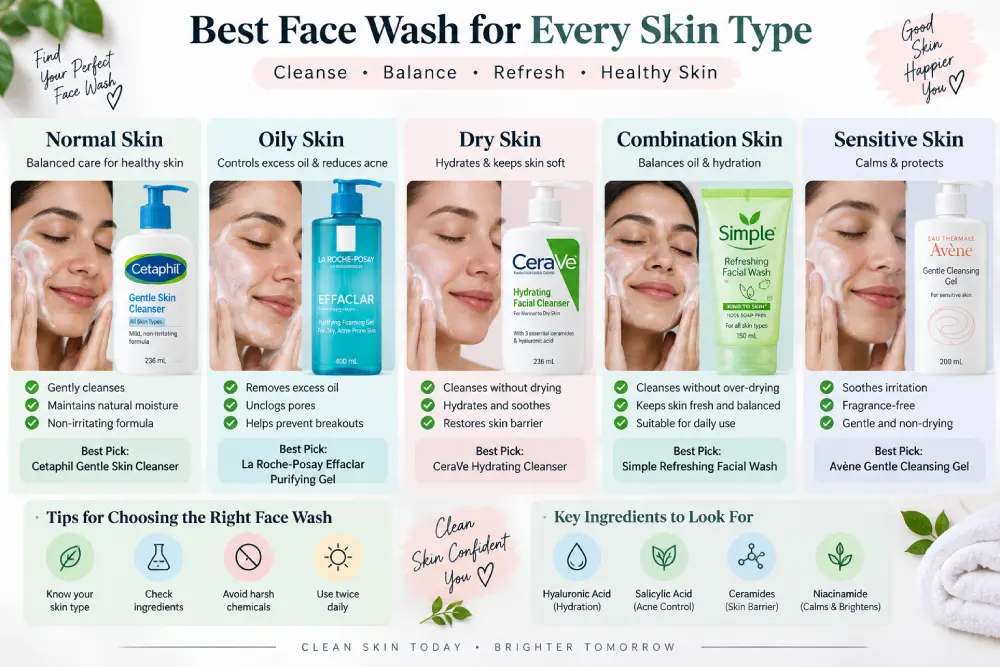
One of the most confusing parts of buying a cleanser is the texture. Here‘s the short version:
| Texture | Best For | Feel | Watch Out For |
|---|---|---|---|
| Gel |
Oily & combination skin |
It lights up often deep-cleansing. | Can be drying if over-formedulated with actives |
| Foam | Oily & acne-prone skin |
Airy, satisfying “squeaky clean” feel |
That squeaky feeling can mean it‘s stripping too much. |
| Cream |
Dry & sensitive skin |
Fills rich, cushiony, hydrating | Can weigh down very oily skin |
Mini summary: For skin that produces excess oil, gel or foam formulas are best for controlling shine. For skin that feels dry or tight, cream formulas will restore skin hydration instead of stripping it.
Texture Isn’t the Only Factor — Formulation Matters Too
Two gel cleansers can behave totally differently depending on what you add into them. A gel cleanser based on Alcohol and Salicylic acid is not going to feel the same as a gel cleanser based on Niacinamide and Aloe. It is the ingredients in the product which will tell you how it is going to perform on your skin.
Tip: first filter by texture, then read the ingredients list before buying this is particularly useful if you have sensitive or reactive skin, where a “gentle- sounding” gel can still contain deactivating actives.
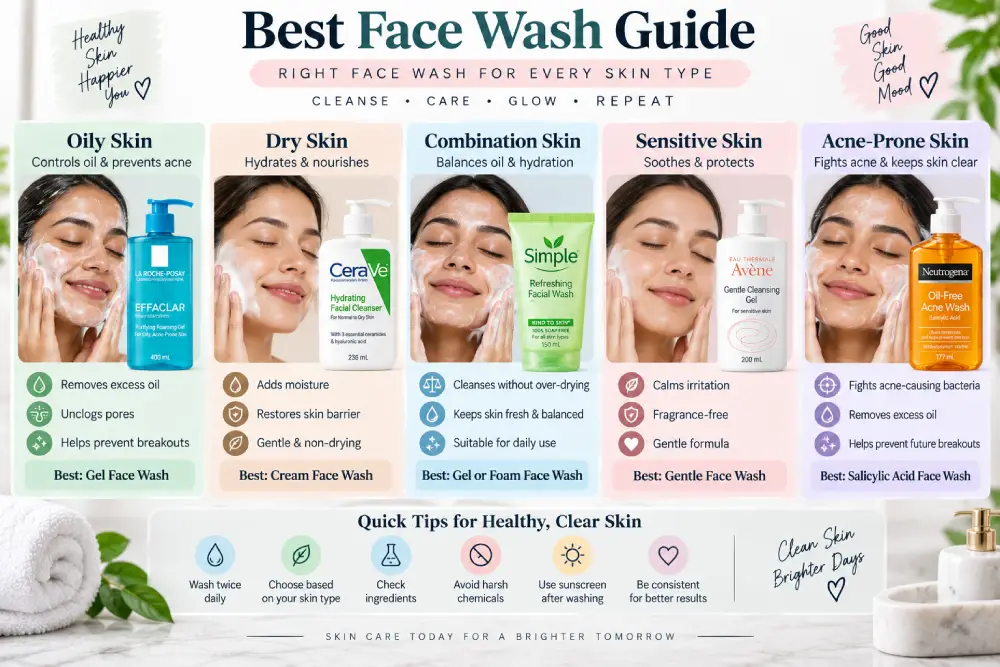
Best Face Wash by Skin Type: Quick Overview
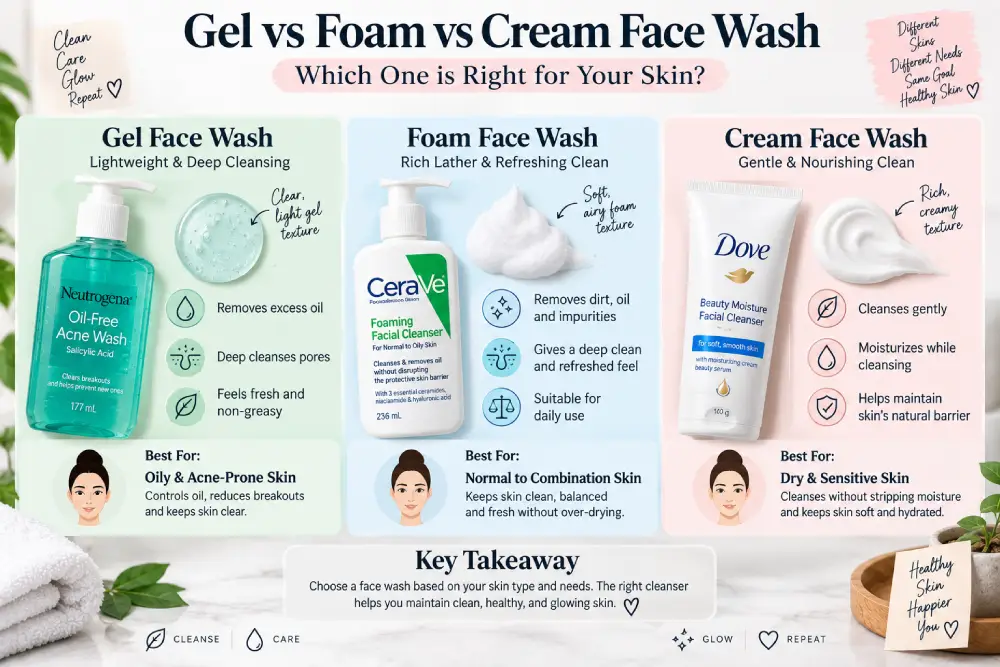
Oily Skin
Oily skin requires a formulation that reduces excess sebum production without overdrying the skin (because the resulting rebound effect increases the sebum even more). Use light-weight gel or foam cleansing formulations with salicylic acid or niacinamide.
Key takeaways:
- Avoid heavy, rich, creamy formulas
- Salicylic acid (0.5–2%) penetrates and exfoliates the pore lining. It has an anti-inflammatory effect. It reduces the number and severity of acne, and unblocks pores without leaving the skin dry.
- Niacinamide is known to diminish the excess oil in the skin, thus regulating the oil production in the longer run
Oily skin is also the primary culprit of the ‘over-cleansing trap’ (yes, the vicious circle of washing more frequently, or harder, trying to control the shine). This inevitably does more harm than good because damaging the skin barrier tells your oil glands ‘produce double as much this guy’, leading to a vicious circle of overproduction. The answer is not washing more often: the solution is finding the right formula and sticking to it long-term, twice daily.
👉 Read More: [Best Face Wash for Oily Skin]
Dry Skin
Dry skin particularly for women who already suffer from makeup fallout requires a cream or moisturing gel cleanser that does not break the moisture barrier when cleansing. Ceramides,glycerin, and hyaluronic acid are your best buds here.
Key takeaways:
- (ALS) your most damaging (and most removing). Skip anything with sulfates (SLS/SLES) – they are the biggest drying culprits
- Check the label for “creamy”, “moisturising” or “non foaming”
- Any water over lukewarm (hot water too drying).
Dry skin can be exacerbated by the colder season as well as by dry air conditioning conditions and other dry air ambient environments, where moisture leaves the skin core rapidly and the skin is not able to replace it as fast. If you find out your one ever so familiar daily cleanser is starting to feel stripping when it’s the season change, then it might be thanks to your skin “normal” moisture requirements changing-a nice indication that you should upgrade to richer moisturizer temporarily.
👉 Read More: [Best Face Wash for Dry Skin Women]
Combination Skin
Strangely enough, even the hardest skin to find products for is combination. This is because you‘re trying to treat an oily T-zone without over-drying a normal-to-dry face. You want a really good gel-cream that balances.
Key takeaways:
- Steer clear of formulas aimed specifically at “oily skin” (as they tend to be too harsh and dry out your cheeks).
- You can look for balancing ingredients such as, niacinamide,
- Multi-Area cleansing (different products in different areas) is rarely needs one all round product works just as well.
Here‘s an approach towards combination skin: your T-zone and cheeks are not two separate skin types on one face, but one type of skin that reacts relative to where it is on the face in relation to dense concentrations of glands.That‘s why a good, balanced formulary cleanser is probably much better than the impulse to “products for oily areas, products for dry areas.
👉 Read More: [Best Face Wash for Combination Skin]
Men’s Skin
Men‘s skin is naturally oilier because of, increased testosterone levels, and can be more sensitive due to shaving daily. Therefore, men generally require a face wash containing a bit more oil controlling action than a lady‘s face wash but one that isn‘t too harsh to used around a shaved face.
Key takeaways:
Post-shave skin needs a soothing, non-irritating formula
- Oil control is more important although barrier support still has some value
- Less is more most guys prefer a one-step, no trouble routine.
Men tend also to have thicker skin with larger, more prominent pores- this is also why oil and congestion can be more easily perceived- but not all men have oilier skins, drier and more sensitive skin are also often encountered in the male population and the ‘one-size-fits-all oil control ’ advice frequently used on men can often be detrimental to such skins.
👉 Read More: [Best Face Wash for Men]
Tan & Sun-Exposure-Prone Skin
Sri, Mahabhringraj, Kukusadhi: Leave-on face washes to remove surface tan caused by sun effects and dullness due to sun exposure, specific to India’s climate and are equipped with brightness boosting actives such as Vitamin C, niacinamide or plant extracts.
Key takeaways:
- Multiple Tan removal face washes are merely cosmetic exfoliators and not to be taken as substitutes of SPF. It is just not to be negotiated on any account
- Look for brightening agents like Vitamin C, licorice extract or niacinamide.
- Consistency is more important than force—Gentle daily usage is preferable to harsh scrubbing.
Now a word of reassurance. Tan removers do exactly that – remove surface skin by using mild exfoliants to buff away dead cells, and promote skin renewal rather than “bleach” your skin away. It can take three to four weeks of regular use to see any perceptible changes, which is how so many women give up just as their skin suddenly transforms.
👉 Read More: [Best Tan Removal Face Wash]
Acne-Prone & Dark Spot–Prone Skin
Acne and its aftermath are two separate issues that can tend to go hand in hand. For example,while you have a breakout, salicylic acid is aimed at treating the blemish itself, but niacinamide and Vit.C are very effective at helping to fade that all too familiar dark mark.
Key takeaways:
- Treats me to own a dual action formulation for the crises and spots
- Washing more than twice a day may make the acne worse rather than better.
- Patience is key darkspots will take a few weeks to fade, not just a few days
It can be useful to mentally distinguish between these two problems, even when you‘re using a single product: keeping active pimples at bay is an issue of present inflammation, whereas dark spots (post-inflammatory hyperpigmentation) are marks left by previously existing pimples. A face wash can help in both case but it takes more time to do its magic on old spots than on preventing newer ones.
👉 Read More: [Best Face Wash for Pimples and Dark Spots]
How to Layer Face Wash Into Your Full Skincare Routine
Face wash is not the be all and end all. The first of several steps in a sequence, being in the right order is arguably just as important as finding the right formula.
Morning routine:
- Washes with warm water:
- Use a thin serum (either niacinamide or Vitamin C depending on the problem you want to address)
- Moisturize
- Wrap up with SPF even when you‘re inside, even when it‘s cloudy
Night routine:
- Double cleanse if you wore makeup or use sun cream (which is oil-based, so first remove it with an oily cleanser then use your normal face wash)
- Apply any other treatment serums or actives (retinol, exfoliating acids etc.)
- Moisten to seal everything in
Practical tip: if you do just one thing differently in your routine, just one, it‘s this. Never, ever forget to use a moisturizer after cleansing, no matter what skin type you have. It‘s the single most common error I see in every skin type I‘ve discussed in this guide.
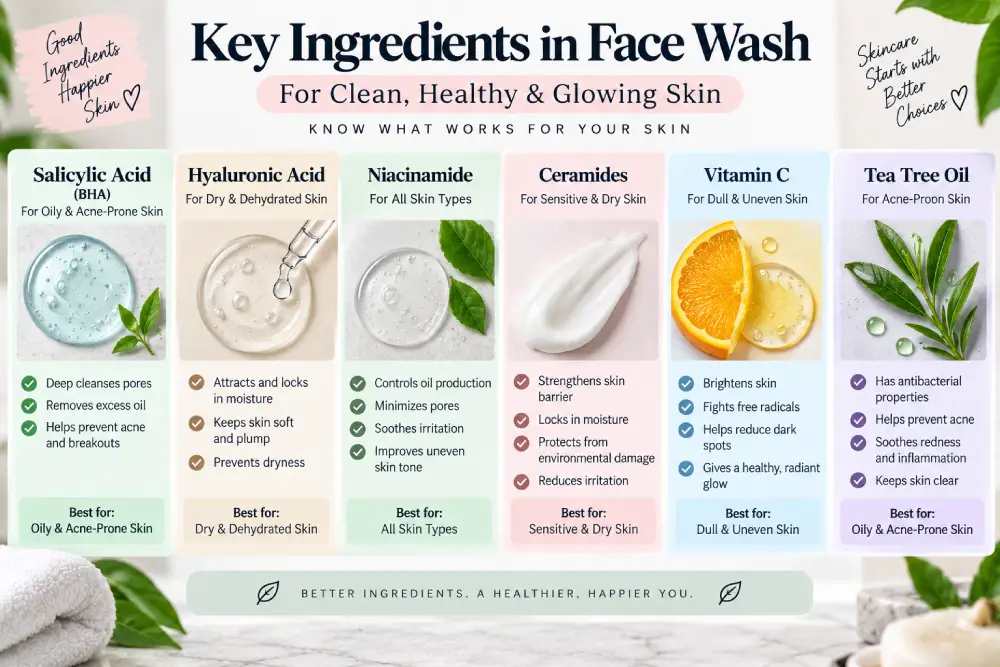
Face Wash Ingredients: What to Look For
| Ingredient | What It Does | Best For |
|---|---|---|
| Salicylic Acid |
Unclogs pores, controls oil |
Oily, acne-prone |
| Niacinamide | Balances oil Brightening Calming. | All skin types |
| Ceramides | Repairs and strengthens skin barrier | Dry, sensitive |
| Hyaluronic Acid | It pulls moisture in. | Dry, dehydrated |
| Glycolic Acid | The body is gently exfoliated as it fades the tone.. | Dull, course skin |
| Vitamin C | Whitenes, makes more paler, quicker tans and marks | Dull, pigmented skin Furthermore, is the defective skin type on the surface tests. |
| Aloe Vera / Centella | Soothes irritation | Sensitive reactive skin. |
Mini summary: The ingredients are completely everything. A face wash whose actives fall closely to your founding skin concern is a dead good candidate. no matter the brand!
Ingredients to Avoid in a Face Wash
Not every “cleansing” ingredient is doing your skin a favor. A few common culprits:
- Sulfates (SLS/SLES): Produces that the foamy lather but strips excess oils.
- Alcohol (denatured): initial refreshing sensation but becomes dry and irritating through application
- Synthetic fragrance: A major contributor to sensitivity and breakout cysts for reactive skin
- Parabens: when there are alternatives these should be avoided as they are preservatives that have been associated with possible hormonal questions
- Menthol/Peppermint (in too high of a concentration): Provides a “tingling and cleansing” feeling which can actually be a subtle form of irritation
Tip to remember: a squeaky-tight face when you step out of the shower isn‘t a sign of “deep clean” it‘s a sign you just blew a hole in your barrier.
Common Face Wash Mistakes (Even Careful People Make These)
- Too much cleansing: washing more than twice daily deprives your barrier of its natural oils causing it to go into overdrive and produce more oil and breakouts.
- Using hot water: Feels great, but the rapid removal of your skin‘s natural oils makes it a little too harsh.
- Not moisturizing: Oily skin does require moisture to balance the natural oils. Not moisturising will cause the skin to produce more oil.
- Can you use body wash on the face? Thicker body skin so you need something different as your face skin is so much more delicate.
- – Using the same cleanser no matter the time of year: skin tends to require more emollients in the winter and lighter emulsions in the summer.
- Every day scrubbing with physical exfoliants: Using aggressive scrubs daily can cause micro-tears in the skin barrier if used repeatedly even if they seem pleasurable at the time.
- Deciding a cleanser doesn‘t work after one wash: There‘s formulas with actives such as niacinamide or salicylic acid generally require at a minimum 2-4 weeks of daily application before you get the full benefits, so cut them some slack and test for a reasonable time period
- Should we also forget about the neck and jaw?: Acne, and dullness, sometimes even more so, can spill over even further…just one or two more sweeps beyond the face would prevent a blatantly wrong color mismatch.
Myth vs. Fact
| Myth | Fact |
|---|---|
| Foaming =deep cleaning | Not all foam means effective–for example many mild cleansers don‘t produce much foam. |
| “Oily skin does not need a moisturizer” | Haven‘t used moisturizer? … will make oily skin worse. |
| All natural ingredients are always gentler. | Certain natural extracts (such as oils from citrus) may be more irritating than the synthetics. |
| More expensive always equates to higher quality. | Price point is insignificant. What does matter is from formula to skin. |
| ” You ought to experience your skin feeling ‘squeaky clean” | That sensation is usually an indication that your barrier has been over-stripped |
Regional Insight: India vs. USA Skincare Needs
India: Humidity is high on coasts and pollution is high in metros. Therefore, in-cide control and pollution-defense ingredients (antioxidants, niacinamide) become more important. Hardwater in some areas of India can make skin feel drier than normal, even for oily skin types; hence a gentle, pH balanced formula can make all the difference.
USA: Any given part of the country can have extremely different weather! Those who live in more humid American states like the South tend to need light gel washes and those in dryer Midwest & Northeast often require cream-type hydrating cleansers.
In a nutshell: your place of residence actually has a real effect on what “the best face wash” will be for you climate and tap water quality are just as high up the list as your basic skin type.
Practical example: A person with naturally oily skin in a hot, humid Indian coast city might have to use a lighter, shiner-sapping formula than a person with the same skin type in a dry winter US climate, in which a naturally oily face might start to feel a tad parched. The phrase “oily skin” doesn‘t necessarily interpret to “the same product in all places of the world” your surrounding is just one of the factors.
A word on hard water If you are in an area where you have hard water (which is frequent in some parts of India and some of the US), mineral deposits can leave a deposit on the skin that makes exfoliants feel less effective, and has the potential to contribute to dulling over the long term. If you are in such an area, look for chelating or gentle clarifying agents, and try a rinse off with filtered (or softer) water.
When to See a Dermatologist
What constitutes a good face wash? While it can help you address most basic skin issues, it does not replace a visit to the dermatologist. You may need one if:
- Breakouts are cystic, painful, or leave scars rather than surface pimples
- They‘re still dry or red, even after changing to a mild, fragrance free Shah.
- The dark spots have not cleared up, even with 6–8 weeks of twice daily application of a brightening agent.
- All of a sudden you have strange fluctuations in your skin which seem contrary to anything you‘ve used or changed in your other routines.
PSA! Face wash is a maintenance product, not a treatment it won‘t fix the underlying issues present in eczema, rosacea, hormonal acne, those must be addressed with professional help as well as choosing the correct daily cleanser. The American Academy of Dermatology provides advice on how to build a routine to your skin.
Future Trends in Face Wash Formulation
- Formulations that are microbiome-friendly. Means in synergy with skin‘s natural bacteria protective with microbiome requirements so as not to disturb the overall balance.
- Waterfree/solid cleansing bars increase in acceptance due to better sustainability
- In one step, multi–function 2-in1 formulas with cleansing plus brightening and/or barrier repair.
- Clean-label transparency more brands listing precise percentages of active ingredients12 Active ingredients knowledge customers know the exact percentage of active ingredients in the product.13
Does Price Determine Quality?
One might be tempted to think that a higher priced face wash is a better one, however this need not be true. High price of an item is essentially a result of it being priced high on its packaging, advertising and many other factors.
What actually matters more than price:
- Whether the active chemicals are present in a relevant, clinically significiant concentration
- How the product should behave, such as in the case of a cream that has the right color, texture, filling the hand well. You can do anything about the consistency of the formula if your skin type does not agree with ingredients. If your skin type does not agree with ingredients.
- If you are able to use it consistently. After two weeks, whatever “best” face wash you put aside isn‘t doing you any good.
How Often Should You Wash Your Face?
More or less, the twice daily rule AM and PM, would be the safe zone for just about everyone.Over-washing dries out the skin‘s protective barrier; under-washing results in the accumulation of oil, sweat, sunscreen and pollution.Sweating from exercise, rinse at the finish line, but No scrubbing! Use tepid water
Conclusion
The best face wash is not just one product, but effectively the right formula for your skin type, your climate and the ingredients your skin appreciates. Oily skins benefit from gels or foam formulas and ingredients that control oil. Dry skins require creamy hydrating formulas. Combination skin needs matching. Special concerns such as tanning, pimples, dark spot removal or men‘s care require specific focus.
So, use this as your jumping off point, then delve into the detailed cluster guides linked throughout to find the absolute best face wash for your unique skin type and skin concern. Cleansing is the most underrated upgrade you can make in your skincare routine and it all begins with choosing the best face wash for you (not just what website you visited).
FAQs
Q1. Which face wash is best to use on daily basis?
There‘s nothing as best face wash it all depends on your skin type. For oily and combination skin, gel and foam face wash are better, whereas for dry and sensitive skin, use the cream face wash.
Q2. How do I know of which face wash is best for my skin?
After cleansing do a simple 30 mins test: Oily face with shine/oiliness or flaky skin for dry skin and combination skin shine/oiliness as well as flaky skin.
Q3. Which is better for Oily Skin, Foam or Gel Face Wash?
Both are easy for oily skin. The Gel formula with salicylic acid or niacinamide usually does a better job at oil regulation, whereas heavier foams at times can be excessively drying.
Q4. Can I use the same face wash for pimples as well as dark spots?
Yes Several products contain both salicylic acid (for actual breakouts) as well as niacinamide or Vitamin C (for dark spot fading).
Q5. How frequently do I need to change my face wash?
Stick to your current cleanser if it is working fine, causing no irritation or no breakouts. The need should be re-evaluated mostly when the pre-identified skin type changes with season or climate.
Q6. Is there a separate face wash for men?
Not necessarily a separate face wash, but as men‘s skin is generally more oily (or, having a thicker texture), and because after shaving skin needs special care, men‘s products usually cater for both these factors.
Q7. Does a face wash used for removing tan actually work?
Tan removal face wash does reduce surface tan and can improve skin brightness with prolonged use, but needs to be gentle and used with SPF daily.