Best Face Wash for Combination Skin: Top Choices & Guide
Published: September 10, 2026 Last Updated: September 10, 2026 Glistening forehead and nose by noon, yet tight or flaky
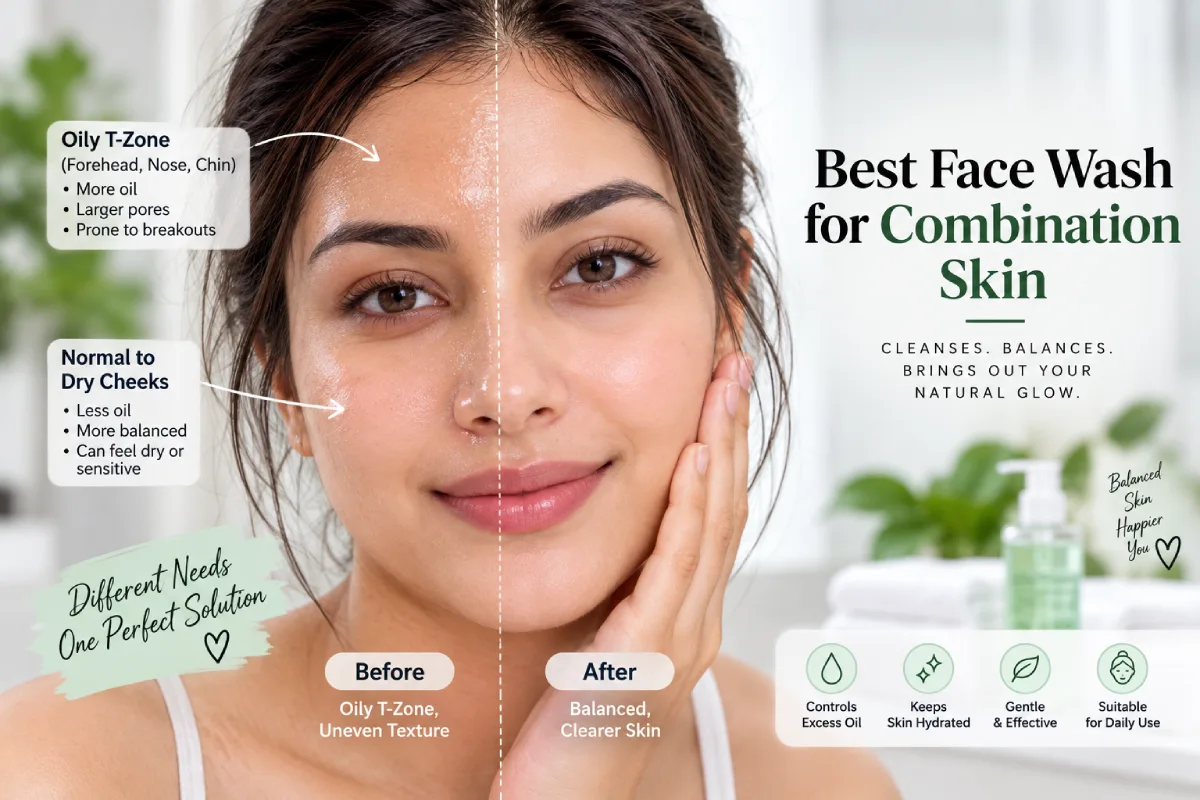
Glistening forehead and nose by noon, yet tight or flaky cheeks by evening? That paradox is precisely what makes combination skin one of the most challenging skin types to shop for. The most best face wash for combination skin is not about taking sides, but about selecting a product that is balanced enough to cater to both.
How to Choose a Face Wash for Combination Skin
Combination skin- the T-zone (forehead, nose, chin) is oilier than the other areas of the face which tend to be dry or normal. This is caused by the fact that there are a greater number of oil glands in the T-zone. Cheek areas tend to have fewer fewer, less active gland and therefore not as oily.
Key takeaway: Choosing a face wash purely marketed for “oily skin” often solves the T-zone problem while making your cheeks drier and more irritated — the opposite of balance. The American Academy of Dermatology similarly advises choosing a cleanser suited to your specific skin’s needs rather than a one-size-fits-all formula.
Your skin type might be Combination skin. It is one of the most prevalent skin types in whole, but the one that gets the least targeted marketing itself by skin care companies because they don‘t do shades of gray the marketed product is for either oily or dry skin. If neither is close to your experience, you‘re probably in the category others are missing: in between; and you should shop specifically for that instead.
What to look for instead:
- A gel or light gel-cream rather than a foaming heavy oil-skin cleanser.
- Are able to balance ingredients such as niacinamide which helps regulate the oil production and not dehydrating.
- A pH balanced to low/neutral formula that is unlikely to compromise your skin barrier in either zone;
Best Face Wash Ingredients for Combination Skin
The right ingredients provide a double whammy providing control of shine in some areas but adding moisture replenishment in others.
| Ingredient | Why It Works for Combination Skin |
|---|---|
| Niacinamide | Controls oily T-zone and soothes, nourishes the drier areas |
| Hyaluronic Acid | Provides light moisture without feeling heavy |
|
Salicylic Acid (low %) |
Helps prevent T-zone congestion without over-drying. |
| Aloe Vera | If you have any irritation present in the composition, soyl settles down for on both oily and dry areas |
| Ceramides | Provides support for the barrier function. beneficial to drier areas of cheek. |
Pro tip: While neither 8 benefits nor 10 benefits literally does it all for this skin type, Niacinamide is the next best thing to that. It is one of the very few actives that can affect moisture levels positively while controlling excess oil, which is why niacinamide will be seen time and again in formulas intended to address this skin type.
Gel vs Cream Face Wash for Combination Skin
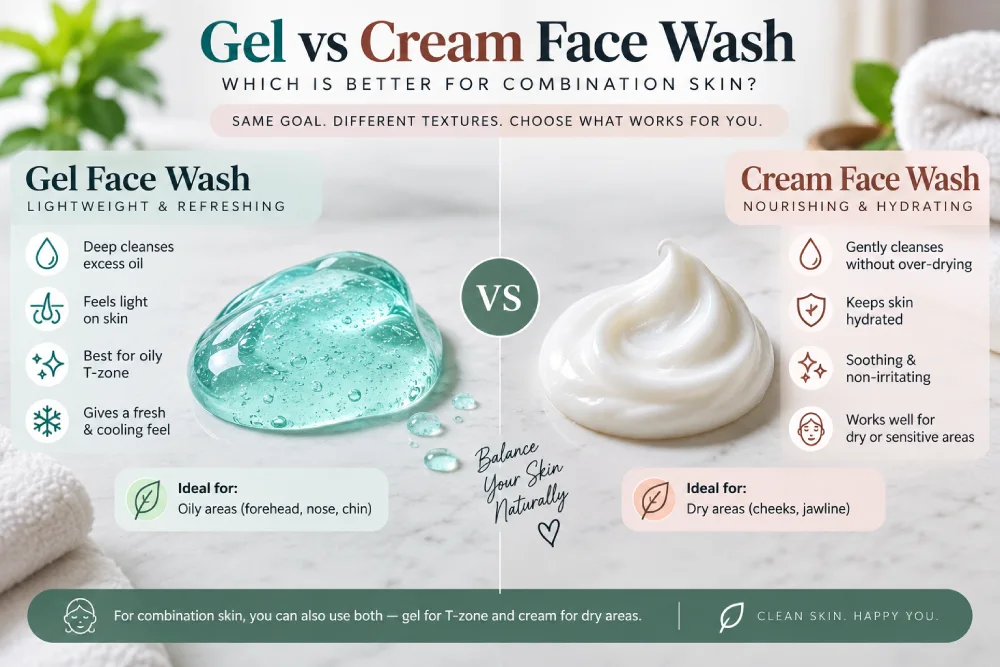
This is one of the most common points of confusion, so here‘s the practical breakdown:
| Gel Cleanser | Cream Cleanser | |
|---|---|---|
| Best for | The bulk of combo skin, particular oilier T-zones | Combination skin tending towards dryness generally |
| Feel | Light, put slightly foaming | Rich, cushiony |
| Risk | Can be drying if combined with potent actives. | Can be too rich and feel congesting on T-zone. |
Practical example: When your T-zone prime oil balance more than your cheeks lean toward dryness, you‘re likely best with a gel formulation containing niacinamide. When your whole face tends to balance toward dryness, a gel-cream in my opinion is preferred over a true gel.
For a full breakdown of texture differences across all skin types, our best face wash guide covers gel, foam, and cream formulas in more detail.
How to Clean an Oily T-Zone Without Drying Your Cheeks
You won‘t have to wipe with two different cleansers for this just a few tweaks in how you cleanse are more effective than mixing up your products every two weeks.
Action steps:
- Use a balanced, all-over formula instead of spot treating various zones with different products.
- Spend a little more time working the cleanse into your T zone, a little less on your cheeks.
- Use a luke-warm water to rinse is much better for drier cheek skin with the effect is less harsh than hot water.
- Follow with a lightweight, non-comedogenic moisturizer all over your face unbelievably, that means even your oily T-zone.
- Disperse a hydrating serum on those areas and this works much better than changing your entire cleanser if your cheeks still feel dry.
Common error: Using two face washes, one for T-zone and another for cheeks. Over complicates the routine and can cause irritation around the blending areas.
Seasonal note: combination skin tends to change more dramatically from season to season than other skin types. The T zone can get oilier in summer and muggy weather, the cheeks can get noticeably drier in winter or in air conditioning. If your regular happy medium isn‘t working as well as it used to, it‘s probably just a seasonal change rather than a indication of the need for a totally new routine.
Face Wash Ingredients to Avoid for Combination Skin
Just as important as what to add is what to skip:
- Sulfates (SLS/SLES): Very stripping, further dehydrates cheeks become quite dry as it does little for the T zone.
- High-alcohol content: Has a cooling effect initially but breaks down your barrier
- Heavy, rich oils in a face wash: can be felt too much for the T-zone even if they are beneficial for the cheeks
- Strong, scented: Increase the chance of irritation, particularly across the more sensitive cheek and jaw line.
Myth vs fact:“Combination skin requires two cleansers for two zones”. Fact: for most people a single, well balanced formula used correctly will perform better than any two.
Myth wh Myth Fact: I have an oily T-zone, I should only use products that control oil on the rest of my face. Fact wh However, if you concentrate only oil control on the rest of your face, your cheeks may be under-hydrated; I would say a balance between oil control and good hydration should be your aim.
To see how face wash fits into a bigger weekly rhythm — not just a single product decision — check out our best tan removal face wash for brighter, even-toned skin.
Conclusion
The best face wash for combination skin depends on balance. This lightly-foaming gel or gel-cream with niacinamide can prevent (or clear up) that slick oily T-zone while it takes care of the drier spots without requiring you to pick one or the other. Avoid harsh sulfates, rich oils, and too much fragrance and tailor your cleansing method instead of trying another product. The answer for combination skin is NOT a more complex wash regimen.
FAQs
Q1. What would be the most suitable face wash for combination skin type? The most suitable one is a light weight gel or gel-cream form face wash which contains niacinamide as a key ingredient it will provide oil control on the T-zone and maintain moisture in cheeks accordingly.
Q2. Do you recommend two different face washes for combination skin? Not usually. A well-balanced product, used correctly, will do a better job than zone-specific use of different items.
Q3. Which is better for combination skin: the gel or the cream? Gel formulations are ideal for combination skin if you tend to be more oil-dominant through your T-zone, while the gel-cream hybrids work well if your skin is generally more balanced-to-dry.
Q4. What ingredients should combination skin be avoided? The main ingredients known to cause havoc with combination skin are:Sulfates Alcohol (high percentage)heavy oilsA perfumed…..
Q5. How do I recognize combination skin? When your T-zone (forehead, nose, chin) gets shiny but your cheeks remain normal and/or dry, you probably have combination skin.