Outfit Styling Guide: How to Put Together Outfits
Published: September 26, 2026 Last Updated: September 26, 2026 Quick Summary: Outfit styling is the skill of turning separate
Quick Summary:
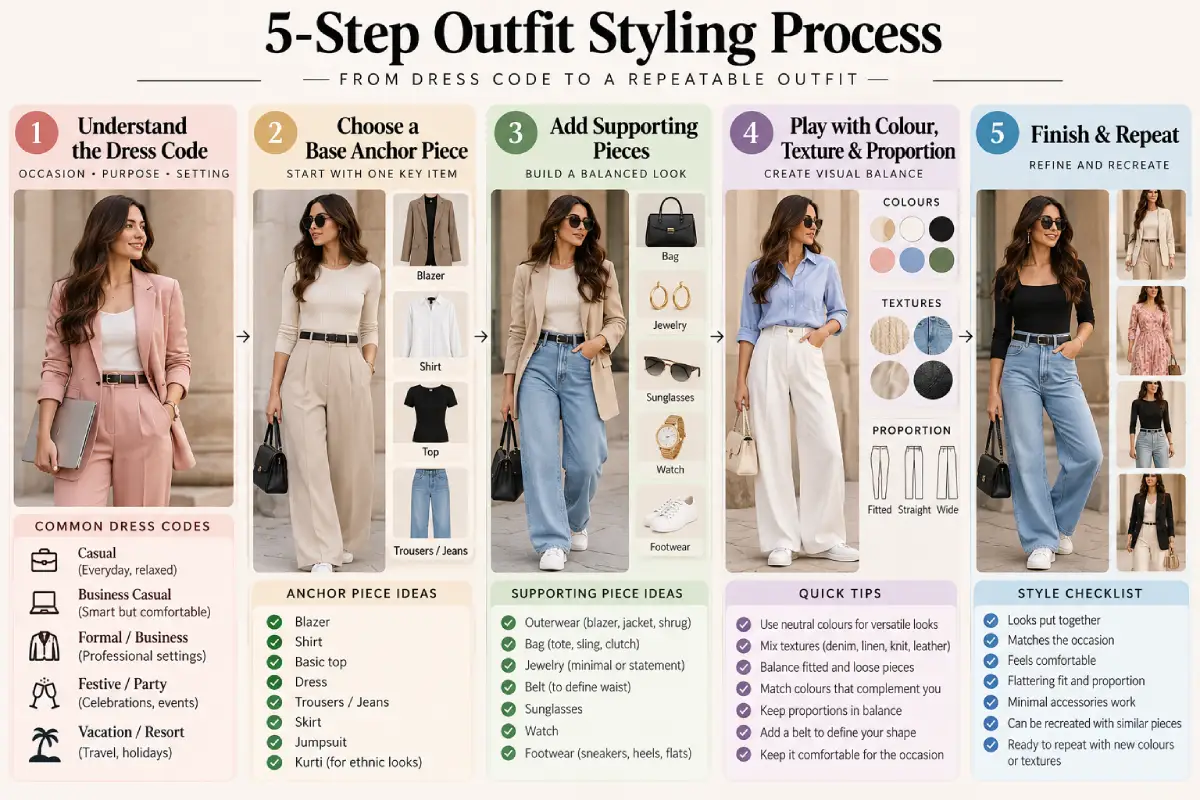
Outfit styling is the skill of turning separate clothing items into a look that fits your day, your body and your budget. It comes down to five repeatable moves: read the occasion and comfort needs first, pick one anchor piece to build around, balance colour/texture/proportion against that anchor, finish with shoes and accessories that match the effort level of the outfit, and save what works so you can repeat it without re-deciding from scratch every morning. This guide walks through each step at a practical level and links out to deeper guides on colour pairing, casual dressing, formal dress codes, festive outfits, capsule wardrobes and oversized silhouettes — the six areas where outfit styling gets more specific.
Getting dressed shouldn’t feel like solving a puzzle every single morning. Outfit styling is simply the skill of turning individual pieces of clothing into a look that works — for your day, your body, your budget and your comfort. It is not about owning more clothes. Most people who feel like they “have nothing to wear” actually own enough; what they’re missing is a method for putting what they already have together with confidence.
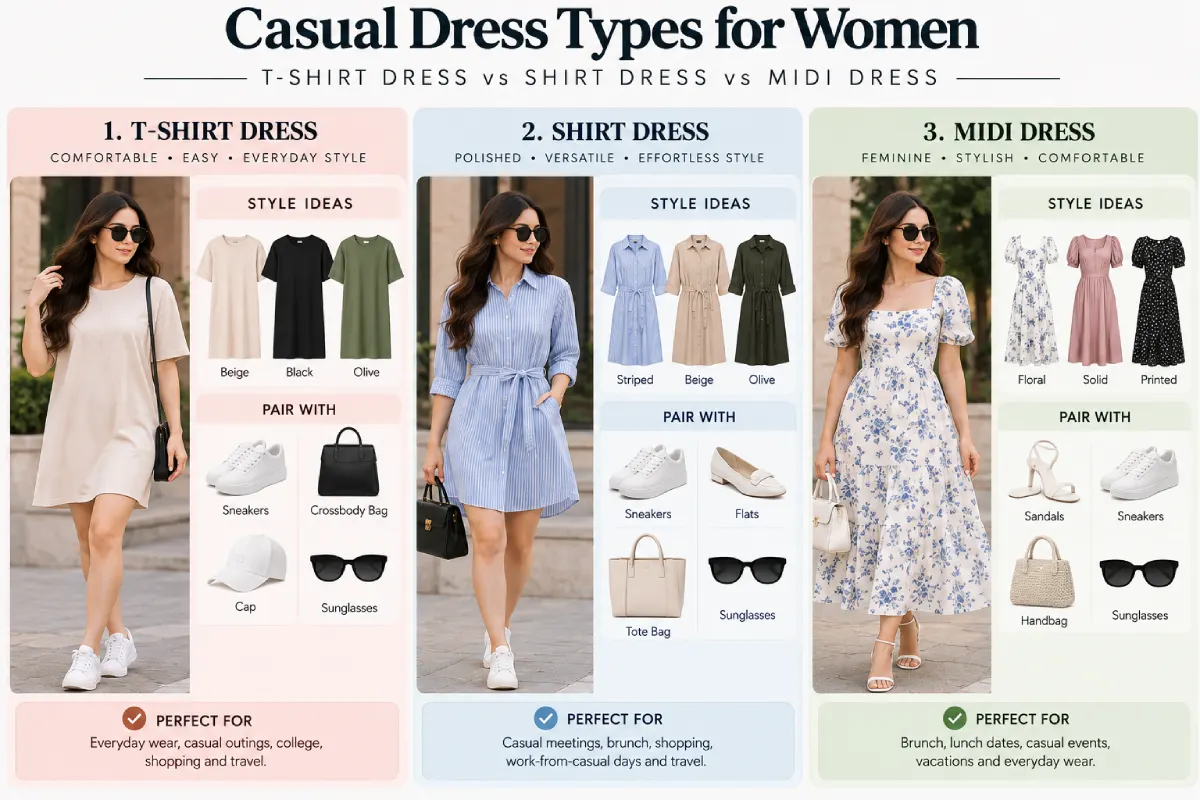
This guide breaks outfit styling down into five practical steps that work whether you’re dressing for a Tuesday at your desk, wedding-season events, or a festive family gathering. Along the way, it points to deeper guides on specific situations — colour pairing for dresses, casual dressing, formal dress codes, Christmas outfits, capsule wardrobes and oversized silhouettes — because each of those deserves more room than a single section here can give it. Think of this page as the map, and the linked guides as the detailed routes.
Start with Your Day, Dress Code and Comfort Needs
Every well-put-together outfit starts before you touch a single item of clothing — it starts with a quick, honest read of what the day actually requires.
Three questions do most of the work here:
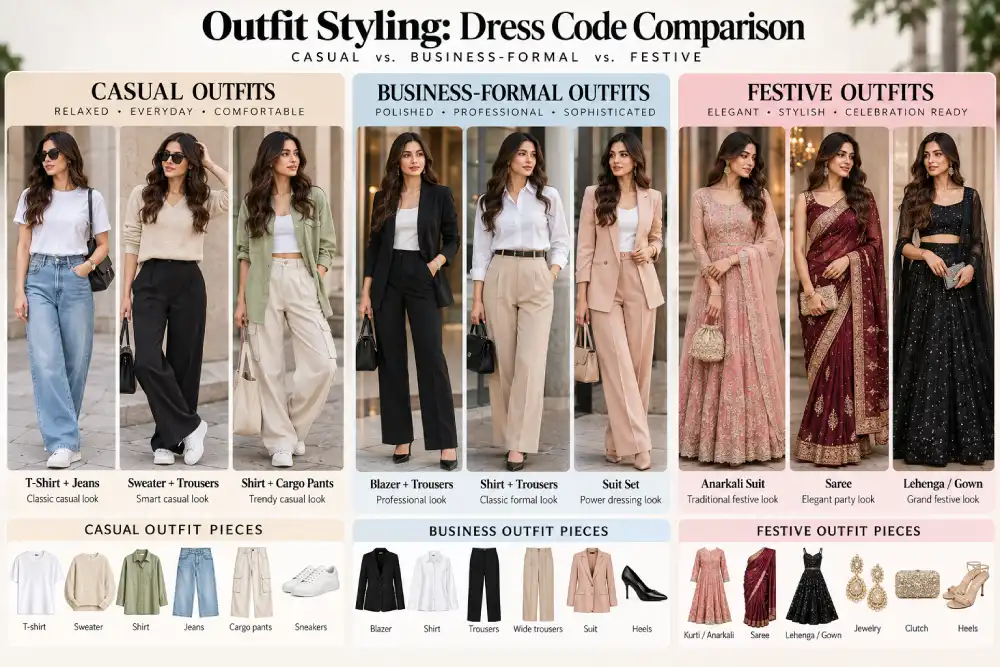
- What is the dress code, spoken or unspoken? A client meeting, a college lecture, a wedding reception and a weekend brunch all carry different expectations, even in casual environments. Dress code isn’t only about formality; it’s about not standing out for the wrong reasons.
- How long will you be in this outfit, and doing what? An outfit that looks great sitting at a desk can fall apart after a long commute, or in humid weather typical of much of India for a large part of the year. Comfort isn’t the opposite of style — it’s a design constraint you style around.
- How do you want to feel, not just look? Confident and polished feels different from relaxed and approachable, and clothing choices shift depending on which one you’re going for.
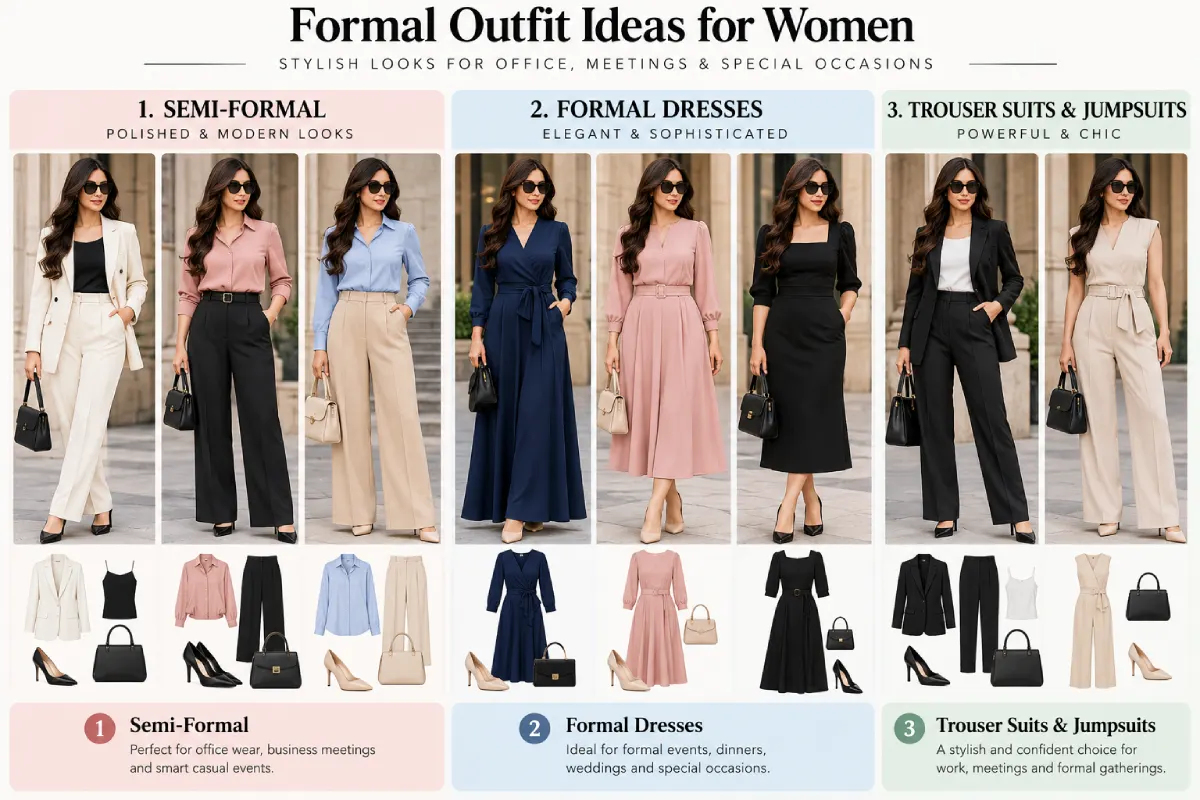
This is also where dress code confusion tends to show up. “Smart casual,” “business formal” and “festive” mean different things depending on context, and getting them wrong is one of the most common outfit mistakes. If you’re dressing for a workplace or event with a specific formality requirement, the detailed dress-code breakdown in Formal Outfit Ideas for Women: Dress Codes Explained is worth reading before you start pulling clothes out — it explains what each dress-code term expects in practical terms.
On the more relaxed end, everyday dressing has its own logic — comfort-first, but still intentional. If your day calls for something easy and wearable rather than dressed-up, How to Style Casual Dresses for Women: Outfit Ideas goes deeper into casual-specific pairings, fabrics and footwear than this section can.
The takeaway for this pillar-level step: decide the dress code and comfort requirement first, before choosing pieces. Every later decision — colour, proportion, accessories — is easier once this constraint is set.
Choose an Anchor Piece and Build Around It
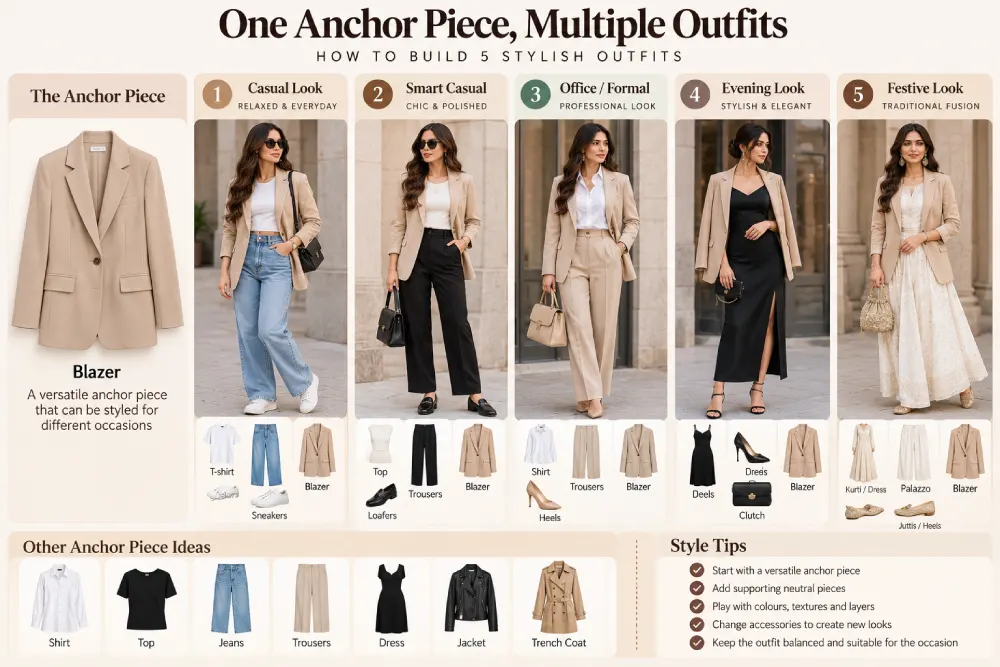
Once you know what the day demands, the next step is choosing one anchor piece — the single item the rest of the outfit will be built around. This is the single biggest shortcut to looking “put together” rather than randomly assembled.
An anchor piece is usually the item that:
- Has the strongest colour, print or silhouette in your outfit
- Would be the first thing someone notices
- Determines the formality level of everything else
It could be a dress, a blazer, a patterned kurta, a statement coat, or even a pair of striking trousers. Everything else in the outfit — the neutral layers, the footwear, the accessories — exists to support that one piece, not compete with it.
A simple way to test whether you’ve chosen the right anchor: if you removed every other item and kept only the anchor piece, would the outfit’s “personality” still be recognisable? If yes, you’ve picked correctly.
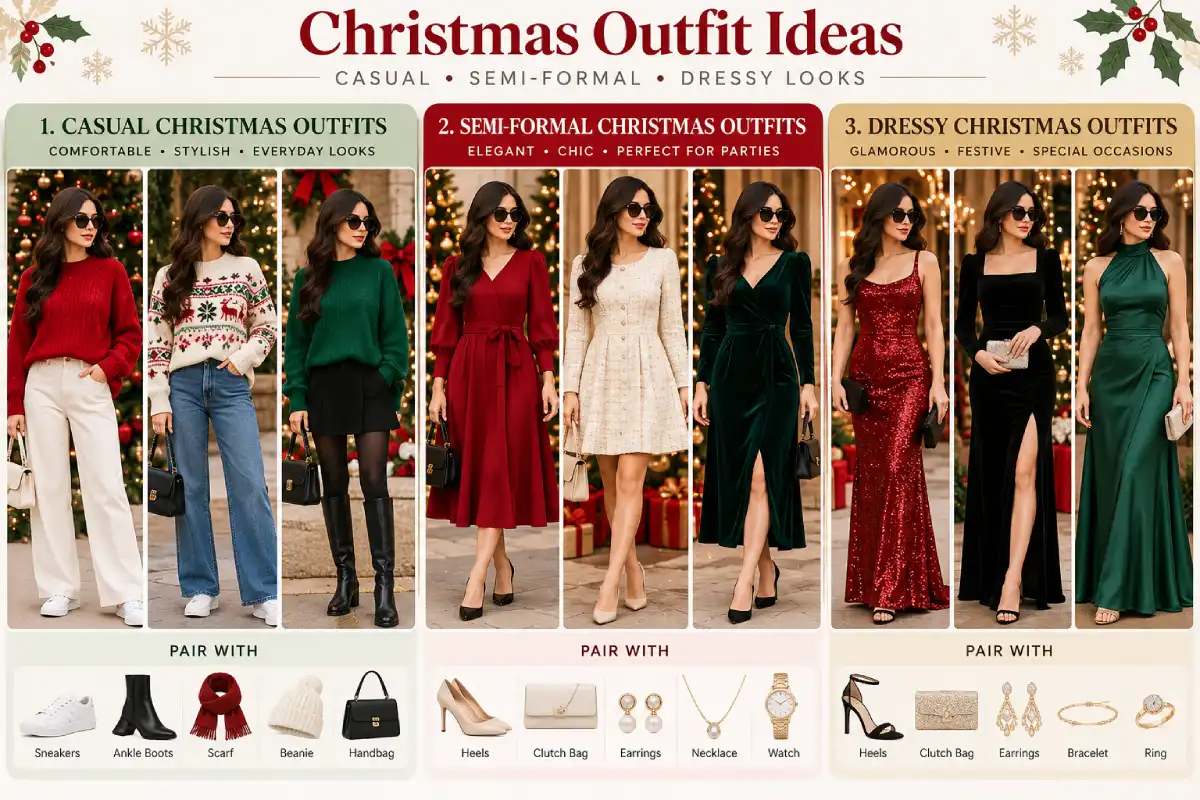
This anchor-first approach becomes especially useful during occasion-heavy periods of the year, when you need multiple outfits in a short window without repeating the exact same look. During the festive season, for example, a handful of strong anchor pieces — one statement dress, one rich-coloured top, one textured jacket — can be restyled across several gatherings just by changing what supports them. If you’re planning outfits for the holiday season specifically, Christmas Outfit Ideas for Parties and Family Gatherings shows how this anchor-piece approach plays out across party looks versus more low-key family gatherings, which call for different levels of “supporting cast.”
The pillar-level rule to remember: pick the anchor before you pick anything else, and let every other decision serve that one piece.
 Formal Outfit Ideas for Women:
Combine Colours, Textures and Proportions
This is where most outfits succeed or fail, and it’s also the section with the most sub-topics — because colour, texture and proportion are three separate levers that all affect how “finished” an outfit looks.
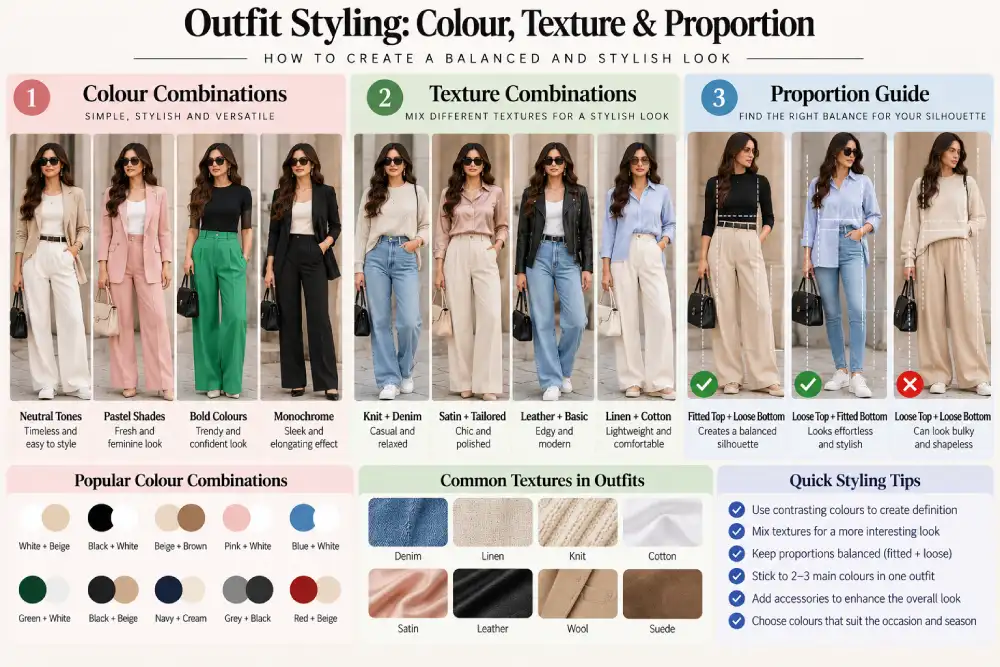
Colour is the most obvious lever. A safe, reliable starting principle: build most outfits around two to three colours, where at least one is a neutral (black, white, grey, beige, navy) that lets the other colour(s) do the talking. Beyond that starting point, colour pairing gets genuinely detailed — which shades flatter which skin tones, which combinations work for specific dress styles, which pairings feel modern versus dated. That level of depth belongs in its own guide: Colour Combinations for Dresses: Outfit Pairing Guide covers specific pairings, seasonal colour choices and dress-specific combinations in depth this pillar doesn’t need to repeat.
Texture matters most when colour is limited — for example, in an all-neutral or monochrome outfit. When everything is one colour family, mixing matte and shiny fabrics, or structured and flowy ones, keeps the outfit visually interesting rather than flat. A monochrome outfit in flat cotton throughout can look unfinished; the same outfit with one textured or slightly reflective piece — a satin layer, a ribbed knit, a structured blazer — reads as intentional.
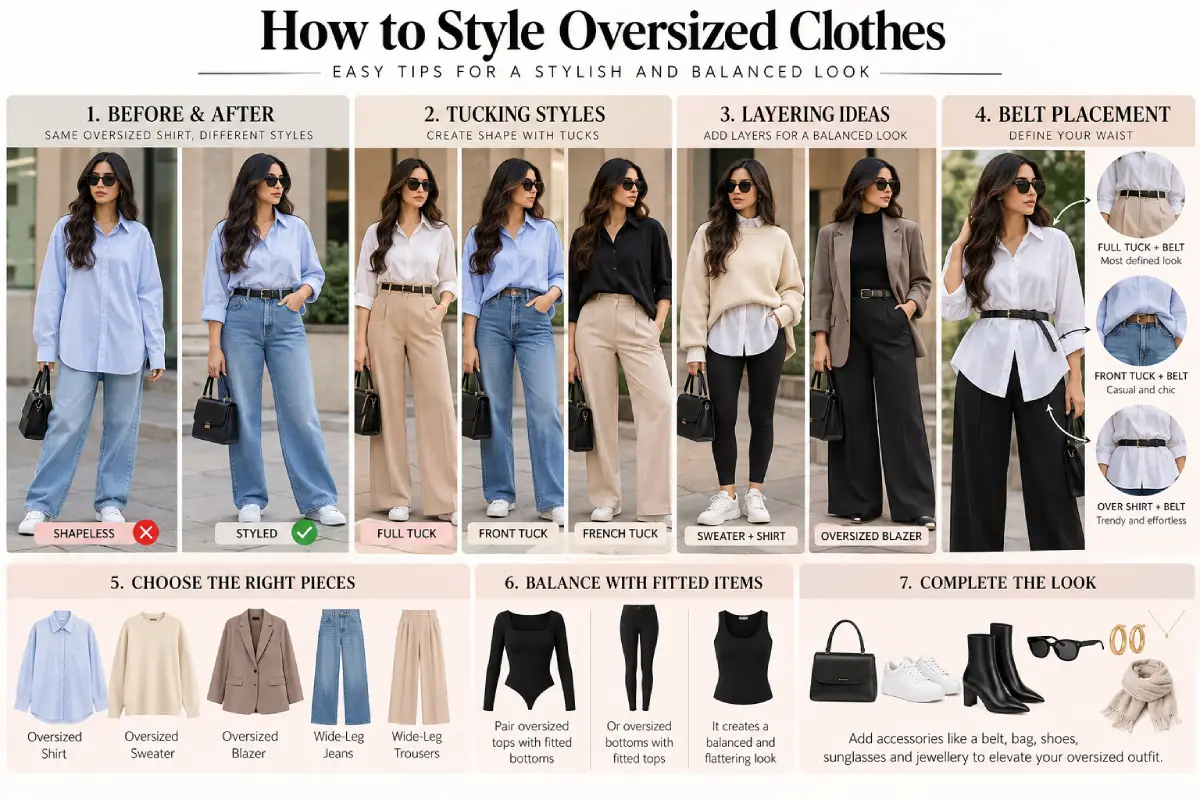
Proportion is the least understood of the three, but it’s often the real reason an outfit “feels off” without an obvious explanation. In practice, proportion comes down to volume balance: if the top half of an outfit is loose or voluminous, the bottom half generally needs to be more fitted (or vice versa), so the silhouette doesn’t read as shapeless on both ends at once. A quick proportion check: look at the outfit and ask whether one half is doing all the “volume work” while the other half defines the shape. If both halves are loose, the outfit usually needs one point of definition — a belt, a tucked-in layer, or rolled sleeves — to avoid looking unstructured.
Proportion questions come up constantly with oversized clothing specifically, since an oversized top or dress removes one of the two “anchors” a silhouette normally relies on. If oversized pieces are a regular part of your wardrobe, How to Style Oversized Clothes: Balance and Outfit Ideas goes into the specific techniques — tucking, cinching, layering, footwear choices — that keep oversized fits looking deliberate rather than shapeless.
Finish the Outfit with Shoes and Accessories
Shoes and accessories aren’t decoration added at the end — they’re the step that signals how much effort an outfit is putting in, and how it should be read by other people.
A few practical guidelines:
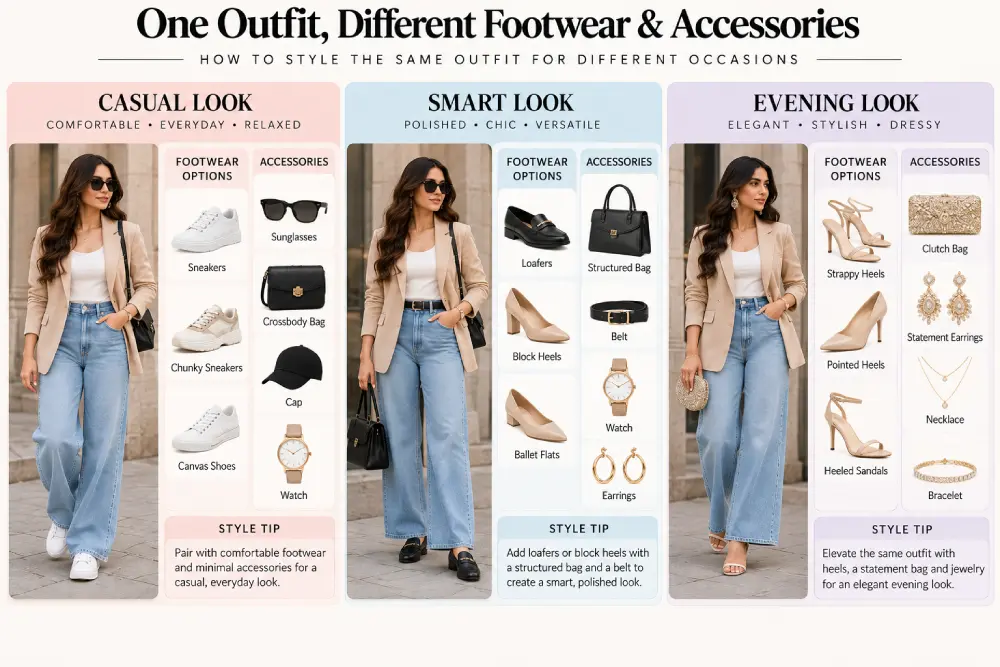
- Match footwear formality to the rest of the outfit. Trainers under a strictly formal outfit undercut the formality; heels under a deliberately relaxed weekend outfit can overshoot it. Footwear should generally match the least formal element of the outfit, unless a deliberate contrast is the whole point of the look.
- Limit statement accessories to one per outfit. One bold accessory (a statement necklace, bold earrings, a striking bag) reads as intentional. Two or more competing for attention usually reads as cluttered.
- Use accessories to adjust formality up or down without changing clothes. The same base outfit can shift from daytime-casual to evening-appropriate simply by swapping flats for heels and adding one more refined accessory — genuinely useful for anyone who needs to move from office to evening plans without a full outfit change.
Footwear and accessory choices interact closely with the dress-code decisions from Section 1 and the anchor-piece decision from Section 2 — part of why these steps work best done in sequence rather than picked at random.
Create Repeatable Outfits from Your Existing Wardrobe
The most useful part of learning outfit styling isn’t creating one great outfit — it’s being able to repeat the method without starting from zero every time. This is what actually saves time and money over the long run.
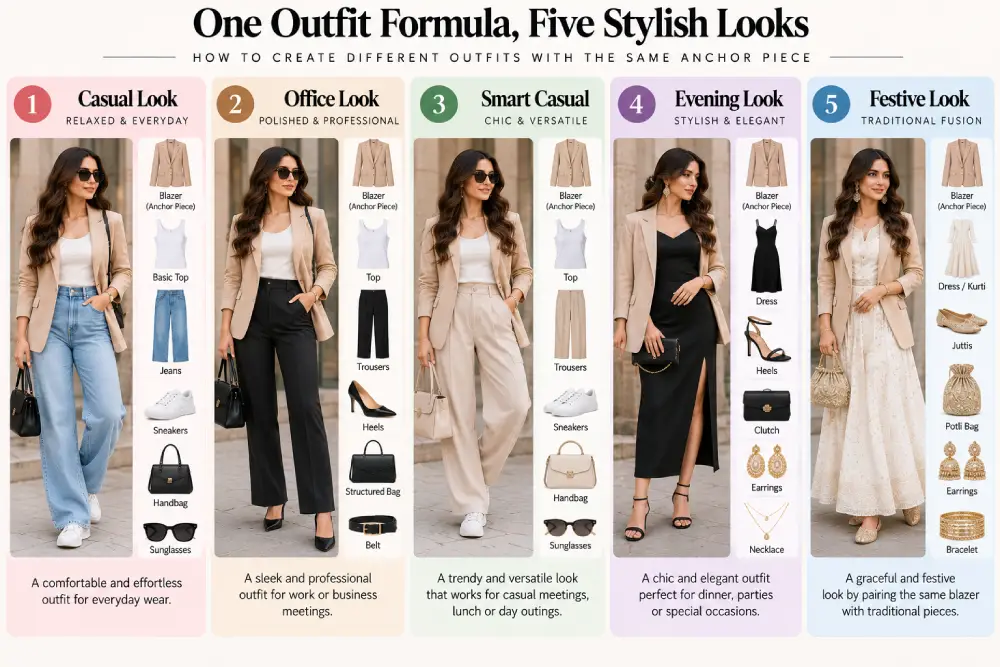
A practical way to do this: once you find an outfit formula that works — a specific anchor-piece type, colour pairing and proportion balance — treat it as a template, not a one-off. Swap the anchor piece for a different item in the same colour family or silhouette category, and the rest of the formula (the neutral layers, footwear logic, accessory rule) carries over. One working formula can realistically produce four or five different outfits just by rotating the anchor piece and one accessory.
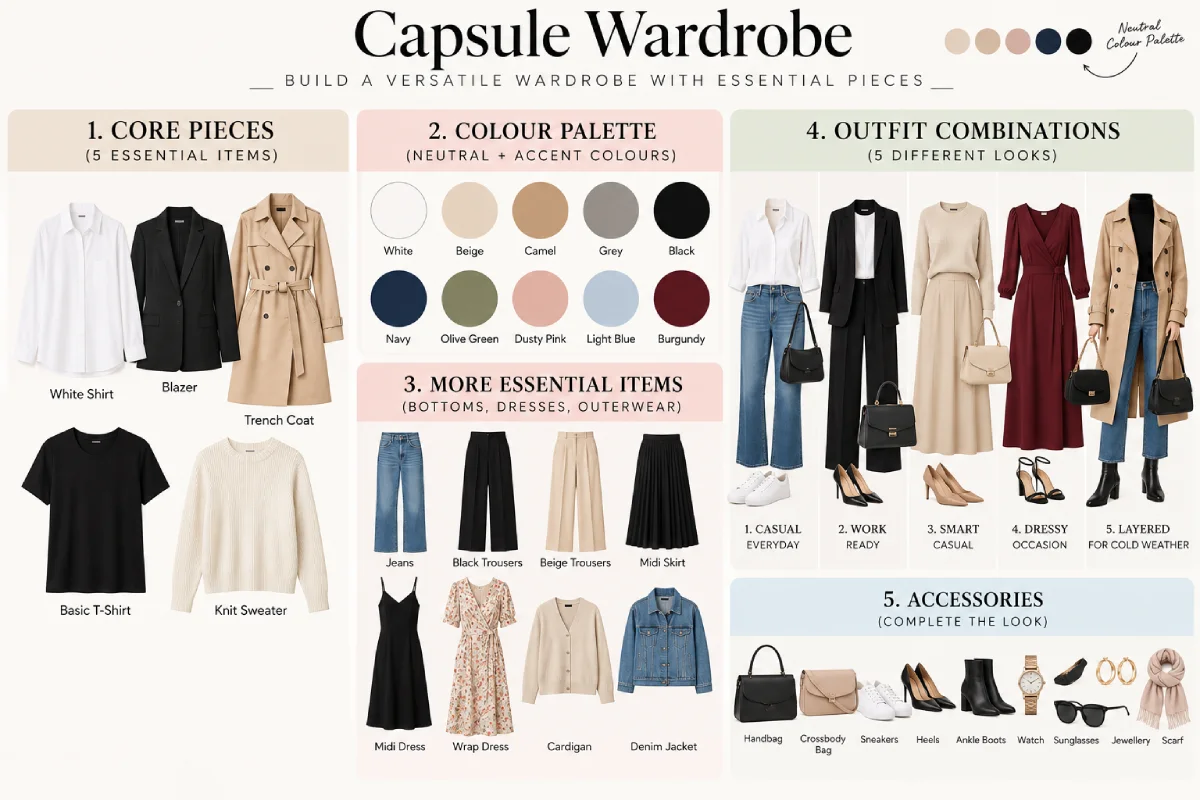
This is also the point where it’s worth stepping back and asking a bigger question: does your current wardrobe actually support this kind of repeatable mixing, or does it contain a lot of pieces that only work in one specific outfit? If it’s the second scenario, a more structural fix is worth considering. How to Build a Capsule Wardrobe: A Beginner’s Guide walks through how to plan a smaller wardrobe of pieces designed to work with each other — the long-term version of the repeatable-outfit principle covered at pillar level here.
Common Outfit Styling Mistakes
A short, practical list of the mistakes that come up most often across the steps above:
- Choosing two competing “loud” pieces instead of one anchor and supporting neutrals
- Ignoring comfort for the actual duration of the day, then feeling and looking uncomfortable by the afternoon
- Over-accessorising instead of applying the one-statement-piece guideline
- Repeating the same silhouette proportion every day (loose-on-loose or fitted-on-fitted) without a point of definition
- Buying new pieces instead of re-combining existing ones, which usually solves a styling problem with a shopping habit rather than a method
None of these mistakes require buying anything to fix — they’re method fixes, which is the entire point of learning outfit styling as a skill rather than collecting outfit ideas one at a time.
Bringing It Together
Outfit styling, at its core, is a five-step sequence: read the day and dress code, choose an anchor, balance colour/texture/proportion around it, finish with shoes and accessories that match the effort level, and save what works so it can be repeated. None of these steps require expert-level fashion knowledge — they require doing them in order, consistently, until the sequence becomes automatic.
From here, the right next step depends on what you’re dressing for. For everyday and casual dressing, or formal dress-code situations, or festive occasions like Christmas gatherings, or a full wardrobe reset through a capsule wardrobe, or the specific challenge of oversized silhouettes — each linked guide above picks up exactly where this one leaves off.
FAQs
What is outfit styling?
Outfit styling is the process of combining individual clothing items — tops, bottoms, layers, footwear and accessories — into a cohesive look that suits an occasion, a body, and a personal comfort level. It’s a repeatable skill built on a small number of decisions (dress code, anchor piece, colour/texture/proportion, and finishing touches) rather than a fixed set of rules.
How do I start putting together an outfit if I don’t know where to begin?
Start with the occasion and comfort needs, not the clothes. Once you know the dress code and how long you’ll be wearing the outfit, choose one anchor piece — the item with the strongest colour, print or silhouette — and build the rest of the outfit to support it.
How many colours should be in one outfit?
A reliable starting point is two to three colours, with at least one neutral (black, white, grey, navy or beige) doing most of the “background” work so the other colour or colours stand out clearly. For dress-specific colour pairing in more depth, see the dedicated colour combinations guide linked above.
How do I fix an outfit that looks “off” without knowing why?
Check proportion first. If both the top and bottom of the outfit are loose or voluminous, the silhouette often reads as shapeless; adding one point of definition — a tucked-in layer, a belt, or rolled sleeves — usually resolves it.
Can I style the same clothes into multiple outfits?
Yes — this is the basis of a repeatable outfit system. Once a specific combination of anchor piece, colour pairing and proportion works, you can usually swap just the anchor piece (or one accessory) and get a genuinely different outfit while keeping the same underlying formula.