How to Build a Capsule Wardrobe: A Beginner’s Guide
Published: September 26, 2026 Last Updated: September 26, 2026 A capsule wardrobe is a small, deliberately chosen set of
A capsule wardrobe is a small, deliberately chosen set of clothes that all work together, so you spend less time deciding what to wear and less money buying pieces that don’t earn their place. Building one starts with auditing what you already own and mapping it against your actual weekly activities — not with buying a whole new wardrobe. From there, picking a flexible colour palette, choosing core pieces, testing outfit combinations, and reviewing gaps seasonally turns a cluttered closet into a working system over time.
A capsule wardrobe is a small, intentional set of clothes chosen specifically because they work together — instead of a closet full of pieces that each only pair with one or two other things. Building one properly takes a bit of upfront thinking, but the payoff is real: less time spent deciding what to wear, less money spent on clothes that never actually get worn, and a wardrobe that genuinely reflects how you spend your days. Here’s a beginner-friendly, step-by-step way to build one.
What Is a Capsule Wardrobe and Who Might Find It Useful?
A capsule wardrobe is a curated collection of clothing — usually built around a limited colour palette and a set of versatile, well-fitting core pieces — designed so that most items can be mixed and matched with most other items. It’s not a fixed number of pieces or a strict formula; it’s a principle: every item earns its place by working with several others, rather than being a one-outfit piece.
This approach tends to suit a few situations especially well: anyone who feels overwhelmed by a full closet with “nothing to wear,” anyone trying to spend less on clothing by buying fewer but better pieces, anyone who travels frequently and needs a wardrobe that packs efficiently, and anyone who simply wants to reduce daily decision-making. It’s less suited to someone whose role or lifestyle genuinely requires a wide range of very different outfit types week to week (though even then, a capsule approach can work within one category, like workwear).
Audit Your Clothes and Map Your Weekly Activities
Before buying anything new, start with what you already own. Pull everything out — yes, everything — and sort it into three groups: pieces you wear regularly and like, pieces you rarely wear, and pieces that don’t fit or feel right anymore. The first group is the seed of your capsule; the second and third groups are where most of the useful information about your current wardrobe’s problems tends to live.
At the same time, map your actual week rather than an idealised version of it. Write down what you do on a typical Monday through Sunday — office days, casual days, workouts, social plans, errands — and roughly how many of each. This matters because a capsule wardrobe built around an imagined lifestyle (constant dinners out, frequent formal events) won’t actually serve someone whose real week is mostly casual and practical, and vice versa. Match the “regularly worn” pile from your audit against this weekly map: pieces that show up often in both are your foundation; gaps between the two are what you’ll actually need to add.
Choose a Flexible Colour Palette and Core Pieces
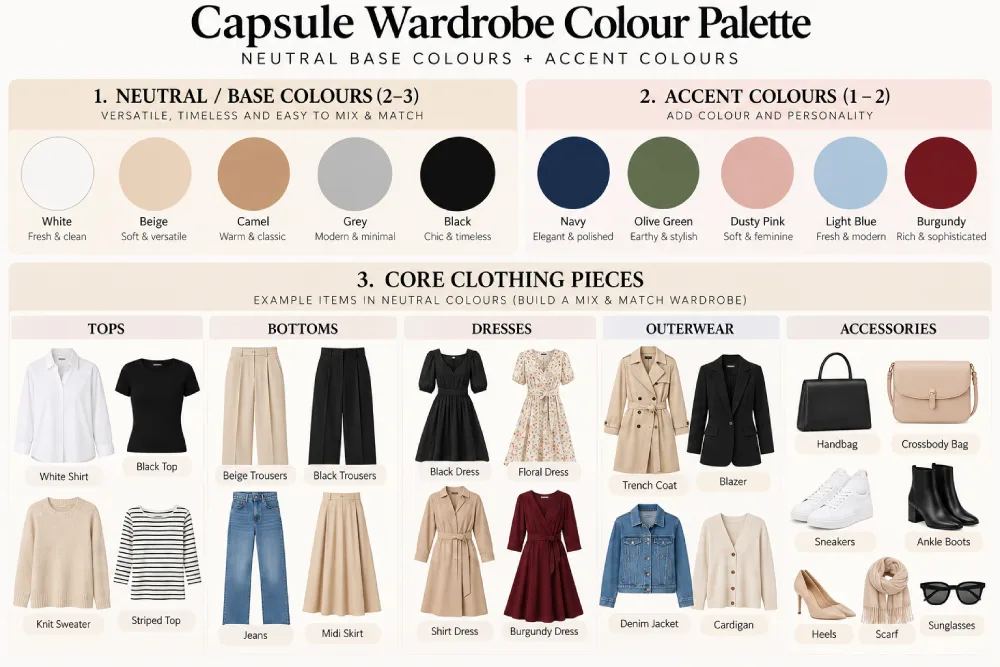
Once you’ve audited your wardrobe, a colour palette often reveals itself rather than needing to be invented — look at which colours dominate your “regularly worn” pile and build outward from there, rather than picking a palette in the abstract and forcing your existing clothes to match it.
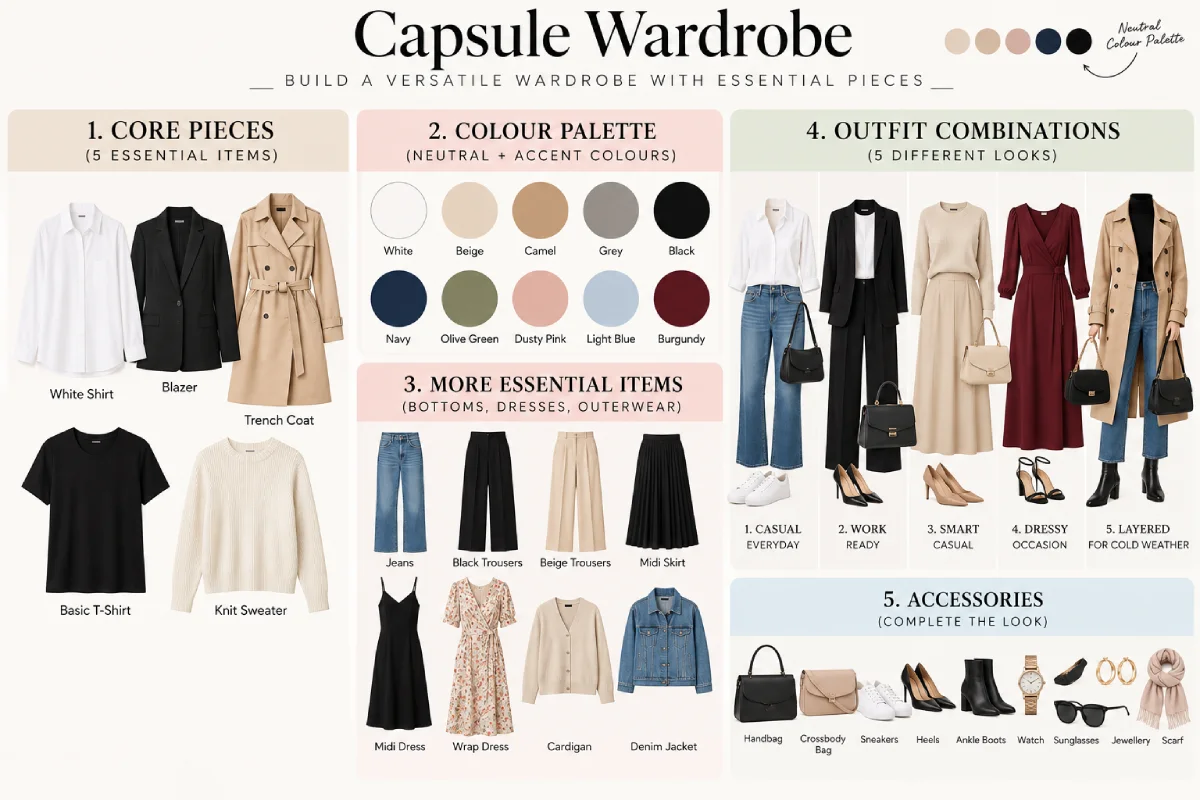
A workable approach: choose two to three neutral base colours (black, white, grey, navy, beige or camel are the most common) that make up the majority of your pieces, then add one or two accent colours you’re consistently drawn to. Neutrals do the heavy lifting because they combine with almost everything; accents add personality without requiring every piece to coordinate perfectly.
From there, identify your core pieces — the categories that show up across the most outfit combinations. Common core categories include: a well-fitting pair of trousers or jeans, a versatile dress, a button-down or simple top, a blazer or structured layer, and one pair of adaptable shoes. The specific items matter less than the principle: each core piece should be able to combine with several others in your capsule, not just one.
Build Outfit Combinations Before Buying More
This is the step most guides skip, and it’s the one that actually tests whether a capsule is working: before adding anything new, try building complete outfits from only what you’ve kept after the audit.
A simple exercise: take five core pieces (a mix of tops and bottoms) and see how many distinct outfits you can make just by recombining them, adding only shoes and one accessory each time. If you can get to five or more genuinely different-feeling outfits from five pieces, your current combination is working well. If you’re stuck at two or three, that’s a sign either your pieces don’t share enough in common (clashing colours, mismatched formality levels) or you’re missing one connecting piece — often a neutral layer or a versatile pair of shoes — that would unlock several more combinations at once.
Only once you’ve done this exercise should you consider buying anything new, and the goal of any purchase should be filling a specific gap this exercise revealed, not adding something simply because it’s appealing on its own.
Review Gaps, Budget and Seasonal Changes
A capsule wardrobe isn’t a one-time project — it needs periodic review, especially around season changes and budget cycles.
For budget-conscious building, there’s no requirement to build a full capsule at once. A practical approach is replacing or adding one or two pieces per month, prioritising whichever gap showed up most clearly in the outfit-combination exercise above, rather than buying a whole capsule’s worth of clothing in a single shopping trip.
For seasonal changes, most capsule wardrobes benefit from a smaller “swap” review every few months rather than a full rebuild — swapping heavier layers for lighter ones (or the reverse), while keeping the same core colour palette and core pieces largely intact. This matters differently depending on climate: a reader building a capsule wardrobe in a US region with four distinct seasons will swap more dramatically than a reader in a warmer part of India, where the main seasonal shift might be more about fabric weight and layering for air conditioning than a full wardrobe change.
FAQs
How many pieces should a capsule wardrobe have? There’s no fixed number — the useful measure is how many outfits your pieces can combine into, not the piece count itself. Some capsule wardrobes work well with as few as 20–30 pieces (including shoes and outerwear), while others are larger; what matters is that most pieces combine with several others rather than just one.
Do I need to buy new clothes to start a capsule wardrobe? No. The first step is auditing what you already own and identifying which existing pieces already work well together — new purchases should only fill specific gaps that become clear once you’ve tested outfit combinations from your current wardrobe.
What colours should I choose for a capsule wardrobe? Start with two to three neutral base colours (black, white, grey, navy, beige or camel are common choices) that most of your existing, regularly worn clothes already fall into, then add one or two accent colours you’re naturally drawn to.
How do I build a capsule wardrobe on a budget? Add or replace one or two pieces per month rather than buying a full capsule at once, and prioritise whichever gap shows up most clearly when you test outfit combinations from your current wardrobe — this targets spending toward pieces that will actually unlock more outfits.
How often should I update my capsule wardrobe for the seasons? A smaller review every few months, swapping heavier or lighter layers as needed, generally works better than a full rebuild each season. How dramatic that swap needs to be depends on climate — cooler regions with four distinct seasons usually need more swapping than warmer regions where the main seasonal shift is fabric weight rather than full wardrobe changes.
FINAL CONCLUSION
Building a capsule wardrobe comes down to a straightforward sequence: audit what you already own, map it against how you actually spend your time, choose a colour palette and core pieces that reflect what already works, test outfit combinations before buying anything new, and revisit the whole system periodically as budgets and seasons change. Done this way, a capsule wardrobe isn’t about owning less for its own sake — it’s about making sure everything in your closet earns its place. For the broader outfit-building method a well-planned capsule wardrobe supports — anchor pieces, proportion, and repeatable formulas — the Outfit Styling Guide is the hub this guide connects back to.