Jewelry Stacking Tips: Rings, Necklaces and Bracelets
Published: September 23, 2026 Last Updated: September 23, 2026 TL;DR Good jewelry stacking comes down to three things: pick
TL;DR
Good jewelry stacking comes down to three things: pick one focal piece so the rest of the stack has a clear purpose, vary length, width or texture instead of repeating the same size, and leave a little breathing room rather than filling every finger or inch of wrist and neck. Mixing metals is fine as long as you repeat each tone at least once. A few practical habits — like not stacking thin rings on your dominant hand’s working fingers — keep the look comfortable and your jewelry undamaged, not just photogenic.
Good jewelry stacking looks effortless, but it’s rarely accidental. The difference between a stack that looks curated and one that looks cluttered usually comes down to a few decisions made before you put anything on — not luck, and not owning more jewelry. These jewelry stacking tips cover rings, layered necklaces, and bracelets specifically, along with the metal-mixing and proportion rules that tie a stack together, and a few practical habits that keep your pieces comfortable and undamaged along the way.
1. Choose a Focal Piece and a Comfortable Starting Stack
Before you add anything else, pick one piece to be the focal point of your stack — a statement ring with a larger stone, a pendant necklace with real presence, or a chunky cuff bracelet. Everything else you add should support that piece rather than compete with it.
Once you have a focal piece, build outward with two or three supporting pieces rather than reaching for everything in your jewelry box. A stack of three to five pieces per area (hand, neck, or wrist) is a reliable starting range — enough to feel layered, not so much that any single piece gets lost. If you already wear jewelry daily, like a set of bangles or a mangalsutra, treat those as part of your existing stack and add new pieces around them rather than planning as if you’re starting from a bare wrist or neck.
2. How to Stack Rings Without Restricting Movement
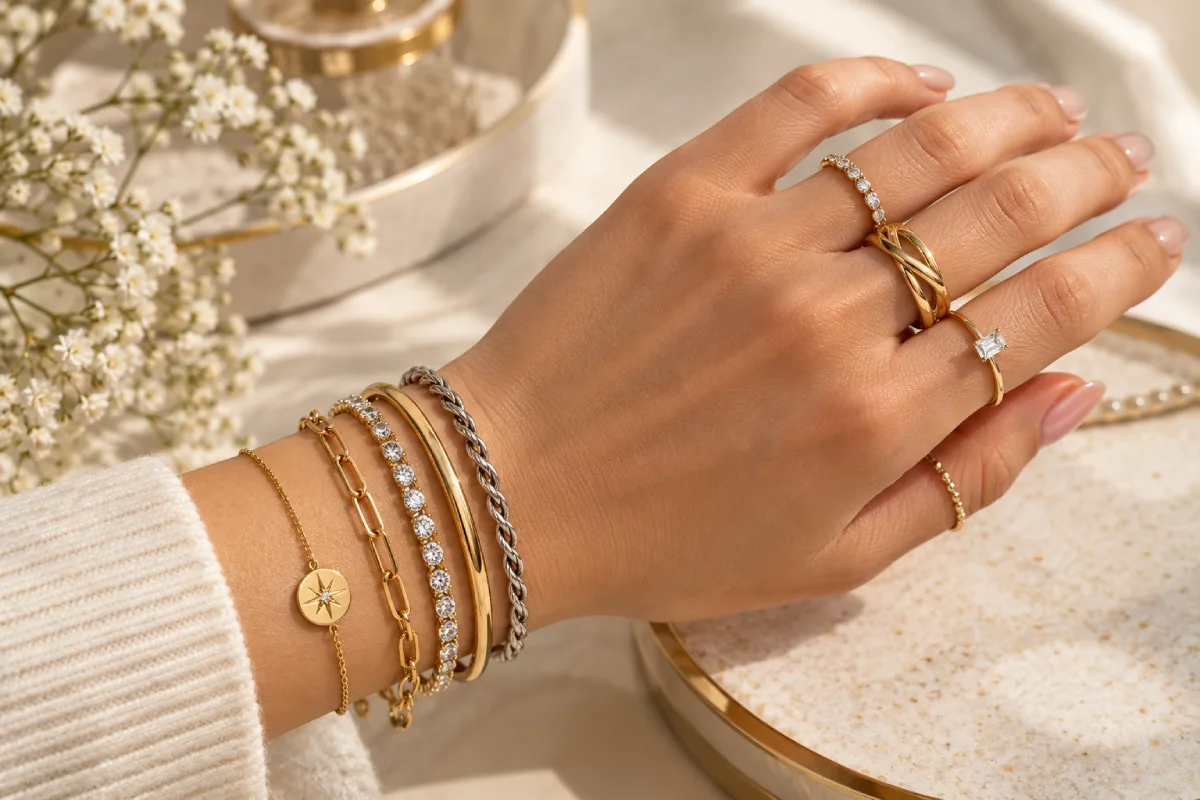
Ring stacking works best when you leave at least one or two fingers free — this keeps the overall look from feeling maxed out and, more practically, keeps your hand functional. A few specific choices make a real difference:
- Keep your dominant hand’s most-used fingers lighter. Thin, stacked bands on the fingers you use most for typing, writing, or gripping can feel restrictive by the end of the day, and stacked rings are more likely to knock against each other and warp over time on the hand that does the most work.
- Build stacks around one anchor finger, or spread pieces across two. Three rings on one finger (a slim base band, a textured middle band, and a statement top ring) reads as intentional. Randomly distributing single rings across all ten fingers usually reads as cluttered instead.
- Mix widths, not just metals. A stack of same-width bands can look flat even in different colors. Pairing a slim band with a wider statement ring creates the contrast that makes a stack feel designed.
Removing rings before activities that put pressure on your hands — exercise, heavy lifting, extensive typing — also protects thinner bands from bending, which is a common and avoidable cause of ring damage in a stacked collection.
3. How to Layer Necklaces with Different Lengths
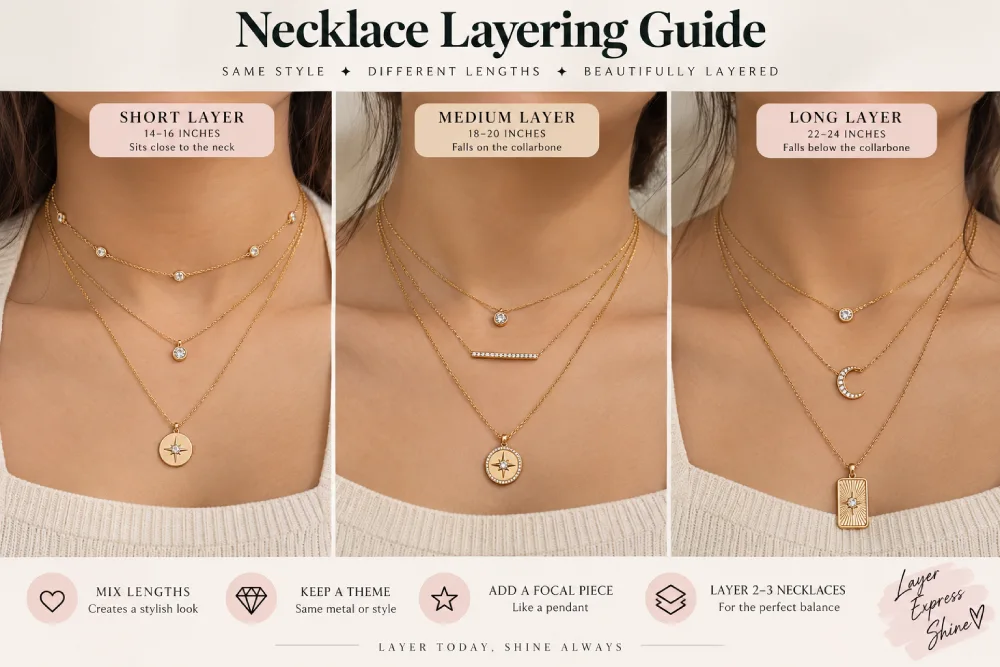
The core rule for layering necklaces is straightforward: vary the length so each piece sits at a different point on your chest, rather than piling multiple necklaces at the same length where they’ll tangle and visually merge into one thick chain.
A dependable starting formula is three lengths: a choker or short necklace sitting at or just below the collarbone, a mid-length pendant necklace resting a few inches lower, and a longer chain finishing below that. Beyond length, vary chain texture and pendant scale too — pairing a fine chain with a slightly chunkier link, or a small charm with one larger pendant, adds visual interest without adding more pieces.
Two practical notes competing guides tend to skip: layered necklaces tangle more easily overnight, so unclasp and lay them flat (or hang them individually) rather than storing them pre-layered, and a heavier layered stack puts more strain on the thinnest chain’s clasp over time, so it’s worth checking clasps periodically if you wear a layered set often.
4. How to Stack Bracelets and Coordinate a Watch
Bracelet stacking follows the same “vary, don’t repeat” logic as rings and necklaces — mix thin bangles with one slightly chunkier piece, or combine a metal chain bracelet with a beaded or pearl one for texture contrast.
If you’re stacking with a watch, put the watch on first and build the stack around it rather than adding it last. A common, comfortable approach is wearing one to three slim bracelets on the same wrist as the watch, positioned to sit between the watch face and your hand rather than crowding the case, and saving anything heavier or more statement-making for the opposite wrist. This also protects the watch case from scratches, which is a real risk when a stack of metal bangles sits directly against it all day.
For readers who already wear a set of bangles daily, adding one or two slimmer, different-toned bracelets just above or below the set is an easier way to build a stack than trying to match a full new set to what you already wear.
5. Mixing Metals, Textures and Proportions
Mixing gold and silver jewelry (or gold and rose gold, or oxidized and polished silver) works well as long as it looks intentional rather than accidental. The simplest way to achieve that: repeat each metal at least once across your stack, rather than using a single odd piece in a different tone. Two gold pieces and two silver pieces mixed throughout a stack reads as a deliberate palette; one lone silver ring among five gold pieces just reads as mismatched.
Texture works the same way — pair polished and matte finishes, or smooth bands with hammered or textured ones, so the contrast feels chosen rather than random. And keep proportions in mind across your whole stack, not just within one area: if your rings and bracelets are already bold and layered, a simpler necklace keeps the overall look balanced instead of competing for attention everywhere at once.
The Bottom Line
Jewelry stacking works when you build around one focal piece, vary length, width, and texture instead of repeating the same size, and leave enough space for the stack to breathe. The metal-mixing rule is simple — repeat each tone at least once — and the comfort side matters just as much as the look: lighter rings on your working hand, watch-friendly bracelet placement, and proper storage for layered necklaces will keep your stack looking good and your pieces in good shape for longer.
For the broader styling principles this builds on, and for guidance on choosing individual pieces before you stack them, see the complete Jewelry Guide.
FAQs
How many rings can I stack at once? There’s no fixed number, but three rings per hand (including your focal piece) is a common, easy-to-balance starting point. Leaving one or two fingers free usually looks more intentional than filling every finger.
Is it okay to mix gold and silver jewelry? Yes. The key is repeating each metal at least once across your stack rather than using a single piece in an odd-one-out tone, which makes the mix look deliberate instead of accidental.
What’s the best necklace layering order? A short choker or necklace closest to the collarbone, a mid-length pendant necklace next, and a longer chain finishing lowest is a reliable three-piece formula. Vary chain texture or pendant size between them for added contrast.
How do I stop layered necklaces from tangling? Unclasp each necklace and store it separately, either laid flat or hung individually, rather than storing your stack pre-layered as one unit. Tangling happens most often in storage, not while wearing them.
Can I stack bracelets with a watch? Yes — put the watch on first, then add one to three slim bracelets on the same wrist, positioned between the watch face and your hand so they don’t scratch the case. Save bulkier pieces for the opposite wrist.
Does stacking damage jewelry over time? It can, if pieces rub against each other constantly. Thin rings are the most vulnerable to warping, especially on your dominant hand, and layered necklace clasps see more strain than a single chain would. Removing pieces before activities that put pressure on your hands helps prevent this.