Fitness in 2026: Your Complete Guide to Getting Strong, Lean & Healthy
Published: September 1, 2026 Last Updated: September 7, 2026 Somewhere between “I really need to start working out” and
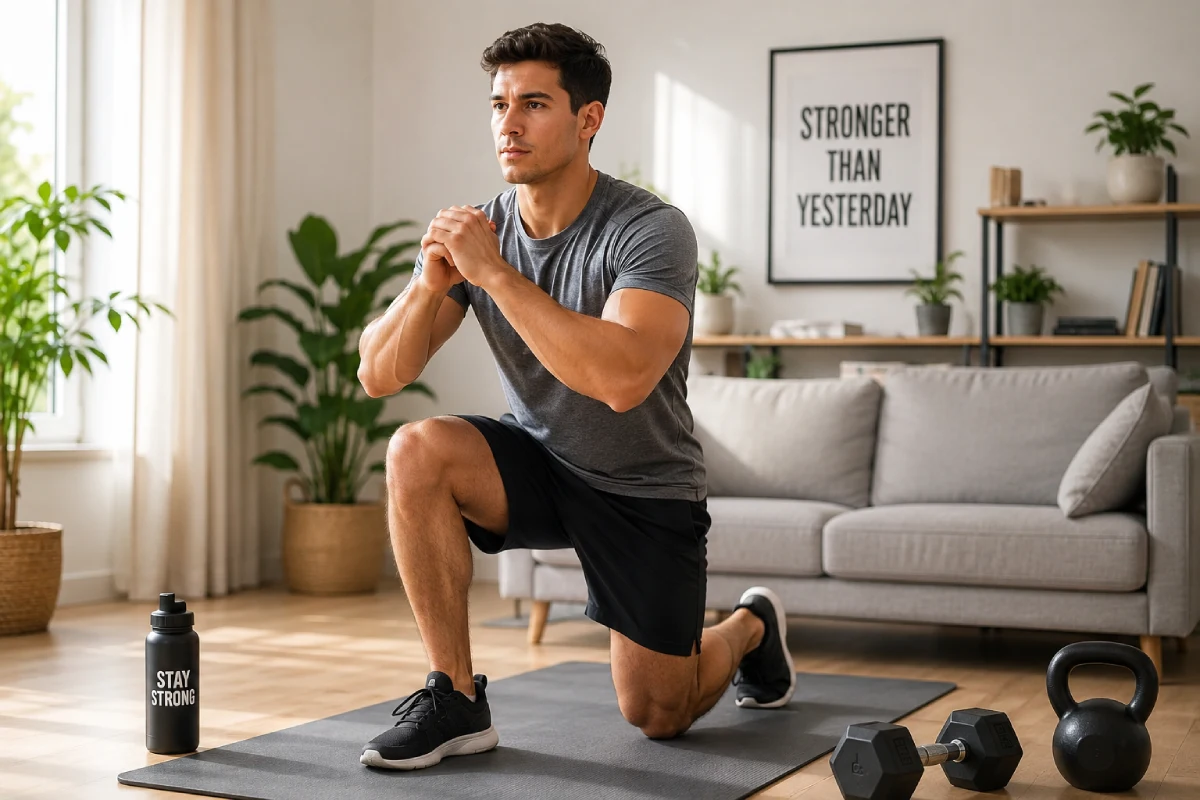
Somewhere between “I really need to start working out” and actually doing it, most Americans get stuck. Not because they are out of motivation on day one everyone has motivation on day one but because no one provides a clear system. They see some weird Instagram workout, do it twice, get a little sore, then disappear for a week and conclude their life plan until the next fairly arbitrary “Monday reset”.
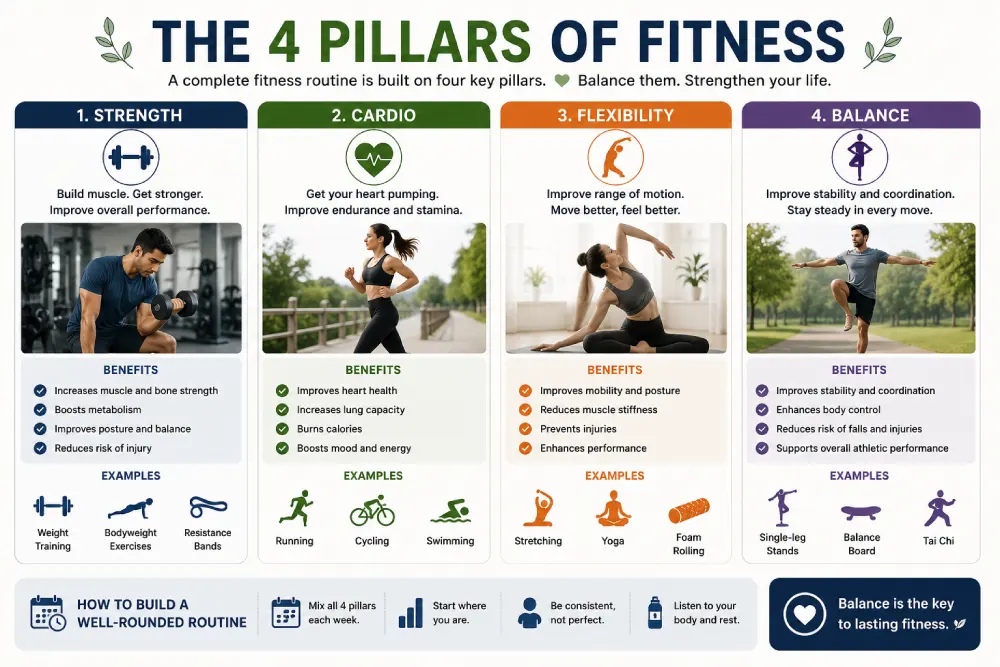
Fitness isn’t one workout, one app, one 30-day challenge. The system is a combination of four things working synergistically: strength, cardio, mobility, and consistency. Miss one, and the entire system collapses completely cardio and no strength, and you‘re fit but weak. completely strength and no mobility, and you‘re stiff but strong; and all of it does nothing if you don‘t have the consistency to keep putting in the effort.
This kit is your entrance map to all of it. Every part below offers a nagging point of the main point, an entry template on how begin today, and links to a full, focused overview when ready to explore further that section in more detail. Home base is this page, and cluster guides are where the step-by-step turn-by-turn directions are.
What Does “Fitness” Actually Mean in 2026?
Back then, fitness was defined narrowly how many reps you could do, how fast could you run, or how good did you look. But in 2026, my definition of fitness has expanded greatly rightly so, since those old definitions exhausted people and drove them to dangerous extremes, such as marathon running.
One more practical, up-to-date version: Fitness is how well all your body‘s systems work together. It‘s your body‘s ability to perform strength, endurance, flexibility, and recovery, backed up by diligent regular habits. For additional evidence-based information about recommended physical activity levels, you can review the World Health Organization’s physical activity guidelines.
Key takeaways:
- Fitness is about function. Not seem to look good naked, can you get the groceries up 3 flights of stairs, play football without collapsing, get down to and sit on the floor comfortably?
- A “fit” body at 25 and a “fit” body at 55 look very different, but the goal underlying both power, mobility, vitality is the same.
- A sustainable fitness wins over the extreme one – a moderate fitness maintained for 5 years is superior to an aerobic craze abandoned after 5 weeks.
A real life example: The person who actually has a “fit” 2026 routine isn‘t really doing an hour and a half in the gym he might do 30 minutes of medium weights 3 times a week, walk daily, stretch in bed. Primal, little, whole, sustainable.
Mini summary: Fitness=maximal amount of function you can achieve from the positive habits you develop not a single workout type, or a certain body shape, or something.
The 4 Pillars of a Complete Fitness Routine
It is beneficial to present all of the routines concurrently, so that the complete picture becomes clearer.
| Pillar | What It Builds | Weekly Minimum (Beginner) |
|---|---|---|
| Strength | Muscle, p bone mineral density and p metabolism | Significant period of time- 2–3 sessions, 20–40 min |
| Cardio | Your heart, endurance, calorie burning | 2–4 sess, 15–30 min |
| Mobility/Flexibility | Joint health, injuries, and body posture. | 10–15 min, nearly every day |
| Consistency | Everything discussed so far activated over and over in the short term & persisted over time a. | The habit system that keeps it all together |
Key takeaways:
- It‘s up to you how many you learn at the same time. There‘s no point in trying to learn all four if you‘re not already reasonably fit. For this reason, you should remember to choose a practical initial combination according to where you are now.
- Most beginners to fitness fail by doing just one pillar (usually cardio or nothing at all) and getting burnt out.
- Recovery is not a fifth optional pillar – it is built in to how you space these 4 out over the week.
Mini summary: An entire fitness program covers each of the 4 pillars weekly, even if short never 1 pillar every day for 3 months and never another.
Best Home Workouts (No Equipment Needed)
You don‘t even have to have a gym membership, a home gym, or even dumbbells –train using your own bodyweight! Bodyweights training (training with your own body as the resistance) is truly effective for beginners and intermediates.
A simple no-equipment starter circuit (repeat 2–3 rounds):
- Repeated 10 times. Use correct downward motion, pause b4 pushing up to full extend, excellent for pullups (90% of pullup strength comes from the legs).
- 8 push-ups (knee push-ups are a perfectly reasonable variation)
- Plank hold – 20 seconds.12.7.66.11., Hold yourself up with your elbows in a prone position.
- 10 glute bridges.
- 30 sec of marching on the spot or jumping jacks
Key takeaways:
- Absolutely body weight exercises can produce significant strength. However you will find substantial strength gains in the first 6–12 months, then it will plateau.
- Small apartments (another common constraint in Indian homes and US urban conditions) are no barrier the majority of these movement take up less than 6 feet of space.
- It still applies, when the bodyweight squat becomes unchallenging (and yes, bodyweight squats get unchallenging), then you try pauses or slow repetitions or single-leg variations before you think you need weights.
Read More: Best Home Workouts (No Equipment) a 4 week no-equipment program (from the raw data of this article).
Strength Training for Beginners
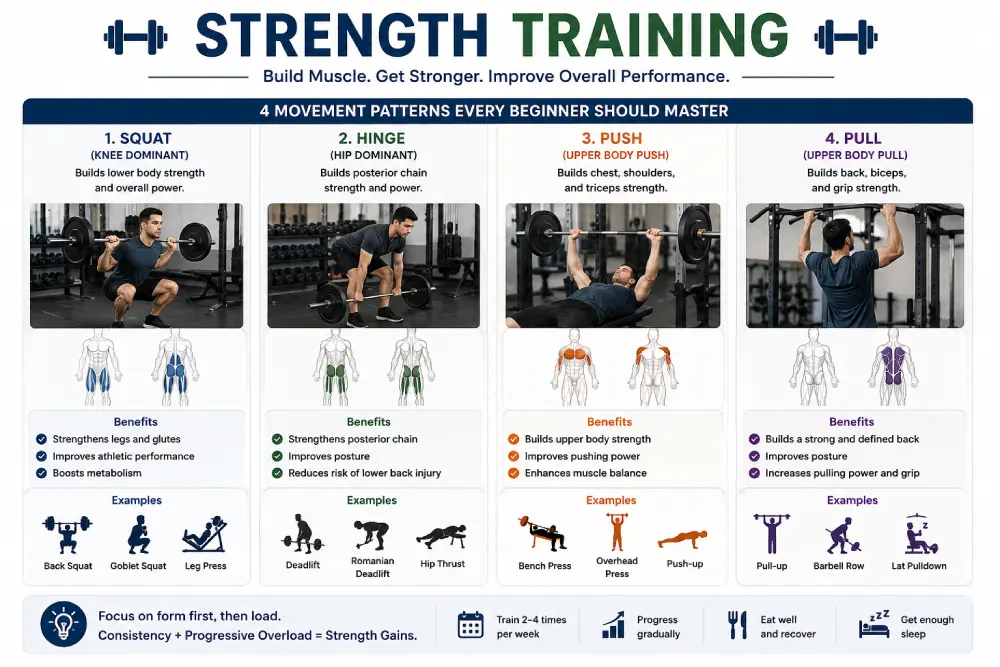
Strength training can seem like a the most daunting way into fitness—big lifts, a plethora of weight-room culture, confusing machines. But as a beginner it‘s actually far less complicated than it appears, and it‘s one of the best investments you can make in long term health: resistance training increases muscle mass, preserves bone density, and increases resting metabolic rate.
Where to start:
- Get comfortable with four basic movement patterns squat, hinge (dead lift), push (push up/press), pull (row).
- Begin with your own body weight or a manageable weight, concentrating on technique in week one, what you are not after is big weights, what you do want is neat, precise action.
- Adding weight: when a movement becomes so easy you can do 12–15 reps with perfect form, a little weight or resistance can be introduced.
Key takeaways:
- Newcomers experience a rapid increase in strength and muscle size about as quickly as nearly any other training phase that‘s often referred to as ‘beginner gains,’ and it‘s an exciting, motivating factor.
- Performing between two and three strength sessions within a seven day period, allowing at least a day of rest between sessions for the same muscles, is sufficient to achieve noticeable results.
- Soreness is not the goal – steady, progression over time is. Being too sore to walk isn‘t the sign of a “good workout”, it‘s a sign of working out too hard too early.
Read More: Strength training beginner‘s guide. (Keep the following phrase intact.) complete movement breakdowns and 4-week beginner program.
Weight Loss Workout Plan — What Actually Works
If this is mainly a weight loss ride, and you want to know one thing in advance, the workout alone doesn‘t quite do it. Most of the calorie debt needs to come from your eating habits the workout schedule makes it quicker and preserves muscle while shifting fat, and greatly improves the sustainability.
What an effective weight-loss workout plan includes:
- Weight training, 2–3x/week maintains & protects muscle. Muscle keeps your metabolism high during a caloric deficit.
- Cardio, 2–3x/week helping with the calorie deficit and increase cardiovascular health – doesn‘t have to be very intense, a brisk walk is acceptable!
- The activity of doing “non-workout” segments every day (steps, stairs, walking meetings) can have a greater end effect than the workouts.
Key takeaways:
- Slash and burn dieting combined with intense exercise will negate all of your training and then some. You will lose muscle at an accelerated rate, become fatigued, lose motivation, and ultimately give up.
- A calorie deficit of moderate degree with strength + cardio training is superior to “workout only” or “diet only” strategies for feasible fat loss.
- Losing weight is not like that. The important is not the single day performance but the average of each week.
Read more: Weight Loss Workout Plan a comprehensive plan for a week with all the calorie deficit basics.
Cardio vs Strength Training — Which Do You Need?
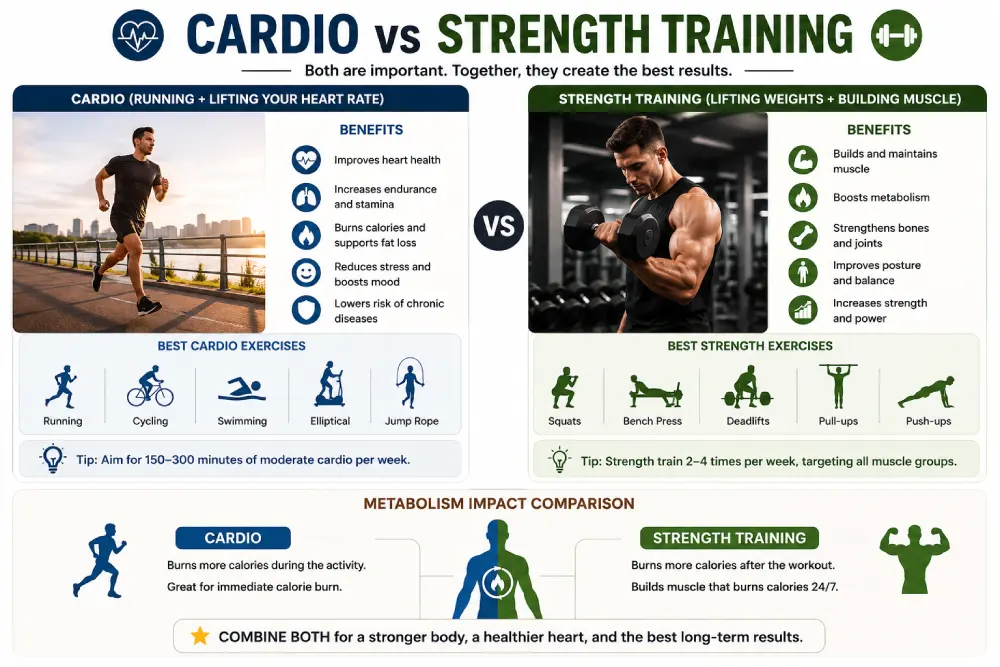
This is one of the most common fitness debates, and the transparent response is: it actually isn‘t a competition. Cardio and weight lifting have different, complementary, roles, and the majority of people find that both are necessary.
| Cardio | Strength Training | |
|---|---|---|
| Primary benefit |
Heart health, stamina, calorie burn during activity |
Muscle, Bone Density, Metabolism, Long-term strength |
| Best for | Endurance, cardiac function, and rapid caloric expenditure |
Long-term body composition change, functional strength |
| Common mistake | Doing it alone, without any mixing of strength and endurance. | It‘s a worry not to do it, for fear of “bulking up too much” |
Key takeaways:
- Muscle building increases your basal metabolic rate more than cardio, because muscle uses up energy even at rest.
- Cardio gives you real heart-health benefits that strength training doesn‘t duplicate.
- Most goals – weight lost, general health, longevity – a balance is better than either one alone.
Practical example: a more than realistic weekly distribution would be 2 strength sessions, 2 cardio sessions and walking every day, instead of choosing one and doing it all five days a week.
Read More: Cardio vs Strength Training – The Full Comparison Guide –explains the heart health benefits, fat loss science and how to combine the two.
Yoga for Fitness & Flexibility
People often don‘t consider yoga “real” fitness, but it is you just need to work on your flexibility and mobility after strength training and cardio. This is the key to preserving your joints and avoiding those hellish stiffness injuries.
Where to start:
- Simple needs 10 minutes of some simple stretches after all training (hamstrings, hip flexors, shoulder girdle, lower back). do more to open up a lot of the tight areas caused by office work, then training.
- Practicing one or two short beginner flows (cat-cow, downward dog, child‘s pose, forward fold) 3–4 times a week quickly creates tangible, visible flexibility in a matter of weeks.
- Breath-centric practice yoga‘s breath element helps in recovering and stimulating the nerve system as it diminishes the level of stress hormones.
Key takeaways:
- Mobility exercises in the form of using foam rollers and other stretching techniques are essential as part of the warm-up and cooldown of any strength or cardio workouts, since they decrease the risk of injury while doing them.
- You don‘t have to be able to do complex poses to get the benefit, you can have just a few simple stretches held for 20-30 seconds.
- Yoga is such a easy way to gain entry into the world of fitness no equipment, almost no space, and adaptable to any fitness level.
Read More: How Fitness & Flexibility Yoga For the complete guide beginner poses to a weekly flexibility program.
How to Stay Consistent With Workouts
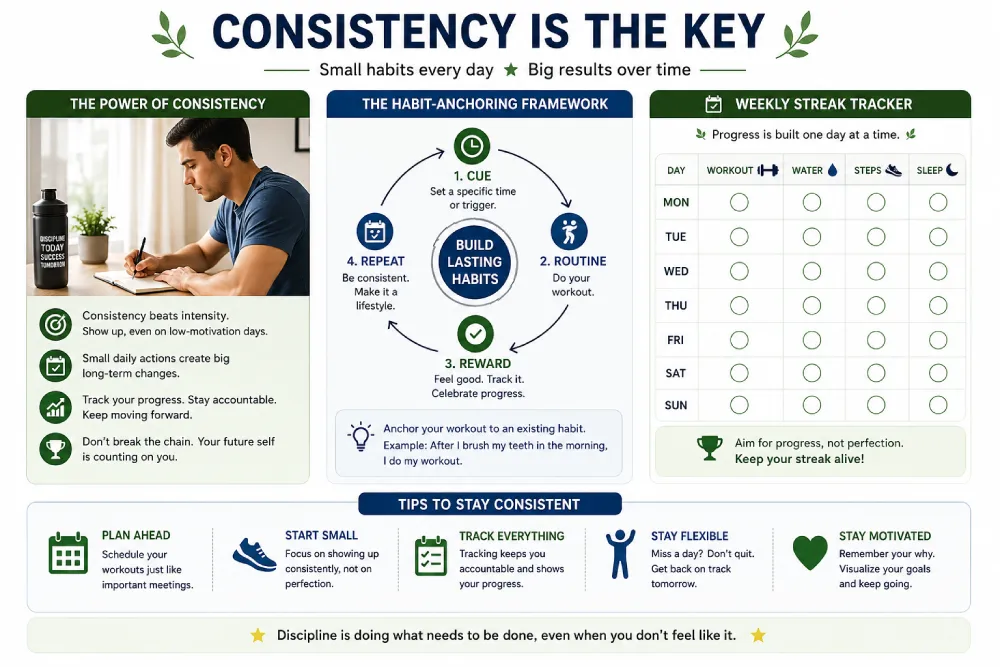
Here‘s the inconvenient truth most fitness information never mentions: the main reason most people can‘t get fit is not because of the workout, but because they stop doing the thing altogether! Most people know about what the right thing is to do, it‘s just a matter of doing it consistently past week 3.
What actually builds consistency (it‘s not motivation):
- Reduce the initial threshold. A 15-minute workout at home, which you may actually do, is better than a 90-minute session at the gym, which you may not.
- Make your workouts a part of an existing routine. “immediately after my morning coffee” is much more effective than “anytime I have free”.
- Have a plan for missed days. Missing a workout is not a failure missing two in a row and quitting entirely usually is a failure that stems from not having a plan for the first missed workout.
- Track streaks loosely, not perfectly. Shoot for 4 of 7 days per week (live and train as much as possible on the 7 days you‘ve planned), instead of a 7/7 ‘all-or-nothing’ streak that falls apart during your first hard week.
Key takeaways:
- Willpower is a weak, fragile resource as a long-term strategy, habit design (eliminating friction, anchoring to existing routines) is far more effective.
- The “all or nothing” approach is another major reason for people dropping out of exercise altogether after missing one week.
- Progress photos and tracking (energy, sleep, mood) are usually more motivational in the long term than the scales.
Read More: How to Drive Consistency in Your workouts The Complete Habit-Formation System & a “Missed Workout” Recovery Blueprint.
Building Your Weekly Fitness Schedule
Integrate all 4 pillars into a single 7-day realistic week alter according to what best fits your individual goals and schedule.
| Day | Focus |
|---|---|
| Monday | Full body or upper core or Abs (armpit to armpit) |
| Tuesday | Perform cardio (20–30 minutes, moderate speed) |
| Wednesday | Yoga/mobility (15–20 mins) or rest |
| Thursday | Strength (in the whole body or lower body) |
| Friday | Walking or active recovery period (walking, light cycling) |
| Saturday | Optional: longer cardio or something fun (sport, hike, dance…,) |
| Sunday | Rest + mobility/stretching |
Key takeaways:
- Begin by training 3–4 days a week if you are really a true beginner, then you can add days as it becomes more like second nature.
- Rest days aren‘t lazy days they‘re days when muscles rebuild.
- Feel free to tweak this. It‘s the order that‘s important (strength + cardio + mobility + rest) more than scheduling on specific days.
Mini summary: A weekly, sustainable schedule will cover all 4 pillars of fitness without dedicating 1 hour of every day to training.
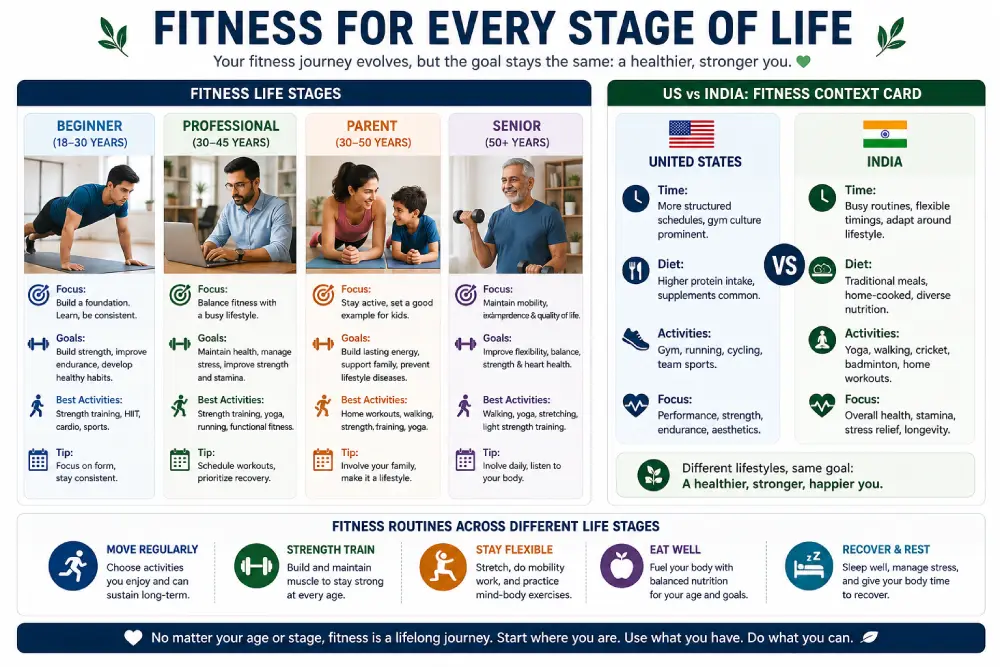
Fitness for Different Goals & Life Stages (US & India)
Beginners to lifting: for the first 4 6 weeks, don‘t overdo it. Prioritize form and consistency first, then worry about intensity. Use bodyweight and light weights, short cardio intervals, and take ample walks every day.
Weight loss focused: (combine the strength + cardio above with nutrition fundamentals (calorie deficit, sufficient protein) the workouts by themselves won‘t make significant changes without the nutrition element.
Demanding in the workplace (US & India): Home Workout, short effective workouts of about 20–30 min eliminate the “no time” reason that hampers usual activities. Walk and talk meetings and stair climbs provide significant individual movement to the daily schedule.
India-specific context: As far as weather is concerned indoor cardio when using machines or other aids is significantly better in between 7 a.m. and 6 p.m. in hotter months, a finding that‘s in line with lifestyles throughout our country. Similarly, indoor workouts are well-suited for most of Indian urban living.
US-specific context: Gym and app-usage availability is high overall, and “all-or-nothing” gym-membership culture (start paying for access, then not use it) is a frequent consistency trap home and hybrid routines prevent this more sustainably.
Key takeaways:
- Of course, there‘s no single “right” workout although the four pillars stay the same, you‘ll want to adapt them to your reality and environment.
- Regional context (heat, space, culture) is truly a change in what is sustainable, otherwise trying to imitate someone else‘s routine would normally go very much wrong.
Myth vs Fact: Common Fitness Misconceptions
| Myth | Fact |
|---|---|
| “You want a gym to get fit.” |
Bodyweight home workouts can build meaningful strength and fitness, especially at beginner-to-intermediate levels. |
| Training cardio is the best way to lose weight. |
Strength training plus a moderate calorie deficit typically outperforms cardio-only approaches for sustainable fat loss. |
| Lifting weights makes women bulky. |
Building visible bulk requires a specific, deliberate training and eating approach — most strength training simply builds lean muscle and definition. |
| ” If you want to achieve something that is worthwhile, the road to get there has to be rough and you will have to suffer along the way. |
Consistent, moderate training beats extreme, painful sessions — soreness isn’t a reliable measure of workout quality. |
| “Yoga is not a real exercise.” |
Yoga builds genuine strength, flexibility, and balance, and reduces injury risk in other training. |
| You need to train daily to achieve results. |
3–4 well-structured sessions a week, done consistently, outperform daily unsustainable sessions that lead to burnout. |
Common Beginner Mistakes (and How to Avoid Them)
- Too much, too soon commencing with daily hour-long sessions virtually guarantees overuse injury or burnout within a matter of weeks. Begin with something even less than you think.
- Missing warm-ups – even 5 minutes of light exercise prior to training may reduce the risk of injury.
- Using soreness as a measure of success soreness is a fallacy! Very sore muscles means you did too much, not good training.
- Copying advanced routines (! need to be more specific here is a program for someone 2 years in training isn‘t scaled for week one).
- Overlooking recovery and sleep muscle is built while recovering, not while working out; under-recovering, no matter how good your workout, doesn‘t allow you to progress.
The Future of Fitness in 2026 and Beyond
A few shifts worth watching:
- Hybrid home-gym routines – an increasing number of people are combining frequent during-the-week home workouts with varied occasional gym or studio sessions.
- Wearables and AI coaching many current fitness devices provide information on form and recovery as the athlete trains, which should be an additive effect to fundamentals, and not a replacement.
- Functional fitness over aesthetics-only training – a recent shift to training in order to be able to function adequately in real life; to be able to carry objects, climb stairs, play with children, etc.
- Micro-workouts brief, focused, 10-15 minute quality workout sessions are becoming popular as an attainable solution for the “no time” obstacle, substantiated by research indicating that numerous brief sessions over time yield results comparable to single, extended exercise programs for many objectives.
FAQs
How do I begin training as a beginner? Begin with three brief training sessions per week that include a combination of simple body weight strength exercises and low impact cardio, emphasize that consistency matters more than intensity in the first month, then increase difficulty when it becomes rote and unthinking.
Can I get fit using just home workouts, no gym? Yes, as for the first 6–12 months bodyweight training can still do a serious job of improving strength and fitness and can be done effectively with limited space or time.
Which is more effective for fat loss cardio or strength? Neither in isolation is the best way. A combination of the two combined with mild caloric deficit wins.
What is the ideal number of training days per week? For beginners doing 3–4 structured workouts between strength, cardio, and mobility training, six days a week with one day off is often enough to produce fast results.
How can I motivate myself to keep exercising regularly? Focus on designing a habit instead of motivation. Connect exercising to an existing daily routine, reduce the difficulty and perceived effort (do shorter sessions), and fix in advance what you will do if you miss a session.
Is yoga a ‘real’ exercise? Yes yoga is developing real strength, flexibility, and balance, and is effective toward injury prevention in strength and cardio conditioning.
Final Thoughts
In 2026, fitness no longer will be seeking out the perfect workout. It will be designing a simple system of strength, cardio, mobility, and consistency that works into your life. You don‘t have to be good at all 6 areas we cover here at one time. Select the one section that currently meets you where you are home workouts, basics of strength, weight loss, or just working toward consistency and start this week. Everything else in this hub can wait.