Cardio vs Strength Training: Which Wins for Your Goals in 2026?
Published: September 2, 2026 Last Updated: September 3, 2026 There aren‘t many fitness debates that get debated quite as
There aren‘t many fitness debates that get debated quite as much about the cardio vs strength training debate and the truth, as dull as it might seem, is and the truth, as dull as it may sound, is is that it isn‘t really a contest. The two serve entirely different purposes for your body, and most people‘s aims really are in need of both rather than one or the other.
This makes it clear what each do in real terms, and how to use them together without wasting time or guessing.
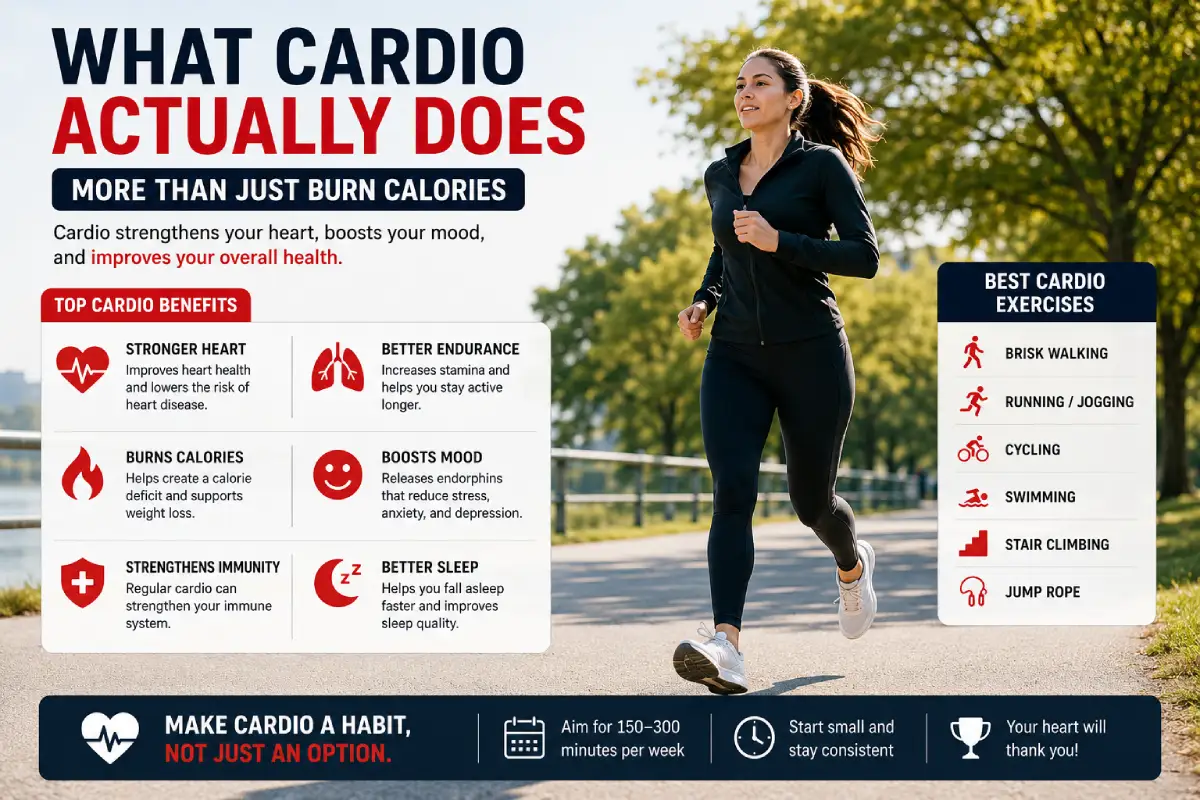
What Cardio Actually Does
Cardio aka running, cycling, fast walking, swimming, rowing exercises your heart and lungs, and, at least while you‘re doing the activity, expends a significant amount of calories.
Cardio benefits:
- Gains strength, endurance, and flexibility; enhances heart and lung efficiency gradually
- Helps to burn calories in real time assists with a caloric deficit
- Says mood and relieves stress by secreting endo-genes
- Provides endurance to perform daily activities and further training
Cardio does actually offer specific heartbenefits that strengthtraining simply can‘t. This is a category where cardio truly has an edge.
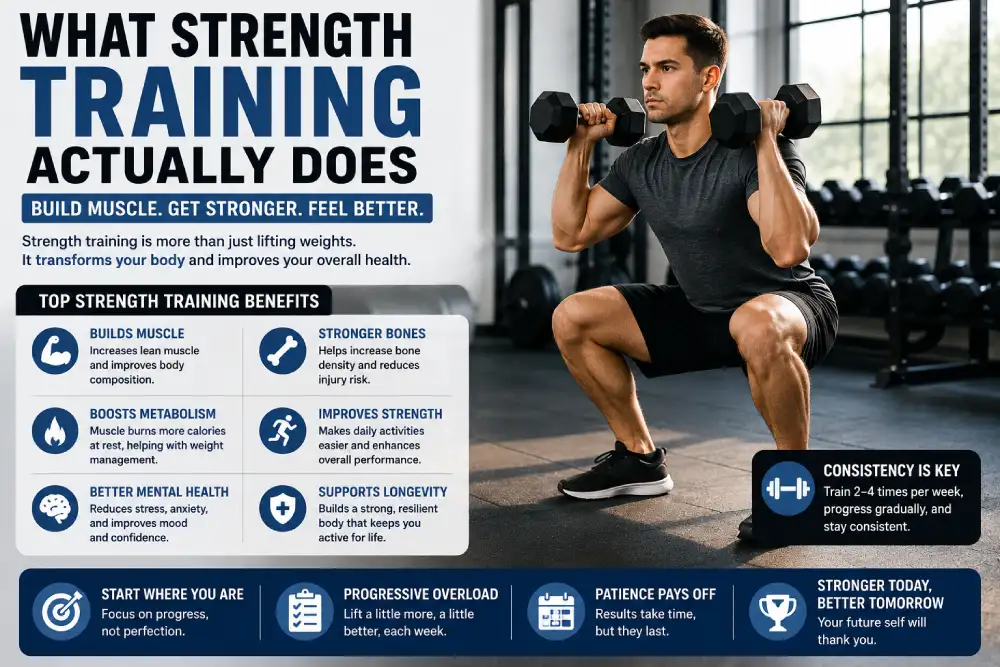
What Strength Training Actually Does
The long-term benefits of strength training (which may be performed with your body weight, dumb bells, resistance machines, etc.) include: building and maintaining muscle, strengthening bones.
Strength training benefits:
- Builds and maintains muscle mass
- Enhances bone mineral density, which can be particularly crucial with growing old
- Increases resting metabolic rate (muscle tissue burns more calories than fat, at rest)
- Develops strength for functional activities over time walking, lifting, ascending stairs withoutcomplaints
Muscle vs Fat Burning: The Real Difference
This is where much of the comparison becomes confused. ‘Muscle vs fat burning’ truly isn‘t a matter of one or the other !
- While working out: most of the time cardio will burn more calories in a single session than doing a strength workout of the same length.
- Over a 24 hour period: training with weights increases your resting metabolic rate, which is a fancy phrase for you burning just a few more calories when you‘re not exercising.
- Body composition– while strength training can alter your body composition so that at the same weight you are leaner and more muscular, cardio mainly changes the number of calories you burn during activity.
Neither wins exclusively cardio is better for immediate calorie expenditure; strength training pays more dividends in energy expenditure in the long run.
Myth vs. Fact: Cardio and Strength Training
| Myth | Fact |
|---|---|
| “Cardio kills muscle gains.” | As far as most people go, about enough cardio and just the right amount of protein and rest shouldn‘t hold back strength increases much. |
| Lifting weights by itself will do the job. | Lifting iron cannot compare to the cardio workout which I received from the cardio work. |
| For this reason, you have to decide which approach you prefer. | Most goals fat loss, overall health, longevity are better served by both than either on its own. |
| Women should not do weight training because they would become too bulky. | Visible bulk takes the right kind of work – a lot of strength training is lean muscle,not bulk. |
The Best Cardio for Fat Loss
The only way to lose fat is to do cardio, but not every type of cardio is equal if fat loss is what you are after. The ideal cardio to lose fat is perhaps a blend of the following:
- Moderate steady state cardio. Seems to be a OK too (brisk walking, cycling, swimming). Easy to do on most days. Quite well tolerated. Not very injury prone
- Interval-style cardio (short bursts of a higher intensity followed by rest) don‘t have a lot of time?, boosts calorie burn after session.
- 7. Everyday incidental activity (getting to the train station, on foot meetings, walking up the stairs to class) usually contributes more total weekly calorie expenditure than structured cardiopre Venturing out7.
The “best” cardio is the one you stick with. So, if you find yourself doing a five day a week brisk thirty minute walk (which beats the shit out of doing a heavy set once and then hanging it up.)
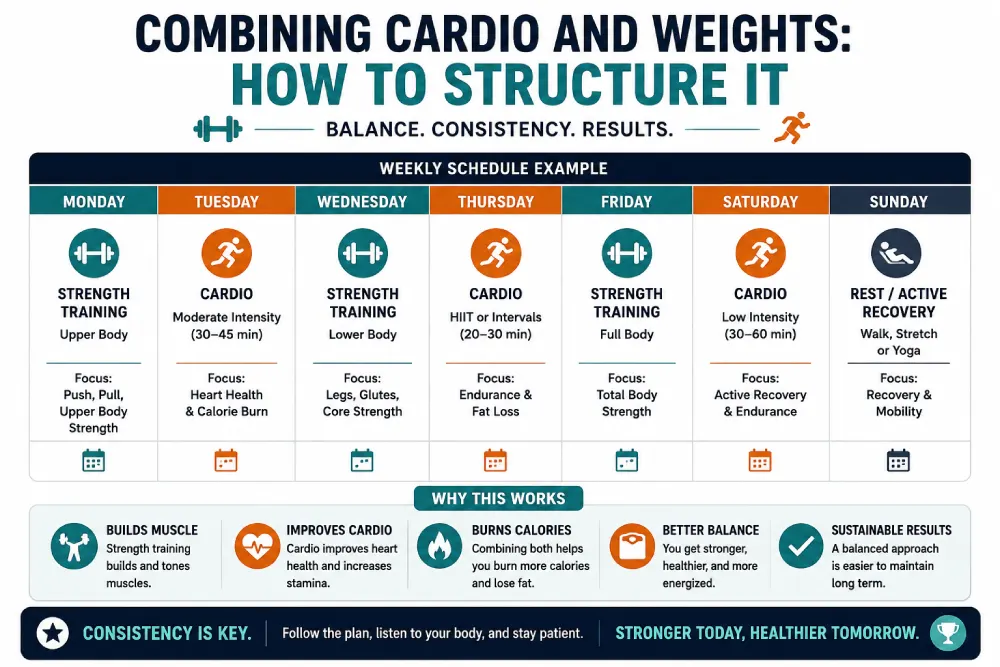
Combining Cardio and Weights: How to Structure It
Most people will achieve the best results by doing the cardio and weights in the same week (or even in the same session), but the structure is important.
Weekly structure that works for most beginners:
| Day | Focus |
|---|---|
| Monday | Strength training (fullbody). |
| Tuesday | Cardio (moderate, 20–30 mins) |
| Wednesday | Rest or a light walk, |
| Thursday | Strength training(Full body) |
| Friday | Cardio (interval-style, 15–20 min) |
| Saturday | Optional 30-minutes of light activity with longer bout of cardio. |
| Sunday | Rest |
If combining both in a single session:
- If building muscles is the main reason for training, Do strength training first (you want your muscles to perform at full strength).
- Get your cardio done up-front: if your main concern is cardio or weight endurance work or a targeted cardio contest, you want to do it first.
- As a beginner, keep combined sessions to 45–60 minutes at the most. Don‘t overtrain yourself.
Which One Should You Prioritize?
The honest answer depends on your specific goal:
- Goal is fat loss:. lean a bit more on cardio volume, but maintain a minimum of 2 strength training sessions a week to maintain the muscles.
- Main focus is gaining strength and increasing muscular mass in the long run, strength (3 times a week) first and foremost. Cardio (1-2 sessions) for cardiovascular health (though not extent of benefit).
- Main aim is ‘broad’ health and life length: get really good truly balanced, i.e. both do roughly equally (say over the life).
No matter what I‘m training for; to lose weight; to gain size; to get stronger; to run faster these somehow all differ, then the answer still comes down individually to cardio or strength training.
Common Mistakes to Avoid
- Just one of these forever. Cardio-only diets throw away advantages to metabolism and bone-density. Strength-only diets throw away advantages to cardiovascular health.
- Too much intensity in both simultaneously. Doing the hardest cardio and the hardest strength training in the same week without a recovery week is counterproductive and results in burnout.
- Never taking time off to recover between workouts. Both aerobic and strength training need to be followed by rest in order to see true improvement.
- Opt for intensity rather than persistence. A moderate, maintainable combination of the two is more effective than an intense, unsustainable extreme that is abandoned after a few weeks.
When viewed accurately, the cardio vs strength debate ceases to be a debate and instead is just a logistical planning question: how much of each is appropriate to meet your individual goals this week? For the vast majority of individuals at most times, most of the time, it is preferable to have some combination of the two.
FAQs
Which is more effective for weight loss, cardio or strength training? Combining cardio to sustain a calorie deficit with strength training to maintain muscle and metabolism is more effective than either is alone.
Will cardio impede strength gain? For most healthy individuals, moderate cardio (up to 3 times per week, 20-30 mins, not at maximum intensity), consumed in balance with protein intake and 48 hours of rest, does not significantly inhibit strength gains.
What is the best cardion for fat loss? A combination of moderate steady state cardio and a tiny bit of intervals, mixed with daily accidetal movement (steps, walking) does the trick because consistency is far more important than intensity.
Alternatively should I do cardio before or after weights? Do weights first if muscle growth is your main aim and cardio last if endurance or cardio performance is your main goal.
Can strength work substitute for cardio? No. Strength training won‘t build cardiovascular improvements the way specific cardio work does.
How many days a week should I do cardio and strength? For most beginners, it is normal to do 2–3 days of strength and 2–3 days of cardio a week depending on your goal.
Final Conclusion
Cardio vs strength training: no competition. Both do something that you can‘t get from the other. Cardio? Has to do with protecting your heart and getting rid of a lot of calories in the moment. Strength training? Has to do with creating muscle and protecting your long-term metabolism. A little of both a few times a week, oriented toward your fitness goal, and you have it no compromise.