Self Care: The Complete 2026 Guide to Nurturing Mind, Body & Soul
Published: August 31, 2026 Last Updated: September 4, 2026 You know the feeling. You‘ve responded to all the e-mails,

You know the feeling. You‘ve responded to all the e-mails, have been present for everyone else, and sometime along the way, you‘ve become the last task on your own list.
That‘s not your fault it‘s simply the result of taking care of yourself as a luxury rather than a lifestyle. And that‘s the problem this book intends to solve.
Self care is the deliberate act of protecting and maintaining your physical, emotional, mental, social, spiritual, and financial health. It’s not a candle-lit bath (although those are great). Self care can be described as a system small, ongoing actions that maintain your life as the best version of it, even when life isn’t slowing down.
At Cultones, we speak with people from all around the country, and throughout India, daily who care about their appearance and care about their well-being and 99% of the time, their well-being is #1. This expanse is designed to be your home base: a comprehensive guide to self care in 2026 with immediate access points for more specialized, context-sensitive resources based on where you find yourself in life today.
Our. First. Should this open with “Let‘s get into it”?
What Is Self Care, Really?
Self Care is any intentional activity that a person does to maintain, protect, or improve their own health, well-being, and functioning physically, mentally, and emotionally. The modern definition (thanks to the World Health Organisation, who defined it as a public health practice) encompasses so much more than just indulging oneself. It consists of sleep, boundaries, food consumption, exercise, rest, and feelings.
The term is so easily thrown about the term has been drained of meaning. BROWSE social media and self care is a candle, a face mask, an iced coffee. These things aren‘t wrong – they certainly have a place – but there are the bling. The core, the hard wear, the boring. Drinking water. Going to the doctor rather than trying to ride out the pain. Saying “I can‘t take that on right now”.
Key takeaways:
- Self care is an active process, not passive- it is preventative care, not remediating care.
- It will depend on each person there won‘t be one definitive list of what to do to get your life sorted.
- It‘s a discipline, more like brushing your teeth than a vacation.
- The ‘aesthetic’ presentation of self care (candles, skincare shelfies) is a reality but it‘s only the surface of a more rigorous practice.
Practical example: Rather than waiting until you are right at the end of your tension and fatigue to put your feet up, self care is planning to build 10 minutes of cooling down into your evening no matter what happened that day. It‘s also paying attention to when you‘re about to say “yes“in guilt, and instead saying“I‘ll do that another time.
Mini summary: Self care is the daily practice of caring for yourself, not an emergency response.
Why Self Care Actually Matters (Not Just Trendy Talk)
Chronic stress affects more than your mind: you can see it in your skin, your sleep, your relationships, and your patience. A large body of research links chronic, unmanaged stress to impaired immune function, sleeping issues, and premature skin aging (among the wealth of other chronic conditions that stress can exacerbate), which is one of the reasons why the beauty and wellness industries have become so Pashkov, 200319 intertwined. Your skin looks its worst when your cortisol is elevated for such long periods of time that it is having negative effects, such as Breakouts, dullness, and a significant delay in the skin‘s healing (Pashkov, 2003).
There‘s an added perspective on productivity that people tend to overlook. Rest is written off as time wasted. What actually destroys output is chronic under-recovery. When your brain is exhausted and dysregulated, you make worse decisions, you take longer to do basic tasks, and your responses in conversations become disproportionately reactive and aggressive. Self-care isn‘t contrary to productivity: it‘s foundational to it.
Key takeaways:
- Self care is not a luxury it is preventative healthcare.
- Avoiding this doesn‘t save you time; it will often cost you more time down the line, in the form of burnout, illness, or emotions imploding.
- Small self care habits done over time accumulate in the same way a face routine or gym routine does, the results appear in weeks not days.
- Neglected self care first appears physically (skin, sleep, appetite) before emotionally.
Practical tips:
- Observe your energy for a single week. Keep in mind that I acknowledged skipping some of the basics (sleep, food, exercise) unless you notice a clear correlation between your skipped days and moods.
- Frame self care as “maintenance,” not “reward.”
- Monitor your skin and sleep, they are early warning signs your skin and sleep will usually show stress before your mood does.
Mini overview: Self care is a maintenance regimen; if you don‘t do it, nothing else works well.
Signs You Might Be Neglecting Your Self Care
Sometimes the most difficult part isn‘t knowing what to do it is figuring out that you have to do something. Some of the most overlooked flags include:
- You often feel extremely tired even if you have had a good nights sleep.
- You get easily annoyed at the most minor of airmiles.
- You have quit shopping abstain from going to the mall7 months out of the year (you don‘t go during the holiday months).
- You‘re always saying that you haven‘t got time for things, even just to have something to eat.
- Since your skin, hair, or appetite has changed and you can‘t identify a medical explanation.
- As soon as you sit down and do nothing, you feel guilty.
- You have canceled plans with people you genuinely care about, literally dozens of times, just to “recuperate”/run away from human interaction.
Key takeaways:
- These aint cues your body and your brain asking you to buy more credit, they are signs indicating something is in need of repair.
- Catching these signs early is a lot easier than trying to rebuild once you‘ve hit full burnout.
Mini summary: If two or more of these look familiar, it‘s not about doing “more” self care, starting somewhere today.
The 6 Pillars of Self Care
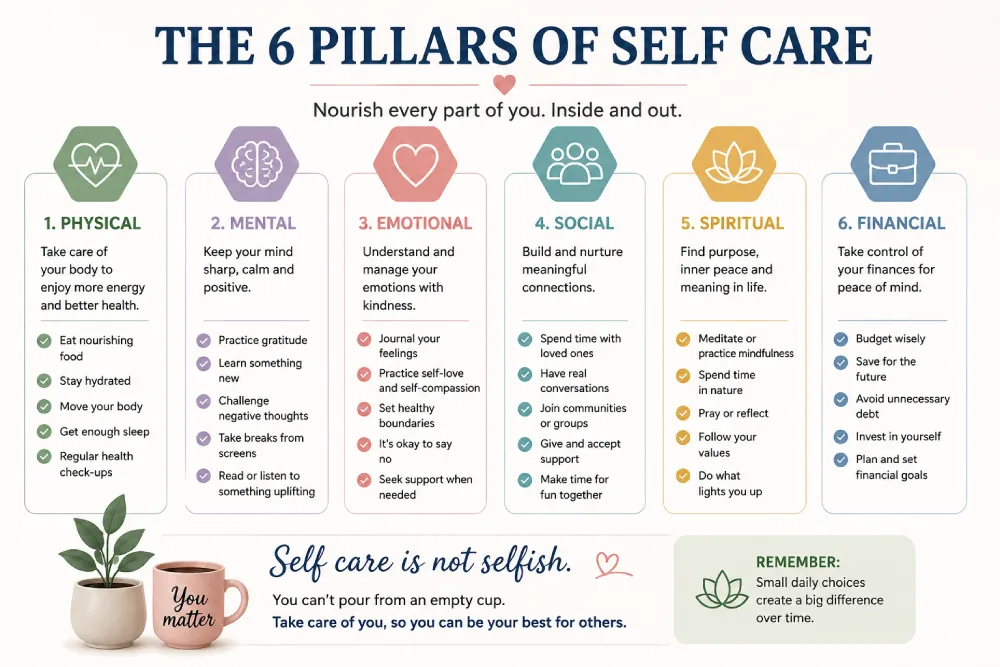
Most “self care ideas” lists throw random tips at you with no structure. Here’s the framework we use at Cultones — six categories, all working together.
| Pillar | What It Covers | Example |
|---|---|---|
| Physical | Sleep… and movement, nutrition, skincare, and so on. | 7 – 8 hrs sleep, daily skincare routine, consistent … |
| Emotional | Tri-terms: processing emotions loving kindnessbecoming aware of sensations, thoughts, and feelings,, requires handling our feelings. Self compassionarises when we notice our feelings without trying to stiffen and control. | Keeping a journal, going to therapy, identifying your feelings and labeling your emotions. |
| Mental | Cognitive rest, learning, concentration | Digital detox; (singing; reading; lessening decision fatigue) |
| Social | Relationships, boundaries, connection, | Saying no, making plans to meet friends |
| Spiritual | During…meaning…establish frequency on mainahls….values….increase.using a values list….mindful…root out…values……….engage in…mindful reflection..if they could be living in the ideal life the patient,…theme of meaning is significance, in the…contpext…mindful. | Meditation Gratitude practice Time spent in nature |
| Financial | Managing money related stress34. Money is a major source of life stress and those who are experiencing financial problems are more likely to have a negative outlook and feel depressed.35.3740. Since the economy and people‘s financial situation are unlikely to be improving between the years of 2008-2010, it can be assumed that money-related stress will continue to be a significant concern for the state of mental health. | Budgeting, a cause for concern about the emergency fund, resistance to overspending |
Let‘s look at each of these in a little more detail because most people are only strong in one or two:
Physical self care is the only most famous pillar when we think about self care that‘s what we think about; sleep, moving, eating, drinking, skin getting ready, etc. However, it is also the one people tend to focus upon because it‘s the easiest to purchase your way into (gym membership, serum, new mattress). It isn‘t.
Self care emotionally is the process of feeling what you feel rather than blocking it out. It could mean journaling, reaching out to a friend, therapist, or loved one; or it could mean out loud naming (I‘m anxious about this,” “I‘m disappointed”) rather than stuffing.
Mental self care is about safeguarding your attention and mental bandwidth. Constant notifications, doom-scrolling, and decision fatigue can drain mental energy throughout the day. Taking regular breaks from screens can help create more space for rest and focus. Explore our guide to Digital Detox for practical ways to reduce screen time and build healthier technology habits.
Social self care involves your relationships. This can mean maintaining positive relationships, and protecting yourself from those relationships which drain you. It can mean arranging time with those who give you energy, and it can mean settling limits and limits on your commitment.
Spiritual self care can be non religious. It is about accessing meaning whatever that means for you: through thoughtful awareness, being in nature, using a gratitude practice or making a decision to absorb information again, especially if you want a good shrugging-shoulders conversation with yourself.
Financial self care is the most neglected pillar of all. Money stress is one of the major contributors to chronic anxiety, and yet nearly no “self care” material discusses it. Creating a budget, establishing a small emergency fund, and learning to guilt free shop are all valid forms of self care.
Key takeaways:
- The more people lack the more they over-invest by convention to one of the four pillars, principally the physical aspect, at the expense of the other three.
- Burnout is caused by an imbalance, rather than a total neglect of self care.
- The two most frequently over looked areas of the pillars are financial and social self care.
For example: a person who trains every day but does not say no at work is responsible for the physical pillar (training), but ignores the social pillar (say no). This person will still eventually burned out.
Mini summary: Real self care is taking the initiative to check in on how we (all six pillars) are doing, not just what looks good on Instagram.
Self Care Ideas: Where to Actually Start
If you‘re new to this, please don‘t attempt to change everything in one event. Begin with micro self care small, manageable steps organized by pillar so you can select those you‘re most lacking in.
Physical:
- Take a 8 oz glass of water and down it prior to your AM java
- Come outside in the sun for half an hour PM passes through the skin and is converted to D; where it is stored for up to a 3 month supply in the liver, was then free to travel in the blood as D3. [–that is if there‘s any sun!
- Have a 5 minute stretch before heading off to sleep.
- Make that appointment you‘ve been delaying (dentist, doctor, chiropractor, hairdresser, etc)
- If the late night is catered for, it isn‘t much to switch one restless night to sleep early, even by half-hour.
Emotional:
- Jot down three things you are grateful for
- Say one emotion you‘re experiencing at the moment out loud or on paper:@ .
- Just call a friend and say you‘re really doing well.
- Not bravely prancing ahead and stuffing/containing. Allow yourself the opportunity to cry, and do not take it on forcibly
Mental:
- 2–Turn your cell phone on Do Not Disturb mode for one hour each day.
- Choose a small choice to cut out this week (meal prep, a capsule wardrobe rotation, etc.)
- Read something not related to work.
- Go for a walk without a podcast, without music just absolutely silent.
Social:
- Say no this week to one thing that exhausts you.
- Call a friend you haven‘t caught up with in a while
- Establish one minor limit you haven‘t yet set.
Spiritual:
- Do I think you should disconnect for five minutes and go sit outside without your mobile? Yes.
- Write what was one thing today that truly mattered to you.
- Experiment with breathing quietly for five minutes before you are going to sleep;
Financial:
- Check your bank account non-judgemental just information
- Save some money, even just a few rupees or dollars.
- One subscription you forgot you had, cancel.
Key takeaways:
- Ideas will only work if they‘re doable for your real day not someone else‘s.
- Do a few brainstorms a week rather than give yourself too many to complete in one go.
- Choose from whatever pillar you’re lesser at, not the one that‘s easy.
Read More:• What Self Care Ideas on a Budget 0 Cost and Low Cost Rituals that requires nothing at all to bespent!
Building a Self Care Routine That Sticks
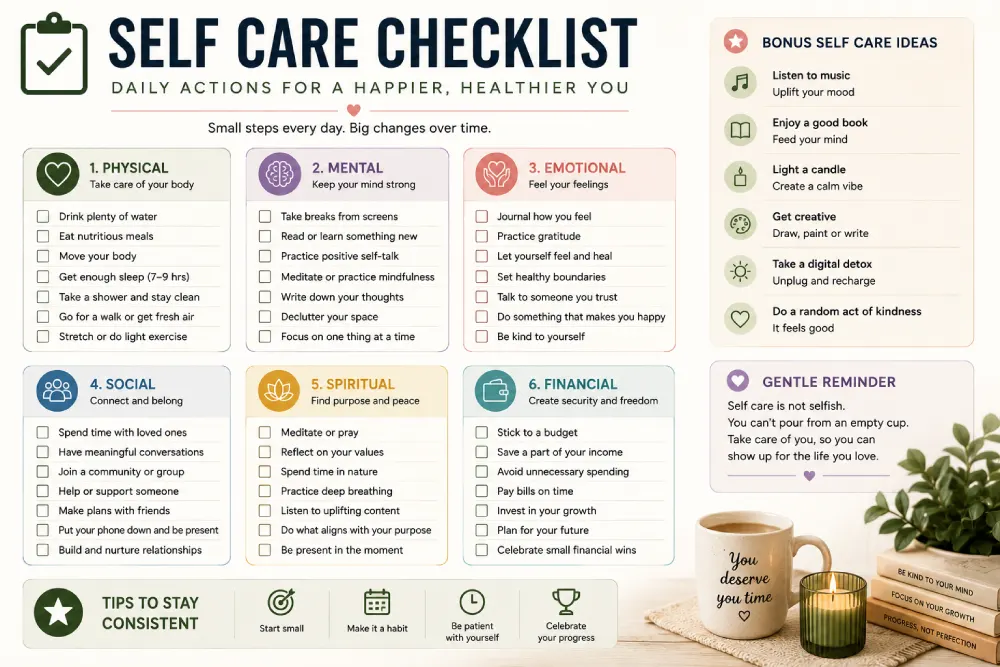
One self care “idea” is a lovely moment. Self care routine is what truly transforms your life because it‘s consistency, not power, that makes the difference. This is the crucial difference between those who claim self care “doesn‘t work for me” and those who made it part of their life: the latter made it manageable enough and persistent enough to make it through a bad week.
Framework: The 3-Layer Routine
- Day time layer (5–15 mins): essentials that are not up for discussion moisturizing, drinking water, a small amount of peace and quiet.
- Weekly layer (30–90 min): a deeper reset a legitimate Sunday tradition a meaningful workout a catch-up call with a friend
- Monthly layer (a couple of hours): bigger recalibration solo outing, financial review, decluttering.
The of course is that this three-tier system is far more effective than a onitchl daily checklist. This is because it takes away shame if you‘re having a particularly rough day, only doing the daily layer will be enough for self care, you don‘t have to do the whole weekly ritual to “count.” That‘s what enables the process to be sustainable over the long-term.
The simplest strategy is habit stacking. By attaching a new self care routine with one you already perform habitually, you won‘t need to consciously recall it. Examples: After I brush my teeth, I will write one sentence in my journal. After I pour my coffee, I will consume one glass of water before I begin drinking it. After I lock my car, I will sit for one minute before entering the house.
Key takeaways:
- Don‘t build a routine around what you wish your week were like build it around what your week actually is.
- Tie new habits to current habits (e.g., “after I brush my teeth, I journal for 2 minutes”) in order to make them stick.
- A flexible, layered approach will outperform a rigid daily to-do list every time life gets busy.
Practical example: A working parent‘s daily layer might be just skincare + 5 minutes silence in the car before walking into the office. That‘s enough small and repeated beats big and abandoned.
Read Also: 5 Tips to create a Daily Self Care Routine for Busy People a complete time-block system for people with less than 20 minutes to spare.
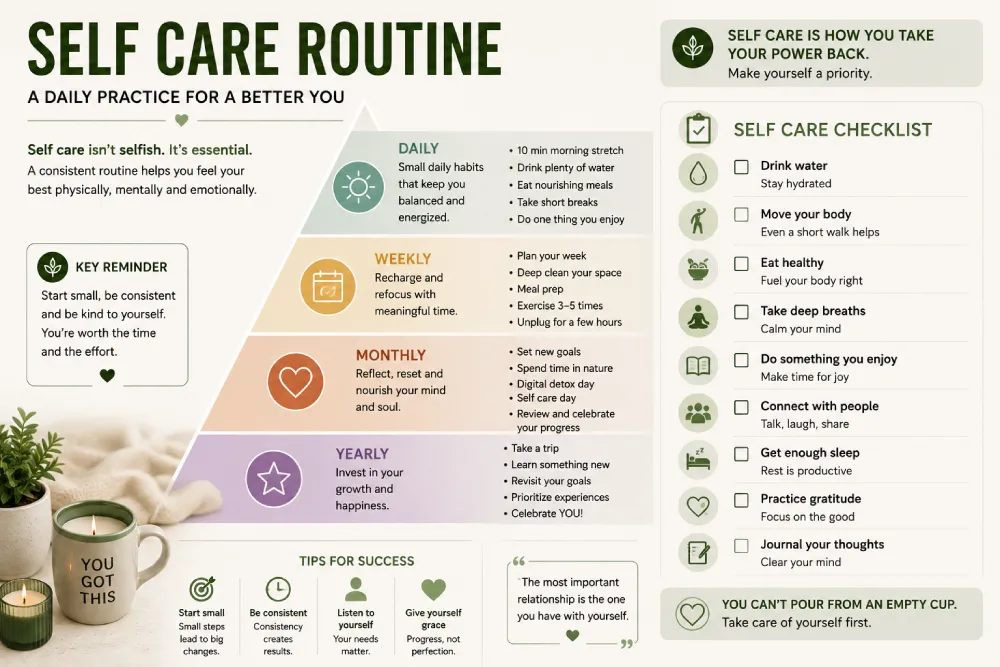
The Self Care Checklist: Your Quick Reference
Just something to use as a simple gut-check not as a hard rulebook.
Daily check-in:
- ( ) Did I sleep for about 7–8 hours?
- [ ] I was not drinking, so once a day [ ] would be good too; and the ”[ ] I should have had more water today.
- [ ] Did I have any physical movements, even a little bit?
- [ ] Did I take an eye break?
- [ ] Did I said no to an energy killer?
- [ ] Did I do one single thing just because it brought me joy?
- [ ] Did I check in with how I‘m actually feeling?
Weekly check-in:
- [ ] Was at least one meaningful, un-stressed conversation with someone I love?
- [ ] Did I do something that was irrelevant?
- [ ] If yes, how often? (e.g., several times a day, once a week).
- What [ ] I was able to keep up with my finances and not go on a downward spiral?
Monthly check-in:
- [ ] Am I feeling more refreshed than I was a month back, or less?
- [ ] Is there a self-draining habit that I have not yet done Away With?
- [ ] Have I had sheer fun?
Key takeaways:
- You don‘t necessarily have to mark all the boxes each day – three or four is really pretty good.
- Use weekly to find the pattern of the price action, not daily, that‘s just for a pressure test.
- The monthly check-in where you catch slow burnout before it hits crisis.
Mini summary: A checklist is far more useful when used as a mirror than as a score-card.
Self Care Sunday: The Weekly Reset
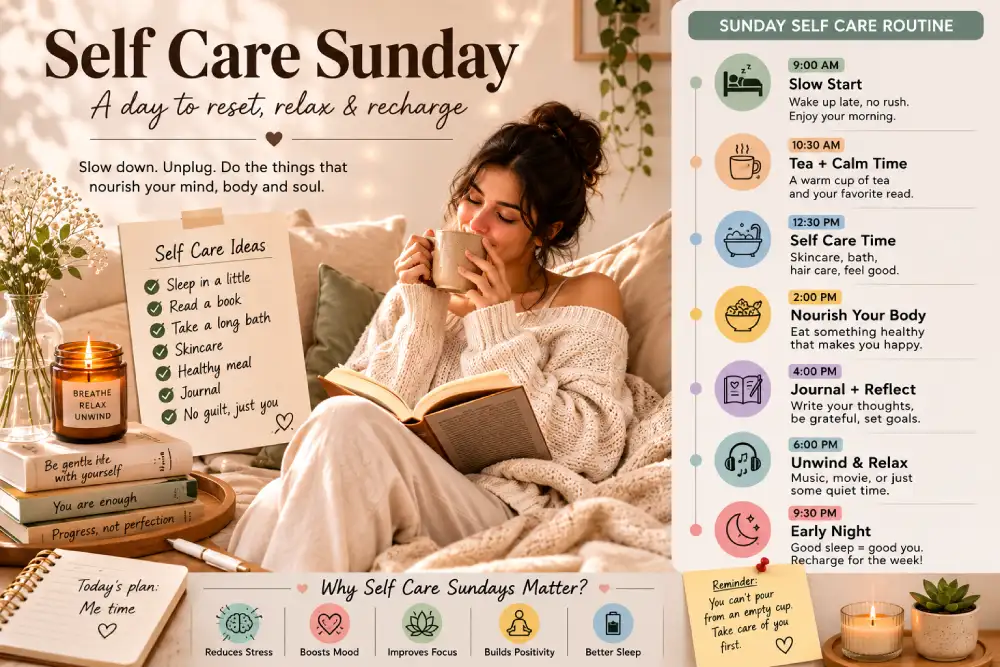
‘Self Care Sunday’ is a popular colloquial term that embodies that weekly resetting ritual and it works because it grants your nervouse system a consensual stopping point before the new week. It‘s knowing that day‘s already protected no matter how along the last one was that seems to be potent.
Key takeaways:
- It‘s not about getting everything done on one day; it‘s about saving a few hours so you can reset.
- The ideal Sunday worship physical & emotional reset are all of the following: laundry, schedules, journal, slow time.
- It does not have to be Sunday just choose whatever day it makes sense to precede your busy period.
Example in practice: a Self Care Sunday, where I spend an hour on skincare and prepare a slow breakfast, spend an hour on a hobby, prep my meals for the week, and wind down in a tech-free zone before sleep.
Read More: (Downloadable) self care sunday rituals full structure of a ritual you can take this weekend.
Self Care and Skincare: Where Beauty Meets Wellbeing
The skin is one of the most frequent gateways into self care for good reason. It is a sense organ, it is something we see, it can serve in a meditative ritual (wash, lather, wash again, apply, hold, breathe) even if we do not envision it to do so.
The key distinction: skincare is self care when you do it consciously, not a product you just plug in as another box to check. Two minutes of consciously massaging in moisturizer is more self care than a high end 10-step routine, mindlessly slathered on with your thumb in a Netflix binge.
Key takeaways:
- What matters is the ritual as much as the product bathe the ingredients, not just the final product.
- Stress shows up on the skin sometimes even before you become aware of it (acne, dullness, dehydration).
- A simple, consistent routine is better than the complicated one you‘ll give up in three weeks.
Practical tips:
- Make your skincare a part of your phone-free 2 minutes, even if your whole day isn‘t.
- Notice skin changes as data– a signal of stress that is worth looking at, not a brand problem?
Mini summary: Morning and evening skincare routines are one of the easiest, most accessible daily rituals to incorporate into your self care practice as long as you‘re being mindful, not mechanical.
Self Care in the Workplace
You spend somewhere in the neighborhood of 1/3 of your waking hours at work, which makes work one of the most important and most neglected arenas of practicing self care. Most people think that self care must take place after work, when a work day with no self care included is the source of the fatigue you need to unwind and recover from in the evening.
Practical workplace self care:
- Take genuine lunch breaks, away from your workspace, at least a few days each week.
- Build in a 5-minute buffer between meetings instead of scheduling one directly after the other.
- Create a “shutdown ritual” for example, a routine that indicates that the workday is finished (shutting down your laptop completely, taking a brief walk.)
- Refuse one unnecessary meeting each week
- Use your PTO you might think that an Excel sheet should be the extent of your un-paid paid time off, but really it should be an unspent free-for-all [id].
Key takeaways:
- Non-continuous self care cannot outweigh a zero (restorative) workday.
- Boundaries at work (realistic response times, protected breaks) are self care albeit not looking like it.
Mini summary: The workday is where most burnout is created which makes it one of the most important places to establish self care habits, not just recover from and escape from afterwards.
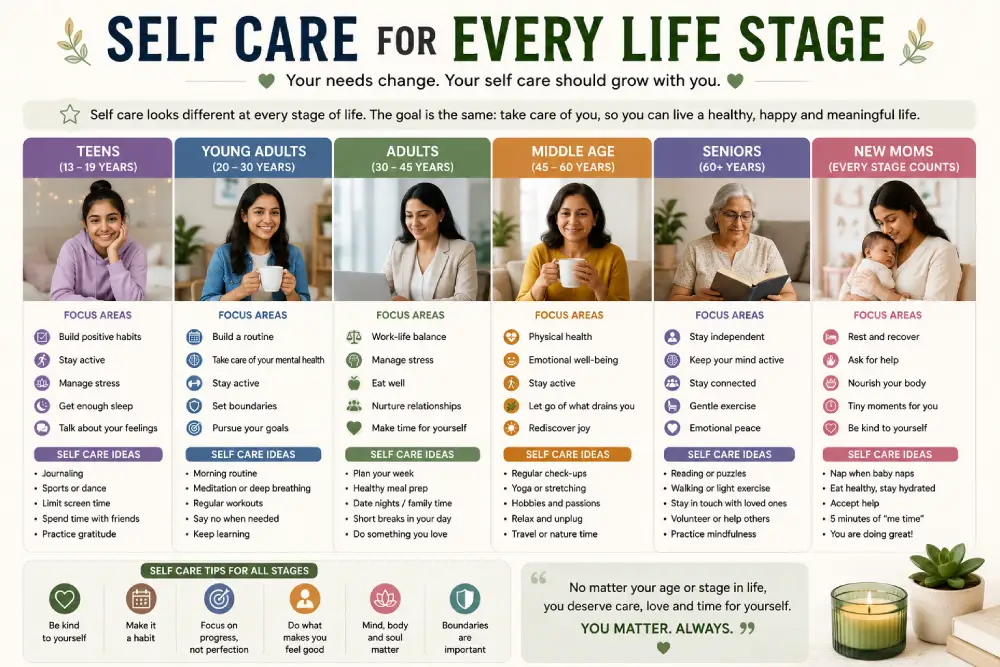
Self Care for Different Life Stages
Generic self care advice doesn‘t work. It simply doesn‘t take into account who you are. Here‘s the plain truth: A new mother and a college student will not have the same self care plan. Life stage changes what is realistic, what is necessary and even what can be done.
Self Care in Your 20s
Frequently about forming routines before things get complicated sleep routines, money habits, boundaries early so you aren‘t overwhelmed by career and family taking up so much of your time.
Self Care in Your 30s and 40s
Tends to be about protecting space in the middle of an intensity of responsibility careers, kids, aging parents. Self care is often very small and ruthlessly prioritized rather than any 10-step process.
Self Care for Students
Academic pressures, unpredictable hours and lack of money must also make for self care to be either free or a very low cost activity, during small gaps between lectures or study periods.
Self Care for Men
Self care is still seen as something shameful for a lot of men in a lot of households, as ‘not being man enough’. That‘s changing, and it needs to keep changing.
Read more: Self care tips for men down to earth practical tips (nothing too spa-like here!) based on real life routines: gym, grooming, mental health and boundaries.
Self Care for New Moms
The life after the birth does not provide any space to “me time”, which emphasizes the importance of self care.
Read More: : Self Care during the Fourth Trimester and Beyond is achievable by using these simple ideas for realistic 5-minute self care ideas for new moms.
Mini summary: The very best self care plan is the one that is established in the context of your own stage of life (not a general or outside range).
Self Care: A Cultural Lens (US vs. India)
Self care isn‘t the same everywhere, so saying that it is is one of the reasons why most writing on it feels inauthentic.
In the US, the focus has mostly been on mental health integration, affordability (self care as a privilege debate), and individual boundaries-blaming usually set within hustle culture and cultures of long work hours.
In India, discussions of self care are a hybrid of nativethrough kitsch oil massage (champi), herbal nostrum blueprints, teetering joint-family configurationsand big global ideas about daily well-being and individual entitlement to care of oneself. Establishing limits of individual time and space in a joint/extended family context is unlikely to be intuitively experienced as individualized and impose-able as the West, and must be negotiated with known family members explicitly and conspicuously. The demand for simultaneous festival season, study pressure as well as monsooni, mood and skin rollercoaster- specifics are seldomacknowledgedin prescriptive self care literature.
Key takeaways:
- Self care guidance provided without consideration of cultural background or family influences may lack feasibility.
- Traditional practices (oil massage, herbal remedies, community rituals) are valid self care, not the “less modern” form of it.
- Boundarying surely varies by family structure something we have more than enough reasons to recognize.
Mini summary: Self care is universally principle-based; the best practice (in the author‘s humble opinion) is extremely local, specifically grounded in where and how a person actually is.
Common Self Care Mistakes to Avoid
- Handing yourself self care as a reward only doing it when you “deserve” it means you‘ll hardly ever do it.
- Having a few similar items, or doing the same exercise someone else recommends, is good, of course, but copying someone else‘s routine word-for-word the same “before” and “after” pictures used by an influencer with no kids and a 9-to-5 won‘t work for you.
- All or none thinking – If I miss one day I can‘t have had any impact at all.
- Please spare the “boring” pillars sleep and boundaries are more important than a face mask.
- Pouring into an emotional problem a new skin care line isn‘t going to help. Rest will.
- Normal life schedules…, putting self care when they have enough extra time to do it sets the routine up for failure.
- I was mixing up numbing and resting. Hours of scrolling can seem like resting. Instead it really drains you out.
- Not voicing your needs assuming others will just know you need space or support generally results in anger rather than relaxation.
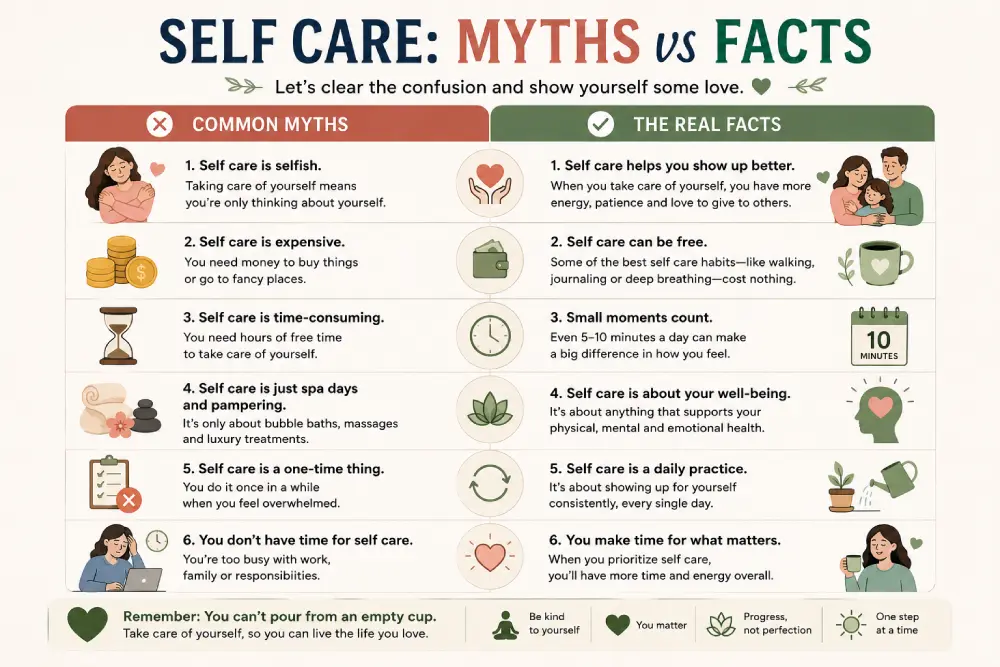
Myth vs. Fact: Self Care Edition
| Myth | Fact |
|---|---|
| Self care is selfish | Going green: the first level of self care is what enables you to continue showing up in life with others in a sustainable way. |
| I was increasingly caring of myself. Economically, I was willing to use money for R&R trip and spa day. | Self-care consists largely of ordinary day to day activities. |
| Self care is expensive. | Much of the greatest self care that can be practiced (sleep, boundaries, breathing) is absolutely free. |
| Its only for women to do self care. | Everyone needs a self care practice the form just appears in different ways |
| Just have a lot of free time on your hands. | 5–10 min. of stable self care is more effective than a brief 3 hour binge. |
| Self care can reform mental health issues | Self care is part of maintaining wellbeing but it can‘t take the place of necessary treatment from a professional |
| Once you establish a routine, you‘re all set. | Self care requirements vary over stage of life, season and life circumstance – patterns should adapt |
Troubleshooting: “I Keep Falling Off My Self Care Routine”
If your routine isn‘t sticking, it‘s usually one of these problems:
- It‘s just too large. Compress it. If a once 30-minute warm-up still fails, compress it down to 5 minutes.
- Wrong time for you. If you find mornings a hustle, then your new routine should be right before sleeping.
- It‘s not really fun. Self must-dos you loathe to do are not really self care unless you‘re suppose to do it. Replace it for something you can‘t wait till the deadline comes!
- You‘re going for motivation instead of structure. Motivation is a terrible thing to depend on; stacking habits and reminders are not.
- You‘re fighting it alone where it would be helped by others. A friend, a partner or even a couple‘s tracker can make maintaining consistency easier.
- You haven‘t made up for the misses. One missed day is not a failed routine it‘s just a missed day. Get back on your next one without the guilt spiral.
Tools That Can Support (Not Replace) Your Self Care
Apps and tools can create consistency, but they are really just structures and reminders, not the self care.
- Habit trackers helpful for creating a daily level without the tediously remembering to record every little thing.
- To help you get started, try meditation apps good for beginners who are intimidated by sitting quietly.
- Sleep trackers – a handy tool for recognizing trends, not for fretting over absolute values
- Budgeting apps bolster the financial pillar easily overlooked if not highlighted
- Simple journaling apps or even a physical notebook removes the barrier to emotional timewaster
Key takeaways:
- Tools are scaffolding, they are not the practice itself. Don‘t let tracking be another form of control.
- The easiest tool you‘ll actually use will always beat the most powerful tool you‘ll use for a week.
The Future of Self Care: What’s Changing in 2026
- Micro self care instead of marathon self care shorter, more regular self care moments are replacing the ” spa day” model.
- Digital minimalism as self care creating purposeful boundaries on screen time is now in the same habit routine as skin care.
- Self care as identity, not indulgence the guilt narrative is disappearing, particularly for younger users in the US and India.
- Regionally self care In India the self care discourse is becoming more hybridized, blending traditional practices oilmassage, remedies, delineation of nuclear family from joint family with more contemporar routines; In the US, the discourse is moving towards affordability and mental health integration.
- Quiet luxury self care the distillation of abundance, with time and rituals for pampering rather than clutter.
- AI-fatigue recovery As our world becomes increasingly digitized and mediated, intentional analog self-care (reading real books, writing in your journal, taking unplugged walks) is emerging as its own niche rather than nostalgia.
Self Care and Sleep: The Most Underrated Pillar
If you only managed to correct one aspect of this entire handbook, sleep would offer you the greatest benefit. It‘s the one habit that has an impact on every other pillar of health it‘s essential for keeping your mood in check, your decisions on point, your hunger in check, it repairs your skin while you snooze, and it keeps you emotionally sturdy and it‘s the first thing to get sacrificed when life is demanding.
Poor sleep doesn‘t just make you tired, it makes you a worse you in ways that are easily confused. And whatseems like personal flaws: being irritable so much of the time that people start to think you‘re crazy not being able to concentrate so that it seems like youjustcan‘tfocus reacting emotionally to things in a way that just seems to bethe wayyou are these are more often symptsofits more being an restless nervous system that has forgotten to rest.
Key takeaways:
- Sleep debt adds up one worse night is recoverable, a series of worse nights is not.
- Many times a regular sleep and wake time is more important than is duration.
- Pre-sleep screens not only push back sleep time but also cause decline in sleep quality, even once asleep.
Practical tips:
- Choose a wind-down cue such as turning down lights, playing a certain playlist, closing down your laptop that tells your brain it‘s time to wind down.
- Protect the 30 minutes before bed from work messages and doom-scrolling, even if you can‘t protect the rest of your evening.
- Always have trouble getting or staying asleep no matter what? Mention this to your doctor as well this is no longer a self care issue.
Mini summary: Sleep is not one self care practice of many; it‘s the one self care practice that makes all of the other self care practices work better.
Self Care During Genuinely Hard Times
The majority of self care material operates from the assumption that we know what normal is that we have a busy week ahead of us, that we are caught in the midst of a full working life, a full parenting experience, or a full educational experience. But with grief, sickness, a major life change or true crisis, all of this becomes comparatively irrelevant.
In the truly hard days, “self care” becomes base measures not optimization. Having something to eat, even if it‘s boring. Allowing someone to help instead of demanding independence. Removing standards from “getting through the day”. Elimination of overly ambitious routines and long lists of things to “get done”, instead the aim is only to not make it worse than it already is.
Key takeaways:
- Self care in a time of crisis is not to try harder but to expect less.
- As long as that‘s what you need, receiving assistance is a kind of self care.
- Professional (therapy, counseling, doctor‘s care etc) is also self care, it is not an additional category that distinguished an area of more serious issues.
Practical example: while mourning, a concrete self care goal could be: eat one real meal daily, allow one individual to care for you, and step outdoors a single time. That‘s not a watered down self care. That is all of self care there is for that chapter.
Mini summary: Self care scales to the moment what it looks like in a hard season is not a failure to meet a higher bar, it‘s the right bar for that season.
How to Talk to the People Around You About Needing Self Care
One of the least noisy obstacles to regular self care isn‘t a lack of motivation, it‘s people around you assuming you do not require quiet, space, and support in the first place. Expecting them to be psychic is usually a recipe for resentment on both sides.
This is even more true in shared-caring/split household, joint families or over-stretched partners. Come out with a quick, direct conversation rather than just hoping someone is aware of your stress levels.
Practical scripts:
- I require 20 minutes of solitude upon arriving home before I am ready to engage could we factor this into whatever we are discussing?
- I‘m not angry with you, I just need a chilled night to recharge.
- Could you take the next school run so I can get to my appointment?
- I’ w been agreeing to everything too much recently, I need to step back for a while.
Key takeaways:
- A specific request is more likely to be successful. For example, a request such as “I really need to rest,” is more likely to be understood by others as “Please let me have some time off”.
- People generally respond better to being requested directly than to being expected to detect insidious lethargy.
- It makes it so much easier the second and third time if having done this the initial time.
Mini summary: Self care based on others’ ability to dream up your needs doesn‘t tend to survive in the crash of a hectic household. Just tell them what you need.
A Sample Week of Self Care, in Practice
Frameworks are great, but they‘re more helpful when you see them put into practice. This is what a ‘framework’ week could look like for someone with a full-time job and a busy personal life er, not a wellness influencer Instagram-ready week, but a week you can actually manage.
Monday: Only the daily layer. Skin care, a glass of water before the coffee, five minutes of silence in the car before walking into the building. It‘s a plan, and it works.
Tuesday: A tough day of working. Self care means just safeguarding the evening by not letting anything more happen, going to bed a bit earlier and just a brief stretch before going to sleep.
Wednesday: Hour in the middle of the week. A quick hour walk, no phone, then a text to a friend to actually check in, not plan.
Thursday: Daily layer, on top of that, a little financial check in “where did all the money go this week?” look, but non-judgmentally.
Friday: A set boundary choosing to reject our last-minute Friday-night commitments to snuggle into bed, no questions asked.
Saturday: weekly layered activity- a hobby, a workout that is a pleasure, or unscheduled play time with individuals who re-energize rather than sap.
Sunday: everything I do to convert my mind from weekend to workweek. The full Self Care Sunday reset calmamazing slow AM, food to homeamazing, a non-stuffy brain hour, and a wakeup.
Key takeaways:
- Most days just require the daily layer, which is normal and not indicative of failure.
- The routine is flexible when it comes to what the day actually calls for.
- One well-secured weekly reset is all it takes to feel a sense of relief from the giant emotional baggage that strewn-out six days of chaos ”‘almost” self care” could not have.
Mini summary: self-caring week to be not only realistic but achievable – isn‘t one size fits all, but will adapt to needs, General Day(s) much as out of bed but one or two taking the extra hit.
Building Your Personal Self Care Plan in 4 Steps
Reading about self care and having a plan in place are two very different things. This is a simple four step process to turn everything we have covered in this guide into a plan that is specific to your life.
Step 1. Audit your six pillars. Make an honest, self-reporting act of rating each of your six pillars: physical, emotional, mental, social, spiritual & financial self care. So the easiest one or two (the one or two that feel totally out of whack or are glaringly low) that call you are. Don‘t begin with the pillar you think will be the easiest or most fun.
Step 2: Choose one habit for each of the weak pillars; Just one tiny, specific thing for each pillar you got a low score on. “Be more mindful” won‘t make it through a busy week; precise ones like “five minutes of silence before going to bed” will.
3. Tie it to something you‘re already doing without thinking after you brush your teeth, after you park your car, after you drink your first cup of coffee. This one is the most powerful methods.
4. Meet Monthly Not Daily. Make a recurring monthly appointment with yourself to ask: Is this still working? Has anything changed? The self-care needs of your calendar will change with the seasons, the outside pressures on your time, life itself…what worked in January might not be what you need in June.
Key takeaways:
- Particularity leads to realization when I give mysel goal and focus on it, I am more likely to accomplish it than when I set five vague intentions.
- The formation of new habits is facilitated by its association with old habits so that it removes the reliance on willpower or even on memory.
- Self care plans should be reviewed from time to time.
Mini summary: this self care plan is effective because it is concrete, it is small, and it is linked to another activity you already do.
Frequently Misunderstood Self Care Scenarios
Some real-life situations that seem to keep coming up in the application of self care advice are:
I have young kids and zero alone time.” Self care doesn‘t always need alone time to be effective. A five-minute skincare routine in the morning while your partner keeps an eye on the kids, a few minutes of a podcast during the school run, sitting down with a meal without trying to do twenty-five other things simultaneously all count as valid self care.
My job doesn‘t even let me take proper breaks. You have to adopt micro self care a 90 seconds breathing space in between calls, having water at your desk, going outside in the time of one song. Not optimum, but definitely better than nothing.
‘I feel guilty everytime I try to rest’: this often signals a feeling that rest has to be earned. “Reframe rest as maintenance (like charging your phone) not reward for a while: it may help to dispel that guilt, but well worth exploring with therapist if guilt lingers.
I don‘t even know what I do enjoy anymore. This is completely normal after a long spell of burnout or caring responsibilities. Think back to what you did enjoy in your teen or early 20s before life overtook you, they are often a best bet even if they seem so alien.
Key takeaways:
- The majority of our real barriers to self-care are capable of being solved to a certain extent without perfect conditions.
- Guilt about resting and disconnection from enjoying are both very prevalent and both very treatable, only over time.
Brief summary: the self care advice is available, it must include the messy real world constraints, not the sterile, show limited time given in most shelf content.
How to Know Your Self Care Routine Is Actually Working
It‘s a very gradual process which is a chief reason why people give up ‘before it‘s done’… Like many forms of self care it doesn‘t loudly proclaim its achievements, it‘s not a big bright ‘before’ and ‘after’, it‘s a seemingly imperceptible series of tiny shifts.
The indicators that it is working tend to be: returning to baseline quicker after a stressful day rather than hanging on to it all night, having that feeling of irritation happening but then not actually reacting to it by snapping at a loved one, sleeping a little better on average, catching yourself feeling the urge to do a habit rather than forcing it. None of these are massive, but all are real.
Another thing to keep an eye out for is the more subtle indication that this is no longer labelling yourself as lazy, but rather taking time to rest has just become easier. As time passes, guilt starting to wear off is often the easiest indicator of this.
Key takeaways:
- You should expect progress in self care to be slow, so you can underestimate just how much change you‘ve achieved.
- The most obvious indication that an established routine is set is that guilt over taking time off is gone.
- Emotional recovery to stress happen sooner is a better indicator of improvement than an external assessment of how “productive” the self care routine appears to be.
Mini summary: Don‘t measure your self care by how shiny and well tended it looks, measure it by how much faster it feels like your under eye bags are draining out and how much less guilty you actually are feeling 9 times over from a month previously.
Bringing It All Together
The art of self care is not one monumental act but hundreds of tiny habits that are practiced so frequently that they become a part of ourselves. It‘s not about completely rewriting your life this week. It‘s about selecting one “pillar” that has been escaping your attention, choosing one tiny morsel of wisdom from this guide, and trying it with all your heart for the next 7 days.
A couple of weeks here will resemble a true Self Care Sunday. A few weeks there will look more like a glass of water and two minutes of silence in a parked car. Both work. The whole idea that only managing when life is easy isn‘t a routine, it‘s a fantasy. The one that endures a rough week is the one to create.
No matter what stage of life you‘re in or what circumstance you‘re facing busy dad, broke college student, new parent, or clueless guy who has no idea where to start there‘s a specific manual just for you right here:
FINAL CONCLUSION
This pillar page is here to accomplish one task:own the wide self care conversation while directing targeted, intent-matched visitors to the five cluster articles. For each H2, it provides just enough value to establish credibility and address the emerging question before clicking through the to the more specific, pain-point targeted content precisely how a topical authority hub should operate.