Daily Self Care Routine for Busy People (2026 Guide)
Published: September 4, 2026 Last Updated: September 4, 2026 Between the 7 AM alarm clock and the 11 PM
Between the 7 AM alarm clock and the 11 PM scroll, you somehow lose your self care. Not because you don‘t want to participate in it because all your life you were told that self care had a place. It just isn‘t on there.
A daily self care routine does not need an additional hour. It only requires a framework: a couple of minutes in the morning, a couple of minutes in the evening and a few small resets in between. That‘s all. Here‘s a self care routine designed for those who are living real lives, working real jobs, facing real commutes and sitting under real inboxes. To understand the bigger picture and explore the different areas that contribute to your wellbeing, read our complete guide to self care. No matter you are in Mumbai, New York, Bengaluru or Chicago.
Why “Someday” Self Care Never Happens
Most us wait until we have a free evening to “finally” begin to care for ourselves. That evening usually never happens. The solution is not more free time — it is a routine so tiny that it makes it through the worst days: Two minutes of skin care and one glass of water a day.
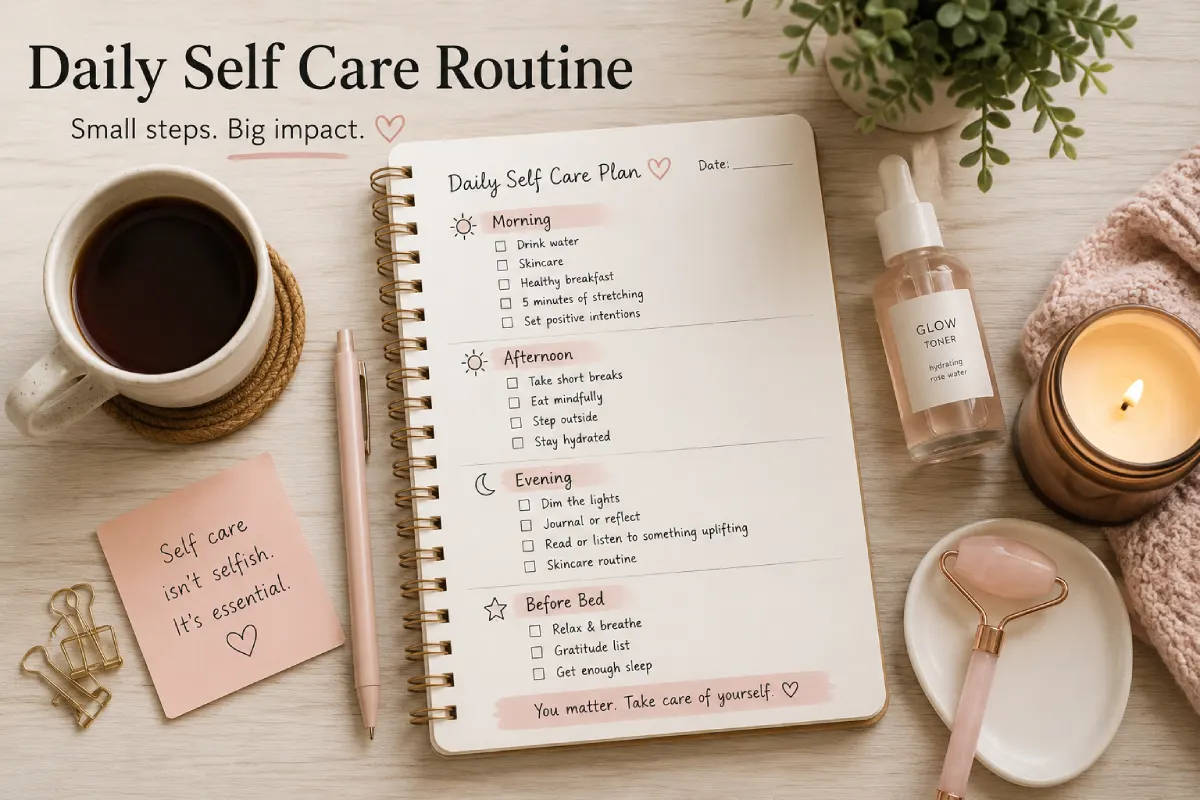
Morning Self Care Routine (10 Minutes)
Mornings set the tone for everything after. You don‘t need a 5 AM wake-up you need three anchors:
- Hydrate than caffeinate (1 minute): A glass of water before your first coffee or chai gets your body up and moving before your nervous system.
- Two-minute skincare done consciously (2min): wash face and moisturizer with true intention, rather than while scrolling. This simple ritual can be something you truly do for yourself.
- Sunshine / fresh air (5 minutes): Take yourself outside or onto a balcony before you get sucked into screens. Morning light controls your body clock.
- Just one thing, not everything on your list (2 minutes): identify one thing you‘d like today to feel like calm, energized, appreciated. Just a quick mental shift before the chaos hits.
A realistic morning self care protocol you can run even on your most hectic day, as none of it eats into any time you just don‘t have:

Evening Self Care Ritual (10 Minutes)
Without doubt, burnout begins in the evening. Not because the day was particularly hard, but because there is no transition when nothing indicates to the body it is stopped.
- A shutdown cue (2 minutes): Fully shut down your laptop, or move your phone into another room. This signals to your brain that the workday is over.
- Skincare (again with purpose): (3 minutes) your evening routine is is when the repair work happens to your skin and when you have a handy built-in, phone-free time slot.
- A 3-line brain dump (3 minutes): jot down what is nagging you. No need to fix it, just need it out of your head before sleeping.
- B) Five minute screen-off (2 min buffer): postures, breaths, or mind free sitting. The highest-leverage habit of any night time self-care routine, due to the enhanced sleep quality it safeguards.
5-Minute Self Care Ideas for the Middle of the Day
You don‘t have to do it all before and after work. Try fitting any of these in while you‘re waiting for the bus, your lunch break or between meetings. The good news is that meaningful self care does not have to be expensive, and you can explore these self care ideas on a budget for more simple and affordable ways to take care of yourself.
- Take a walk around the block leave your phone behind.
- Use a 90- second breathing exercise prior to a stressful phone call.
- Text a friend just to say hello, without any particular purpose.
- Five-minute pause. Sit in your car (or a cozy corner) for five minutes, breathe slowly and steady your nerves, then take a fresh start when you walk through the door.
- Decline one case you know would take from you today.
More examples of why these 5 minute self care ideas matter: Consistency trumps intensity, a 5-minute reset every day will have a better impact than a ritual lasting an hour once a month.
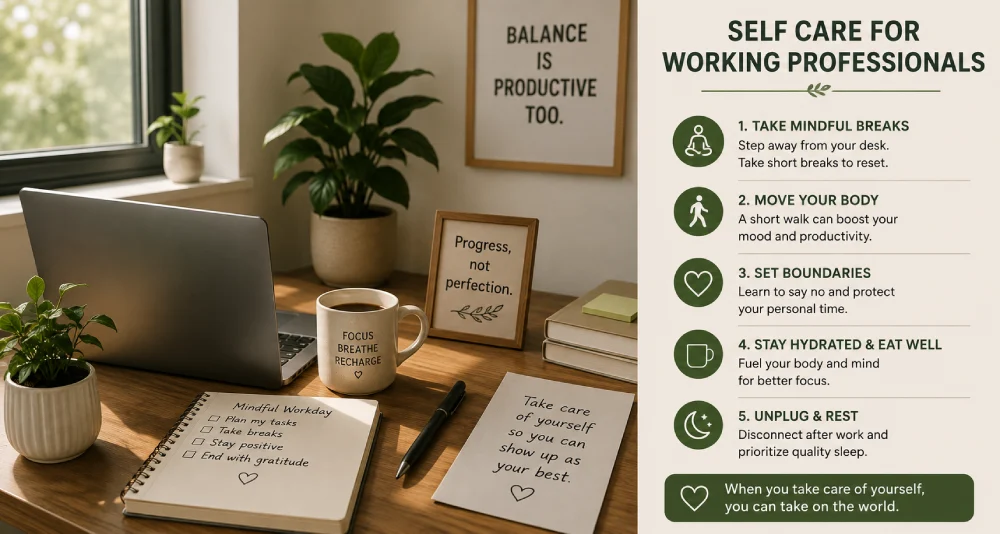
Self Care for Working Professionals: Making It Stick at the Office
The day itself is where most people sacrifice themselves, not just where the effects of it have to be recovered from. Here are a few simple changes that truly make a difference:
- Actually step outside your work environment for a lunchtime break, even if only three times a week.
- Allow a 5-minute gap: having a five-minute interval between consecutive meetings is very beneficial.
- Create a closing ritual turn off your laptop, take a small walk that signifies you are done working.
- For protect, those must be risen or turned off 30 minutes before going to sleep, no matter what day from up to you.
This is the foundation of self care for working individuals, learning to treat the workday as a place to practice boundaries, not just a place that you get through until you are home to take care of yourself.
Common Mistakes That Break a Daily Routine
- Trying to do too much. If you plan to teach fifty minutes and give yourself forty-five, you can‘t get through it, and it gets dropped by Wednesday. Scale it down until you have no choice but to hit it.
- Entertaining the id. Number 4 on the list is “Doing it only when you ‘deserve’ it”. Remember what we said before about self care as a reward. If you follow this advice you‘ll never get there! Think of it as maintaining.
- All-or-nothing thinking, Drwatsondiagnosed.blogspot.com: Missing one day doesn‘t cancel out the whole system (just the one day), just pick back up the next day and move on.
- What about copying someone else’s routine entirely? A 10-step influencer ritual will flounder against your actual routine. Work around your day-to-day life.
Myth vs. Fact
| Myth | Fact |
|---|---|
| A real routine requires a minimum of 30–60 minutes per day | 10 minutes, done every day, is better than 1 hour, done.. well.. rarely |
| Self care is only for the weekend | Daily 5-minute habits are more important than weekend rituals to truly recover form stress. |
| It has taken time to fit in because you have to get up early. | It ‘s also integrated into your existing routines the coffee you already make, the commute you already take. |
Quick Action Steps
- Choose any one morning anchor of what you have listed above and any one evening anchor. That‘s it.
- Always attach each to something do on a daily basis (after brushing your teeth, after locking the car).
- Add one 5-minute mid-day reset thisch week.
- What was good and what could be improved with benefit to the service user. (review after 7 days to see what could be kept or dropped from what had been done previously to benefit the service user)
Having a daily self care practice does not mean doing more. It means guarding a handful of sincere minutes to yourself morning and evening. So that the rest of the day has a reliable base to stand on.
FAQs
Q1. Which daily self care routine is best for beginners? Begin with two anchors. 2 min mindful face-care in morning, 5 min evening screen-off-go-to-bed. Each anchor added only when routine becomes natural.
Question 2. How do time-strapped working folks manage to squeeze in self-care? Attach them to the stuff you already do before it‘s getting in the way hydrate before you get the coffee, establish a shutdown ritual after shutting down your laptop.
Q3. any ideas for quick 5 minute self care? A walk without your phone, a quick breathing exercise, texting a friend, pausing for a few seconds before moving onto the next task of the day all are actual self care.
Q4. Which is a more valuable time for a self care practice: morning or evening? There is no better time because both are necessary; mornings may lay the foundation for the day, but evenings protect one‘s sleep and ease the body back toward homeostasis. Two small practices are more effective than one large one: ten minutes to both sides.
Q5. How long do I need to keep this up before it becomes a habit? Generally, if your new habit is small, and tied to an established habit, you‘ll find you‘re doing it regularly within 2–4 weeks of starting.
Final Conclusion
A daily self care routine doesn‘t ask for a spare hour you haven‘t got it just asks for two un-shared, protected spaces: a few minutes here and there, in the morning and evening, and a five-minute catch-your-breath, when you can. Set one anchor in the morning, one in the evening, hook them to something that already happens in your life and let the routine run its course. That‘s it and it works, even when you have a full week.