Footwear Size Guide: Measure Feet and Compare Sizes
Published: September 25, 2026 Last Updated: September 25, 2026 Your shoe size starts with one number: your foot length
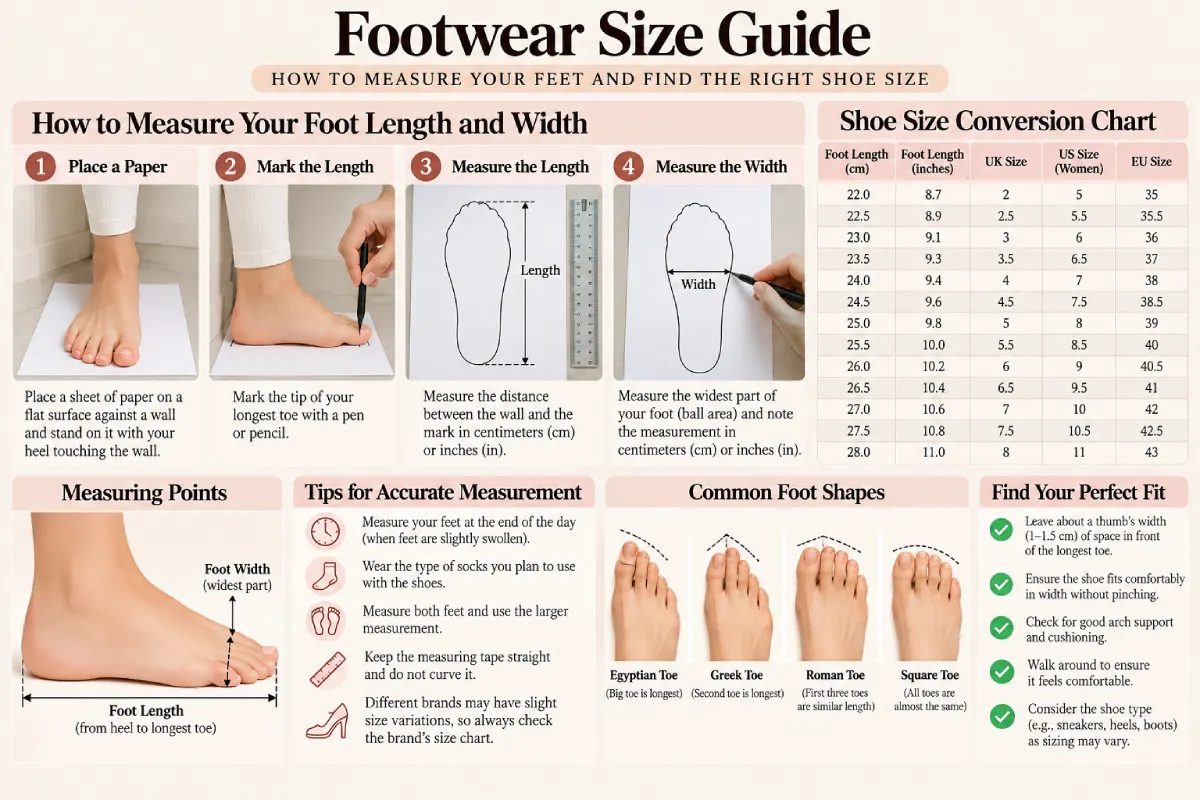
Your shoe size starts with one number: your foot length in centimeters, measured while standing. From that single measurement, you can convert to UK, US, or EU sizing and check it against any brand’s specific chart — which matters because sizes aren’t standardized across brands, and India generally follows the UK numbering system. If you’re between sizes or your two feet differ, this guide also covers exactly what to do.
Most shoe-size confusion isn’t really about your feet — it’s about the fact that “size 8” means something slightly different depending on which brand made the shoe and which country’s sizing system it’s using. A proper footwear size guide fixes this by starting from one fixed point: the actual length and width of your foot, in centimeters. Once you have that, converting between UK, US, and EU sizes — and reading any brand’s specific chart correctly — becomes far more reliable than guessing from memory.
What You Need Before Measuring Your Feet
You don’t need special equipment. Gather a blank sheet of paper larger than your foot, a pencil or pen, a ruler or measuring tape, and a hard, flat floor to stand on. If you have a printed foot-measuring guide from a specific brand, that works too, but a plain sheet of paper is just as accurate.
Measure in the evening rather than first thing in the morning. Feet swell slightly over the course of a day, so an evening measurement reflects the size your foot actually reaches at its largest — which is the size you want your shoes to comfortably accommodate. Wear the type of socks you’d typically wear with the shoe you’re buying, since sock thickness can shift the fit slightly.
How to Measure Foot Length and Width
Length:
- Place the paper against a wall on the hard floor.
- Stand with your heel touching the wall and your weight evenly distributed on both feet.
- Mark the tip of your longest toe on the paper — note that this isn’t always your big toe; for some people the second toe extends slightly further.
- Measure from the wall edge to the mark, in centimeters.
- Repeat for your other foot.
Width:
Wrap a soft measuring tape around the widest part of your foot, which is typically across the ball of the foot just behind the toes, and note that measurement in centimeters as well. If you don’t have a soft tape, mark the widest points on your traced outline and measure the straight-line distance between them with a ruler.
Your two feet are very likely not perfectly identical, and that’s normal rather than a problem. Use the larger of the two length measurements and the larger of the two width measurements as your reference figures — sizing to your larger foot is the standard approach, since a shoe that’s slightly roomy on the smaller foot is far more comfortable than a shoe that’s tight on the larger one.
Understanding UK, US and EU Shoe Sizes
Foot length in centimeters is the anchor measurement that every sizing system is ultimately built from, but each system converts that length into its own numbering.
- UK sizing is based on a unit called the barleycorn, roughly a third of an inch per size step. It’s the system most commonly used for footwear sold in India, and it does not use separate numbering for men’s and women’s shoes the way US sizing does.
- US sizing uses the same barleycorn-based step size as UK sizing but starts counting from a different point, and — unlike the UK system — uses different numbering for men’s and women’s shoes. As a general rule, men’s US sizes run about half a size above the equivalent UK size, while women’s US sizes run about two full sizes above the equivalent UK size.
- EU sizing is based on the Paris point, where each full size equals two-thirds of a centimeter. EU sizing is technically unisex — the same number is used for men’s and women’s shoes at a given foot length — though women’s shoes in a given EU size are typically built on a narrower, shorter last than men’s shoes in that same number.
Here’s an approximate length-to-size comparison across the three systems. Because exact conversions shift slightly by brand, treat this as a reliable starting point rather than a guarantee:
| Foot length (cm) | UK size | US size (women’s) | US size (men’s) | EU size (approx.) |
|---|---|---|---|---|
| 22.5 | 3.5 | 5.5 | 4 | 36 |
| 23.5 | 4.5 | 6.5 | 5 | 37 |
| 24.5 | 5.5 | 7.5 | 6 | 38 |
| 25.5 | 6.5 | 8.5 | 7 | 39–40 |
| 26.5 | 7.5 | 9.5 | 8 | 41 |
| 27.5 | 8.5 | 10.5 | 9 | 42 |
| 28.5 | 9.5 | 11.5 | 10 | 43–44 |
Because footwear sold in India generally follows the UK system, your best starting reference as an Indian shopper is usually the UK column — but always double-check against the specific brand’s own chart, since international brands selling in India sometimes label sizes using their home-market system instead.

How to Read a Brand’s Size Chart
A brand’s own size chart should always take priority over a general conversion table like the one above, because it reflects that brand’s actual last — the foot-shaped mold each shoe is built on — rather than a generic average.
When you open a brand’s size chart, look specifically for:
- The foot-length column in centimeters. This is the most reliable figure to match against your own measurement, more reliable than the size number alone.
- A stated sizing system. Some brands note “runs true to UK sizing” or “US sizing” directly; if this isn’t stated, check whether the chart’s numbers align more closely with the UK or US columns in the table above.
- Width information, if offered. Not all brands publish width options, but if a brand does, and your measured width falls outside the “medium” range, sizing up in length to compensate for a narrow width chart is usually a worse outcome than looking for a brand that publishes a wider option.
- Customer sizing notes, such as “runs small” or “order a half size up.” These notes exist because a brand’s chart doesn’t always perfectly match its actual fit in practice, and they’re often more accurate than the printed numbers alone.
Between Sizes, Unequal Feet and Online Ordering Checks
Two situations account for most sizing frustration, and both have a clear, practical answer.
If you’re between two half sizes: size up rather than down. A shoe with slightly more room at the toe is far more comfortable to wear than one that’s tight, and most materials — leather especially — ease slightly with wear, while a shoe that’s already too short won’t gain the room you need.
If your feet are two different sizes: this is extremely common rather than unusual. Buy based on your larger foot’s measurement. For a shoe with adjustable elements — laces, straps, or buckles — the smaller foot can usually be secured comfortably within a slightly roomier shoe. For slip-on styles with no adjustment, an insole or half-size insert in the shoe for your smaller foot is a practical fix if there’s a noticeable gap.
Before finalizing an online order, run through this quick check: confirm the chart shows foot length in centimeters (not just a size number), confirm which sizing system the brand uses, check for any “runs small/large” notes in reviews or product details, and re-measure your feet if it’s been more than a year since your last measurement — feet do change gradually with age and weight.
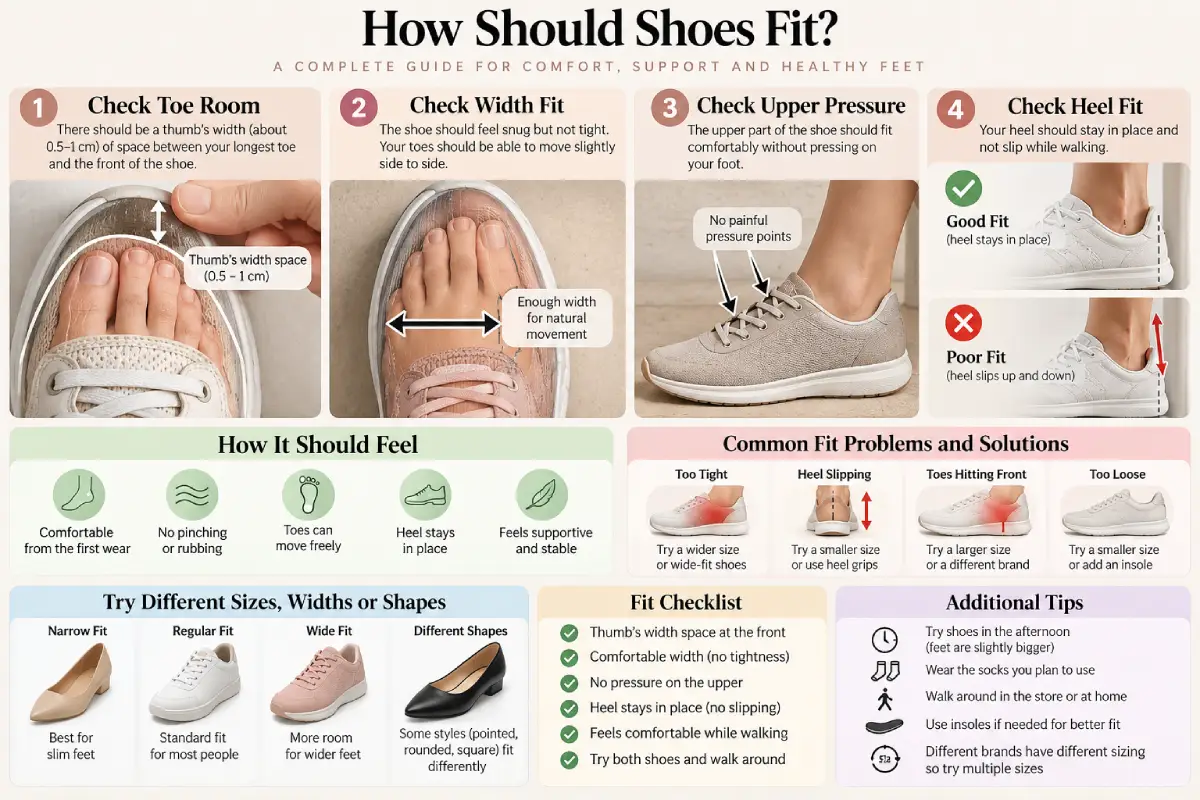
Getting your size right starts and ends with a good foot measurement, converted carefully against the specific brand you’re buying from rather than a size you remember wearing somewhere else. Pair this with a proper in-shoe fit check once the shoes arrive — how a shoe should actually fit covers that next step in detail — and you’ll cut down on returns and discomfort considerably.
FAQs
How do I know if I should use UK, US or EU sizing when shopping in India?
Footwear sold in India generally uses UK sizing, so that’s usually the safest default. However, some international brands label their India listings using their home-market system (often US or EU), so always check the brand’s specific size chart rather than assuming.
What’s the most accurate way to measure my foot at home?
Trace or mark your foot’s length and width while standing on paper in the evening, when feet are at their largest, and measure in centimeters. Foot length in centimeters is the most reliable figure to compare against any brand’s size chart.
Should I size up or down if I’m between two sizes?
Size up. A slightly roomier shoe is more comfortable and safer for foot health than a tight one, and most materials ease slightly with wear rather than stretching to fit a too-small shoe.
My feet are different sizes — what size should I buy?
Buy based on your larger foot’s measurement. Adjustable shoes (laces, straps) can usually be secured comfortably on the smaller foot within a slightly roomier size; for slip-on styles, an insole insert can help fill extra space on the smaller foot.
Why do I wear different sizes in different brands?
Brands build shoes on different lasts — the foot-shaped forms shoes are constructed around — so the same size number can correspond to a different actual foot length or width depending on the brand. This is why checking a brand’s specific centimeter measurement matters more than relying on the size number alone.
Final Conclusion
A reliable footwear size guide comes down to one habit: measure your actual foot length and width in centimeters, and check that figure against the specific brand’s chart rather than trusting a remembered size number. Do that consistently, and UK-to-US-to-EU conversions stop being guesswork — even when you’re buying from a brand you’ve never worn before. Once your size is confirmed, the next step is making sure the shoe actually fits once it’s on your foot, which is exactly what the footwear guide walks through next.