Fashion Accessories Guide: Types and How to Style Them
Published: September 24, 2026 Last Updated: September 24, 2026 Quick Summary: A fashion accessory is anything you wear or
Quick Summary:
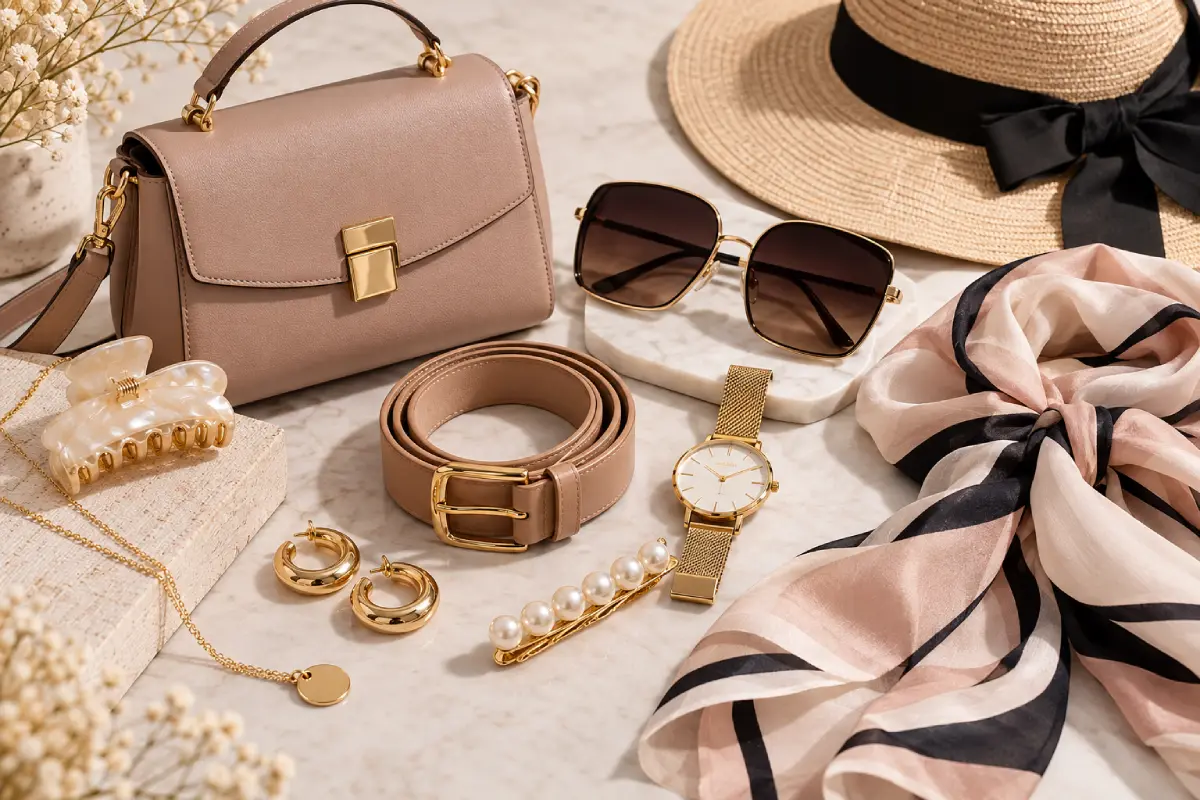
A fashion accessory is anything you wear or carry that complements your clothing – hair accessories, handbags, shoes, jewellery, belts, hats, spectacles, scarves etc. Good accessorising is not about having a cupboard full of them, it’s about learning how to select accessories appropriate to the occasion, relate colours and scale, try before you buy and develop a small, flexible collection that can be mixed and matched. This will be a quick-reference guide to the basics; each category in the list below is expanded in its own, more comprehensive guide to describing how to buy, wear and trouble-shoot.
Most of us don‘t find it hard to purchase clothing. We find it hard to complete our outfit. There‘s nothing wrong with having a wardrobe full of good, basic pieces, yet still feeling like something is lacking when you is in front of the mirror and dressed – and this is usually an accessory
This accessorizing guide is designed to fix just one problem: not “what should I buy,” but rather “how do I think about accessories so that my existing one are used effectively.” You‘ll learn what really makes an item a true accessory, how to combine one piece with your outfit and situation, styling guidelines that help everything look like a plan and not like it was thrown together randomly, foolproof fit checks so you‘re not just guessing your way through the sizes, and a way to create a small, diverse collection instead of a bottomless drawer of never-used tags.
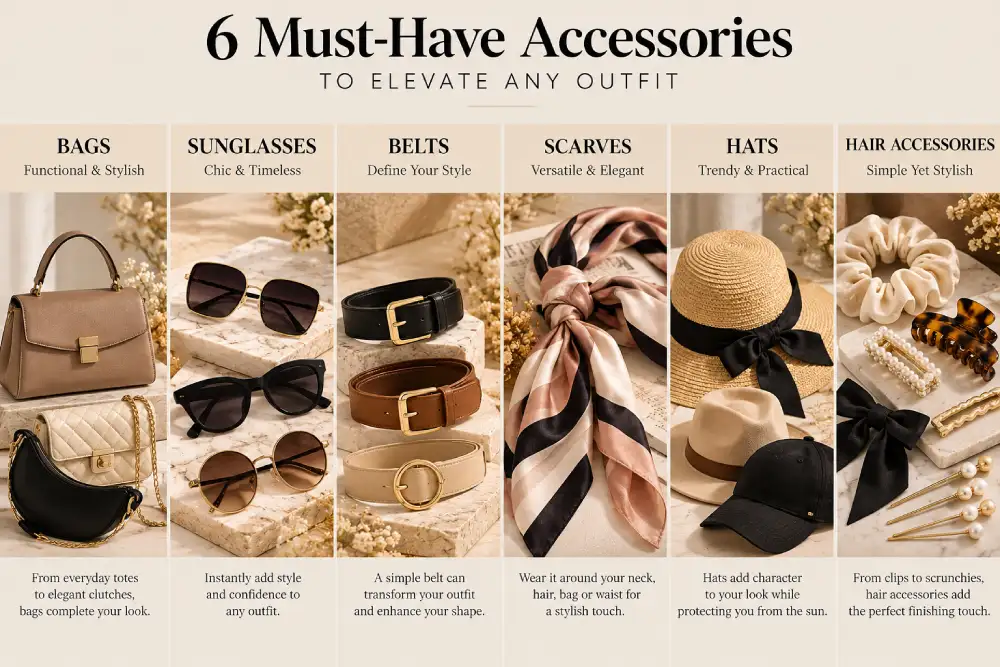
This guide also works as a hub. Each of the six major accessory categories below — hair accessories, sunglasses, handbags, belts, scarves and hats — has its own dedicated, deeper guide linked from this page, so you can get the overview here and go as deep as you need on the category that matters most to you right now.
What Counts as a Fashion Accessory?
A fashion accessory is any item worn or carried alongside clothing that completes, personalises or supports an outfit — without being a garment itself. That covers a wide range: jewellery, hair accessories, sunglasses, handbags, belts, scarves and hats are the core categories most people think of first, but the same definition stretches to watches, gloves and even footwear in the broadest sense.
The Difference Between Functional and Decorative Accessories
With the result that we can loosely separate the accessories into two groups, as they are selected and styled a little differently.
Functional accessories are made for a purpose. A purse fulfills a function, for instance, to hold your personal belongings. Sunglasses are designed to keep sun glare and the sun‘s UV radiance from your eyes. A belt can keep your pantyhose or slacks in position or contribute shape and line to a loose fitting garment. A hat can provide sun protection or barrier from the cold. The functions are priority, then fashion.
Decorative Accessories are about bringing personality. Brooches. Layered bangles. Statement ear rings. A pretty coloured hair slide. They aren‘t about “working” within a sense of function. They just “perform” visually.
In general, most accessories fall in between these two extremes. A classic wrap is both functional and visually interesting. A sleek, structured bag will do the work of both protecting your items and creating a chic, sleek silhouette. But what exactly is any one accessory meant to accomplish? Recognizing what a piece is meant to do for the rest of the look will help you ignore or emphasize it accordinglyä decorative piece can be allowed to be the one bold element in an otherwise quiet outfit.
The Six Accessory Categories This Guide Covers
The guide is structured in six accessory categories, each with its own deep dive page which you can navigate to by clicking down the guide:
- Hair accessories clips, scrunchies, headbands, pins and hairbands
- Sunglasses – how to choose the right frame shape for your face shape
- Handbags general bags, special bags and how to assess quality
-
Belts — types, widths and how sizing actually works
- Scarves Styles of covering, materials, to wear an scarf, occasions to wear the scarf and the time of year to wear them.
- Hats Styles, uses and how to find the right one for you
Jewellery, watches and shoes are included as part of the accessories world, and they come into the discussion above when relevant. However jewellery, watches and shoes deserve more detailed treatment than they are given here – they are integrated into the six categories laid out earlier.
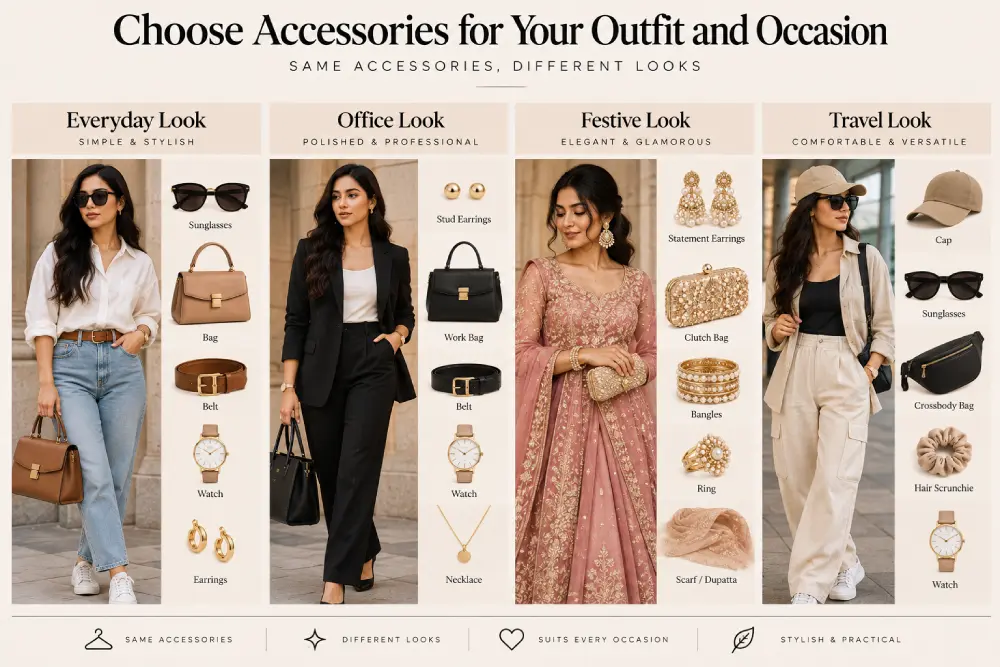
Choose Accessories for Your Outfit and Occasion
The biggest accessorying mistake isn‘t simply choosing the “wrong” item it‘s choosing an item without first having contemplated where you are these days by actually trying to imagine where you‘re wearing it. The amazing mirror selfie accessory can very easily feel totally wrong when you find yourself in a meeting-room, aisle or cattle-class train.
A Simple Occasion Framework
Instead of memorising strict rules for every conceivable event, it‘s far more useful to think in terms of four general occasion types and to ask what each one actually calls for in an accessory.
- Casual/informal. Comfort and ease are paramount. Accessories must last a whole day out from a bag you can really hurl about and tote all day to time-saving footwear edit to simple and snag free jewellery. Bring out all your easy-to-wear, multi-tasking essentials.
- Office and workwear. Accessories here should seem sharp and professional without being a distraction. Professional styling tends to lean toward sculpted bags, keeping jewelry, a good fitting belt and beige or gray accessories.
- Holidays, special occasions and fashion-enthusiast days. When there is no need to break the bank you can be more daring you can wear statement jewellery, luxurious fabrics in scarves and stoles, co-ordinate accessories with the embroidery, texture and colour of ethnic clothing. Since ethnic clothing (sarees, kurta sets, separates etc) is cut differently to Western clothing, the accessories that flatter them (belts that flatter the waist, shaped clutches, multi-layered jewellery) are also different.
- Travel. Nothing too ornate. Good zippers and pockets for everything. Practicality and durability above all. Crossbody, and more than sturdy, sunglasses, hats that pack well and scarves that double as a layering piece all earn a place here.
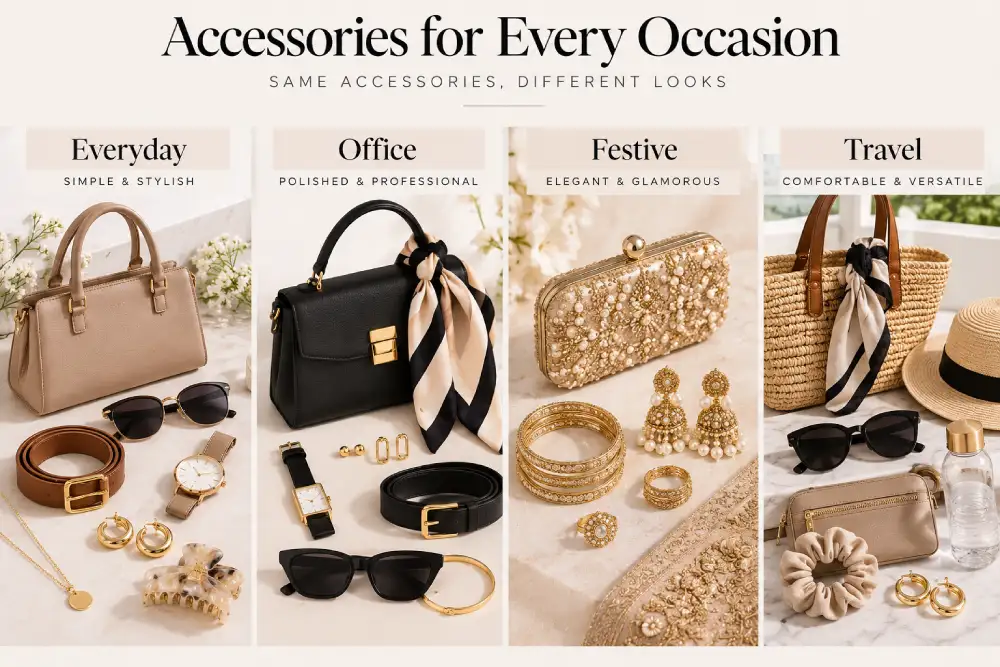
None of these categories is fixed — (“what does this occasion actually need from an accessory?”)
| Occasion | What accessories should ‘full focus’ go on? |
Accessories that tend to work well |
|---|---|---|
| Everyday / casual |
Comfort, durability, easy to carry all day |
Cross-body/tote bag ,4-pair set simple studs, sunglasses, casual scarf |
|
Office / workwear |
Wants to fit in yet stands out, polished but not trying to attract too much attention. | Structured bag, thin belt, lower key accessories, shoes, use of dark-tone items |
| Celebratory – ethnic – formal | In combination with richer fabric and colour, can be daring | Statement jewellery, shaped clutch, broader ornamental belt, stole. |
| Travel | Convenient, safe, easy to transport | Cross-body bag with closeable opening, pack-away hat, durable glasses, light-weight bandana |
This table is merely a guide the correct accessory for you will vary with the climate, your wardrobe and your tastes, but this table is a handy way to give a brief guide of where to go.
Matching Accessories to the Outfit, Not Just the Trend
It‘s tempting to purchase an accessory because it is current and then find that it doesn‘t quite complement the rest of your wardrobe. An easier way to develop one‘s style is to work from what you already own, and identify what is lacking – in terms of color, construction (like having a waistline in your dress) or elevating even the cheapest of t-shirts – in place of working backwards from a trend story.
This is where personal style is relevant again also. If your style is minimalist you‘ll naturally tend to use very delicate jewellery, fewer items of jewelry and accessories in neutral shades; if your style is more flamboyant you‘ll use accessories to be your statement. Neither approach is “better” the point is that your accessories feel appropriate to your choices of manner of dressing, instead of as if you borrowed them.
Balance Colour, Texture and Visual Weight
It‘s not just about buying pieces that you love however. Once you have worked out what an occasion demands, the next thing to learn is how to pull your accessories together so that they work cohesively with each other and the ensemble as a whole. (This comes down to three elements: colour, texture and visual weight.)
The One-Statement-Piece Rule
A handy rule of thumb: pick one accessory as the star feature, and make all else work to support it. For example, if you‘re going for big eye-catching earrings, wear a short-sleeve or strapless dress and forgo your necklace. If your bag is a bright colour or print, keep your jewelry and belt in neutral shades. This isn‘t an ironclad rule many fantastic ensembles layer several bold pieces on purpose but it will help keep an unsightly, accidental feel.
Another common piece of famous styling advice, reputedly from Coco Chanel, ‘before leaving the house, take one thing off’ (which is a variation of the suggestion to pare your accessories down by one piece before leaving) hits the same note: less can seem more thoughtful. For an occasion, you may want to stick to two accessories, selected carefully; for every day, some layering is possible.
Mixing Textures and Metals Without It Looking Accidental
It‘s great to match every accessory to a metal or to the same exact tone, but it can also look a bit rigid. A mixture of gold and silver, or matte and shiny textures, is OK if there is a reason for this variation – a colour family, time period/aesthetic or one main metal and the other used as an accent.
Texture is as important as colour. A silk scarf, a leather handbag with a certain the more structured feel to it and warm coloured jewellery can all sit comfortably with each other because they support rather than compete with each other. An easy tip: if all of your accessories had the same degree of polish, texture, depth of colour, it will look flat; mixing just one slightly matte finish with one slightly shiny finish, one soft fabric with one hold fabric is enough to create interest without appearing too random.
Visual weight completes the equation. chunky statement necklace, huge tote and oversized hat are all “heavy” accessories wearing multiple heavy pieces together can threaten to swamp either a petite frame or a delicate look, and meanwhile equipping your body with many tiny, precious accessories can get visually lost against something bright & blocky. balancing your accessories has to do with weight, too. your accessories to the weight of your outfit — not just the colour — is one of the most reliable ways to make a look feel intentional.
Practical Fit Checks for Bags, Belts, Hats and Sunglasses
It’s all good advice if whatever you’re accessorizing with isn’t quite the right size. This is such an often-forgotten part of accessorising which you can check in a flash before buying or before you style something around a piece you already have.
Quick Fit Checks Before You Buy
Bags:
Test the strap drop (the point at which the bag hangs when worn) in accordance with your height and occasion a bag that hangs too low can seem accidental, while a bag that is too high can feel constricting. A shoulder or cross-body bag that hits comfortable at around hip level tends to be flattering for most body sizes and most outfit combinations whereas a bag that is high at or above the waist is a bit more formal looking or suited to specific casual or formal occasions. Also keep the proportion of size of bag against the size of your overall figure in mind, very large bags can look over powering against a small frame; very tiny bags look out of proportion against a tall frame.
Belts:
Measure at the point on your body where you intend to wear the belt (waist or hips, for a Western style). Note that most belts are sized bigger than pant sizes.
Hats:
The best way to would be to measure correctly. (Use a soft tape measure around the widest part of your head, above your ears and eyebrows, not simply “small/medium/large” guessing and refer to the brand‘s sizing guide rather than assuming a mail order size will fit.) Measure and match the hat‘s brim width to your height and shoulder width. A wide brim that is too wide for your frame will drown you and a narrow brim will look small if you are broad.
Sunglasses:
Verify that the frame width is approximately equal to your face width (does the frames wrap around and protrude noticeably past your face?) and that the bridge is comfortable and not pinching; verify that the temple arms fit over your ears comfortably without pinching and without sliding down. Make sure the sunglasses provide protection against UV rays-; this is a practical issue, not merely a fashion-related one, and it is worth verifying explicitly rather than taking it for granted that darker lenses mean UV protection.
Common Fit Mistakes to Avoid
The single most frequently made fitting error in all four of these categories is choosing based on how an article looks while sitting on a model, a stall, or other printed photo, rather than on you or your own head. Second only to that is believing there is only one size that works for all occasions a mistaken presumption that a daily-bag and an event-bag often truly do have genuinely different optimal proportions (and that‘s ok). Each of the deep-dive guides linked below delves deeper in each category‘s sizing, so that this is a broad, quick-reference beginning rather than a monopoly on all the available options.
Build a Small Collection You Can Wear in Different Ways
The most versatile accessory wardrobes aren‘t the bloated ones they are the ones where you can wear most of your accessories with most of your outfits. You‘ll get much more out of developing that than from adding things randomly one at a time.
The Neutral-Base-Plus-Statement Method
Here is a clever idea to gather a small but high-mileaget collection. Think in two layers.
The neutral base is the accessories you will wear day in day out. All the elements should be versatile basic pieces. For example one reliable everyday bag in a neutral colour that goes with everything. One fairly basic belt that compliments the majority of your entire wardrobe. Single items of simple everyday jewellery and a pair of sunglasses that flatter your face shape and compliment the most part of your wardrobe.
Statement layer: a few less-wearable, stronger objects – a more impressive scarf, or a more noticeable hat, a bag with a bright colour or pattern, distinctive jewellery for the special occasions – that you select when you want your ensemble to say something extra. The fact that your base layer of neutrals is already doing the ‘everyday’ task makes these statement pieces less necessary for practical or multiple wear: they work for their effect.
Seasonal Swap-Ins Without Overbuying
Instead of replacing your entire selection of accessories each season, it’s more eco-friendly and most likely more covetable in any case to simply add a handful of seasonal pieces over your core wardrobe of neutral basics. A summery scarf or sun hat, a deeper coloured scarf or stole, one in a different shape, and a new bag, even a heavier-weight one, will often suffice, without re-purchasing a look-alike you already have.
And here‘s where you should also be mindful of giving into the temptation to pick up an accessory for the sole reason that others are. A trend item that you wouldn‘t wear with anything else in your wardrobe is still costly at wear. Items you actually intend to make room for in your small wardrobe are those you could see with at least a handful of outfits.
How you build this collection should also take India‘s climate into consideration, as it figures more into the equation here than in most style guides for cooler climates. The fierce and lengthy summers in most parts of the country means that fabrics which can keep you cool, sun protection and accessories lighter level weight are 9 months a year and not just for 3 months in the summer season. months and the festive season (which often bring heavier fabrics, richer colours and more formal occasions in close succession) are where the statement layer of your collection tends to get the most use. Building your neutral base around pieces that hold up to heat, dust and frequent wear — and reserving delicate, high-maintenance pieces for the statement layer — tends to work better in practice than following a four-season wardrobe model built for a different climate.
Hair Accessories for Women
Hair accessories are one of the easiest, lowest-cost ways to change how an outfit reads — a plain hairstyle with the right clip, scrunchie or headband can look considered rather than unfinished, and the same outfit can shift from casual to polished depending on which hair accessory you choose.
As for a hub, the key point to grasp is that the categorization of hair accessories can be summarized as mostly functional (i.e. scrunchies, the occasional basic clip, an often largely plain pin) or decorative (embellished claw clips, statement headbands, printed ribbons) – and, just as with the general rule of accessorizing discussed above, selecting one piece as the ‘star of the show’ and layering a few less-conflicting standout items on top tends to look an awful lot sleeker. Hair type makes a bigger impact here than most other accessories – what holds securely and comfortably varies completely depending on the configuration of fine versus coarse, dead straight versus wildly curly.
Occasion is relevant in here as well, but in a more limited analogy of the previous structure: a basic, unadorned cotton scrunchie or a straightforward clip is enough for a simply dressed, easy-to-manage use of hair, whereas decorating the head with a festive flat headband, or an event-appropriate rhinestone pin or a uniformity choice of several small clips can alter a celebration-appropriate hair-do without redoing the hair left intact.
This overview only scratches the surface. Our dedicated hair accessories for women guide covers specific accessory types in depth, which ones suit different hair types and textures, and how to choose pieces for everyday wear versus special occasions.
Sunglasses for Every Face Shape
It is head-wear, in many ways; not only are sunglasses extremely practical accessories they shield your eyes against glare and harmful ultra-violet radiation but they rest on the face, making them hard to ignore. This makes the fit and shape of sunglasses particularly important:
What needs to be grasped at hub level is that frame shape and face shape generally sit best in “contrast” with one another: that is, rounder frame shapes are good for “taming” rounder faces, and more angular or geometric frame shapes are good for “defining” softer, rounder faces. This is a principle of matching, more than a set of rules-by which there are many rules: there are many more frames that suit a face than ones that don‘t, and it‘s up to you and the customer to consider which suit best.
Apart from shape, all of the fit tests that I discussed earlier in this guide (frame width, bridge comfort, temple length, and confirming that your lenses offer true UV protection) are eminently applicable to sunglasses, and they count far more than most customers understand; stunning frames that bite a little at the bridge of your nose or slip down between your cheek and nose won‘t last.
Sunglasses are also one of more climate affected accessories on this list with strong sun exposure across most of India for a large part of the year, they function as genuine eye protection rather than a purely optional styling extra, which is worth keeping in mind if you’ve been treating them as a fair-weather accessory rather than a year-round one.
For a full breakdown of frame shapes, how to identify your own face shape, and how to match the two with confidence, see our dedicated sunglasses for face shape guide.
Handbags: Choosing an Everyday Bag That Works Harder
A handbag may be the most used functional accessory most of us own, which is precisely why for your everyday bag winning the choice is more important than for one time only bags. A functional everyday bag has to make its own case: it should be just the right size for what you really carry, and have a strap or handle drop comfortable for hours, and either a colour or fabric that will I fit in with most of your wardrobe rather than one outfit.
The only really useful differentiation at the hub level is between an all-rounder a bag you choose because it is good value, reliable, large and fits everything in, one that will do for every day whatever you need to carry and whatever the weather, and the occasion bag, a bag you choose primarily because it looks smart, well-matched and elegant with one particular outfit, where the practicality is an almost non-issue. And the trouble is, most unhappy customers and users are trying to do the double. The bag isn‘t wrong, just the occasion & all-rounder.
Material and hardware quality are also deserve a brief consideration prior to purchase as they determine durability of a bag after months of everyday use but the specific buying checklist with pertinent questions on how to evaluate hardware/material quality, structure of a bag, etc. may be found in the guide rather than here.
For the full buying framework — sizing, material checks, structure types and how to build a small, versatile bag collection — see our dedicated how to choose an everyday handbag guide.
Belts: Types, Sizing and Styling
Belts occupy fascinating territory: They are truly functional accessories for some ensembles (to keep trousers up and to give a garment the right hang) yet entirely ornamental for others (to define a dress‘s or kurta‘s waist purely for shape). this dual function, belt styling is very much outfit-dependent:
The most common error (done in detail in the fit-checks section above) is designing a belt length as you would for trousers there are other factors involved in belt sizing so most belts should be sized separately. Width is just as important as length in fact narrow belts can look more delicate or formal; wider belts are more visually obvious and are better to emphasize the waist over dresses/ kurtas.
The choices in belt styling, however, extend beyond size. They involve selecting a style of belt that fits the level of formality and visual proportion (width) of the corresponding clothing, a guideline that parallels the occasion diagram discussed in the previous section of this guide.
Material also influences how a belt will wear: leather and leather-look belts naturally adapt to the wearer‘s shape and keep their form; while fabric or woven belts are often lighter and more casual but offer less structure for cinching or shaping an outfit.
Our dedicated belts guide goes deeper into belt types, width-by-occasion guidance, and precise sizing method.
Scarves: How to Wear a Scarf
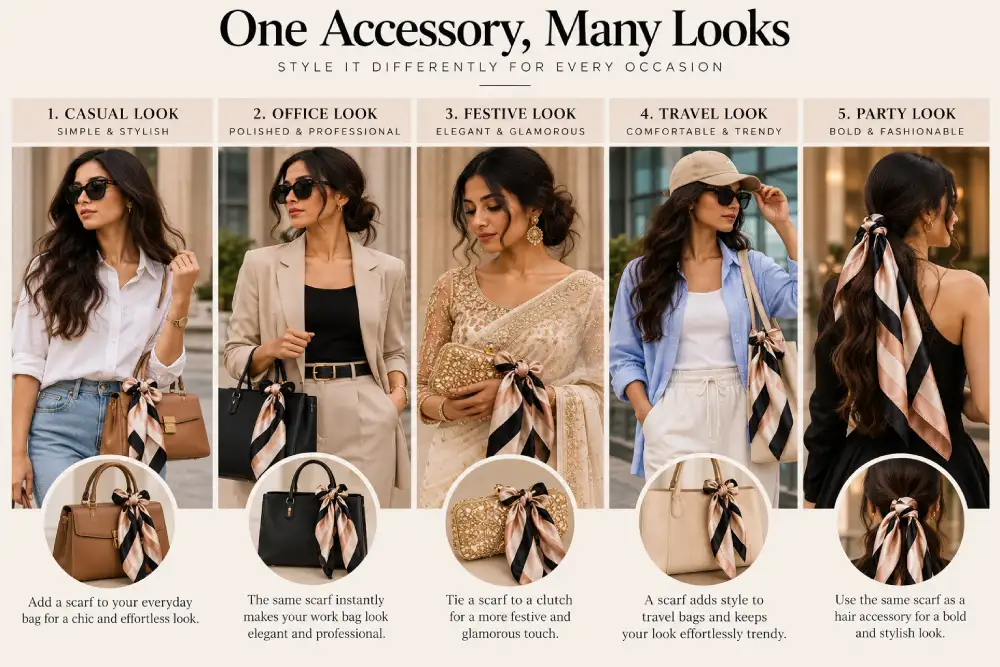
The scarf is one of the all-time most flexible accessories in terms of absolute value (per item). The same item works either as a neck tie, shawl, a headwrap, a hair wrap, or a handbag handle wrap.
At hub level, the two things to understand are fabric and season. Lighter fabrics (fine cotton, light silk, etc.) are appropriate for warmer months, providing colour or pattern without excess heat, while heavier fabrics (wool blends, heavier silk, pashmina-like weaves) will actually provide warmth and are appropriate for cooler months or evening wear. For most accessories, the season/fabric match is not so important, but for scarves, it is important to get the match right; a lovely scarf in the wrong season‘s fabric, no matter how attractive, will not be worn.
The actual tying methods – and there are far more than most people give them credit for – are where the true style potential of a scarf is, but that is precisely what the dedicated cluster guide is there for and not this general overview.
Perhaps most oddly, scarves make excellent travel accessories, since several can be used as a neck band, a light layer. against air-conditioning, a hair cover, or even an improvised bag accent — which is worth keeping in mind if you’re building the small, versatile collection described earlier in this guide.
For step-by-step tying techniques, fabric guidance by season, and how to build a scarf into different outfit types, see our dedicated how to wear a scarf guide.
Types of Hats for Women and How to Style Them
Hats can often clearly separate into two teams: those who will bear any hat with confidence, and those who feel silly… it is often a matter of success in choosing the right type for the occasion as well as for a particular face shape.
For hats, at a summary level it can also be useful to be aware of categories of hats and their general functions: certain categories are functional and valuable in India‘s climate (wide-brim hats, sunhats) for a large part of the year. others fall more into the category of ornaments that complement an outfit (berets, structured caps, fedora-type headlines).and like with sunglasses, there is a general rule of thumb based on face-shape that is useful to be aware of: a brim shape and crown height that balances gently with your face shape is most likely to be a good place to start and experiment, but is not a strict requirement.
Fit (which was touched on in the fit-checks above) is crucial to hats, in particular head circumference is the metric that truly reflects a hat‘s comfort and fit, not the vague “small/medium/large” sizes that a good number of hats are sold as.
Apart from style, actually very useful for most of the Indian year on the whole choose a broad brimmed or structured cap as appropriate can meaningfully reduce sun exposure on hot days, which is a good reason to treat hats as a functional wardrobe staple rather than only reaching for one on holiday.
Our dedicated types of hats for women guide covers each hat style in depth, face-shape suitability, and how to style hats for different occasions.
Frequently Asked Questions
What is the difference between an accessory and jewellery?
Jewellery – rings, necklaces, earrings and bracelets – is just one part of the world of fashion accessories. Broader term ‘fashion accessories’ also covers hair bands, sunglasses, shoes, handbags, hats, belts, watches and scarves.
How many accessories is too many?
There isn‘t really a rule of thumb, but a good rule of thumb is to pick one piece that is meant to be the heavy hitter and keep the other pieces more subtle or understated, particularly for an office or professional setting. However, outdoor or casual settings can generally handle more layers.
Do accessories need to match exactly?
No. Accessories don‘t have to match perfectly (in colour, metal or finish) as an ensemble, indeed this can often be a bit too ‘done’. A common colour tone, sense of the same level of formality or a conscious contrast of texture often works best.
What accessories should I buy first if I’m starting from scratch?
A functional everyday bag, comfortable belt, basic everyday jewellery and the right sunglasses to flatter your face shape make a good foundational starting point, as these are the items worn most commonly by most people. Starting with there, add statement pieces (a distinctive scarf, a hat, occasion jewellery) as you identify genuine gaps in your existing outfits.
How do I know if an accessory actually fits before I buy it online?
Check the brand’s specific measurements (strap drop for bags, waist/hip measurement for belts, head circumference for hats, frame width for sunglasses) against your own measurements, rather than relying on generic size labels like small, medium or large, which vary significantly between brands.