Fashion Accessories Guide: Types and How to Style Them
Published: September 24, 2026 Last Updated: September 24, 2026 Quick Summary: A fashion accessory is anything worn or carried
Quick Summary:
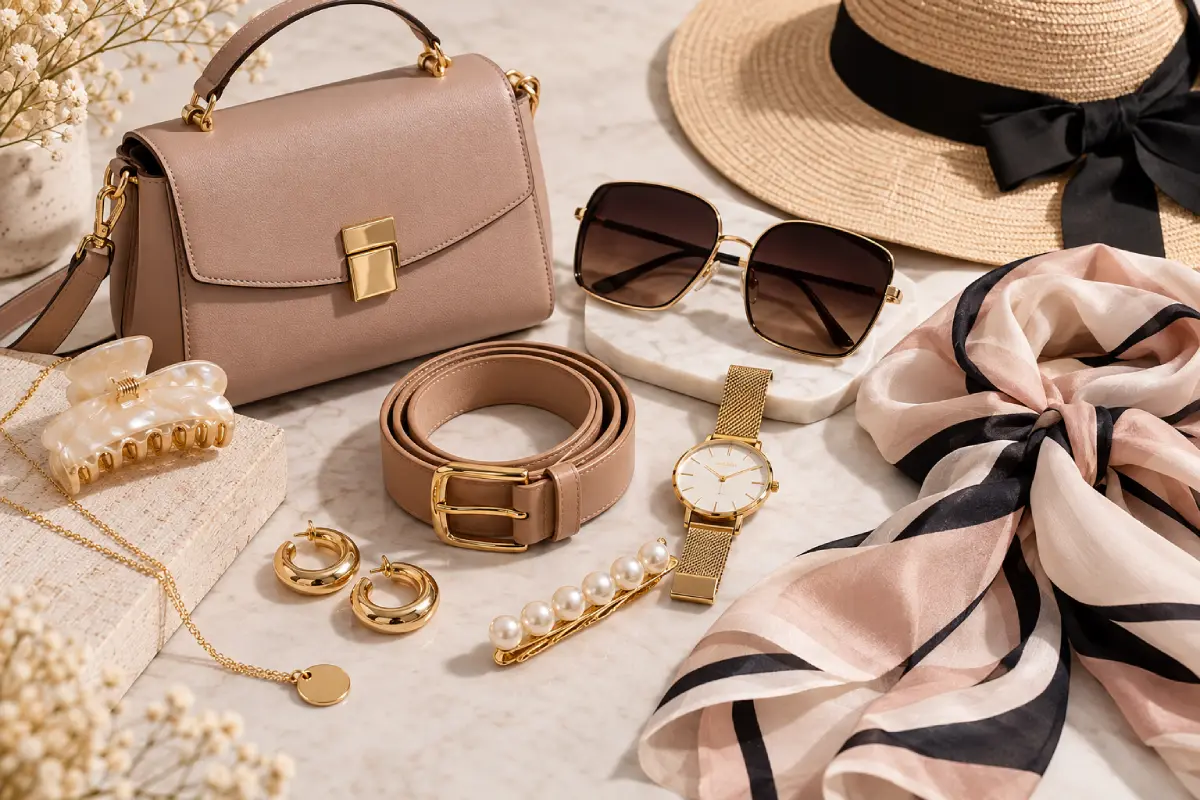
A fashion accessory is anything worn or carried alongside clothing — hair accessories, sunglasses, handbags, belts, scarves, hats, and jewellery among them — that finishes, protects, or personalises an outfit. Good accessorising is less about owning more pieces and more about matching accessories to the occasion, balancing colour and visual weight, checking fit before you buy, and building a small, versatile collection that can be worn in different combinations. This guide explains the core principles at a glance; each accessory category listed below has its own dedicated, deeper guide for detailed buying advice, styling techniques and troubleshooting.
Most people don’t struggle to buy clothes. They struggle to finish a look. You can own a wardrobe full of good basics and still feel like something’s missing when you’re dressed and standing in front of the mirror — and more often than not, that “something” is accessories.
This fashion accessories guide is built to solve a specific problem: not “what should I buy,” but “how do I think about accessories so that what I already own works harder.” You’ll get a clear definition of what actually counts as a fashion accessory, a simple framework for matching accessories to your outfit and occasion, the styling principles that make accessories look intentional rather than random, practical fit checks so you stop guessing at sizing, and a method for building a small, versatile collection instead of an overflowing drawer of pieces you never reach for.
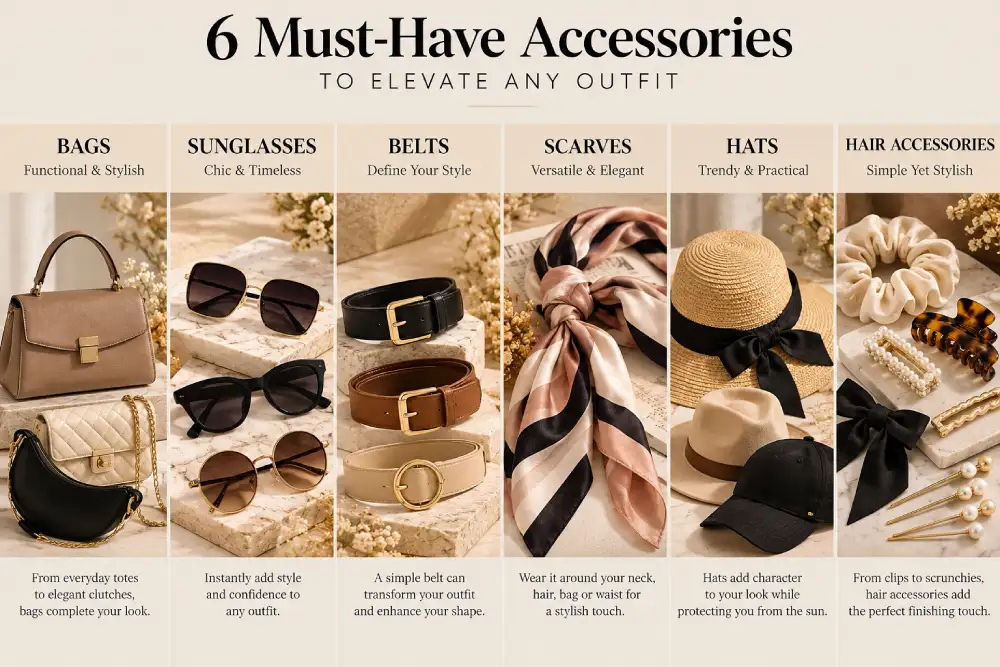
This guide also works as a hub. Each of the six major accessory categories below — hair accessories, sunglasses, handbags, belts, scarves and hats — has its own dedicated, deeper guide linked from this page, so you can get the overview here and go as deep as you need on the category that matters most to you right now.
What Counts as a Fashion Accessory?
A fashion accessory is any item worn or carried alongside clothing that completes, personalises or supports an outfit — without being a garment itself. That covers a wide range: jewellery, hair accessories, sunglasses, handbags, belts, scarves and hats are the core categories most people think of first, but the same definition stretches to watches, gloves and even footwear in the broadest sense.
The Difference Between Functional and Decorative Accessories
It helps to separate accessories into two loose groups, because they get chosen and styled slightly differently.
Functional accessories exist primarily to do a job. A handbag carries your things. Sunglasses protect your eyes from glare and UV exposure. A belt can hold trousers up or help a loose garment sit properly at the waist. A hat can shield you from sun or cold. These pieces are chosen first for how well they perform that job — size, fit, material durability — and second for how they look.
Decorative accessories exist primarily to add personality and visual interest. Statement earrings, a brooch, a patterned hair clip, layered bracelets — these don’t need to “do” anything functional; their job is entirely about how they read visually.
Most accessories actually sit somewhere between the two. A well-chosen scarf can keep you warm and be the most eye-catching part of an outfit. A structured handbag protects your belongings and signals a polished, put-together look at the same time. Knowing which purpose a piece is primarily serving helps you decide how much weight to give it when you’re building a look — a purely functional piece can often be simple and neutral, while a decorative piece can be allowed to be the one bold element in an otherwise quiet outfit.
The Six Accessory Categories This Guide Covers
This guide is organised around six accessory categories, each with a dedicated deep-dive page linked from the relevant section below:
- Hair accessories — clips, scrunchies, headbands, pins and hairbands
- Sunglasses — frame shapes and how they relate to your face shape
- Handbags — everyday bags, occasion bags and how to judge quality
- Belts — types, widths and how sizing actually works
- Scarves — fabric choices, ways to wear one and seasonal use
- Hats — styles, occasions and how to choose one that suits you
Jewellery, watches and footwear are part of the wider accessories world and are referenced throughout this guide where relevant, but they are not covered in the same depth here, since this guide’s structure is built around the six categories above.
Choose Accessories for Your Outfit and Occasion
The single biggest accessorising mistake isn’t picking the “wrong” piece — it’s picking a piece without first thinking about where you’re actually wearing it. An accessory that looks brilliant in a mirror selfie can feel completely wrong once you’re standing in a meeting room, a wedding hall, or on a long train journey.
A Simple Occasion Framework
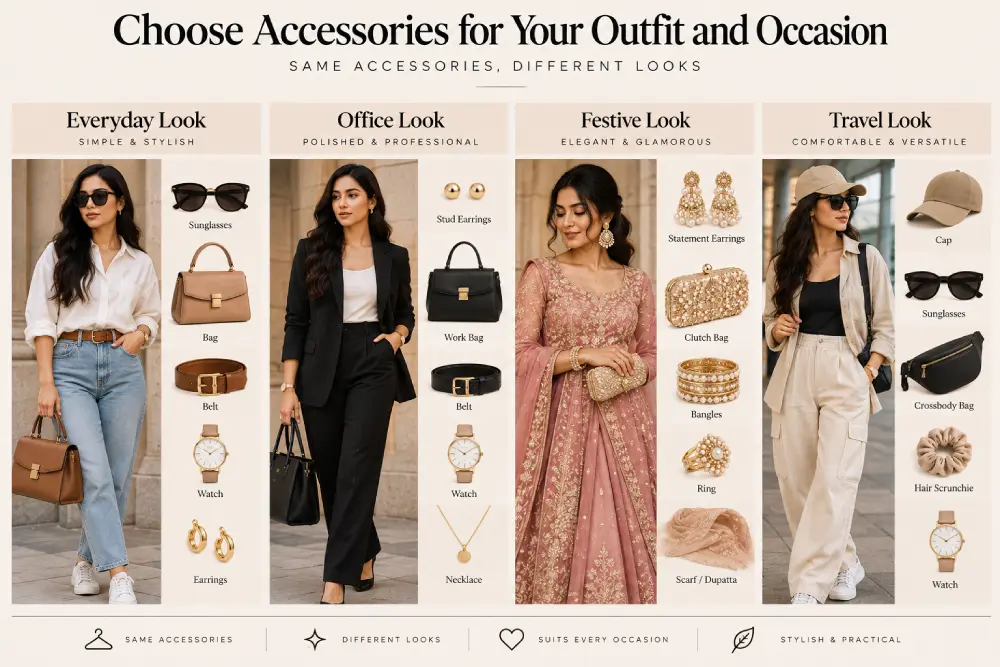
Rather than memorising rigid rules for every possible event, it’s more useful to think in terms of four broad occasion types and ask what each one actually demands from an accessory.
- Everyday and casual. Comfort and practicality come first. Accessories should be able to survive a full day out — a bag you can actually carry for hours, footwear-friendly styling, minimal jewellery that won’t catch on things. This is where your most versatile, lower-maintenance pieces earn their keep.
- Office and workwear. Accessories here should read as polished without competing for attention in a professional setting. Structured bags, simple jewellery, a well-fitted belt and neutral-toned accessories tend to work harder than anything oversized or very bold.
- Festive, ethnic and formal occasions. This is where you can afford to be bolder — statement jewellery, richer fabrics in scarves and stoles, and accessories that coordinate with embroidery, colour and texture in ethnic wear. Because sarees, kurta sets and other ethnic silhouettes are cut differently from Western clothing, the accessories that flatter them (waist-defining belts, structured clutches, layered jewellery) often differ from what you’d reach for with jeans and a shirt.
- Travel. Practicality and durability matter more than anything decorative. Cross-body bags, sturdy sunglasses, hats that pack well and scarves that double as a layering piece all earn a place here.
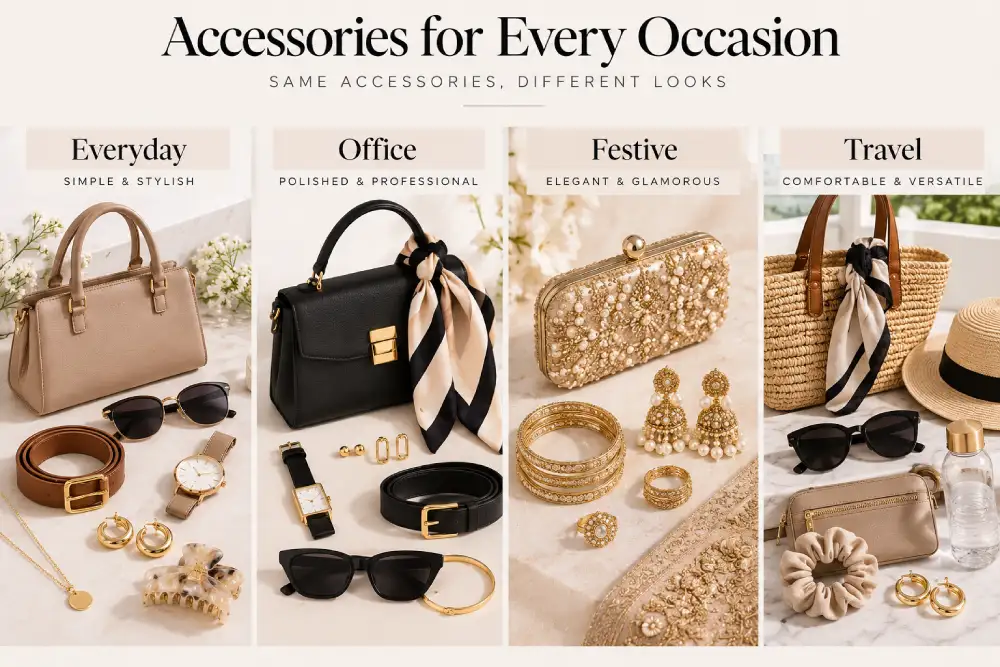
None of these categories is fixed — (“what does this occasion actually need from an accessory?”)
| Occasion | What accessories should prioritise | Accessories that tend to work well |
|---|---|---|
| Everyday / casual | Comfort, durability, easy to carry all day | Cross-body or tote bag, simple stud earrings, sunglasses, casual scarf |
| Office / workwear | Polished but not attention-seeking | Structured bag, thin belt, minimal jewellery, neutral-toned pieces |
| Festive / ethnic / formal | Coordinated with richer fabric and colour, can be bolder | Statement jewellery, structured clutch, wider decorative belt, stole |
| Travel | Practical, secure, easy to pack | Cross-body bag with secure closure, packable hat, sturdy sunglasses, lightweight scarf |
This table is a starting point, not a rulebook — the right accessory for you will also depend on climate, personal style and what you already own, but it’s a useful quick check when you’re deciding what to reach for.
Matching Accessories to the Outfit, Not Just the Trend
It’s easy to buy an accessory because it’s trending and then struggle to fit it into your actual wardrobe. A more reliable approach is to start from the outfit you already have and ask what it’s missing — a pop of colour, a structural element at the waist, a way to elevate a plain top — rather than starting from a trend report and working backwards.
This is also where personal style comes in. Someone who leans minimalist will naturally reach for finer jewellery, simpler bags and understated colours; someone who prefers a bolder aesthetic will use accessories as the main way to express that. Neither approach is more “correct” — the goal is that your accessories feel consistent with how you actually dress, not borrowed from someone else’s aesthetic.
Balance Colour, Texture and Visual Weight
Once you know what an occasion calls for, the next skill is making sure your accessories don’t fight each other — or the outfit — for attention. This comes down to three things: colour, texture and visual weight.
The One-Statement-Piece Rule
A useful starting principle: choose one accessory to be the focal point, and let everything else support it. If you’re wearing bold statement earrings, keep your necklace minimal or skip it. If your handbag is a strong colour or print, let your jewellery and belt stay neutral. This isn’t a strict law — plenty of great looks layer multiple bold elements deliberately — but as a default, it prevents an outfit from looking cluttered or accidental.
A related, well-known piece of styling advice attributed to Coco Chanel — to remove one accessory before leaving the house — captures the same idea: restraint often reads as more considered than abundance. For formal settings, this can mean limiting yourself to two well-chosen pieces; for casual settings, you generally have more room to layer.
Mixing Textures and Metals Without It Looking Accidental
Matching every accessory in the same metal or exact same tone can look polished, but it can also look stiff. Mixing gold and silver, or matte and shiny finishes, works well as long as there’s a reason for the mix — a consistent colour family, a shared era or aesthetic, or one dominant metal with the other used sparingly as an accent.
Texture matters just as much as colour. A smooth silk scarf, a structured leather bag and soft, warm-toned jewellery can sit together beautifully because the textures complement rather than compete. As a simple check: if every accessory in your outfit has the same finish, texture and colour intensity, the look can read as flat; a small amount of contrast — one matte piece against one shiny piece, one soft fabric against one structured one — usually adds interest without looking chaotic.
Visual weight is the last piece of the puzzle. A chunky statement necklace, a large tote and an oversized hat are all “heavy” accessories — wearing several heavy pieces together can overwhelm a smaller frame or a delicate outfit, while several small, delicate pieces can get visually lost against a bold, structured outfit. Matching the weight of your accessories to the weight of your outfit — not just the colour — is one of the most reliable ways to make a look feel intentional.
Practical Fit Checks for Bags, Belts, Hats and Sunglasses
Style advice only gets you so far if the accessory itself doesn’t actually fit. This is one of the most overlooked parts of accessorising — and it’s worth a few quick checks before you buy or before you style a look around a piece you already own.
Quick Fit Checks Before You Buy
Bags:
Check the strap drop (how low the bag sits when worn) against your height and the occasion — a bag that sits too low can look unintentional, while one that sits too high can feel restrictive. A shoulder or cross-body bag that hits roughly at hip level tends to suit most heights and most outfits, while a bag that sits at or above the waist can feel more formal or occasion-specific. Also check the bag’s proportion against your own frame: very large bags can overwhelm a petite frame, and very small bags can look out of scale on a taller frame.
Belts:
Measure at the point you’ll actually wear the belt (waist or hip, depending on the style), not just your general trouser size, since belt sizing typically runs larger than clothing size to account for the buckle and loop placement. As a general guide, look for at least two to three comfortable adjustment holes rather than buying a belt that only just fits on the tightest setting, so you have room to adjust as needed across different outfits or over time.
Hats:
Head circumference, not “small/medium/large” guesswork, is the most reliable measurement — if you can, measure around the widest part of your head (above the ears and eyebrows) with a soft tape and compare it to the brand’s size chart rather than assuming a generic size will fit. Brim width should be considered against your height and shoulder width — a very wide brim can overwhelm a petite frame, while a narrow brim can look undersized on a larger frame.
Sunglasses:
Check that the frame width roughly matches your face width (the frame shouldn’t extend noticeably beyond the edges of your face), that the bridge sits comfortably without pinching, and that the temple arms reach your ears without pressure or sliding. Beyond fit, always confirm the lenses offer UV protection — this is a functional requirement, not just a styling one, and it’s worth checking explicitly rather than assuming darker lenses automatically mean better protection, since tint and UV filtering are not the same thing.
Common Fit Mistakes to Avoid
The most common fit mistake across all four categories is buying based on how a piece looks on a stand, a model, or in a product photo rather than on your own body or head. A second common mistake is assuming one size works for every occasion — an everyday bag and an occasion bag often have genuinely different, correct proportions, and that’s fine. Each of the deep-dive guides linked below goes further into category-specific sizing, so this section is intentionally a quick-reference starting point rather than the full picture.
Build a Small Collection You Can Wear in Different Ways
The most versatile accessory wardrobes aren’t the biggest ones — they’re the ones where most pieces can be combined with most outfits. Building toward that is more useful than buying reactively, piece by piece, whenever something catches your eye.
The Neutral-Base-Plus-Statement Method
A practical way to build a small, high-mileage collection is to think in two layers.
The neutral base covers the accessories you’ll reach for most often: one well-fitted everyday bag in a versatile neutral colour, one belt that works with most of your trousers and dresses, simple everyday jewellery, and a pair of sunglasses that suits your face shape and goes with most of your wardrobe. These pieces are chosen for versatility first, so they should be relatively understated.
The statement layer covers a smaller number of bolder pieces — a standout scarf, a distinctive hat, a bag in a strong colour or print, statement jewellery for occasions — that you bring in deliberately when you want an outfit to say more. Because your neutral base is already doing the “everyday” job well, statement pieces don’t need to be practical or versatile in the same way; they earn their place through impact rather than frequency of use.
Seasonal Swap-Ins Without Overbuying
Rather than buying a completely new set of accessories every season, it’s more sustainable — and usually more stylish — to swap in a small number of seasonal pieces on top of your existing neutral base. A lighter scarf and sun hat for warmer months, a richer-toned scarf or stole and a structurally different bag for cooler months or the festive season, are usually enough to refresh a look without duplicating pieces you already own in a similar role.
This is also where it’s worth resisting the urge to buy an accessory just because it’s trending. A trend piece that doesn’t combine with anything else in your wardrobe is expensive per wear, however striking it looks in isolation. Pieces that earn a place in a small collection are the ones you can genuinely picture wearing with three or four different outfits, not just one.
India’s climate is also worth factoring into how you build this collection, since it plays a bigger role here than in many colder-climate style guides. Long, intense summer heat across much of the country makes breathable fabrics, sun protection and lighter-weight accessories more of a year-round consideration than a purely seasonal one, while the shorter cooler months and the festive season (which often bring heavier fabrics, richer colours and more formal occasions in close succession) are where the statement layer of your collection tends to get the most use. Building your neutral base around pieces that hold up to heat, dust and frequent wear — and reserving delicate, high-maintenance pieces for the statement layer — tends to work better in practice than following a four-season wardrobe model built for a different climate.
Hair Accessories for Women
Hair accessories are one of the easiest, lowest-cost ways to change how an outfit reads — a plain hairstyle with the right clip, scrunchie or headband can look considered rather than unfinished, and the same outfit can shift from casual to polished depending on which hair accessory you choose.
At a hub level, the main thing to understand is that hair accessories broadly split into functional pieces (scrunchies, plain pins, basic clips that hold hair in place) and decorative pieces (embellished claw clips, statement headbands, patterned ribbons) — and, much like the wider accessorising principle covered above, choosing one to be the visual focus rather than layering several competing pieces usually looks more intentional. Hair type also matters more here than with most other accessories: what sits well and stays in place varies significantly between fine, thick, curly and straight hair.
Occasion matters here too, in a smaller-scale echo of the framework covered earlier: a plain cotton scrunchie or a simple clip suits an everyday, low-maintenance look, while a decorative headband, an embellished pin or a set of coordinated clips can lift hair styled for a festive outfit or a special occasion without requiring a completely different hairstyle.
This overview only scratches the surface. Our dedicated hair accessories for women guide covers specific accessory types in depth, which ones suit different hair types and textures, and how to choose pieces for everyday wear versus special occasions.
Sunglasses for Every Face Shape
Sunglasses do two jobs at once: they’re one of the most functional accessories you own — protecting your eyes from UV exposure and glare — and, because they sit directly on your face, they’re also one of the most noticeable. That combination is why getting the fit and shape right matters more here than with almost any other accessory category.
The core idea worth understanding at hub level is that frame shape and face shape work best in a kind of contrast relationship: rounder frames tend to soften angular faces, while more angular or geometric frames tend to add definition to softer, rounder faces. This is a starting principle rather than a strict rule — plenty of frame shapes work well on plenty of face shapes, and personal preference matters as much as any formula.
Beyond shape, the practical fit checks covered earlier in this guide (frame width, bridge comfort, temple length, and confirming genuine UV protection) apply directly here, and they matter more than most buyers realise — a beautiful frame that pinches at the bridge or slides down your nose won’t get worn for long.
Sunglasses are also one of the more climate-driven accessories on this list — with strong sun exposure across most of India for a large part of the year, they function as genuine eye protection rather than a purely optional styling extra, which is worth keeping in mind if you’ve been treating them as a fair-weather accessory rather than a year-round one.
For a full breakdown of frame shapes, how to identify your own face shape, and how to match the two with confidence, see our dedicated sunglasses for face shape guide.
Handbags: Choosing an Everyday Bag That Works Harder
A handbag is arguably the most-used functional accessory most people own, which is exactly why getting the everyday choice right matters more than any single occasion bag. An everyday bag needs to genuinely earn its place: the right size for what you actually carry, a strap or handle drop that’s comfortable over hours of wear, and a colour or material that realistically goes with most of your wardrobe rather than one outfit.
At the hub level, the most useful distinction to understand is between an everyday bag — chosen primarily for practicality, comfort and versatility — and an occasion bag — chosen more for how it looks and coordinates with a specific outfit, where practicality can reasonably take a back seat. Trying to make one bag do both jobs is usually where dissatisfaction creeps in; it’s rarely the wrong bag, just the wrong bag for that particular use.
Material and hardware quality are also worth a moment’s thought before you buy, since they affect how well a bag holds up over months of regular use — but the detailed buying checklist, including how to judge material and hardware quality and how to choose between bag structures, belongs in the dedicated guide rather than here.
It’s also worth thinking about what you actually carry day to day before choosing a size — a bag bought for how it looks on a shelf but too small for your phone, wallet, keys and daily essentials tends to get replaced within months, which makes it a poor long-term investment regardless of how well-made it is.
For the full buying framework — sizing, material checks, structure types and how to build a small, versatile bag collection — see our dedicated how to choose an everyday handbag guide.
Belts: Types, Sizing and Styling
Belts sit in an interesting spot: genuinely functional for some outfits (holding trousers in place, helping a garment sit correctly) and purely decorative for others (cinching a dress or kurta at the waist purely for shape). Because of that dual role, belt styling depends heavily on which job the belt is doing in a specific outfit.
The most common mistake, covered briefly in the fit-checks section above, is sizing a belt the same way you’d size trousers — belt sizing typically needs its own measurement, taken at the point you’ll actually wear it, since buckle and loop placement affect where a “true” fit falls. Width matters just as much as length: narrower belts tend to read as more formal or delicate, while wider belts tend to have more visual presence and work well for waist-defining looks over dresses, kurtas or looser silhouettes.
Beyond sizing, belt styling comes down to matching the belt’s formality and width to the outfit’s formality and silhouette — a rule that echoes the occasion framework covered earlier in this guide.
Material also affects how a belt behaves over time: leather and leather-look belts tend to mould to the body with wear and hold their shape well, while fabric or woven belts are often lighter and more casual but offer less structure for cinching or shaping an outfit.
Our dedicated belts guide goes deeper into belt types, width-by-occasion guidance, and precise sizing method.
Scarves: How to Wear a Scarf
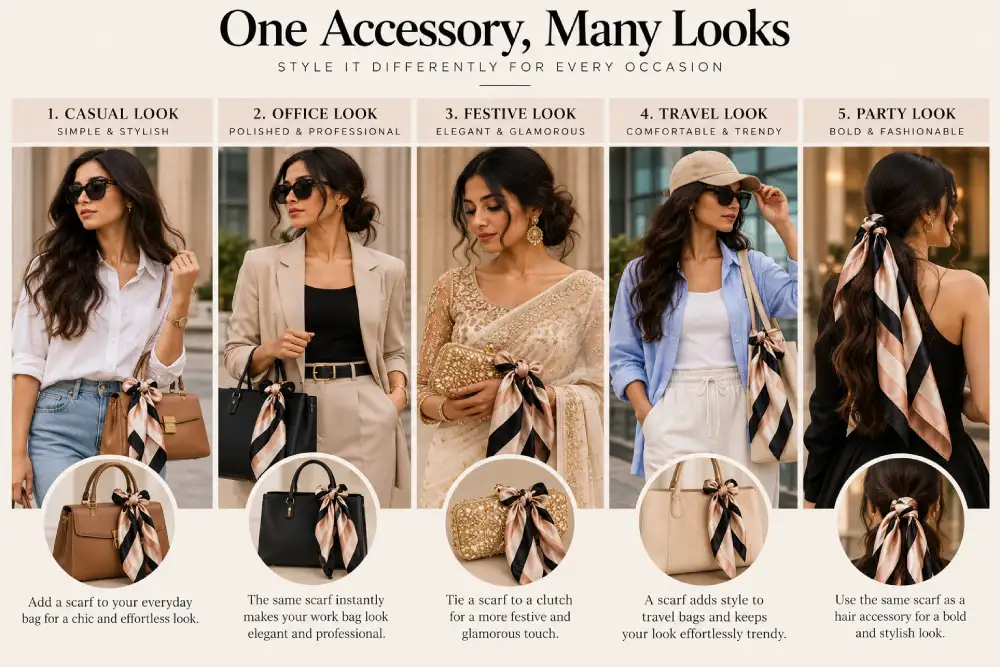
A scarf is one of the most versatile accessories in terms of pure value per piece — the same scarf can be worn tied at the neck, draped over the shoulders, wrapped around the head or hair, or looped through a bag handle, which makes it one of the easiest accessories to justify investing in.
At hub level, the two things worth understanding are fabric and season. Lighter fabrics (fine cotton, light silk) suit warmer months and can add colour or pattern without adding warmth, while heavier fabrics (wool blends, heavier silk, pashmina-style weaves) genuinely add warmth and tend to suit cooler months or evening wear. Getting this match right matters more for scarves than for most accessories, because an otherwise beautiful scarf in the wrong fabric for the season will either go unworn or feel impractical.
The specific tying techniques — and there are considerably more than most people realise — are where the real styling value of a scarf lives, and that level of detail is exactly what the dedicated cluster guide is for rather than this overview.
Scarves are also unusually good travel accessories, since a single piece can function as a neck wrap, a light layer against air-conditioning, a hair cover, or even an improvised bag accent — which is worth keeping in mind if you’re building the small, versatile collection described earlier in this guide.
For step-by-step tying techniques, fabric guidance by season, and how to build a scarf into different outfit types, see our dedicated how to wear a scarf guide.
Types of Hats for Women and How to Style Them
Hats tend to divide people into two camps — those who wear them confidently and those who feel self-conscious in them — and the difference usually comes down to choosing a style that suits both face shape and occasion, rather than any lack of general styling skill.
At a hub level, it’s worth knowing that hat styles broadly serve different purposes: some (wide-brim styles, sun hats) are primarily functional, offering genuine sun protection that matters in India’s climate for large parts of the year; others (berets, structured caps, fedora-style hats) lean more decorative and are chosen mainly for how they complete a look. As with sunglasses, there’s a loose face-shape principle worth knowing — brim shapes and crown heights that contrast gently with your face shape tend to be the most flattering starting point, though this is a guide rather than a rule.
Fit, covered briefly in the fit-checks section above, matters enormously with hats specifically — head circumference is the measurement that actually determines comfort and fit, far more than the vague “small/medium/large” sizing many hats are sold under.
Beyond styling, hats are genuinely practical for large parts of the Indian calendar — a well-chosen wide-brim or structured cap can meaningfully reduce sun exposure on hot days, which is a good reason to treat hats as a functional wardrobe staple rather than only reaching for one on holiday.
Our dedicated types of hats for women guide covers each hat style in depth, face-shape suitability, and how to style hats for different occasions.
Frequently Asked Questions
What is the difference between an accessory and jewellery? Jewellery — rings, necklaces, earrings, bracelets — is one specific category within the broader world of fashion accessories. “Fashion accessories” is the wider term that also includes hair accessories, sunglasses, handbags, belts, scarves, hats, watches and footwear.
How many accessories is too many? There’s no fixed number, but a useful guideline is to choose one accessory as the clear focal point and keep the rest simple or minimal, especially for formal or professional settings. Casual settings generally allow more layering before a look starts to feel cluttered.
Do accessories need to match exactly? No. Accessories don’t need to be the exact same colour, metal or finish to work together — in fact, exact matching can sometimes look overly coordinated rather than stylish. A shared colour family, a consistent formality level, or a deliberate contrast in texture usually works better than an exact match.
What accessories should I buy first if I’m starting from scratch? A well-fitted everyday bag, a versatile belt, simple everyday jewellery and a pair of sunglasses that suits your face shape form a practical starting base, since these are the pieces most people reach for most often. From there, add statement pieces (a distinctive scarf, a hat, occasion jewellery) as you identify genuine gaps in your existing outfits.
How do I know if an accessory actually fits before I buy it online? Check the brand’s specific measurements (strap drop for bags, waist/hip measurement for belts, head circumference for hats, frame width for sunglasses) against your own measurements, rather than relying on generic size labels like small, medium or large, which vary significantly between brands.
IMAGE / VISUAL SUGGESTIONS
Approximately 6 high-value visual opportunities for a pillar of this length — not one per section, only where a visual genuinely adds understanding beyond the text.
| # | Placement | Visual concept | SEO filename | ALT text |
|---|---|---|---|---|
| 1 | Hero image, top of article | Flat-lay or styled shot showing one example each of the six accessory categories (hair accessory, sunglasses, bag, belt, scarf, hat) arranged together | fashion-accessories-guide-hero.webp | Flat lay of fashion accessories including a handbag, sunglasses, belt, scarf, hat and hair clip |
| 2 | “Choose Accessories for Your Outfit and Occasion” | Simple 4-panel graphic visualising the occasion table (everyday, office, festive, travel) with one representative accessory per panel | accessories-by-occasion-guide.webp | Four fashion accessory looks for everyday, office, festive and travel occasions |
| 3 | “Balance Colour, Texture and Visual Weight” | Before/after style graphic: one outfit with too many competing accessories vs. the same outfit with the one-statement-piece rule applied | one-statement-piece-accessory-rule.webp | Outfit comparison showing balanced versus over-accessorised styling |
| 4 | “Practical Fit Checks” | Simple labelled diagram showing where to measure a bag’s strap drop, a belt’s waist point, a hat’s head circumference, and sunglasses’ frame width | how-to-check-accessory-fit.webp | Diagram showing how to check the fit of a bag, belt, hat and sunglasses |
| 5 | “Build a Small Collection” | Capsule-style grid graphic showing a neutral base layer of accessories plus a smaller statement layer | capsule-accessory-collection.webp | Neutral base and statement accessory pieces for a small, versatile collection |
| 6 | Cluster section (choose the most visually distinct category, e.g. hats or scarves) | Styled photo demonstrating two to three different ways to wear the same piece (e.g. a scarf tied three ways, or a hat styled two ways) | how-to-style-a-scarf-different-ways.webp | Three ways to style a scarf with different outfits |