How to Spot Fake Jewelry: Marks, Materials and Limits
Published: September 23, 2026 Last Updated: September 23, 2026 TL;DR You can catch most obvious fakes yourself by checking
TL;DR
You can catch most obvious fakes yourself by checking for a hallmark, comparing weight and feel to a known genuine piece, and looking closely at craftsmanship — loose stones, uneven prongs, or a stamp that looks shallow or smudged are all warning signs. But no home test, including magnet checks or scratch tests, can fully confirm authenticity. For anything valuable, get it verified by a certified jeweler or an assay office before you rely on it.
Whether you’re buying online, checking a gift, or looking at a piece you’ve had for years, knowing how to spot fake jewelry starts with understanding what “fake” actually covers — because it isn’t one single problem. This guide walks through what to check yourself, what those checks can and can’t tell you, and when it’s worth paying for professional verification instead of guessing.
1. What Does Fake Jewelry Mean?
“Fake jewelry” usually falls into one of three categories, and knowing which one you’re dealing with changes what you should expect.
Misrepresented jewelry is sold as something it isn’t — a plated piece described as solid gold, or a simulated stone sold as a genuine gemstone. This is the version most people mean when they worry about being scammed.
Fashion jewelry is openly made from base metals, plating, and simulants like cubic zirconia, and isn’t trying to pass as fine jewelry at all. There’s nothing deceptive about fashion jewelry sold honestly — the concern only applies when it’s priced or described as something it isn’t.
Counterfeit branded jewelry copies a specific designer or brand’s design and markings, which adds intellectual property and quality concerns on top of the material question.
This article focuses mainly on the first category: figuring out whether a piece’s stated metal, purity, or stones match what it’s actually made of.
2. How to Read Stamps, Hallmarks and Material Descriptions
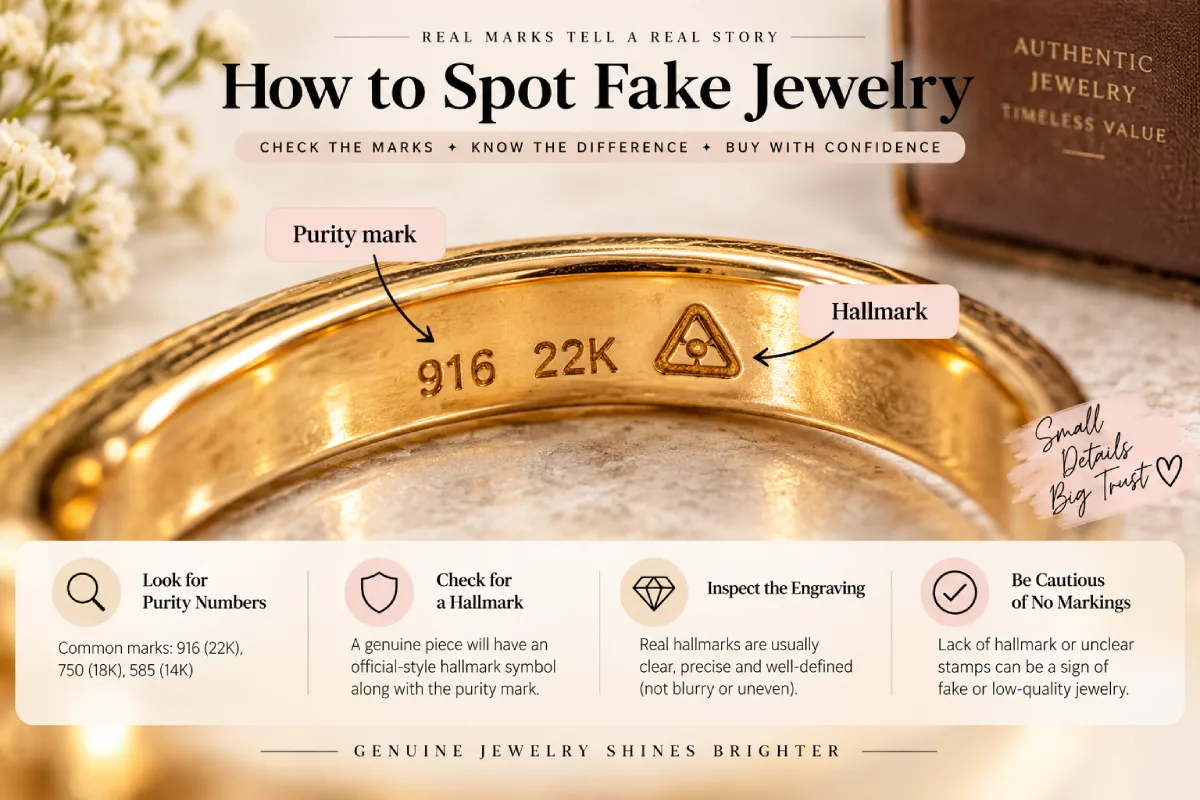
A hallmark is a small stamp — usually inside a ring band, on a bracelet clasp, or on a small tag attached to a chain — that states the metal type and purity. Common examples include 916, 750, or 585 for gold (representing 91.6%, 75%, and 58.5% purity), and 925 for sterling silver.
In India, gold jewelry sold through organized retail is generally required to carry a BIS (Bureau of Indian Standards) hallmark, which since 2021 includes a six-character Hallmark Unique Identification (HUID) number specific to that piece. This HUID can be checked against BIS records, which is a more reliable verification step than a purity stamp alone.
A few terms are worth knowing because they’re easy to confuse:
| Term | What it actually means |
|---|---|
| Solid gold / solid silver | The entire piece is made of that metal (at the stated purity) |
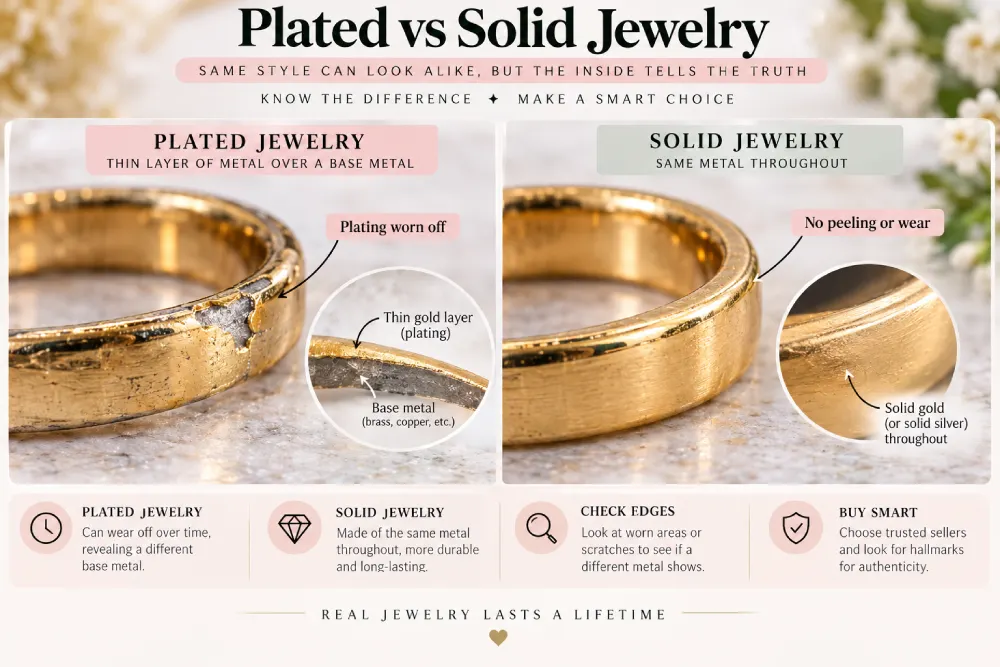
| Gold-plated (GP) | A thin layer of gold over a base metal |
| Gold-filled (GF) | A thicker, mechanically bonded gold layer over a base metal — more durable than plating, but still not solid gold |
| Vermeil | Gold plating over sterling silver specifically — a higher-quality plating, but still plating |
Here’s the part most guides skip: a hallmark stamp on its own doesn’t prove authenticity. Purity stamps like “925” or “750” can be applied to base-metal pieces, and a genuine-looking stamp doesn’t guarantee genuine metal underneath. Treat a hallmark as a starting point for your check, not a final answer — especially on a piece bought secondhand or from an unfamiliar seller.
3. Visible Warning Signs to Check Before Buying
A close, unhurried look at a piece catches a surprising number of fakes before you need any test at all.
- Weight that feels wrong. Precious metals are dense. A ring or chain that feels unusually light for its size is a reasonable reason to look closer, especially compared to a similar piece you already know is genuine.
- Color that’s uneven or fading in places. Plated jewelry often shows its base metal at points of friction first — the inside of a ring, the clasp of a bracelet, or high-contact edges. A yellow or white patch peeking through a “solid gold” piece is a clear sign of plating, not solid metal.
- Hallmarks that look shallow, blurred, or inconsistent. Genuine stamps are applied with even pressure and depth. A stamp that looks smudged, unevenly pressed, or positioned somewhere unusual for that type of jewelry is worth questioning.
- Loose stones, rough edges, or uneven prongs. Careless craftsmanship on the setting is a common tell on lower-quality counterfeits, even when the visible metal and stones look convincing at first glance.
- Pricing that’s noticeably below the going rate for the stated purity and weight. Precious metals track a public market price. A “solid 22K gold” piece priced well under what that weight of gold would cost is a red flag worth acting on before you pay, not after.
4. Why Home Tests Cannot Prove Authenticity
A few DIY tests come up often in jewelry forums and guides — a magnet test (genuine gold and silver aren’t magnetic, so a piece that clings to a magnet likely isn’t solid), a scratch test against unglazed ceramic, or soaking a piece to check how quickly tarnish forms on silver.
These can be useful as a rough first check, but none of them confirms authenticity on their own. A magnet test only rules out a magnetic base metal — a non-magnetic fake, like brass or a nickel-free alloy, will pass it easily. Scratch tests can damage the piece and still produce ambiguous results depending on the exact alloy involved. Acid testing, which jewelers use to check how a metal reacts to specific acids, requires handling caustic chemicals safely and interpreting subtle color changes correctly — it’s a professional tool, not a kitchen-counter test, and getting it wrong can damage a valuable piece without giving you a reliable answer.
In short: home checks can raise a red flag, but they can’t clear a piece as genuine. If a home check makes you suspicious, that’s useful information. If it doesn’t, that’s not the same as proof.
5. When to Get Professional Testing or Verification
Professional verification is worth the cost when a piece is valuable, when you’re buying secondhand or from an unfamiliar seller, or when a home check has already raised a concern. A certified jeweler or an assay office can test metal purity accurately, check a gemstone’s authenticity under magnification, and — for BIS-hallmarked gold in India — verify a HUID number against official records.
This is especially worth doing before a high-value purchase closes, rather than after. Many jewelers offer verification as a standalone service even if you didn’t buy the piece from them, and the cost is typically small relative to the value of the item you’re checking.
The Bottom Line
Spotting fake jewelry starts with the checks anyone can do — reading the hallmark, weighing the piece in your hand, looking closely at the craftsmanship, and noticing pricing that doesn’t add up. Those steps will catch a lot of obvious problems. What they won’t do is give you full certainty, and that’s fine as long as you know where your own checking stops and a professional’s begins. For anything you’re not willing to be wrong about, that professional step is the one worth taking.
For more on the difference between fine and fashion jewelry, and what to check before buying gold in India generally, see the complete Jewelry Guide.
FAQs
Does a hallmark guarantee jewelry is real? No. A hallmark is a useful starting point, but purity stamps like “925” or “750” can be applied to base-metal pieces. Treat a hallmark as one signal among several, not proof on its own — especially for secondhand or unfamiliar sellers.
Can a magnet test tell me if jewelry is fake? It can rule out some fakes but not all of them. Genuine gold, silver, and platinum are non-magnetic, so a piece that’s strongly attracted to a magnet is likely not solid precious metal. However, many counterfeit alloys are also non-magnetic, so passing a magnet test doesn’t confirm authenticity.
Is gold-plated jewelry considered fake? No, as long as it’s sold honestly as gold-plated. Plated jewelry is a legitimate, widely sold category — it only becomes a “fake jewelry” problem when it’s marketed or priced as if it were solid gold.
How does BIS hallmarking work for gold jewelry in India? BIS-hallmarked gold jewelry carries a purity stamp (such as 916 for 22K) along with a Hallmark Unique Identification (HUID) number specific to that piece, which can be checked against official BIS records for verification.
Should I try an acid test at home? It’s not recommended. Acid testing involves handling caustic chemicals and requires experience to interpret correctly, and a mistake can damage the piece without giving you a reliable result. It’s better left to a jeweler or assay office with the right equipment and training.
What should I do if I suspect a piece I already own is fake? Start with the visible checks in this guide — weight, color consistency, and hallmark quality. If anything looks off, or if the piece has meaningful value or sentimental importance, take it to a certified jeweler for proper verification rather than relying on a home test.