Body Care Routine Steps: The Correct Order for Healthy Skin
Published: September 9, 2026 Last Updated: September 9, 2026 Let‘s face it, most people‘s sad body care routines are
Let‘s face it, most people‘s sad body care routines are in fact perfect just not in the right order. Slathering on cream before a scrub, skipping SPF because it feels like a “face-only” step, or using an abrasive scrub every day and not once a week can all quietly sabotage you. Getting your body care routine steps in the right order is often the surefire way to banish dry patches, dullness, and rough textures.
Mathew‘s guide simplifies the process what to do, when to do it and how often so you don‘t have to wonder.
What Are the Essential Body Care Routine Steps?
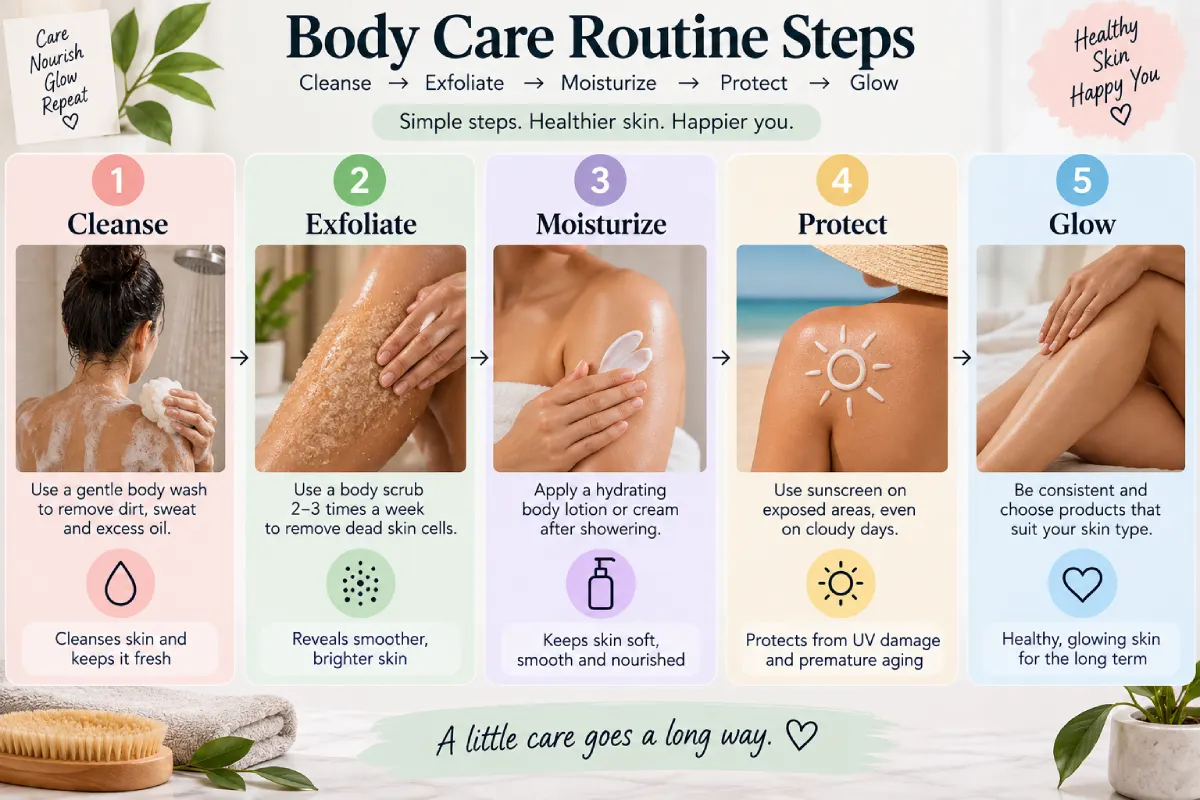
A complete body care routine comes down to four core steps, done in this sequence:
- Cleanse cleanses sweat, oil, and dirt, allowing for clearer skin
- Exfoliate – removes dead skin cells (1 – 2 times a week not everyday)
- Moisturize – retains moisture and water to skin while moist.
- Protect– SPF on skin that has been exposed during the day.
Every step has a job that subsequent steps depend on. Miss one or do it out of order, and the entire process is way less effective–the moisturizer just sits there on dead skin, it doesn‘t sink in or SPF gets skipped because it feels like an “extra” step.
Quick tip: cleansing and moisturizing should be a daily habit. Exfoliation should be done weekly. Make sure to keep a clear distinction, as the number one common mistake is over-exfoliation.
Step 1: Cleanse Your Body Without Stripping the Skin
Cleansing sounds so easy, but that is really where most of the damage occurs from hot water or detergents or some other ingredients that are too abrasive.
- Instead of using a drying bar soap switch to a pH balanced sulfate free body wash
- Keep showers warm, not hot.hot water shallows out natural oils faster than they can be replaced.
- keep shower duration short, anywhere from 5-10 minute; long time in the shower can remove enough water to dehydrate the skin barrier
- Pat dry instead of vigorously rubbing with a towel.
Myth vs. fact Myth that squeaky clean skin indicates it is, in fact, clean. fact that squeaky feeling is the skin barrier being stripped of natural oils and causing more dryness, not less.
Step 2: Exfoliate to Remove Dead Skin Cells
Exfoliation gets rid of the excess dry, dead skin cells that make skin look dull and uneven in texture as well as rough and bumpy. Remember though this is a weekly step and not a daily one.
- Physical exfoliants (scrubs, loofahs, exfoliating gloves) are effective on coarser parts, such as knees and elbows
- Chemical exfoliants (AHA, BHA, body lotions with lactic acid) are a less harsh option for larger applications and sensitive skin.
- Never do physical and chemical exfoliants on the same day…SI will just irritate!
- Dermaweekly: Stick to 1–2 weekly, anything more than daily exfoliation is one of the main reasons of irritation and damage to the skin barrier
Practical example: If your shins are rough no matter how much moisturizer you slather on, the cure isn‘t MORE lotion; it‘s an entire weekly session of exfoliation to allow the lotion to penetrate.
Step 3: Moisturise and Lock In Hydration
This is the stage on which most people get the science correct but time incorrect. Moisturizers are most effective on damp skin, not necessarily fully dry skin as they trap in any water already there.
- Use body lotion, cream or butter within 2–3 minutes of leaving the shower
- Choose texture according to your skin: light lotion for hot/humid climates, richer cream or butter for dry skin or cold/dry winters
- Pour on specifically for high-friction, low-oil areas: elbows, knees, shins, and heels
Read more: Weekly Body Care Routine: What to Do Each Day for a full 7-day schedule you can follow, plus how to adjust it by season and skin type.
When Should You Add Body Oil, Treatments and SPF?
Once the core three steps are consistent, a few optional additions can round out the routine:
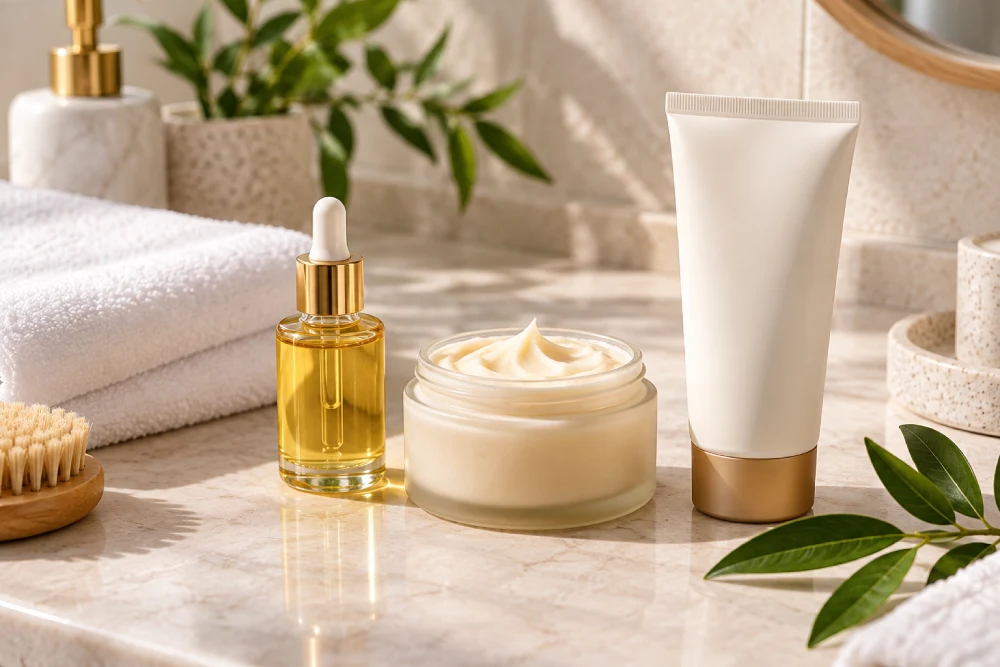
- Apply a little body oil afterward after moisturizing, or add a few drops in to the moisturizer; adds a glossy glow and smoothness. This should be regarded as a final finishing touch and not as a substitute for moisturizer.
- Treatments – overnight balms or intensive creams for very dry patches (elbows, heels) are applied last, in the evening
- SPF– use on exposed areas of body- (arms, hands, neck, chest) every morning after moist to before leaving the house.
Common mistake: Sun exposure and SPF guidance sourced from the American Academy of Dermatology. Treating SPF as optional on the body. Unprotected sun exposure on arms, hands, and neck is one of the biggest causes of uneven tone and early skin aging — and it’s also one of the easiest steps to build into an existing routine.
FAQs
What is the correct order to apply body care products?
First clean, exfoliate 1 – 2 a week, following by locking moisture to the skin while it‘s still damp, and sun protection, such as SPF, as the last step during the day.
Is it safe to exfoliate every day for faster results?
No. Exfoliating every day is more likely to lead to irritation and barrier damage rather than faster benefit. Keep it to 1–2 times a week.
Can I switch body oil for moisturizer?
No. It gives your skin that attractive healthy glow and a silky seal to help lock in the moisture, but it won‘t hydrate your skin in the same way as a lotion or cream. Use it on top of moisturizer, not instead of.
Do I need SPF on my body everyday even when I am indoors?
If you are constantly close to the windows or stepping outdoors for short periods then exposed areas like hands, arms and neck will need daily spf, particularly in high-UV areas such as most of India and the US Sun Belt.
Final Thought
Getting your body care routine steps in the right order — cleanse, exfoliate weekly, moisturize while damp, and protect daily — solves most common skin complaints without adding a single new product. Once this sequence is consistent, everything else (body oils, treatments, skin-type tweaks) becomes an easy addition rather than a fix.