Body Care Routine: Complete Guide for Healthy, Glowing Skin
Published: September 9, 2026 Last Updated: September 9, 2026 So when you have a nine-step face routine and in

So when you have a nine-step face routine and in the shower use whatever‘s left of it on everything else on your body you‘re not the only one-and you look it! Elk elbows that stay ashy no matter what. Sandpaper shins come bed time. A back that is breaking out more than your face ever does-none of that is bad luck. It‘s probably just a missing body care routine.
The good news: a body routine does not have to be complex. It needs consistency and it needs to tailored to your skin. This guide is your launch pad a comprehensive overview of what a good routine is, how to tailor it to your skin type, how often to do each step and the little habits that quietly sabotage everybody‘s progress. Use it as the ‘home base’ read this first, then follow the links to the deeply detailed, step-by-step guides below:
By the end, you‘re going to figure out precisely where your program is lacking and what I think you should work on improving first.
What Is a Body Care Routine and Why Is It Important?
A body care routine is a series of repeatable actions cleansing, exfoliating, moisturizing and protecting done to your skin from the neck down. It‘s there because, like a face routine, skin is skin. It lives on your neck, arms, hands, legs, anywhere, and it benefits from repetition.
The problem is that the face you wash regularly but neglect the rest of your body to a bar of soap and hot water. This eventually manifests itself as dull, dry, rough skin with uneven pigmentation in high impact, low oil gland areas like elbows, knees and shins.
Key takeaways:
- The body skin has less oil glands than facial skin at most of the parts, because of that it tends to dry faster and requires some conscious moistening.
- Hot water, strong soap, air conditioning, dry winters (which are typical of North India and much of US) remove the body natural oils faster than they are replenished.
- Simple routine performed regularly 2-4weeks for most people. Enhances texture, tone and comfort.
- “Glowing skin” is more of a case of leaching away dead skin cells and trapping moisture in the right way, rather than about miracle products.
Practical example: Applying a thoughtful non-foaming body wash instead of a daily hot shower & bar soap can result in, for most individuals, noticeably less tightness & flaking within the first 2 weeks without any adding new “actives.”
Mini summary: body care is important because body skin requires the same structure as face skin – cleanse, treat, hydrate, protect – only designed slightly differently (see above).
Read more: Body Skin Care Routine: The Complete Guide for the full breakdown of why body skin behaves differently from facial skin and how to build a complete regimen around it.

How to Build the Perfect Body Care Routine Step by Step
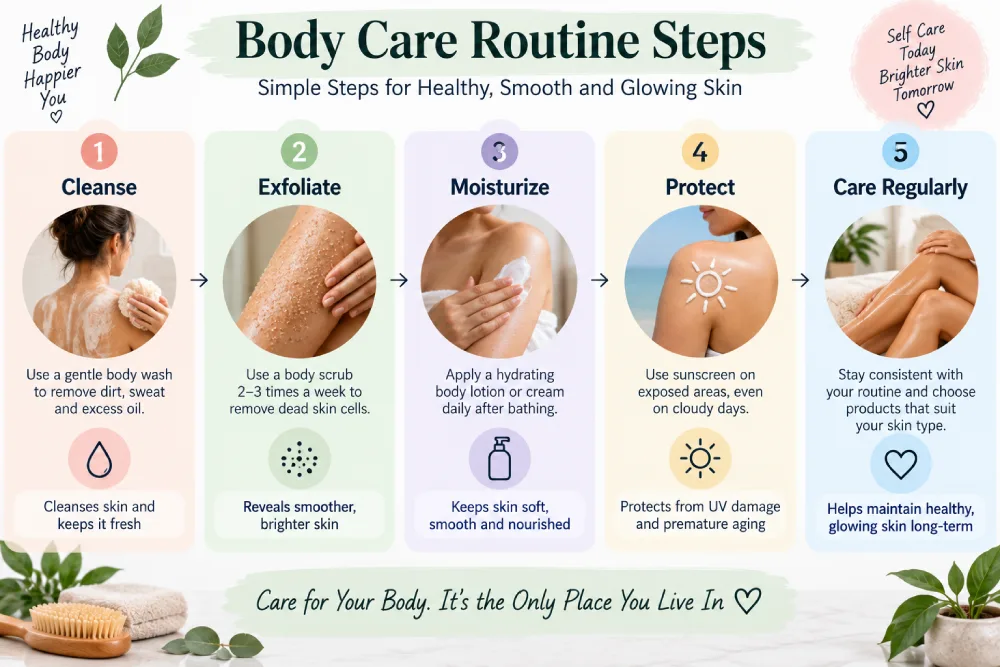
At its core, every effective body care routine follows four stages, in this order:
- Cleanse Eliminate sweat, oil, dirt, and residue from products. This should not strip the skin barrier.
- Exfoliates (not everyday) removes dead skin cells which can make skin dull, rough and bumpy.
- Moisturize can be applied when skin is just slightly damp to lock in moisture
- Protect amount of protection required during each part of the 24 hours. Must find “cleanest, driest, most comfortable part of the day to apply sunscreen. (Nothing is needed at night other than moisturizer)
Key takeaways:
- It‘s all about sequence: it should be exfoliated first and then moisturized. The moisturizing ingredients will penetrate more easily into smoother skin than a layer of rough, flaky dead cells.
- The cleanse/moisturize: daily, the exfoliation: once a week rather than every day
- Applying sunscreen on the body is one of the most overlooked steps and one of the biggest causes of uneven skin tone and premature aging on the arms, hands and neck so lead by example.
- The right product texture (lotion vs cream vs butter vs oil) is as important as the actual ingredients listed.
Practical tip: Use body moisturizer 2–3 minutes after leaving the shower while the skin is still damp – a simple change to your routine that is one of the most effective and most often unnoticed hydration boosters.
Mini summary: All you need for the ideal body care regime is four steps administered at the right time, in the right order. The majority of “failed” regimes are either missing a step completely(most importantly protection), or exfoliating more than once a week.
Read more: Body Care Routine Steps: The Correct Order Explained for a full walkthrough of each step, how long to spend on it, and which mistakes to avoid at each stage.
Best Body Care Routine for Different Skin Types
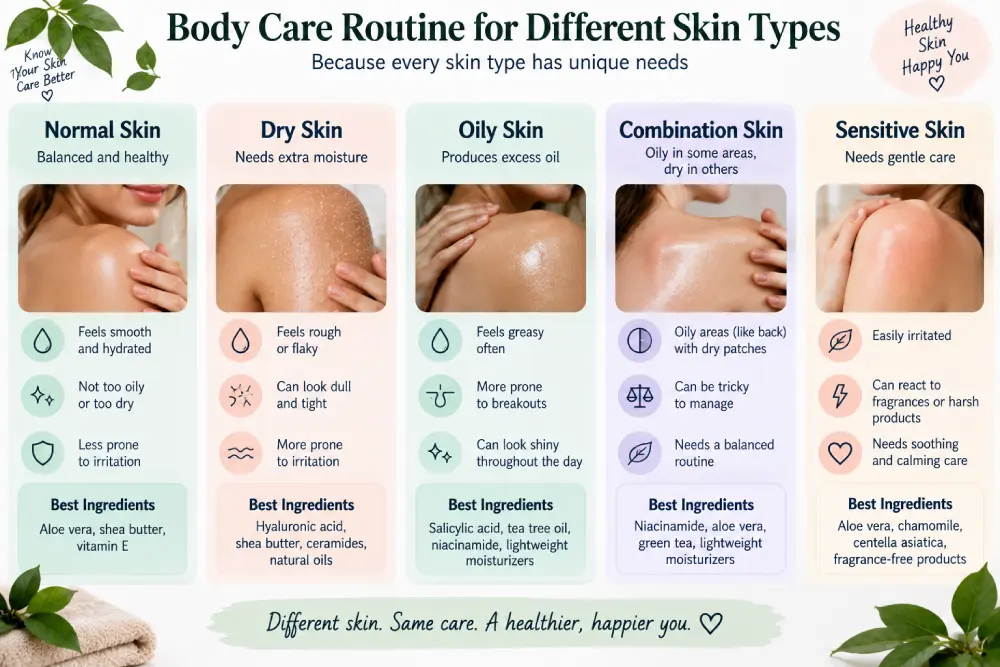
No two skins respond in exactly the same way and what is perfect for one skin can actively make another worse. It is useful to have prior knowledge of what classification you belong to:
| Skin Type | How It Feels | What It Needs |
|---|---|---|
| Dry | Its tight, flaky, sometimes itchy after a shower. |
Rich creams/butters with ceramides, shea butter, or hyaluronic acid; gentle, low-lather cleansers |
| Oily | Shiny on chest/back, prone to acne. | Lightweight, noncomedogenic lotions and gels Gentle exfoliation to prevent hair follicles from becoming plugged |
| Combination | Oily on trunk, dry on limbs | Area based method heavier product on arms/legs and lighter on chest/back |
| Sensitive | Easily upset, prone to blush or feel itchy | Fragrance free formulas, patch testing, low ingredient lists |
Key takeaways:
- Recognizing whether your body‘s skin type is dry, normal, or oily is not the same as knowing whether your face has that same skin type. People tend to have different skin types on their face than on their body.
- Ingredient texture (gel, cream, butter) is more important on the body than exact “actives,” since most often we are looking for hydration and barrier support not treatment.
- One of the most common reasons for body breakouts is when individuals use a rich body butter on back and chest skin which is already prone to oiliness.
Practical example: if you‘ve got chalky-dry shins and a breakout back, you‘ve got combination-skin. That‘s not a contradiction. You have to treat each zone separately. Don‘t use one body moisturizer all over.
Mini recap: Finding body texture and ingredients that make your body skin type happy not just settling on “the best body lotion” is what really keeps dryness and breakouts away.
Read more: Body Care Routine for Dry Skin: Ingredients & Steps That Work and Body Care Routine for Oily Skin: What to Use Instead for skin-type-specific routines, ingredient lists, and product textures.
Daily vs Weekly Body Care Routine: What Should You Do?
One of the largest reasons of confusion and a key reason a routine can blow up is confusion over what things should go into a daily routine and what things should go into a weekly routine.
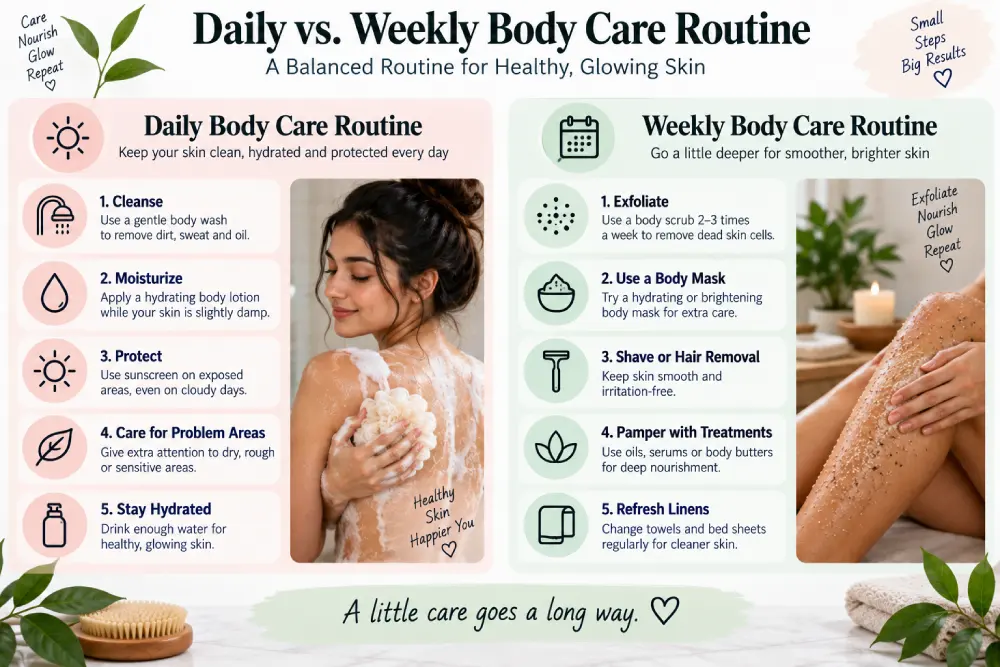
Daily steps:
- Use a mild, pH balanced body wash to cleanse;
- Moisten straight away after showering
- During the day, sunblock all exposed parts (arms, hands, neck, chest) this should be reapplied regularly
Weekly steps (1–2x per week, not more):
- Scrub physical scrub or chemical exfoliant (AHA/ BHA), never both on the same day
- Deep-condition very dry patches ( elbows knees heals) with an overnight treatment or occlusive balm.
- Dry brushing if you do it before washing.
Key takeaways:
- Daily exfoliation is one of the most common contributors to irritation, redness, and a compromised skin barrier; exfoliating once a day should generally be avoided. [American Academy of Dermatology]
- In a dry climate, missing a single day of moisturizer can reverse more than a week of improvement.
- If having weekly treatments such as masks, intensive balms etc. then this will work as each week there is a recovery period for the skin to repair itself and for more intense products to penetrate the skin
Practical tip: Choose a day of the week and set your exfoliation schedule for that one day of the week alone (say, every Sunday), rather than allowing it to entrench itself in your daily routine by accident this is the most rapid solution for over exfoliated skin.
Mini summary: daily= cleanse/moisturize/protect. Weekly= exfoliation /deep treatments. The flip-flop of this cadence accounts for most” my routine stopped working” whines.
Read more: Weekly Body Care Routine: What to Do Each Day for a full 7-day schedule you can follow, plus how to adjust it by season and skin type.
Body Care Routine Mistakes That Can Damage Your Skin
Even the most disciplined individuals can ruin all their hard work by simply doing these three things:
- Over-exfoliating applying chemical or physical exfoliants more frequently than recommended, resulting in redness, sensitivity, and a compromised barrier
- I don‘t think it is wise to pass up moisturizer just because your skin is ‘good’ hydration needs to be constant, not just when one‘s skin is behaving!
- Using hot water – a long shower, hot, deposits a lot of oils at a faster rate than they can be restored.
- Incorrect product texture for skin type heavy butters on the acne prone back/chest or very dry shins that would typically require more occlusion
- Photograph of the body with no sunscreen results in an uneven tone, speckled oxidation and premature aging on hands, arms and neck
- Use a physical and chemical exfoliant on the same day causes even more irritation rather than smoothing texture
- You should apply the moisturizer on completely dried skin – seals in less moisture.
- Applying scented products to delicate or reactive skin, a silent and often ignored cause of itch and redness.
Key takeaways:
- Most “my skin‘s not better” claims originate here, not in the Unknown Miracle..
- In many cases, correcting just 1–2 of these errors can result in an apparent correction occurring within a few weeks
- More important is to be precise in putting more steps or products into the right direction.
Practical example: If you are doing “everything right” but still seeing rough, red patches it is usually over-exfoliating dropping the scrub from daily to twice a week is a common solution without any other changes.
Mini summary: A body care regimen cannot be undermined by doing nothing too often, but rather by doing the wrong things too often. Correcting the mistake is generally faster than adding new products.
Read more: Body Care Routine for Glowing Skin: What Actually Works to see how correcting these mistakes — rather than adding more products — is the real path to brighter, smoother skin.
Regional Notes: Body Care in the USA and India
Climate also alters what a routine requires, but the four basic steps remain constant.
- Dry, cold-winter areas (e.g., midwestern/northeastern US, North India in winter) moisture is sapped from the skin indoors faster (with heating); increased use of heavier rich creams and butters and the use of a humidifier can compensate
- Humid areas (US South, coastal, South India, monsoon) lighter lotions or gels that provide moisture without leaving a heavy, tacky feeling; oily-acne prone areas may want to opt for non-comedogenic formulas.
- While in high-UV areas (most of India, year-round, how the sun hits a significant portion of the US Sun Belt)–you‘re already wearing a daily SPF on exposed body skin, whether or not you realize it: skin tone, over a long term, settles unevenly if unprotected.
Mini summary: Don‘t alter the four-step plan for your local climate but will you need to alter the product kind, richness, and frequency of exfoliation?
Frequently Asked Questions
In what order should I do my body care? Cleansed, exfoliates (1-2x week), moisturized, and sun protection in the daytime. Moisturizes should be applied to damp skin immediately upon showering.
How frequently should I exfoliate my body? For most skin types, once to twice a week is sufficient. Excessively dry skin from over exfoliating can cause damage and irritation to the barrier and does not give you better results.
Is body lotion sufficient or should I also have a body oil and body butter? For most people a decent lotion or cream is fine for day to day use. Body butter is a must for dry, rough areas such as elbows and heels; body oil is a ‘nice to have’ and merely adds slip and a shine rather than moistness.
Is it necessary to wear SPF on my body at all? (not just face). For sure. Arms, hands, neck and chest are always exposed which often results in uneven pigmentation, pigmentation flecks and premature aging due to unprotected UV exposure.
Can I use a body care routine to deal with body breakouts (acne)? Yes. Gentle cleansing, keeping thick occlusive products from the back and chest, and controlled exfoliation to keep the follicle opening clear all contribute to less breakouts down the line.
Timeframe. How long do I have to wait to see the difference? In general, most will see a change in skin texture and softness and feeling of dryness in 2-4 week of daily skin cleansing and moisturizing and closer to 6-8 weeks for the complete transformation (tone, smoothness).
Final Thought
A great body care routine isn‘t complicated, it‘s just about doing four things the right way, in the right order, and at the right frequency for your skin. Begin with the skin friendly four steps here on this page, then explore the linked guides to learn everything about your skin type, your weekly body care schedule, and the sure-fire routine to get the healthy, glowing skin you want.