Managing Work-Related Stress: 2026 Playbook for Professionals
Published: September 8, 2026 Last Updated: September 17, 2026 In the lives of most working adults, managing work stress
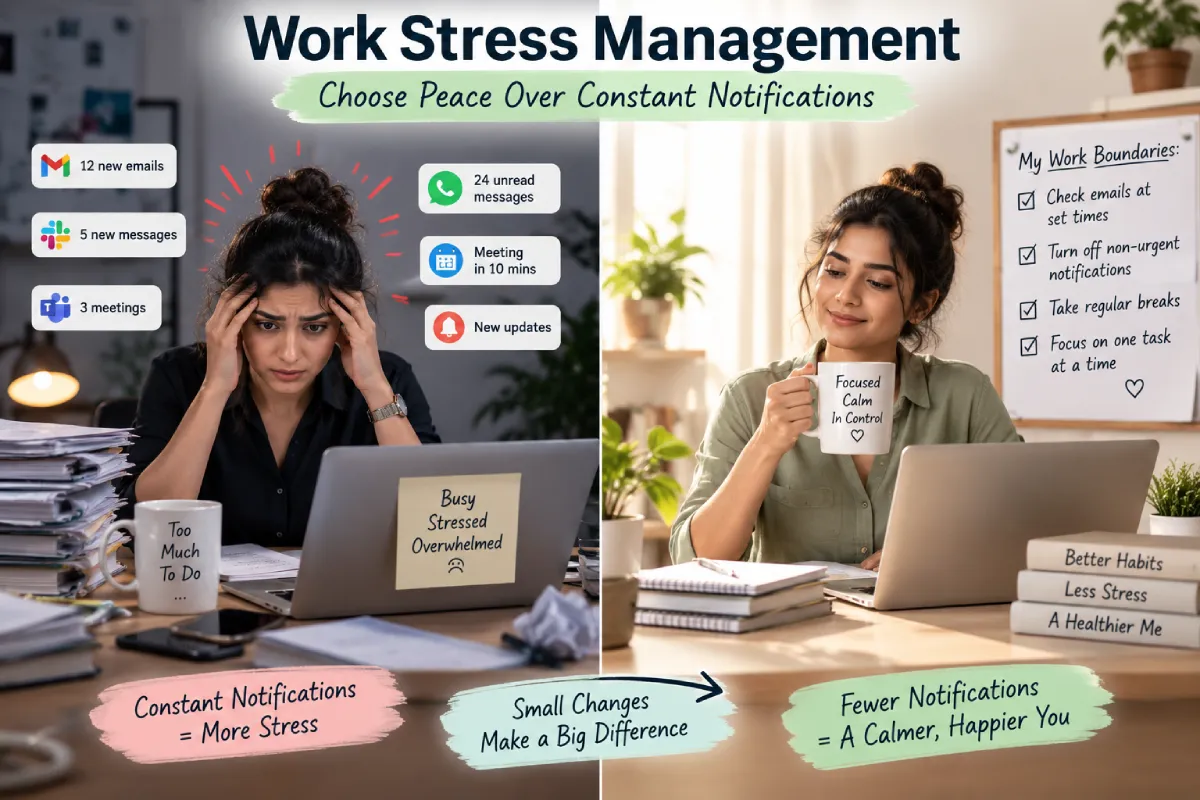
In the lives of most working adults, managing work stress management is not a matter of choice it is what differentiates preserving the career to which they dedicated decades, from the prolonged acquiescence to burnout. Regardless of whether you operate within United States’ menacing office culture or in India where relentless haggling and complex hierarchies define the norm, the pattern remains the same work stress is hardly ever due to one arduous task.
Here‘s a useful guide for dealing with it before it gets out of hand.
Why Work Stress Feels Different in 2026
Remote and hybrid work wasn‘t reducing stress which sounds great, except for the fact that to many people it was removing the old “off switch” that leaving the office used to provide. A few common trends emerged over and over:
- Notification creep push messaging from Slack, email, and messaging tools trickles into nights and weekends.
- Meeting overdose consecutive meetings are a big drain on mental resources you can‘t think during the meetings, and there aren‘t any breaks in between to recover.
- Presence pressure having to be present and on all the time, or be perceived as being so to seem committed.
- Role ambiguity-uncertainty about expectations generates ongoing, diffuse apprehension about not measuring up.
Set Boundaries That Actually Stick
Most advice stops at “set boundaries” without saying how. Here‘s what actually works:
1. Establish a hard stop time and stick to it. Choose a real end of day and approach it like a face-to-face client meeting that you can‘t cancel. Say “I complete my daily work by 6pm and I continue working on this at 9am” when someone asks.
2. Disable notifications in the outside of work time. Turning off clickovers isn‘t impolite-he is maximally effective work tomorrow.
3. Say the boundary out loud once, loud and clear. “I don‘t check messages after 7pm but I‘ll get to this first thing tomorrow” puts the expectation in place once so you won‘t need to renegotiate the boundary every time.
4. Schedule buffer time between meetings. Just 10 minutes between phone calls to breathe, get on your feet, or reset can significantly reduce stress in your day.
5. Middle of nowhere. How often do you lay your head down in the middle of the road? Instead, make sure your work area is visually or physically isolated, as in if you work from home close your laptop, move to another room, a different chair any movement towards discontinuing work!
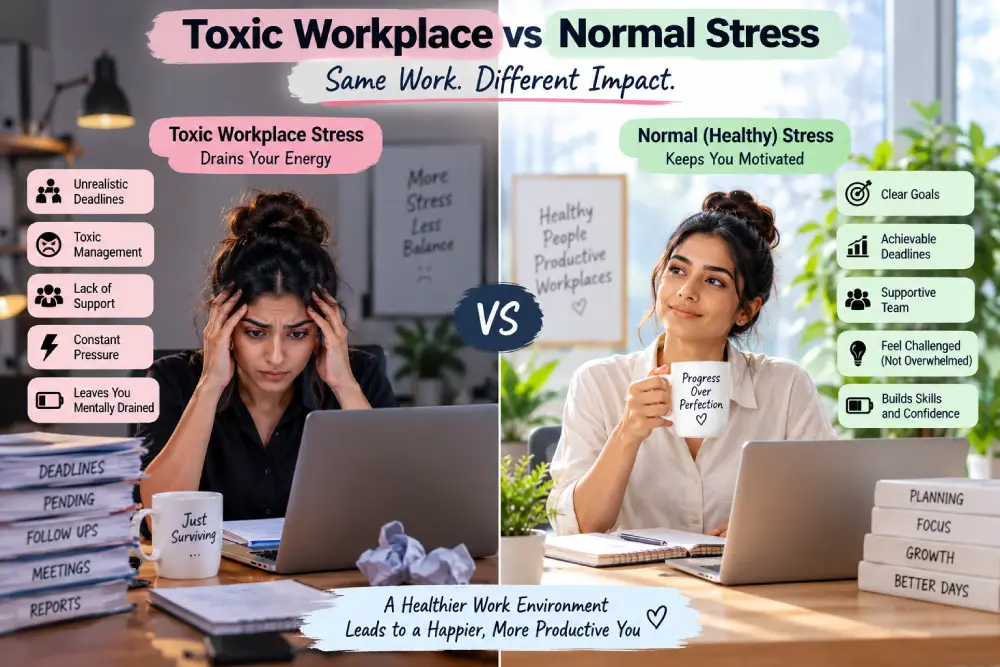
Toxic Workplace Stress vs. Normal Job Pressure
Not all workplace stress is something you can boundary your way out of. It‘s worth distinguishing:
| Normal Job Stress | Toxic Workplace Stress |
|---|---|
|
Busy periods with clear end dates |
Persistent feeling of urgent.need for immediate help always. |
| Intermittent controversy or commentary | Consistent belittling, blaming, or fear-based management. |
| Reasonably achievable workload in most weeks |
Chronic understaffing treated as normal |
| Stress relief on days off | Stress levels are on holiday with you |
Practical example: A demanding product launch week is normal job stress. A manager who regularly messages at midnight and calls it “dedication” is a toxic workplace pattern that boundary-setting alone often can’t fix — it usually requires a bigger conversation, HR involvement, or, eventually, a change of environment.
Common Mistakes People Make With Work Stress
- Picking up extra work to prevent arguments, a passive way of training others to do the same.
- Recycling Exhaustion into a Badge of Honor rather than a Warning Pathology.
- Avoid mentioning particular stress “work is stressful” is too vague, “I have no buffer between meetings” is something you can change.
- Waiting for rest approval not planning recovery into the week beforehand.
When Job Stress Starts Looking Like Burnout
If you’ve tried boundaries and the exhaustion, detachment, or dread hasn’t lifted, it may not be ordinary work stress anymore. Early burnout often shows up as indifference toward work you used to care about, alongside constant fatigue that a weekend doesn’t fix. Our burnout recovery guide walks through the warning signs and how to actually recover, not just push through.
Conclusion
Work stress management isn’t about doing your job with less care — it’s about protecting the edges of your day so the demands of work don’t quietly take over the rest of your life. Start with one boundary this week: a hard stop time, muted after-hours notifications, or 10 minutes of buffer between meetings. For the full picture of how stress affects your body and mind beyond the workplace, see our complete stress management guide.
For more on workplace stress and mental health at work, the World Health Organization’s mental health at work fact sheet is a useful external reference.
FAQs
What are the biggest drivers of work-related stress in 2026? The greatest sources of stress stem from information overload outside of work hours, continuous meetings with no breathing space, lack of clarity about role requirements, and expectation that workers must always be available, even when working remotely.
How do I establish limits without seeming to be uncommitted? Be explicit and direct in what you are willing to accept. When you establish a clear, firm boundary (e.g., I‘m not available after 6 p.m. any day), and follow through on it every time, most coworkers will accept it.
How do I know if myJob is really toxic and not just busy? Job stress ingeneral, should drop-off during less-busy periods and shouldn‘tfollow-upon breaks.Job toxics stressin a workplace, is omnipresent, generally featuresfear-based management, doesn‘tdisappearduringvakations.
Is getting out of job stress implying I have to stop my current job? No, it might not be. There are quite a lot of cases that job stress can be alleviated seriously by establishing clearer boundaries, buffering time and tackling down the exact stressor directly. Yes, to quit my job is the right choice sometimes, yet it is definitely not the first choice.
Can I get burnout from work stress even if I like my work? Absolutely.Burnout is caused by ongoing, unmanaged stress not by dissatisfaction with work; even people who love what they do can develop burnout without proper boundaries and recuperation.