Best Diets for Weight Loss in 2026 (Ranked by Science)
Published: September 7, 2026 Last Updated: September 8, 2026 There is always a new “best” diet each year, and
There is always a new “best” diet each year, and every single year the truth remains unchanged: the best diets for weight loss are the ones you can actually adhere to. Whether it is Keto, Mediterranean, low-carb, and DASH; they all induce weight loss via the same mechanism- a calorie deficit- in different ways by adhering to different food standards and restrictions.
Here‘s a list of some of the best science-backed diets ranked by sustainability and practicality so you can pick which one’s right for your life, not just for TV.
Why “Best” Depends on the Person, Not the Diet
All of these diets are based on researched evidence. The factor that really determines success or failure is compliance: the ability of an individual to carry out the plan for months rather than days, and to do this realistically. If a diet disregards the foods that a person usually eats every day, and the life they lead, it is unlikely to last long.
The Diets, Ranked by Sustainability
1. Mediterranean Diet — Most Sustainable
What it is: Focussing on vegetables, whole grains, legumes, fish, olive oil, and moderate consumption of dairy with reduced intake of red meat and processed foods.
Why this is a good low carbohydrate diet? Because you can make it flexible, it removes no food groups, and it‘s supported for weight management and cardiovascular disease.
India/USA fit: Easily modified by using dal, vegetables, whole grains like millet or rice, mustard or olive oil, fish or paneer as protein.
Caution: Drastic or sudden weight loss in the first few weeks is best avoided. It should be noted that fat loss is often slow and steady, rather then rapid:
2. DASH Diet — Best for Heart Health + Weight Loss
What it is: Was originally started as a way to combat blood pressure, highlights foods such as vegetables, fruit, whole grain, lean protein and low sodium.
Why this is in the top 10: Pillars of good practice, body is naturally designed to support slow, sustainable weight loss. Well supported by research, not totally restrictive.
India/USA fit: Perfect with traditional home-cooked food all over the world because it‘s built on real foods more so than packaged “diet” stuff.
Watch-out: Has a need to be cautious towards sodium, as restaurants and processed foods may be tricky.
3. Low-Carb Diet — Fast Early Results
What it is: Cuts back on carbs (grains, sugar, some fruit) and encourages more protein and fat.
Why it is middle listing: Short term success at reducing weight and suppressing appetite. However harder to maintain socially, with a more carbohydrate based diet.
India/USA fit: Possible by cutting down on rice/roti and increasing protein/veg but takes increased planning at family meal time.
Watch-out: early drop in water-weight can be confused with fat loss; sustained results over the long term is a better indicator.
4. Keto Diet — High Effectiveness, Lower Sustainability
What is it: An extremely low carbohydrate, high fat diet meant to push the body into ketosis for fuel.
How it falls short for most: Very powerful diet in the short term, but hard to sustain over the long term due to severe carbohydrate restriction (sometimes under 50 grams per day)7.
India/USA fit: Possible, but not easy cutting rice, roti and most fruit, which are commonly used daily in a large proportion of households, would be very difficult.
Warning: “keto flu” (fatigue, irritability) during the first week and increase in likelihood of nutrient deficiencies without thoughtful planning.
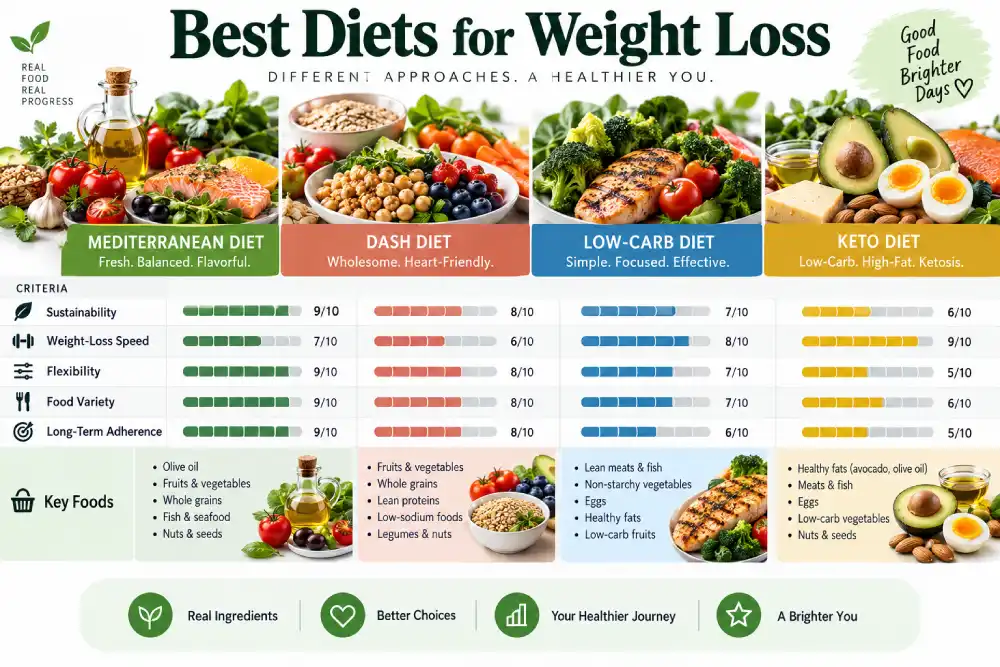
Comparison Table
| Diet | Sustainability | Speed of Early Results | Best For |
|---|---|---|---|
| Mediterranean | High | Slow, steady | For lifelong heart health + weight control |
| DASH | High | Slow, steady | Blood pressure + slow weight reducon |
| Low-Carb | Medium | Fast | Appetite control, short-to-medium term goals |
| Keto | Low–Medium | Very fast | Short-term aggressive results, with discipline |
How to Choose the Right Diet for You
- Look at what you‘re eating now if rice, roti and grains are the mainstay of your diet, then the low-carb approaches (keto, Atkins, etc.) and stricter low-carb diets won‘t be as easy to stick to as the Mediterranean or DASH diets.
- Think about your timetable for your goal are you seeking quick improvements in the short run for a specific event? The low carb or even keto diets are more suitable for this. Trying to make a permanent change and create a lifelong lifestyle? The Mediterranean or DASH are more sustainable.
- Testb4 you sign up try one week of each diet, in the real world, not just by name.
- Combine with eating plan every diet can become easier when a weekly meal plan is made in advance rather than trying to make it up day by day.
Common Mistakes When Choosing a Weight-Loss Diet
- Choosing a diet according to friend‘s results, disregarding personal food likings and cultural background
- Going overboard too soon and exhaust oneself in 2-3 weeks.
- Overlooking intake of protein whatever diet is chosen, which impacts appetite control and muscle retention.
- Assuming the diet name will be enough even without considering overall amount of calories in/out
- 8.7. Second: Experimenting with new diets every 3 weeks rather than following one plan for a period of 4–6 weeks to assess significant change.
Myth vs. Fact
| Myth | Fact |
|---|---|
| KETO is THE fastest way to permanently get rid of fat. | Keto can give rapid early results, but research indicates similar long term fat loss when compliance is equal to other diets |
| Low-carb means no fruit or vegetables! | Most low carb approaches are just restricting the carbs (starchy and sugary) not vegetables and easy fruit. |
| Mediterranean diet is designed only for weight management, not for weight reduction. | Mediterranean eating pattern has been strongly linked to weight loss and maintenance |
| DASH is only used for high blood pressure. | The DASH pattern is also frequently advised for sustainable weight loss because of its emphasis on entire foods with controlled portions |
If you want more information about how diet-specific studies are assessed, then the Harvard Health diet and weight loss library; is a good place to start before going ahead with any plan long-term.
Conclusion
The best diets for weight loss aren’t ranked by which one burns fat fastest — they’re ranked by which one you can realistically follow long enough to see and keep results. Mediterranean and DASH tend to win on sustainability, low-carb offers a solid middle ground, and keto delivers fast results for those with the discipline to maintain it. Whichever you choose, pairing it with a real meal plan and understanding your macros makes success far more likely. For the full nutrition picture, head back to the complete nutrition guide.
FAQs
Q1. What is the most sustainable diet for long-term weight loss? The Mediterranean and DASH diets are generally considered the most sustainable, since they avoid eliminating entire food groups and are built around flexible, whole-food eating patterns.
Q2. Is keto or low-carb better for weight loss? Keto often produces faster early results due to stricter carb limits, but low-carb diets tend to be easier to maintain long-term, especially for people who eat grain-based meals regularly.
Q3. Can the DASH diet help with weight loss, not just blood pressure? Yes — while DASH was designed to lower blood pressure, its whole-food, portion-conscious structure also supports gradual, sustainable weight loss.
Q4. How do I know which diet is right for me? Consider your current staple foods, your goal timeline, and test each diet’s real eating pattern for a week before committing, rather than choosing based on trends alone.