Understanding Macros & Calories: A Simple 2026 Guide
Published: September 7, 2026 Last Updated: September 8, 2026 Have you ever downloaded a nutrition app and felt immediately
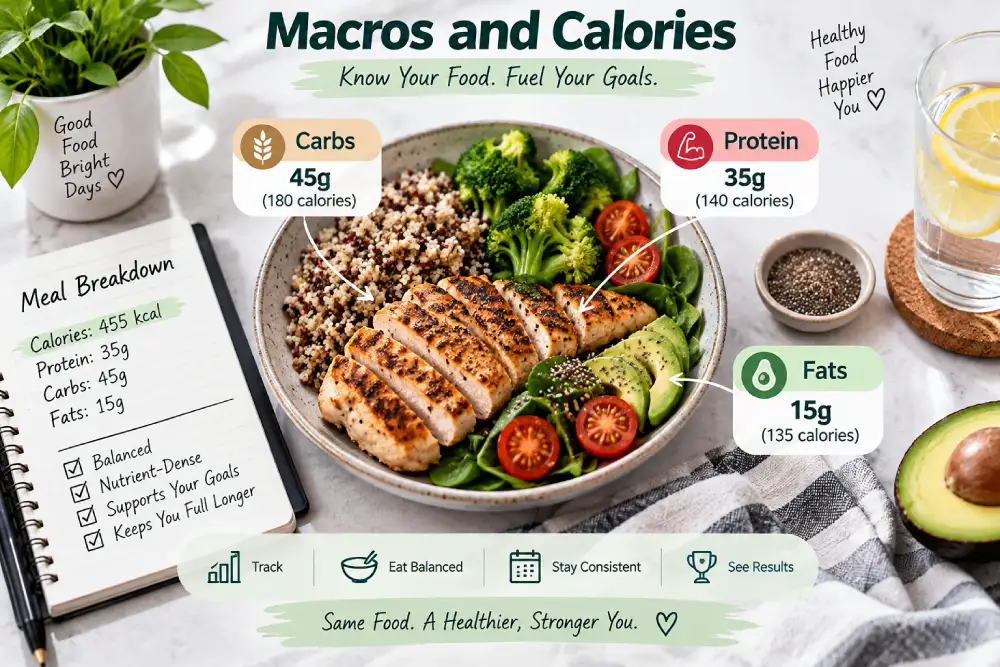
Have you ever downloaded a nutrition app and felt immediately bombarded by numbers? Don‘t worry, you‘re not the only one. In reality, macros and calories are intimidating, but the concept behind them is, in fact, straightforward: Calories inform you about the quantity of food you consume. Macros inform you about the type of fuel you consume.
This guide simplifies both of these concepts in simple language, giving you concrete world food examples so you can make practical use of this knowledge rather than simply memorizing the definitions.
What Are Calories, Really?
A calorie is just a unit of energy. Your body requires a set amount of calories a day just for survival (breathing, digestion, and blood flow) this is known as your Basal Metabolic Rate (BMR), and when used in conjunction with exercise and movement, this is known as your TDEE Total Daily Energy Expenditure.
In simple terms:
- Eat close to your TDEE → stay at your current weight, ie: do not gain or lose weight
- Eat below your TDEE lose weight
- Eating in excess of your TDEE → gaining weight
What Are Macros? (Protein, Carbs, Fats Explained)
The three nutrients that supply calories are called macronutrients. They each in combination while pursue a different purpose in your body.
| Macronutrient | Calories per Gram | Main Role | Common Sources |
|---|---|---|---|
| Protein | 4 | Builds/repairs muscle, maintains satiety | Eggs, cheese(no cream), paneer, fresh milk (for tea/coffee only), dal, chicken, fish, soy/tofu (vegetarian version), Greek yogurt. |
| Carbohydrates | 4 | Primary energy source, fuels brain and workouts | Rice, roti, oats, fruit, potatoes, Quinoa |
| Fats | 9 | Production of hormones, absorption of nutrients and feelings of satiety. | Ghee(none), nuts(almunds), olive oil, seeds(jisps), avagado |
Important note: Fat provides over two times the calories per gram compared to protein or carbs, thus portion control is more crucial than all the “healthy” fats like nuts and oils.
How to Estimate Your TDEE (Without Overthinking It)
You don‘t need an exact number just a ballpark estimate will do for the beginning.
- Rough initial estimate: Multiply your body weight (lbs) by 13–16 to get an approximate range to maintain your body weight (lower figure for less active and higher for more active.)
- Adjust accordingly to actual outcomes: when in that calorie bracket, monitor your weight for 2 weeks keep it stable, that‘s near your TDEE keep rolling with the same number with the scale moving, or change 100–200 calories.
- Use an online TDEE calculator as a rough starting point and then use step 2 to dial things in.
Example: For maintenance a 150 lb (68 kg) moderately active person might begin at approximately 1,950–2,400 calories/day, then modify accordingly to goal.
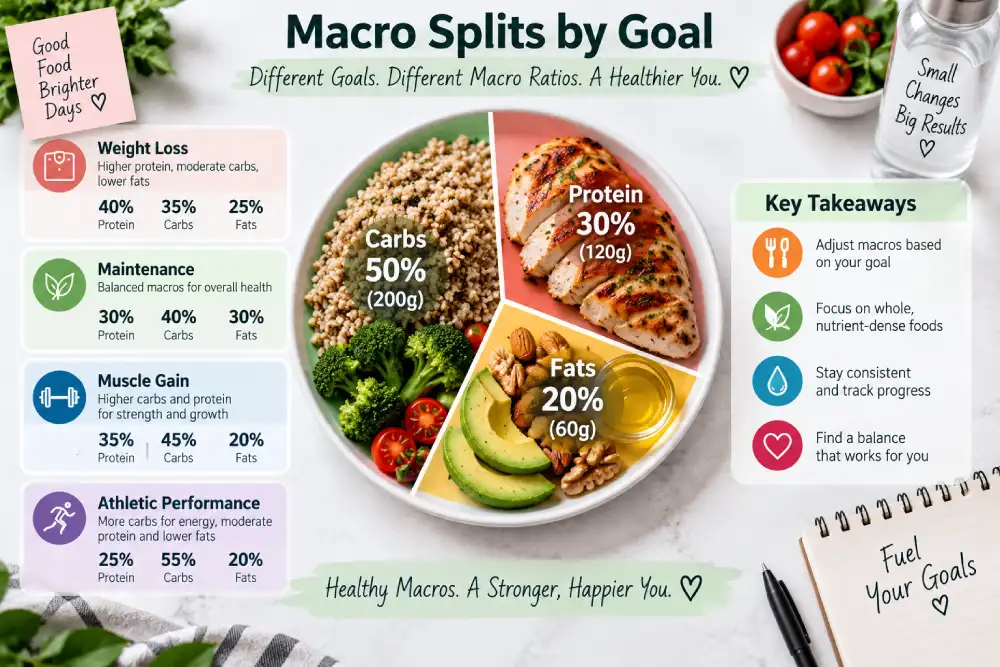
Simple Macro Splits for Common Goals
| Goal | Protein | Carbs | Fats |
|---|---|---|---|
| Fat Loss | 35% | 35% | 30% |
| Muscle Gain | 30% | 45% | 25% |
| General Maintenance | 25–30% | 40–45% | 25–30% |
These are just guidelines, not set rules your response, activity level and food preferences all come into it.
How to Count Calories Without Losing Your Mind
- Begin with consciousness, not accuracy.- tracking your food for a week without altering your intake will at least allow you to identify the sources of your daily calories:
- A food scale only for a few days (this trains up your ‘eyeball estimate’ for a long time and you don‘t need to weigh food forever).
- Protein is the key here reach your protein target every day and your other numbers can be a little off.
- Round, do not obsess Anything in a 100-150 calories of your daily target is all you really need for tangible, bench-mark results.
Common Mistakes People Make With Macros & Calories
- When individuals calculate calories but disregard for protein, resulting in muscle loss when losing weight.
- What snacks? a too low estimate of liquid calories (juices, sugar in tea/coffee, sodas) also adds up quickly
- Using another person‘s macro split, but failing to account for that person‘s body size and activity level.
- Pentel in the way that people focus over every exact number rather than just average of 7 days in a week
- Giving up using tracking apps after a particularly bad day rather than accurately tracking the next meal
Myth vs. Fact
| Myth | Fact |
|---|---|
| In terms of nutrition, all calories are 100% equal for your health. | Calories control body weight, but food quality still influences health, satiety and energy. |
| Strong evidence on a high protein diet: Can cause damage to healthy kidneys. | Greater intakes of protein are safe in patients without pre-existing kidney disease. |
| Forever is what you must track macros to remain in shape! | For many people, this becomes their transition into intuitive, portion-based eating. |
| Cut down on carbs while trying to cut weight. | Carbs are not a naturally fattening foodsource just a matter of overall calorie equilibrium. |
After you have a basic idea of your approximate calorie and macro numbers, the next step is actually to put them to use eating actual food and a bulk TDEE and calorie calculator with included weekly meal plan is just the thing to help you do that on a regular basis.
Conclusion
Macros and calories don’t need to feel like a math problem. Calories control how much you eat, macros control what that eating is made of — and both work together toward your energy, weight, and health goals. Start with a rough TDEE estimate, a simple macro split for your goal, and focus on hitting your protein target consistently. For the full picture of how this fits into your everyday eating, head back to the complete nutrition guide.
FAQs
Q1. What’s the difference between macros and calories? Calories measure the total amount of energy you’re eating, while macros (protein, carbs, fats) describe what that energy is made of — each affecting your body differently even at the same calorie total.
Q2. How do I calculate my TDEE? A quick estimate multiplies your body weight in pounds by 13–16 depending on activity level, or you can use an online TDEE calculator and fine-tune it based on your actual weight trend over two weeks.
Q3. Do I need to count calories forever? No — many people count for a few weeks to learn their typical portions and macro balance, then shift to intuitive, portion-based eating once they understand their numbers.
Q4. What’s a good macro split for weight loss? A common starting point is roughly 35% protein, 35% carbs, and 30% fat, adjusted based on how your body responds and your activity level.