How to Stay Consistent With Workouts in 2026 (10 Tips)
Published: September 2, 2026 Last Updated: September 7, 2026 Here‘s the hard truth that most fitness writers leave out:
Here‘s the hard truth that most fitness writers leave out: the Number 1 reason people don‘t get into shape is not because their workout plan sucks, it‘s because they quit working out! The real skill involved in getting in shape is being able to Workout consistency, and this has virtually nothing to do with will power:
These 10 tips have nothing to do with motivation. They‘re about habit design how to make sure your new habits stick around after a long week, a bad day, or a missed Monday.
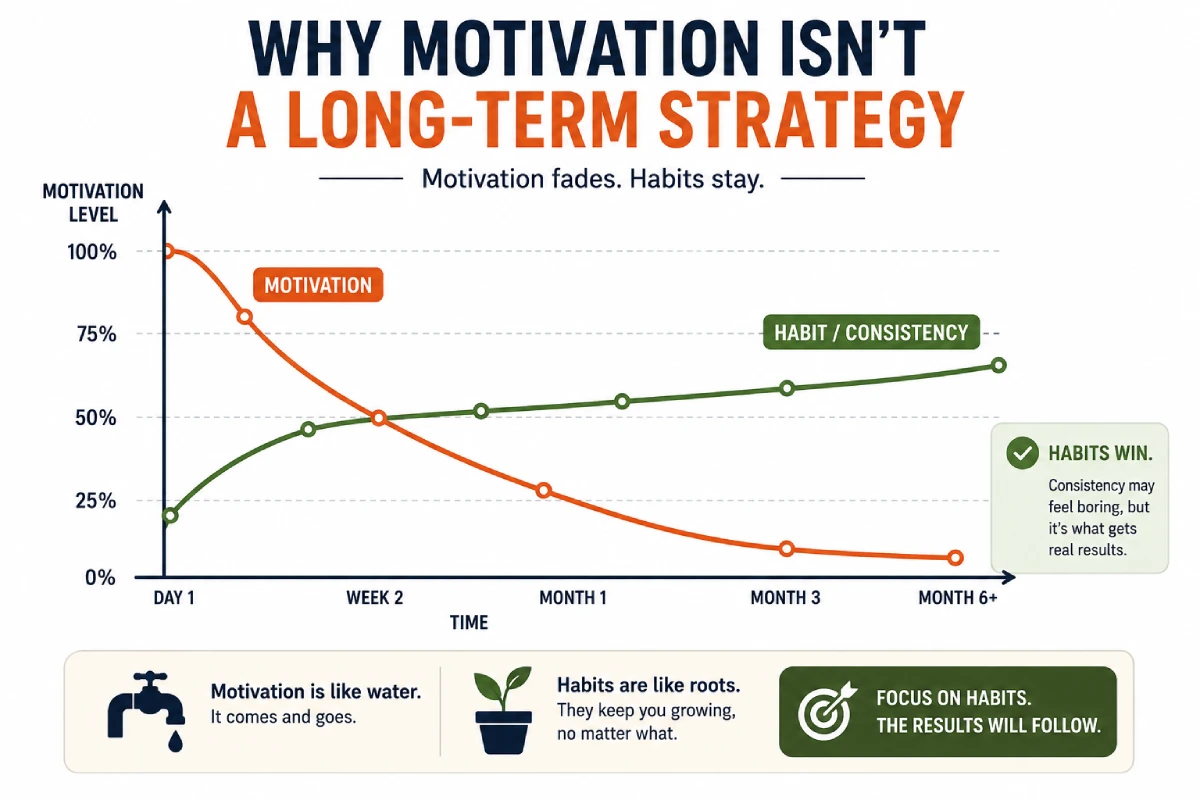
Why Motivation Isn’t a Long-Term Strategy
Motivation is a fragile and weak resource. It‘s powerful the first day, then erodes quickly with the arrival of day to day life (deadlines, sleep deprivation, crap weather). If you bank on motivation to get you through, you‘ll find your program falling apart as soon as motivation loses the battle.
Habit design erasing friction, piggybacking workouts to existing routines, cleaning up the gaps doesn‘t rely on how you feel today.
Myth vs. Fact: Workout Consistency
| Myth | Fact |
|---|---|
| “I just need more motivation.” | Design habits (add friction, anchor routines) much more trustworthy than motivation. |
| Missing one workout derails my progress. | Missing a workout isn‘t a failure missing two in a row and quitting altogether is a failure because there‘s no recovery plan in place. |
| “To really get anywhere, I will have to exercise daily” | The answer is 3-4 well-structured sessions a week, performed repeatedly which is far more effective than daily, unsustainable sessions and inevitableBurn out. |
| A fixed regime is necessary in order to remain disciplined. | A flexible, practical schedule that is willing to bend without breaking is more likely to maintain itself than stubborn, all-or-nothing approaches. |
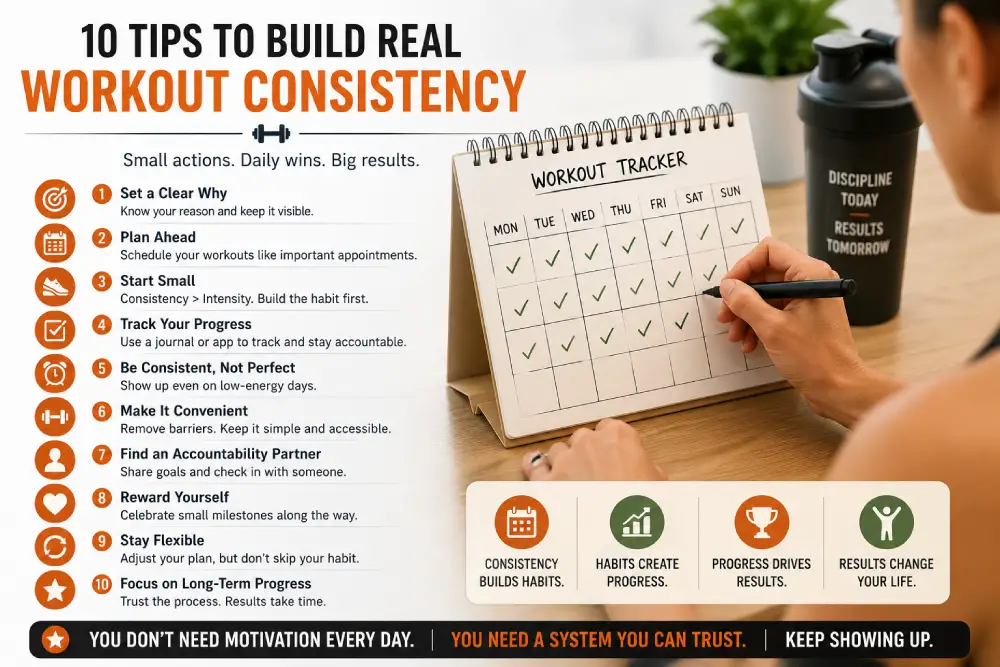
10 Tips to Build Real Workout Consistency
1. Reduce your starting point. A 15 minute home workout you accomplish every day trumps a 90 minute gym session you don‘t. Aim lower than you think you need to. Small increases in habit strength are more powerful than large increases in intensity.
2. Tie workouts to a pre-existing regular. “First thing in the morning after my coffee” is much more effective than something like “sometime when I have free time.” When you tie in a new habit to an already-existing transition, it takes away the mental energy and decision-making that so often gets in the way.
3. Have a pre-determined contingency plan for missed days. Whether it is doing a shorter restorative session or just starting again the next day without any mental damage, pre-determining your plan will keep one missed workout from derailing an entire training plan.
4. Loose Track Streaks, not perfect ones. U are probably best off having a six out of seven day streak rather than, say, a seven out of seven streak. When u have a tough week the loose streak should survive, the perfect one is likely to die at its first hurdle.
5. Create a practical, doable workout schedule. Set up your scheduled workouts according to your busy week, not whatever image of a perfect week you have in your head. Three or four workouts that work in your world are more effective than six bogus ones.
6. Fewer decisions. Prepare your clothes for the next day, have the workout planned out the night before, stick to a plain old stand up and do nothing routine. Less decisions to make in the moment means less opportunities to talk yourself out of it.
7. Establish fitness accountability. Partnering with someone to work out, setting a joint goals-tracking app, or even just reporting plans to a friend for the week induces a tiny social cost to slacking that just might be enough to sway your decision on a low-inspiration day.
8. Be cautious of gym burnout. The tiredness that lasts hours, the urge to quit every session, the lack of progress that continues even with effort; can be signals of gym burnout and not laziness. Solution: typically, a light week or a different activity.
9. Track more than the scale. Your energy, sleep, and mood are all likely to fluctuate before you see any changes in the mirror. Progress pictures and how your clothes fit tend to be more effective long term indicators of positive change than that number on the scale.
10. Make consistency not perfection the aim. The dozen or so times that you do an unexceptional workout each week will see you out-train someone who does one perfect workout and gives up after three weeks.Consistency wins by just beating time.
Building a Workout Schedule That Actually Sticks
A sustainable workout schedule is one that honors your actual week instead of fantasizedaboutweek.
| Day | Focus |
|---|---|
| Monday | Full-body workout (20–30 min) |
| Tuesday | Rest or taking a light walk |
| Wednesday | Cardio Or Workout Of Choice. |
| Thursday |
Rest or light activity |
| Friday | Entire body workout(20–30min) |
| Saturday | Describe optional activity, flexible |
| Sunday | Rest |
Notice this leaves real breathing room flexible days act as a fall back if you miss a session.
Recognizing and Avoiding Gym Burnout
Ancando gym burnout is as much about discipline as it is about effort. It develops from what must necessarily be a culmination excessive short-term intensity combined with insufficient recovery and impossibly high weekly goals over the course of weeks and months:
Warning signs to watch for:
- Bargaininged out on workouts you would have been excited to do
- A deterioration in performance despite regular training
- Chronic fatigue that does not resolve after a good night‘s sleep;
- Dose of irritability or loss of interest specifically related to workout days
What helps:
- Build in a really lighter week every 4–6 weeks.
- Replace an occasional high-intensity session with a walk or relaxing yoga.
- Evaluate if your planned workout routine really fits into your life at this very moment, not in the ideal world you desire
What helps:
* Build in a genuinely lighter week every 4–6 weeks
* Swap high-intensity sessions for a walk or gentle yoga occasionally. You can also explore our guide to Yoga for Flexibility for beginner-friendly ways to improve mobility and flexibility.
* Reassess whether your workout schedule is realistic for your actual life right now, not the one you wish you had
Building Fitness Accountability That Works
There is not an expensive trainer and floor time to support this kind of fitness accountability. It doesn‘t have to be a can of gym. Straightforward systems are just as effective:
- A weekly communicating message with your friend for things you accomplished during the week
- A spaced repetitions spreadsheet or app you and a partner can log sessions in.
- Booking workouts in your calendar when you would book an appointment; as serious as showing up to 10, 30 or even 50 meetings.
- Being publicly committed to a particular weekly goal even on an informal level
Pressure isn‘t the goal it‘s a gentle framework that makes it a little more difficult to skip than to attend.

What to Do After Missing a Workout
This one hit can be what makes or breaks the entire consistency over the long haul. One workout skipped is not in and of itself going to derail things it‘s one hit blip in the pattern that needs to be brushed past, not a guideline that the entire plan is shot to hell.
The recovery move. Just go back to your next prearranged session as normal, without a “remedial” “guilt” session afterwards or an off-on reset. Regular patterns derive from rapid recovery, not 0 misses forever.
Work out Consistently is not a personality trait that some people have and others don‘t. It is a system of small, intentional decisions: desire is lowered, schedule is achievable, a recovery plan is clear, and accountability is realistic. Building sustainable exercise habits can also benefit from following reliable physical activity guidance from the World Health Organization. Build the system and results will come in the long run.
It is a system of small, intentional decisions: desire is lowered, schedule is achievable, “forgiveness” policy is clear, and accountability is light. Build the system and results will come in the long run.
FAQs
Why do I always get unmotivated to work out? No one is entitled to be motivated in the long term, motivation will lose itself in the long run. Establishing habits around your lifestyle is a much better way than having the motivation.
What if I miss a workout? Just move on to your next scheduled workout without guilt or a second “make-up” workout. Missing one day is not quitting! Quitting usually is.
Number of workout days per week (reasonably) for optimum consistency? Performing 3-4 organized workout sessions per week regularly is much more effective than daily sessions that encourage overtraining and exhaustion.
What are the common symptoms of gym burnout? If you find you‘re going to the gym but struggling with workouts which you previously loved, making little progress no matter how hard you try and finding yourself fatigued all the time, then these are signs that you should back off for a little.
How to create fitness accountability without a trainer? Have a friend do regular reminders, use a sharing tracking program, or think of workouts as non-negotiable appointments on your calendar.
Having a rigid or flexible workout schedule? A flexible, realistic workout schedule that can bend without breaking usually lasts 10 times longer than an all or nothing rigid plan.
Final Conclusion
Workout consistency isn‘t about needing more motivation or more willpower; it‘s about creating a system that can withstand the bad weeks: a lower initial starting point, a reasonable timeline, built-in recovery for missed days and mild accountability. Use even three or four of these 10 tips and consistency will stop being a problem, and instead become second nature.