How to Set Boundaries at Work in 2026 (Without Guilt)
Published: August 7, 2026 Last Updated: August 7, 2026 Setting boundaries at work, isn‘t being a jerk it means conserving
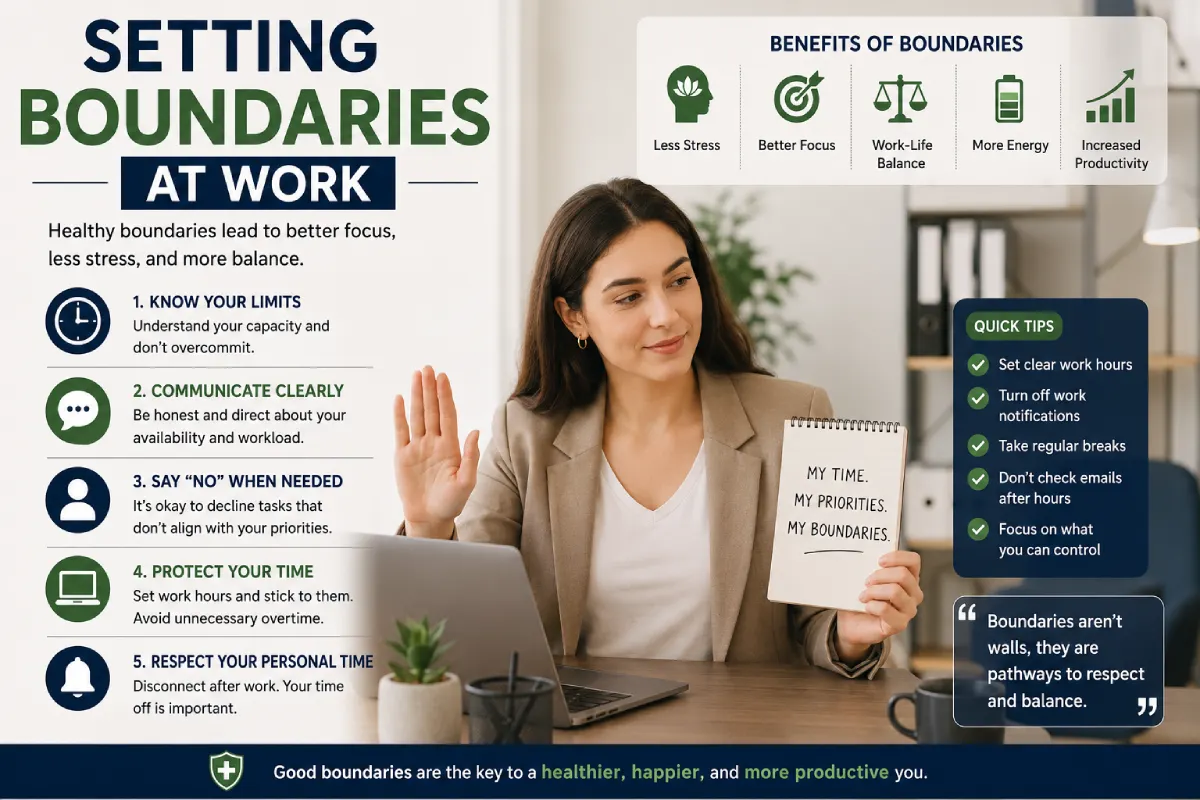
Setting boundaries at work, isn‘t being a jerk it means conserving your time, energy, and mental resources so you can maintain the career you want. This post explores how to say no without alienating coworkers, set realistic response time expectations for emails received outside of office hours, deny partners-in-crime when they ask for too much, and grow the self-assurance to do all that without feeling guilty. Little acts of boundary setting ever day can add up to monumental shifts.
If your stomach drops every time you think about saying “no” to your manager, you’re not alone. Setting boundaries at work is one of those things everyone says you should do—but almost nobody explains how to do it without feeling like you’re letting people down.
The positive aspect? Boundaries don‘t equal being difficult. Boundaries are designed to save the time and energy you need to truly enjoy your work rather than suffer through it.
What Does “Setting Boundaries at Work” Actually Mean?
A work boundary is defined as a healthy limitation you create for yourself in terms of your time, your work load, your availability. To give some examples, its setting a boundary of not responding to emails after a certain time, or creating a boundary of not taking on additional work that is outside of your specified role.
Boundaries aren‘t walls. They are guardrails. keeping your creative work a healthy, sustainable practice.
Why Boundaries Feel So Hard to Set
Most of us grew up not learning this. In most working environments (particularly in the hectic setting of US startups and the India-based corporate system of status that so often comes with hierarchy), ‘always available’ is reinforced as the norm. To say no seems dangerous, even if justified.
Common reasons boundaries feel uncomfortable:
- Fear of appearing inactive or uncooperative
- Concern about letting down a boss
- Pressure from your culture to serve the team instead of yourself
- Previous experiences where rejecting got you into trouble
The first thing to do to accomplish it is giving a reason why it is difficult.
Myth vs. Fact: Workplace Boundaries
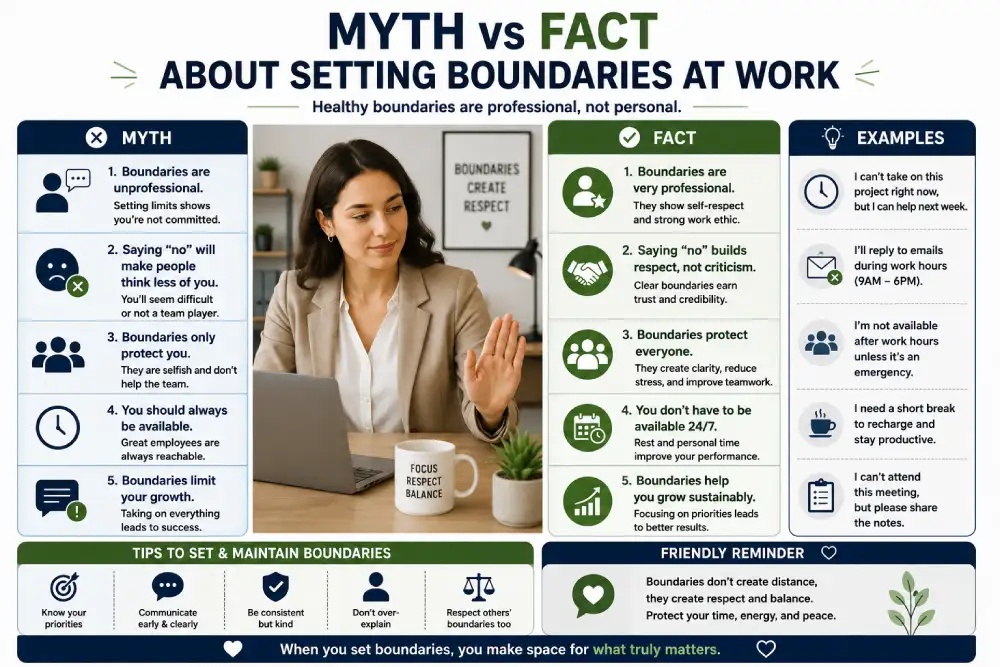
Myth: Boundaries will make you seem less dedicated. Fact: Because employees establish boundaries to safeguard focus time and prevent exhaustion, they tend to work more effectively.
Myth: I cant create a boundary without permission. Fact: It is not a request, it is a responsibility you are taking upon yourself.
Myth: Boundaries equal a never-ending stream of no. Fact: Boundaries help you say yes to what matters and no to what doesn‘t.
How to Say No at Work Without Burning Bridges
Saying no doesn‘t have to sound harsh. A few simple, reusable phrases:
- I can‘t do this now without sacrificing something else can you please ask the professor to clarify priorities?
- That‘s beyond my current bandwidth, but I can assist next week.
- I want to do this justice, so I need to force the deadline.
The important thing is to match the ‘no’ with an explanation or alternative.
Setting Email Boundaries After Hours
One of the biggest sources of quiet burnout is after-hours email pressure. You can reset expectations without making a big fuss
- Include this message in your email signature: “I reply to emails during business hours (9 a.m. to 6 p.m.). Emails received outside of this schedule will be replied to on the next business day.”
- B. Turn off push notification for your email when you‘re done with work.
- If truly pressing issues do come up, make sure to arrange a separate emergency communication method (such as a direct phone call or a particular chat room tagging system).
Sometimes this is the single most effective change you can make to protect family time.
Managing Workload Boundaries
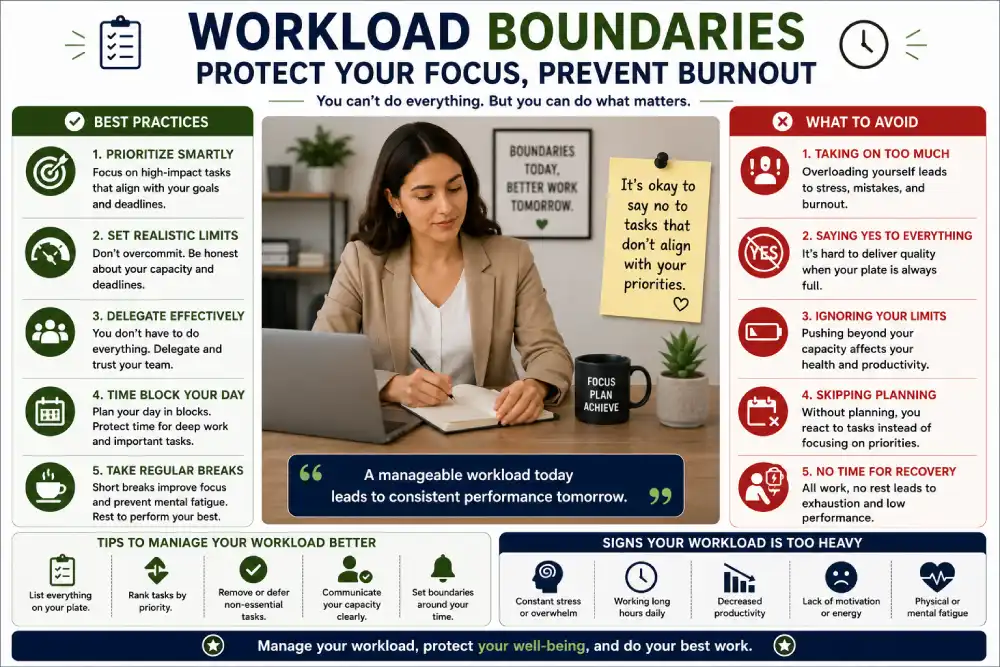
Workload boundaries are about volume, not willingness. Before saying yes to new work, ask:
- Does this match with my current priorities?
- What will I need to put to the bottom of my priorities in order to encompass this?
- Would this be a one off ask, or will they want this to be an ongoing ask?
If the work load gets out of hand, use business data, not emotion. “I have three deadlines to meet this week, which one is most important? “appears to be the manager‘s problem.
Building Assertiveness at Work (Without Guilt)
Being assertive is not the same as being aggressive. Assertiveness is calm and clear. Finding a way to regularly stand up for yourself with small things makes it easier to do with larger issues:
- – Begin with less important contexts (such as choosing to skip an optional meeting)
- No stammers, fillers or non-fluency behaviors. So not, err, yak, yakid and so on. Yet do not come across as aggressive or defensive while speaking. Be at ease but not too casual.
- Remind yourself: a fair ask for balance isn‘t a professional violation.
Less guilt every time you decline. The tenth time you say no you will find very much easier than the first.
Common Mistakes When Setting Boundaries
- Providing too many explanations or being apologetic.
- One boundary is set and reinforced only once.
- Offering inconsistent enforcement, meaning sometimes you follow-through on it and other times you don‘t
- Getting to the conclusion that matters is the point of burnout. When exhausted enough you self-communicate that what‘s you have left is not worth; inactivity and any activity when forced is no progress.
Action Steps to Start Today
- Choose any one boundary (eg. after-hours e-mails), try it out and stick to that boundary this week.
- Develop two or three “no” scripts that you are comfortable with.
- State the limit clearly, once, then (without over-justifying).–Otherwise it might sound like you are offering reasons for the limit.
- Reinforce it on a regular basis for a minimum of 30 days
Work boundaries are also an example of the larger picture–defining boundaries of where you draw the line of where your time and energy belong in all areas of your life, and not just work. That same attention to balance influences how you center your life around sustainable, manageable daily living.
Conclusion
Establishing boundaries at work is not being a pain; it’s being a healthy human being. Protect your time, and your energy, in order to have a career you can keep at for the long run. beginning where you can, following through, and feeling guilty will go away burnout will not. The earlier you can set the boundary, the earlier work will be something you can handle again.
FAQs
Q:How do I establish limits at work without offending? A: This two-step is effective: “Saying No” should be followed by an explanation or offer to compromise. Be succinct and assertive.
Q: Any suggestions on how to manage the boundaries for work email outside office hours? A: Use an auto-reply or signature footer that states your work hours, and mute notifications outside of those hours.
Q How do I push back on a workload that I feel is too heavy? A Bring the specific toodates you are working on, what else is on your plate and ask your manager to help sort out priorities.
Q: Will boundaries damage my career development? A: If anything, they are more likely to be admired than to cause problems. People are much more likely to respect boundaries, especially if they are known and agreed, than to admire silent, unsustainable persistency that results in burnout and low quality work.
Q: How long before I can stop feeling guilty about saying no? A: from what most people have said, 3–4 weeks, if you practice saying no constantly.
Featured Snippet Opportunity: The “Myth vs. Fact” section and the numbered “Action Steps” list are set up to be pulled as snippets.