Sustainable Living: The Complete Guide to an Eco-Friendly Lifestyle
Published: July 30, 2026 Last Updated: August 5, 2026 If you have ever been in a grocery aisle contemplating
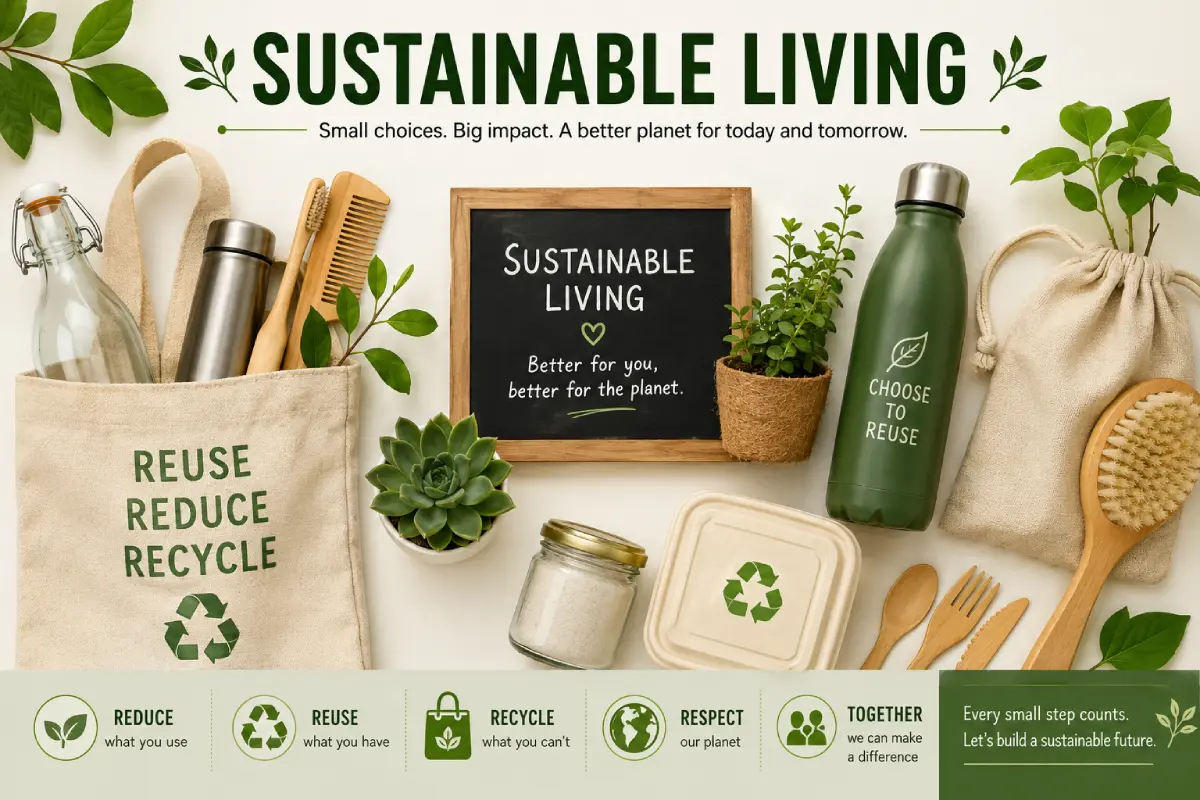
If you have ever been in a grocery aisle contemplating the significance of an “eco-friendly” sticker on something you are not the only one. Sustainable living is one of the most searched lifestyles of the decade, and for obvious reasons: 78% of consumers worldwide believe environmental sustainability is important to them and want to live sustainably, and in India, that percentage is even more according to recent studies, 82% of Indian consumers have lived more consciously in the past 5 years, mostly because of the fear of climate.
But is this really the case? To be truly engaged, most “prescriptive” sources bombard you with 100 tips for you to implement at one go, and others push a one-role-fits-all attitude of a tote-bag-and-straw sustainability stereotype, neither way really do justice to the way toward a sustainable lifestyle.
This is designed to be different. Consider it your compass on the journey, not a how to. We‘ll introduce what sustainable living is, why it matters, the 6 main focus areas where your decisions can make the difference you want to see your home, waste, fashion, beauty, food, and your footprint along with an actual 30-day action plan, a budget or ‘stuff to eat’ breakdown, and an FAQ of the most common objections that prevent people from opening the door in the first place. For each section, we give you the notes and some easy initial steps, then an invitation to follow on with a comprehensive guide.
What sets this apart from the ‘just use a tote bag’ advice you‘ve most likely already encountered is that each sub-heading below it is centered on a single query what‘s the tiniest tweak here that will have the maximum impact? Keep that perspective in mind as you read:
What Does Sustainable Living Actually Mean?
Practicing sustainable living involves taking everyday steps to lessen your contribution to eco stress; trying to minimize your daily consumption of resources and material goods, creating less waste and taking part in activities and behavior that are manageable in the long run.
It comes down to three easy-remember rules that I‘m sure you‘ve heard countless times: Reduce, reuse, recycle. In that order. Cutting your consumption at the beginning trumps trying to come up with nifty new uses for something you didn‘t really want anyway.
Key takeaways:
- Sustainability is not black and white. It is a path not a point.
- Goal is net impact reduction not perfection.
- Small and regular wins are better than one off big wins.
Sustainable vs. eco-friendly what‘s the difference? “Eco-friendly” is often used to describe a single item or thing (a biodegradable toothbrush, for example). “Sustainable” refers to the large picture a system that can stand forever, and not eventually fall apart. An eco-friendly product can be a part of a clearly-unstainable system (imagine: a “green” item being shipped across the world in lots of plastic).
📖 Read More: [What Is Eco-Friendly? Full Breakdown]
The Three Pillars: Environmental, Social, and Economic
In teaching about sustainability, three overlapping circles are often used. If we understand all three we can understand why many of the so-called “green” decisions are unsustainable:
- Ecological sustainability minimizing usage of natural resources, generation of waste and emissions
- 20. Social sustainability fair labor practices, safe working environment, effect on the community
- Financial sustainability financialy viable practices in the long-run, for companies and consumers.
A product might succeed on one pillar, and fail on another: for example, a shirt made from recycled plastic (environmental win), but manufactured in an unsafe factory (social failure).In reality, an indicator of sustainability needs to take all three into account, which is why single-issue marketing claims should be revisited.
Who Actually Benefits From Sustainable Living?
It‘s not just “the planet” in the abstract. In real terms, sustainable habits tend to favor:
- Your wallet Buying less, buying better, and using things for longer&MDASaving money by…
- Your health many sustainable swaps (natural cleaning products, wholefoods, non-toxic fabrics/materials) can contribute towards reducing your contact with chemicals and processed items
- Your local community– supporting local farmers, artisans and small sustainable brands keeps money circulating in yourarea.
- Future generations of resource and climate stabilized through present choices
Why Sustainable Living Matters Right Now
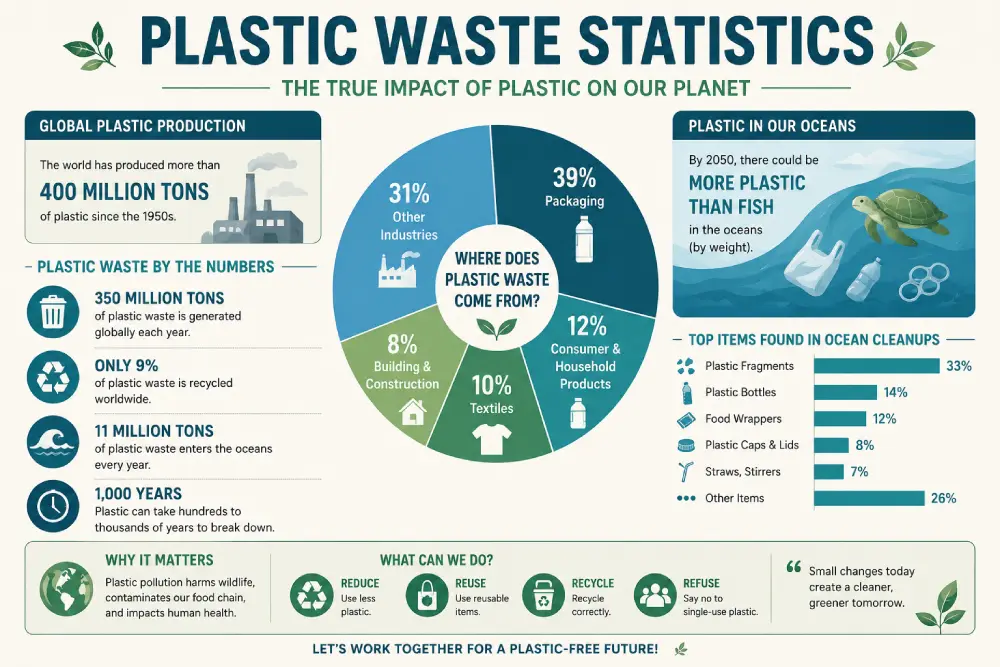
It‘s not just theory; the statistics that underline our present consumption are stark. Plastics alone, in 2023, amount to near 430 million tonnes across the globe, of which approximately 65% [sic.] are ephemeral and hence very swiftly form waste [2]. On an annual basis, between 19 and 23 million tonnes of plastics reach our waterways and seas [3].
At the consumers level, brands are acting quickly an industry report shows that the market for sustainable products accounts for an estimated $217 billion in US retail spending in 2025, or roughly one fifth of overall US retail expenditures.
Key takeaways:
- These many different ‘individual’ decisions all contribute to actual market and environmental changes.
- Sustainable is no longer niche, it‘s mainstream.
- Knowing the “why” makes the “how” so much easier to sustain.
A Tale of Two Markets: USA vs. India
Sustainable living has a very different face depending on which of the two markets you‘re this side of (and they both have very strong points to back up):
- In the USA, the emerging focus is on product innovation through a premium proposition environmentally-efficient appliances, organic certified products, environmentally-conscious packaging are now prevalent, albeit at a price premium. About 55% of mature market consumers are concerned with sustainability in general, but the non-adoption of sustainable practices depends largely on product accessibility and confidence in marketing.
- In India, the motivations are different more anxious: between 78–79% of consumers, in fast-expanding markets, such as India, are worried about sustainability, and almost 70% feel their daily behaviors matter that much. Much of this stems from already-established frugal, lowwaste paradigms reusing containers, patching instead of replacing, purchasing local, directly from farms, markets, etc that Western “zero waste” content repeats and, sometimes, rebrands without citing.
What should readers take away from this in either market? Current consumers may already be doing more than they realize. Sustainable living need not always mean implementing new practices, but forgoing existing ones for more convenient ones.
Zero Waste Living: Where Most People Start
Living Zero waste means sending as little as possible to the landfill by rethinking what you purchase how you purchase it and what happens to it after. This is often where people start their journey towards sustainability because there are concrete and immediate successes.
Practical starting points:
- Use reusables instead of disposables.: water bottles, shopping bags, coffee cups.
- Buy in bulk where feasible to reduce the packaging generated.
- Make compost with kitchen refuse a little compost pail on the counter is all you need in a city apartment
- Prevent excess packaging and free samples from reaching your home Nomorefreebies.org also provides detailed information about how to avoid having excessive packaging and free samples around your home.
You don‘t even need a mason jar-sized trash can to ‘count’. A 20-30% reduction of the waste you throw out in your home is a huge success.
Mini summary of part 2 (the reading): this isn‘t really about having absolutely nothing in quantity, but more about having less quantity intentionally1.
The Zero Waste Hierarchy
Zero waste steps are not all equally important. They are (in order): refuse unneeded things (gratis things, excessive packaging), minimize purchases, reuse what you have, actively find other uses for things, and finally recycle what can‘t be avoided. Most often, people start recycling when they should be starting elsewhere.
Budget Tip
Zero waste swaps usually reduce costs: a reusable water bottle costs the same as multiple purchases of bottled water over just a few weeks (costs comparable to bottled water per liter are reduced significantly), and buying staples in bulk averages 10–30% savings per unit compared to bought in pre-packaged form. Choose the swaps that replace the items you buy repeatedly (rather than one-offs), as this allows savings to compound over time.
📖 Read More: [Complete Zero Waste Living Guide for Beginners]
Building an Eco-Friendly Home
There is no place like your own home where sustainable living can be experienced first hand. And at the same time save money on your electricity bills, water bills, and heating bills, etc.
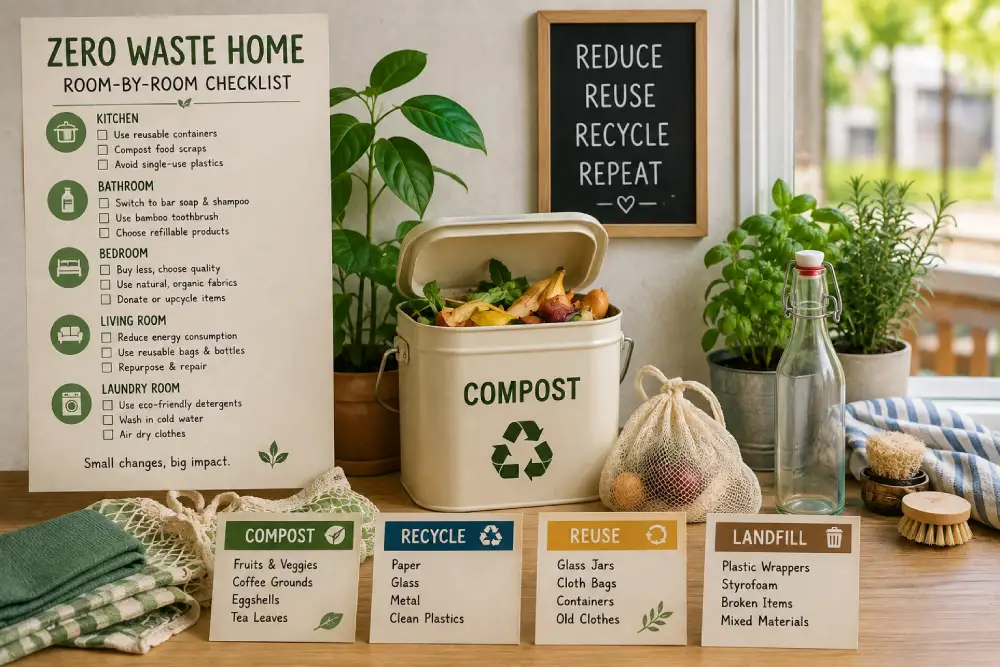
Room-by-room quick wins:
- Kitchen: Refillable bottles for water and fruit juices Re-usable containers for packed lunches and foods Compost bin Energy saving appliances dishwasher, washing-machine, dishwasher Re-usable shopping bags
- Bathroom: low-flow fixtures, refillable bottles, shampoo bars
- Living rooms: LED lighting, intelligent power strips, reclaimed or secondhand furniture
- Laundry: Wash on cold whenever we can, use energy-star rated machines and air dry if we have the option.
Energy saving swaps can repay their cost in less than two years through savings in electricity and water bills – sustainability and savings are so often linked in.
Mini summary; To reduce your home‘s impact on the environment it is not necessary to immediately redevelop your home small changes, done step by step, room by room can make a big difference.
Renters vs. Homeowners
Not all eco-home tips are effective if you are renting or sharing; the more portable non-permanent tips make the best financial sense: LED bulbs (remember to bring them with you when you move), draft stoppers, smart plugs, reusable/washable bottle and packaging alternatives. For homeowners, the investment can be higher effort/higher return on investment items: solar panels, insulation upgrades or water conserving appliances.
Common Mistake
The purchase of all new “eco” household items at once a brand new set of all bamboo items, a set of matching glass canisters generally creates more waste/consumption than the switch is saving, since it is, on the whole, throwing away perfectly good plastic or synthetic items prematurely. The more sustainable course of action is to consign them to the trash as they become eye-candy, replacing them individually with improved models.
📖 Read More: [Eco-Friendly Home Ideas: The Room-by-Room Checklist]
Sustainable Fashion: Building a Slow Wardrobe
The fast fashion industry is considered to be among the most resource-intensive industries worldwide. So it is the most obvious industry to make sustainable. However, it seems rather evident that India is already ahead of the game. According to a Statista consumer survey, 89% of Indian participants commented on shopping for sustainable or eco- friendly apparel or accessories which was the highest percentage across all 12 countries surveyed.
Practical starting points:
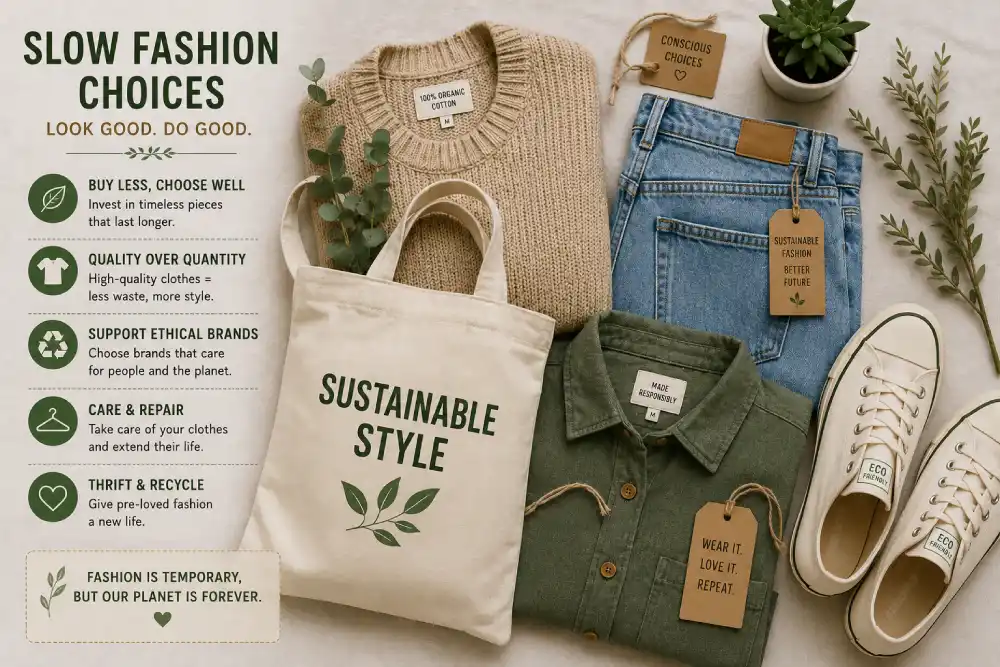
- The change to downward thinking, where we now think in terms of buying things at “cost per wear” instead of focusing on the price tag out of the shop.
- Buy used (or resell) before purchasing new.
- Select natural, durable textiles; such as organic cotton, linen or hemp. Do not select synthetic blends.
- Traditional support brands that manufacture their products by handloom methods; therefore, they produce need using minimum energy and production processes.
Mini summary: Slow fashion is: buy less, buy better and wear longer. It is not about dowdy.
How to Read a Clothing Label Like a Sustainability Expert
Ignore terms like ‘eco-conscious’ (unregulated) and look to the fiber content and care instructions instead. Naturally biodegradable fibers (cotton, linen, wool, hemp) will typically outperform any synthetic blend (polyester, nylon, acrylic) at the end of their life, as synthetics release microplastics in the wash and take thousands of years to bio-degrade. Valid certifications to look for include GOTS (organic textiles) and Fair Trade Certified, or OEKO-TEX, as these are externally verified unlike self-declared ‘green’ criteria.
Drawbacks to Know
Of course, slow fashion is not perfect: more sustainable items tend to be more expensive initially, secondhand shopping takes a little longer to find the perfect item, and sustainable certified brands are still somewhat limited in reach in many smaller cities. Going in with the right frame of mind you are slowly shifting your wardrobe, not instantly changing it makes it a lot less daunting.
📖 Read More: [Sustainable Fashion Guide: How to Build a Slow Wardrobe]
Clean and Sustainable Beauty Routine
The beauty and personal care sector is one of the most neglected parts of the conversation on sustainability yet the industry is rife with packaging waste, water-requiring ingredients, and ethically questionable sources.
Practical starting points:
- Opt for packaging that is either refillable or recyclable rather than disposable plastic.
- Opt for multi purpose items to decrease consumption across the board
- Look out for ingredient lists of biodegradable, low impact formulations
- Support brands with transparent sourcing and manufacturing.
This is where trust matters almost more than any other sector: the fact that when consumers say they trust eco-labels, recommendations etc., is because greenwashing is so rife in the world of beauty.
Mini summary: Sustainable beauty means buying less, buying better, buying products that last longer, more than buying “green”.
Spotting Greenwashing in Beauty Marketing
Words such as “natural,” “clean” and “green” are not legally defined in most markets, so brands are free to claim them regardless of their actual formulation or sources. Focus on verification signals instead such as full ingredient transparency, third-party cruelty-free or vegan authenticity, published sourcing and packaging that states what it‘s made of (recycled post-consumer plastic, glass, aluminum) rather than nonspecific “eco packaging”.
Troubleshooting: “Sustainable Beauty Feels Too Expensive”
This is the most regular concern, and can often be handled by changing how you shop rather than what you shop for. Multi-use products make less necessity for products, (ex: a balm that can be used as a lip stain and cheek color) refill programs remove the expense of packaging every time you purchase the same product, and “buying out” a product entirely (ex: finishing a shampoo bottle before reaching for the next one) before seeking a new routine is, at least partly, more economically and ecologically friendly than regular back and forth.
Read More: [Clean & Sustainable Beauty Routine: What Actually Matters]
Sustainable Eating and Food Choices
What‘s on your plate has a hugely disproportionate environmental impact – over and above transportation, and home energy use – for the typical household.
Practical starting points:
- Limit the number of overnight plant-free and plant-forward trials to introduce 1–2 new plant-forward meals per week; this allows families to test sustainability and make gradual changes.
- Purchase seasonal and local foods to reduce transport pollution.
- Plan meals to avoid waste, and if you can‘t use the food, take advantage of Composting.
- Support farmers’ markets and CSAs if they are available in the community.
Mini summary:…. you don‘t have to go all the way vegan to really affect your diet. Direction is more important than perfection.
Why Food Waste Matters More Than Most People Realize
Overly we throw away not just precious dollars but also precious water and land, pollution from transit, the labor involved in growing, harvesting, sorting and processing food all for something that nobody ever even ate. Simple habits address much of this: shop with a menu in mind and a shopping list derived from it, practice thoughtful storage, and don‘t take date labels too literally except as indicators of flavor and quality.
Real Experience: Starting Small in the Kitchen
A common pattern in successful attempts to change towards greater sustainability is to begin not by reinventing every meal but by establishing one routine (such as a weekly “use it up” meal constructed entirely from foreseen ingredients, or a devoted Meatless Monday). It is precisely the smallest habit that will sustain long term, not the most ambitious one!
📖 Read More: [Sustainable Eating Guide: Practical Food Swaps]
How to Reduce Your Carbon Footprint
The amount of greenhouse gases from your activities that have built up in the atmosphere the total set of greenhouse gases that result from your lifestyle, from the power you consume to the food you consume to the goods you buy and travel you do.
Practical starting points:
- Address the biggest impacts first: home energy, transportation, and diet usually have more impact than the smaller switches.
- Unplug devices, and sign up to a provider of renewable power if they‘re available to you, such as Good Energy, Ecotricity etc.
- Errands: trying to do as much as possible in one trip. Combine errands when possible using “errands clusters”. Use public transport or car pooling.
- Identify your personal biggest levers by using a carbon footprint calculator
Mini summary: Not every ‘green’ behavior makes equal contributions towards sustainability. Prioritize and start with those behavioral modifications that will make the greatest impact on environment.
What Actually Moves the Needle
Home energy source and efficiency by far the biggest consumers for average home. Transportation habits, particular frequent flying or a long single-person commute. Food, especially meat and dairy. Consumption of new goods. Recycling and reducing everyday plastics have an impact, but compared to these four lever points are smaller, so they are worth doing but not where the time and effort should be focused.
Troubleshooting: “I Don’t Know Where My Biggest Impact Is”
This is precisely the function a carbon footprint calculator performs by inputting where one actually lives, commutes and eats, then monitoring travel, it‘s possible to determine where the biggest drain on one‘s lifestyle occurs. An individual may make drastic changes to their home heating, for example, only to discover afterward that their greatest contribution is their air travel. Calculating steps before taking action prevents needless waste.
📖 Read More: [How to Reduce Your Carbon Footprint: Step-by-Step]
Sustainable Living for Families and Kids
Encouraging children to be environmentally friendly isn‘t about policing them — it‘s about establishing long-term habits that require minimal effort once they‘ve been ingrained.
Practical starting points:
- Engage children in recycling and composting (they are more likely to adopt a practice if being involved rather than just observing)
- Secondhand or ‘hand-me-downs’ will be particularly effective for those with rapidly growing children. The rapid turnover of sizes for fast-growing kids makes this a high-pitch swap for families.
- Bring school snacks in containers and bottles that can be used again.
- Utilise toy libraries, exchanges, or second-hand markets for toys that children grow out of rapidly
- Say “why” behind the behavior “Long term consistent” children who are reasoning about beh. parently have the behavior into adulthood more than children just told what to do.
Something about balance: Family life is hard enough without sustainability becoming another guilt-inducing burden. And it only takes one or two constant habits…a family-wide “no single-use lunch packaging ” practice, for example…to apprise the whole family of the principle without demanding parents’ constant attention.
Mini summary:The idea for kids isnt about getting them perfect homes it‘s about making them normal every day stuff. Even from a young age they are not suddenly introduced to sustainable living but they simply grow up with it because it‘s normal.
Sustainable Travel: Vacationing Without the Guilt
Travel: Seems to be one of those areas where people feel they have to give it all up actually, there‘s a broad range of fields between never flying and not even considering the matter.
Practical starting points:
- Opt for direct flights if possible (takeoffs and landings are a very large proportion of fuel burn, so connecting flights often give a higher emissions output than direct flights the same length)
- Pack reusable travel items: a foldable water bottle, a reusable toiletries kit, a tote for day excursions.
- Support local guides, restaurants and accommodation rather than big international chains to leave more tourism money in the local economy
- Use of train or bus where available for regional short trips (where infrastructure is suitable) – a significantly less greenhouse gas-intensive option than short-haul flights
- Be an offset conscientious traveler: there is a big range among carbon offset programs, so make sure you are interested in third-party certified projects and not just airline add-ons.
Mini summary: sustainable tourism is a way of traveling and consuming when you are here, not when you decide to travel.
Sustainability by the Numbers
A quick-reference snapshot of the data behind this guide:
| Metric | Figure |
|---|---|
| US consumers who state that sustainability is important for the purchasing decisions they make | ~74% |
| Predicted 2025 US spend on sustainable products | ~$217 billion |
| Indian consumers who have taken up more sustainable practices in the previous 5 years. | ~82% |
| Indian buyers of ethically produced fashion (highest of the surveyed countries). | 89% |
| Consumers in emerging markets (India, China, Indonesia) worried about the impact of their lifestyles on the environment. | ~79% |
| Producers global plastic in 2023 that became short-lived waste | ~65% |
| Buyers that are prepared to adhere to higher costs for ‘sustainable’ products | ~72% |
The numbers go to further confirm what this guide is trying to say: sustainable habits have shifted away from “niche lifestyle choices” to the norm, in India and in the US (albeit with slightly different lifestyle choices and value propositions for each market).
The Overlooked Category: Digital and Tech Sustainability
While the majority of sustainable-living guides focus on physical products, the majority of environmental impact in recent years has shifted to our digital lives and electronic products, an area that none of the other guides for this topic even attempt to address.
Practical starting points:
- Maintain devices longer rather than rushing to replace them on release cycles manufacturing a new phone or computer creates many times more emissions than keeping it for as long as possible.
- Make use of certified e-waste programs to recycle or exchange old electronics instead of having them stored or landfilled as electronic circuits consist of hazardous elements as well as reusable materials.
- Cut down on wasted cloud storage and email spam Using data centers takes a lot of energy so deleting those old, unneeded files and duplicates photos has a small but tangible impact when scaled up
- Select devices for repair and support right to repair options where available instead of replacing device based on a single damaged part
- Adjust the streaming quality so that you don‘t need full HD or 4K streaming the higher the resolution, the significantly more data and energy spent per hour
Mini summary: Your email inbox and your electronics drawer are just part of your impact and seemingly tiny habits at that but they contribute in all sorts of ways that most how-tos neglect to mention.
Sustainable Living and Eco-Anxiety
It‘s also worth acknowledging something that much of the content on sustainability completely ignores: for many people, thinking about the environment can trigger real feelings of anxiety, guilt or hopelessness. This is a quite normal emotional reaction to a very significant and complex issue, and one worth tackling head-on, rather than ignoring in the name of providing purely practical, emotion-free contents.
A few reframes that help:
- You can‘t be individually and solely responsible for the climate problem. Individual effort plays a role-though admittedly a tiny one-in this big picture, but no single individual was ever intended to carry the burden of the whole thing just by making particular choices in the supermarket.
- Guilt is a weak long term motivator. Habits that are shame motivated tend to be dropped quickly; habits that are motivated by curiosity, or values or real interest tend to stick.
- “Good enough” is a very valid standard. One of the top reasons people go back to their old, less effective, habits is perfectionism. Invalid efforts are still better than invalid efforts.
- Community builds on people‘s efforts. By talking about it with friends, relatives or broader community groups about sustainable behavior, it diminishes the feeling of “what does it matter” and normalizes the behavior for others in the community.
Mini summary: Something that‘s sustainable for the lifestyle that‘s emotionally sustainable for you will be more long-term than something else built on guilt or pressure go at the right speed.
Sustainable Gift-Giving
Gift-giving occasions (birthdays, holidays, festivals) are some of the highest-waste moments of the year (cards, wrapping paper, unused gifts, excess packaging). A couple of simple shifts can have a huge impact without losing the same sense of personal thoughtfulness in a gift:
- Experiences instead of objects, such as classes, tickets, or shared activity, create no physical waste. In addition, are far more likely to be preferred to an object.
- Consumables done well (“Food, drinks or beauty products that are used up and don‘t contribute to clutter”)– Albeit obvious, if it is consumed then it doesn‘t add to the clutter problem.
- Quality rather than quantity. A carefully selected, durable gift, by itself has a lesser impact on the environment and a much longer lifespan than several smaller impulse buys.
- Wrapping smarter: reusable fabric wraps, recycled paper and reusing packaging can all reduce the portion of a present that is thrown away.
- Secondhand and vintage: especially in relation to books, jewellery, and homeware, secondhand presents have moved from being an undesirable option to a very trendy one, particularly with younger shoppers.
Mini summary: Conscious gifting and eco-friendly gifting tend to coincide more than you might think it‘s merely a shift to more thoughtful consumption, not less.
Common Myths About Sustainable Living
| Myth | Fact |
|---|---|
| “It‘s too costly” | Numerous swaps (reusables, energy efficiency, buying less) are expensive to start but will save money in the long-run. |
| “Mine own personal selection doesn‘t can matter” | Aggregated consumer demand is now transforming whole industries |
| “It necessitates a complete change of lifestyle” | Gradual, habit-forced modification is more efficient and sustainable pun application. |
| ‘Sustainable’ is the current buzzword, meaning that we are treating the environment in a ‘green’ way and conserving the resources. | A product can be environmentally friendly without necessarily be created within a sustainable system. |
| You have to replace your existing products with the new ‘sustainable’ ones in order to begin | Reusing what you all readyhave is usually better than premature substitution. |
| “it only counts if everyone does it” | All supply chains change with even partial levels of consumer demand: for example brands react to sales figures, rather than to acceptances |
| “Living sustainably means renouncing” | Much of it is substitution, not deprivation a reuseable waterbottle still contains water, a secondhand jacket is still going to keep you warm. |
Common Mistakes Beginners Make
- Replacing existing products unnecessarily by “eco” versions of them, ie using your existing stock of well-used non-eco products can be more sustainable than depleting them prematurely through replacement.
- Trying to initiate dramatic transformation across all aspects of life in a short period of time generally results in burnout and retreat.
- These other points can often be more important than cost – a cheap item which is replaced every year for example can be less sustainable than a durable and expensive item.
- Getting duped by greenwashing words such as “natural”, “green”, are not regulated in the same way as certified labels
- Distinguish only those choicesvisible actions [programs or items that you see directly a tote bag is visible whereas dropping out of an energy supply is not, but that is probably more effective anyway]
- How do you stack up against “zero waste” influencers which most public zero waste accounts are years of habit-building, not Day 1 standards
Sustainable Living on a Budget
The greatest misconception that influences everyone is cost but sustainable living and frugal living have much more in common than they do differences. This is the reality of how the costs are shared:
Where sustainability saves money immediately:
- X16 reusable bottles, containers, bags will replace spending on equivalent items every few weeks
- The more you buy, the more you spend. The less you‘re buying the less you spend. This effect also explains individual differences when both will buy less (savings tendency).
- Energy-efficient habits (shorter showers, unplugging devices, air-drying laundry) reduce utilities without any start-up costs
- Repairs rather thanreplacement allows you to extenthe life of things you‘ve paid for.
Where sustainability requires upfront investment:
- Energy-efficient appliances and solar panels but these normally only pay for themselves in two or five years.
- More quality, long-lasting clothing and items expensive per item, but much cheaper per wear over its useful lifetime
- Organic and/or sustainably certified food generally 10–20% more expensive, but with narrow difference when shopping seasonal, local.
The pragmatic way: put the priority on the free and cheaper to implement swaps (there are far more of those than people realise) and keep the higher investment ones as things to be taken on on more of a long-term planning basis- don’t swap out the old for a new one until it needs to be replaced.
Your First 30 Days: A Step-by-Step Starter Plan
Rather than trying to adopt every tip in this guide at once, here‘s a realistic four-week on-ramp:
Week 1 Awareness. Monitor your household waste and spend a few days without making any changes. You can‘t manage what you don‘t measure. Write down how much of your trash and money is going where.
Week 2 Zero-cost swaps: begin with free changes: empty out packaging you already have, initiate a “reduce single-use” policy for one category (bags, bottles, cups) and begin diverting and seperating compostable scraps if that‘s appropriate in your area.
W 3 Here is a one category deep dive idea: Choose the cluster from this guide that you identified most with (Home, Fashion, Beauty, or Food) and then actually read the full guide. Make 2–3 specific changes just in that one cluster instead of many half-hearted attempts.
Week 4 Measure and build: Review your baseline from week 1. 10–15% drop in waste or a couple of long lasting swaps is an achievement. Pick another area to tackle over the next month and do it again.
Mini summary: Long-lasting habits are layered into place, not toggled into place all this plan is trying to do is create momentum, not burnout.
Troubleshooting Common Sustainability Challenges
I live a place with few sustainable choices.” Keep it simple and universal first: Going down consumption, reusing what you already have, and wasting less food are choices that do not rely on specialty stores. Once those are understood, then explore bulk and local purchases.
My family/roommates aren‘t on board. First, as always, start with swaps that do not require other people to be on board. This is you, doing your thing. Additional household swaps, such as composting, tend to take up once people experience it as easy.
I keep forgetting my reusables. Keep them where the habit needs to kick in a bag by the door, a bottle in your bag half the time instead of having to remember to put it in. No difference how strong your willpower is, effective environment design beats it.
I didn‘t stick to it and I think I failed. That‘s normal, and that‘s also exactly why this guide‘s “direction, not perfection” presentation style is so important. Doing it imperfectly over and over will always beat not doing it at all – you have no “streak” to maintain, only a general tendency.
Where to Start: An Impact vs. Effort Approach
The main lesson from this guide? If you only remember one thing, just put the potential change in impact (on environment + pocket) x effort (time + cost + upheaval to your routine). Aim for the quick wins first – change the light bulbs for low energy ones, make sure you have your own bottles, do your meal planning, before moving on to the “big” changes – new insulation, the full renovation, the new wardrobe.
The Future of Sustainable Living
Expect several shifts to accelerate through 2026 and beyond:
- More robust anti-greenwashing regulations already taking shape in the US (with the FTC‘s guidance on environmental marketing claims) and India, a move that will compel brands to be more precise in their “eco” labelling, and a more reliable source of information for consumers
- New and expanded availability of refillable and package-free retail formats, broadening out from specialist zero-waste outlets into mainstream retail, including non-food as well as food-related products.
- Ongoing expansion in the resale/swm markets as “circular” consumption transitions from niche to mainstream (fashion)
- Increasing demand for transparency more companies publishing supply chain and sourcing data directly rather than through the words of marketing and branding.
- Technology-enabled decision-making tools such as carbon footprint calculators, food ingredient scanning apps, and sustainability scoring apps that make it more convenient to assess claims without having to do the work
For us and those in India, the message is the same: verification replacing hyperbolic assertions, and convenience’ catching up to intention’. It is easier and easier by default to make sustainable choices, rather than difficult for only the committed.
Final Thoughts
Living sustainably isn‘t ticking things off of a list it‘s about finding a way of life that feels right for you (and sticking to it!). Begin by choosing one topic below to focus on that feels do-able today, whether that‘s zero waste shopping in your kitchen, curating a slow fashion wardrobe, or using natural products on your bathroom shelf. Then take advantage of the linked, detailed guides when you‘re ready to go into greater depth.
If there is one thing to learn from all of the above, it is this: sustainability is not a personality to jump into or an identity to become fully entralled in overnight. It is a series of small, replicable choices what you buy, what you reuse, what you turn down, what you give away that you choose a little bit more mindfully than you did yesterday. Sometimes one week you will make more of those choices and other weeks you wonot and that is okay. The households, everyone‘s, and routines that truly will remain sustainable 10 years from now are almost never those that tried to do everything at once. They are those who opened a guide like this and covered a different section each time along their journey.
Whenever you want to move on, visit this page again as the starting point to see what to do next home, fashion, beauty, food, waste or your carbon footprint and delve into all the detailed guides linked here.
FAQs
What is sustainable living? Sustainable living is simply doing your daily activities, what you buy, eat, wear, and throw away that minimizes your effect on the environment, as well as providing for your needs without sacrificing resources for the next generation.
Is it expensive to live sustainably? Not always. In fact, many sustainable swaps (reusables, energy efficient appliances, buying less in general) actually save you money after purchase, even if some of the swaps are more costly initially.
Where do I begin? Begin with one easy but effective lifestyle change for example, using reusable bags and bottles, installing LED light bulbs, or planning your meals to minimize waste rather than trying to change everything immediately.
What is the distinction between eco-friendly and sustainable? “Eco friendly” tends to refer to an individual product or activity whereas “sustainable” generally implies a broader context of a complete and eventual equilibrium in a lifestyle or system.
But do any one person choices really matter? Efectively, the daily impact of one person is small, but what consumers in general actually drive the variety that brands are making and the way industries are working, change in the behaviour of the collective.