Night Skin Repair Routine for Healthier Looking Skin
Published: June 12, 2026 Last Updated: June 16, 2026 Night skin repair is the biological process where skin regenerates

Night skin repair is the biological process where skin regenerates cells and produces collagen while you sleep, peaking between midnight and 4 AM. To support it, use a gentle cleanser, followed by a repair serum containing retinol (start at 0.25%, twice weekly), peptides, or niacinamide, then seal with a rich moisturiser or sleeping mask. Avoid layering retinol with AHAs or BHAs in the same session. Results from a consistent night repair routine typically appear within 4–8 weeks, with deeper changes in 3–6 months.
While you‘re sleeping, your skin is hard at work invisible to the naked eye. Night skin repair isn‘t a marketing gimmick it‘s an actual science that when facilitated will result in a clearer, firmer and more consistently-colored complexion.
It‘s not even about the fact that your skin is healing itself at night. It‘s about whether your regimen is assisting or preventing that healing.
How Skin Repairs Overnight (The Science, Simply Explained)
Your skin has two modes, daytime defence and night-time repair.
When we‘re awake skin needs to defend against the damage caused by UV rays, pollution, environmental stress and contact. When we‘re asleep all of this is taken away and skin flips into recovery mode.
And then the repair cycle is at its highest from Midnight to 4AM.. During this time your skin producing and regenerating itself. The new cells are replacing the old ones and producing more collagen.
Most notably, your skin‘s barrier is more permeable at night; repair facilitating ingredients are able to penetrate deeper and more efficiently than they would in a morning routine.
Because of this, your night routine shouldn‘t be an extension of your morning one. It needs to be designed in such a way that it can facilitate this repair process not merely moisturising.
The choice of daily UV, heat and pollution load has potential to make the Indian skin undergo a much greater repair challenge on a daily basis. Likewise the UK is subject to a different challenge with cold air, central heating, and winter skin barrier disruption..
📖 Read More: Night Skincare Routine — The Complete Guide
Best Ingredients for Night Skin Repair
Not all night products are equal. Here‘s what really has the potential to boost skin renewal while you rest– and what each one does.
Retinol The Gold Standard for Cell Renewal
Retinol exfoliates dead cells, accelerates cellular turnover and stimulates collagen production. It is the most studied ingredient when it comes to smoothing skin texture, minimizing the appearance of fine lines and evening skin tone in the long run.
Retinol, which penetrates several layers of dead skin, is effective in clearing blocked pores, stimulating collagen and combating fine lines and wrinkles.
The catch is that it has to be introduced gradually. Begin using retinol at 0.25% twice a week. Allow four weeks for your skin to adjust before you start using an exfoliant again. If you jump straight into using a peeler you end up with the red flushing and skin peeling that puts many people off using retinol altogether.
Peptides For Firmness and Barrier Repair
Peptides: are short amino acid chains that inform the skin to produce more collagen. They‘re more gentle than retinol and good for sensitive skin or even as a “retinol alternative” when used on off nights. A Vitamin B Complex replenishes lipids and supports the moisture barrier of the skin head to toe (“Vitamins B1, B2, B6, B 12 & More”, 2009). Keep an eye out for niacinamide (Vitamin B3) in your night items for its effect on the moisture barrier of the skin.
Hyaluronic Acid and Ceramides For Deep Overnight Hydration
These 2 collaborate. Hyaluronic attracts hydrating to the skin, while the ceramides trap it in (and rebuild the barrier). Both are absolute essentials for droughty skin types, or during winter weather in the UK. In India, even oily skins need daily ceramide repair when the skin barrier is weakened by polluted air or the heat.
Vitamin C (at Night, Specifically)
Vitamin C is known to scavenge free radicals and stimulate collagen production. Due to its antioxidant nature it supports the skin‘s natural regenerative process allowing the skin to renew itself and the removal of damaged skin cells. A night only form of Vitamin C (more likely to be stable rather than one formulated for daytime use) could be used in conjunction with retinol on alternate evenings for brightening and repair.

Retinol Benefits Explained: What to Realistically Expect
Retinol results are the real deal but it takes some time and the right perspective.
Weeks 1–4: Your skin will start to get used to it. You may notice that it feels a little dry or flaky. This will soon pass.
Weeks 4–8: Texture of the skin starts to become more smooth. Pores appear to shrink. Tone begins to even out.
Weeks 8 – 12: Reduction of fine lines will be visible. Brighter and clearer complexion.
6 months+: Significant progress in more serious skin issues pigmentation, firmness and collagen levels.
Retinol to be layered with AHAs leads to over exfoliation. Skin is sensitized and texture may temporarily worsen. For non retinol nights, cleanse with no more than ceramides and a soothing cleanser- no AHAs, no BHAs and no other active.
Night Routine Mistakes That Slow Down Skin Repair
Here are common habits that sabotage your skin‘s overnight efforts.
A overload of actives at one time. Just because you include retinol, AHAs, Vitamin C and exfoliating toners all in one routine doesn‘t mean you are going to see the results faster.
Retinol can be drying so I always put a hydrating sleeping mask or moisturiser on immediately afterwards to buffer the skin in case the retinol dries it out.
Using products on skin that hasn‘t been washed. There‘s no such thing as ‘I don‘t need to cleanse at night’. SPF, pollution flakes, oil and makeup lay on your skin throughout the day. If you put your repair products on that skin, they won‘t absorb and they will clog your pores.
Jump straight into a high retinol % rate. Only use retinol twice weekly to start with and work your way up to 7 times a week gradually as your skin becomes accustomed to it. There are no shortcuts.
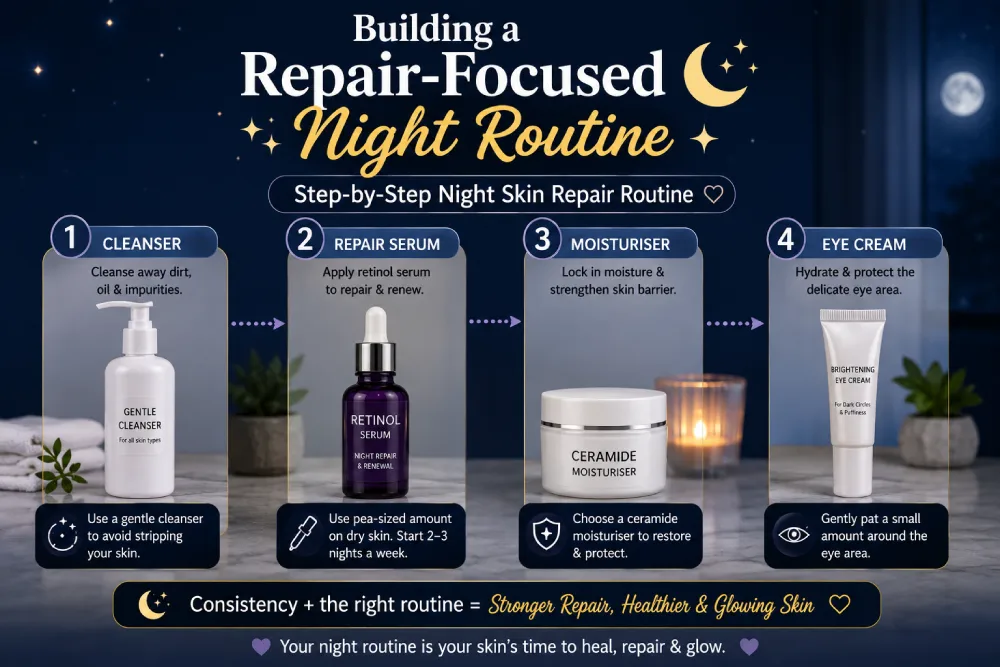
Building a Repair-Focused Night Routine
Here‘s a simple, realistic night skin repair routine that works for both UK and Indian skin types:
Step 1, beyond double cleansers (or soothing cleansing milk) remove pollution, SPF, makeup etc. In India, use micellar water or cleansing oil; then follow with gentle gel cleanser! In the UK, balm or cleansing cream makes a kinder cleansetowind wipes!
Step 2 Repair Serum or Treatment For retinol nights: on clean, dry skin, apply 1 pea sized drop of the serum/treatment and wait 10 minutes before proceeding. For non-retinol nights: instead use a serum high in peptides, niacinamide or hydrating serum.
Step 3 Moisturiser or sleeping mask Lock it all in. A sleeping mask works really well for very dry or dehydrated skin, providing an occlusive barrier overnight to lock in moisture and push through the repair products underneath.
Step 4 Eye Cream (optional) since the skin around your eyes doesn‘t repairs as quickly as the rest of your face, using an eye cream with plenty of peptides on top of your serum may decrease dark circles and lines.
📖 Read More: Skincare Routine — The Full Pillar Guide
Conclusion
Night skin repair isn‘t an optional, luxury extra to your routine it‘s the most effective hours your skin has and with the right products, applied properly, you can see and feel change in your texture, tone and plumpness.
Begin with the essentials a pristine canvas, one specific repairing agent, and a quality moisturizer. Introduce retinol carefully, steer clear of no-no ingredients, and be patient: your night skin repair routine, done consistently, will work wonders.
FAQ SECTION
Q1: What is night skin repair and how does it work?
Night skin repair is your bodies natural cell regeneration, collagen formation and recovery from daily skin damage while you sleep. This process is at its highest between 12am and 4am when the cells are renewing themselves at their fastest rate. Applying the right ingredients to your skin at night enhances and speeds this process up.
Q2: Which night repair ingredients work best for Indian skin?
If you have sun damaged, hyperpigmented, and polluted skin, the best combination is retinol (for renewal), niacinamide (for evening out the tone and barrier repair), and ceramides (for barrier restoration). Begin with 0.25% retinol and use niacinamide alternate nights.
Q3: Can I use Vitamin C at night in my repair routine?
Yes. A stay-healthy, formulated serum at night can be incorporated into the overnight repair routine on no-retinol nights to heal and brighten. Be sure that the two are not combined in the same step so that you use two different steps/alternating nights to keep irritation to a minimum.