Sustainable Travel: How to Explore Responsibly in 2026
Published: August 27, 2026 Last Updated: September 3, 2026 It is no longer a passing trend sustainable travel is
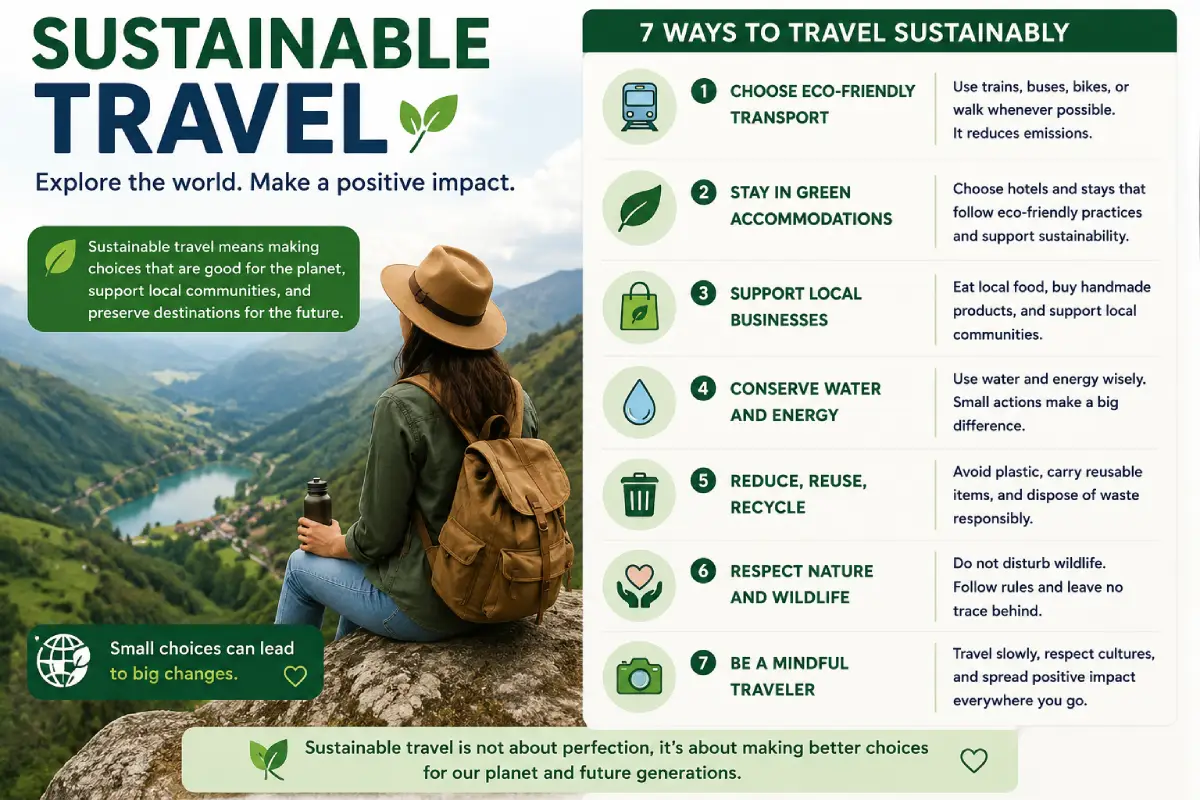
It is no longer a passing trend sustainable travel is simply becoming the way many tourists are planning vacations. When you reserve a quick sojourn in Goa or embark on a road trip through the American Southwest, you are among increasing numbers of tourists wondering the same thing: how do I experience the world and leave it intact? That‘s truly what sustainable travel is all about. It certainly doesn‘t stopping flying or camping in a tent; it means more awareness and intention where you spend your money, where you sleep, how you get around and whom your money actually helps.
What Does Sustainable Travel Actually Mean?
Simply, at its heart, sustainable travel is any approach to having an experience of a destination that is environmentally responsible, economically beneficial to local populations, and respectful of the culture you are visiting. It also falls within a broader framework that encompasses eco-tourism (nature and wildlife focused tourism that helps fund sustainable conservation efforts), ethical travel (being respectful of local communities, wildlife and taking a broader and considered perspective to your travel choices.), and slow travel (traveling for a longer period of time to fewer destinations…».
You will hear these words thrown around so casually and to be honest the distinction is hard to tell. The aim of each and every one is the same: to leave a place in the best condition in which you found it if not better.
Why It Matters More in 2026
Global tourism has recovered to record levels,and aviation is currently responsible for a substantial proportion of travel emissions. Meanwhile, surveys continue to reveal that a considerable proportion of travelers often in excess of 4 in 10 would be prepared to pay a premium for a truly sustainable hotel experience. This is a fundamental shift in demand, not a marketing gimmick.
On a quieter note, slow travel is becoming a thing, with an increasing number of tourists opting to stay on farms, enjoy longer stopovers, and visit fewer places per trip, both for environmental reasons and because a week‘s itinerary across five cities isn‘t exactly relaxing.
Common Sustainable Travel Mistakes People Make
Even well-meaning travelers slip up here. A few of the most common ones:
- Presuming “eco-friendly” branding implies that it‘s really a valid certification. Anyone can print a leaf onto a leaflet.
- What we can do is offset carbon emissions from business activities by investing in projects or schemes that will reduce, avoid or remove greenhouse gases elsewhere. Offsetting is beneficial, but only as an addition, not instead, of cutting emissions.
- Disregarding local enterprises in favor of global ones, which tend to transfer the bulk of revenues out of the community.
- Cramming so many places into your itinerary that you‘re always on the go flying, driving, or exploring this skyrockets your ecological and mental load.
- Failure to research wildlife tourism operators who may inadvertently promote attractions to exploit animals.
Myth vs. Fact: Sustainable Travel Edition
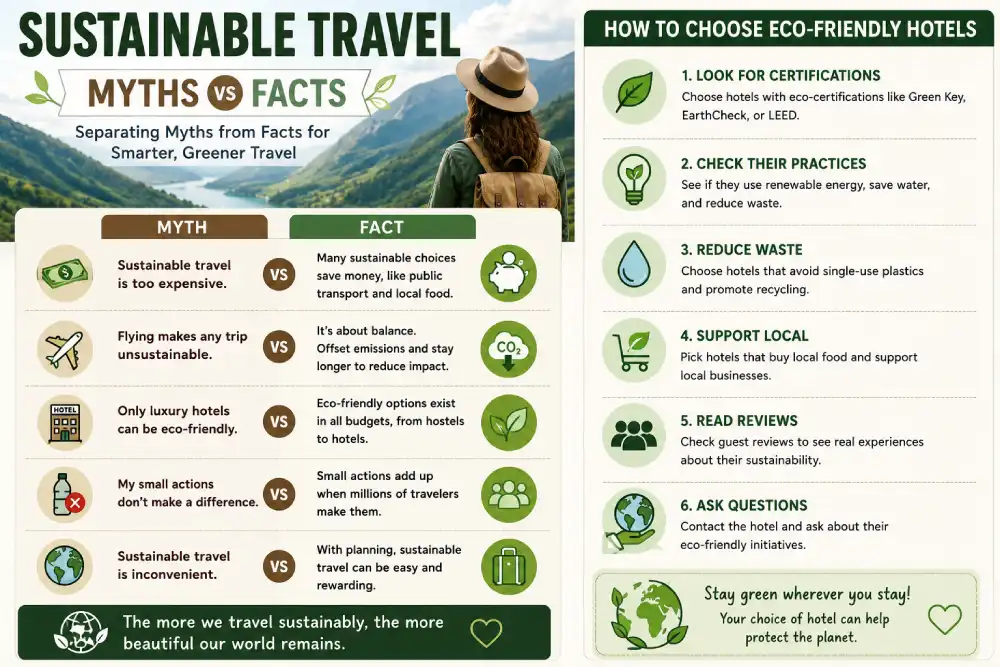
Myth: Green travel is expensive. Fact: Good green options – public transport, small local cafes, homestays, insulated water bottle – are often not only better for the environment but also less costly than the tourist traps.
Myth: You need to give up on the plane all together. Fact: By flying less often, and for longer trips it is very easy to reduce our environmental impact by a large proportion, without having to ‘bite the bullet’ so to speak.
Myth: Eco tourism and sustainable travel are the same thing. Fact: Eco tourism is one aspect of sustainable travel, which is particularly concerned with nature and conservation. Sustainable travel is a larger concept, considering culture, economy and environment in one.
Myth: Our individual actions won‘t impact climate change. Truth: It is precisely because of the collective demand of travelers that more and more hotels are working on getting certified and airlines are taking on cleaner fuels the change is demand based.
How to Choose Green Hotels That Are Actually Green
Look past the word “eco” and check for real signals:
- Other factors include third-party certifications, such as Green Key, LEED or EarthCheck; not simply a self-declared badge.
- Published sustainability reports authentic green hotels publish information on their energy, water and waste data;
- Local sourcing: importantly buying foods locally and staffing locally, as this ensures the money stays in the community.
- Visible practices, not only policy speech – refill stations, solar power, linen re-use programmes, waste separation are reassuring signs.
In both USA and India, filtering directly for green-certified properties on booking portals is becoming easier, so that this process takes minutes not hours.
Practical Tips for Carbon Neutral and Ethical Travel
- Opt for direct flights whenever you can– extra emissions are incurred during every takeoff and landing.
- Pack light. Heavier aircraft consume more fuel per passenger.
- Travel less. The longer you stay, the fewer transit emissions and delights of slow travel.
- Take local transport (train or collective taxi, walk) where you can without having to go privately everywhere.
- Choose to support family-run accommodation and restaurants rather than large chains wherever possible.
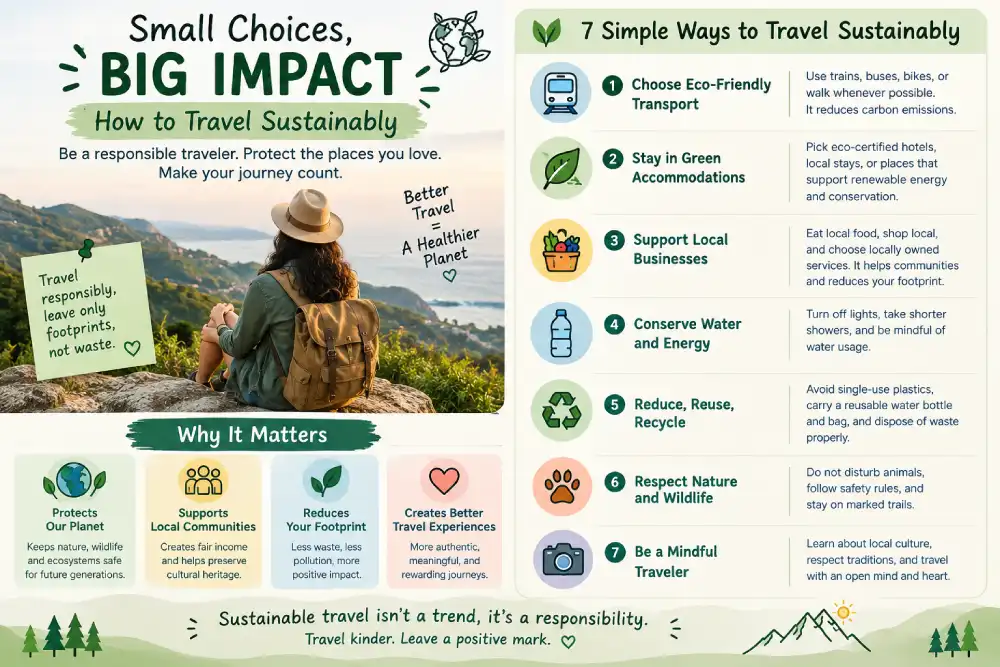
- Bring a refillable bottle and a tote bag instead of single useplastics; a really easy one that will add up over a trip.
- People Places to be careful:ASK before photographing people common courtesy, not a rule. Traditionally, in many countries, especially rural or indigenous communities, it‘s considered impolite to photograph people without asking for permission first.
- Research wildlife encounters in advance- rule of thumb is anything that allows you to touch, ride, or get close to wild animals should be avoided.
Action Steps: Your First Sustainable Trip Checklist
- Choose one destination and plan to stay for a longer period rather than rushing between three.
- Select a Certified Green Hotel or a locally owned homestay.
- Give priority to outdoor pursuits to local guides or businesses run by a family.
- Have a reusable bottle, bag and cutlery kit.
- Opt for trains, where plausible, rather than short domestic flights.
- If you are going to fly, think about a reputable offset program as a supplement not a substitution.
None of this involves a larger budget or a complete lifestyle change. It just means being a little more aware of the choices you are already going to make.
The Bigger Picture
Sustainable travel is not about being perfect. No one credits every mile or makes every decision perfectly. It‘s about turning the tide one choice at a time. Whether you roam the historic towns of Rajasthan with friends, or go single hand your road trip along the California coast, do what you would do if you were to return again, and do what the land would do if you wanted to stay just like this forever.
FAQs
Q: How do I make my travel more sustainable? A: From your hotel. Here is the simple way to go green when you book a certified green hotel or a local homestay, you immediately eliminate a good chunk of your carbon footprint and you help put a bit of cash in the local economy.
Q: Is eco tourism the same as sustainable travel? A: Not quite. When people talk about eco tourism they are most often talking about nature tourism that supports conservation. Sustainable travel is a more broad term.
Q: Is it actually possible to travel in a carbon neutral way? A: It is very difficult to travel in a 100% carbon neutral way, particularly if your means of transport is flights. Practically though, in terms of ‘carbon neutral travel’, it is about minimizing what can be minimized, and then offsetting the rest.
Q: Are green hotels costlier? A: Not always. Several green standards like led lighting, recycle water, sourcing locally, do actually reduce the overall cost of running the property and those discounts are sometimes percolate down to the guest.
Q: How do you distinguish between slow travel and any other kind of travel? A: Slow travel is to spend more time in fewer places and to journey at a relaxed pace and the concept is not really to squeeze many destinations into shorter stay durations. It is a concept and is considered as a part of sustainability.
Final Conclusion
Making sustainable travel choices in 2026 doesn‘t have to mean sweeping sacrifices on the part of the traveler. Instead, it‘s about making a few simple choices that will, over the years, add up. Choosing a green-certified hotel in the town, or taking that extra four hours to meander to a destination will make a difference to the people and places you‘re visiting, without costing you any of the experience.