Travel Lifestyle: The Ultimate Guide to Living, Working & Exploring the World
Published: August 18, 2026 Last Updated: August 28, 2026 The travel lifestyle isn‘t just for vacations more. It‘s a
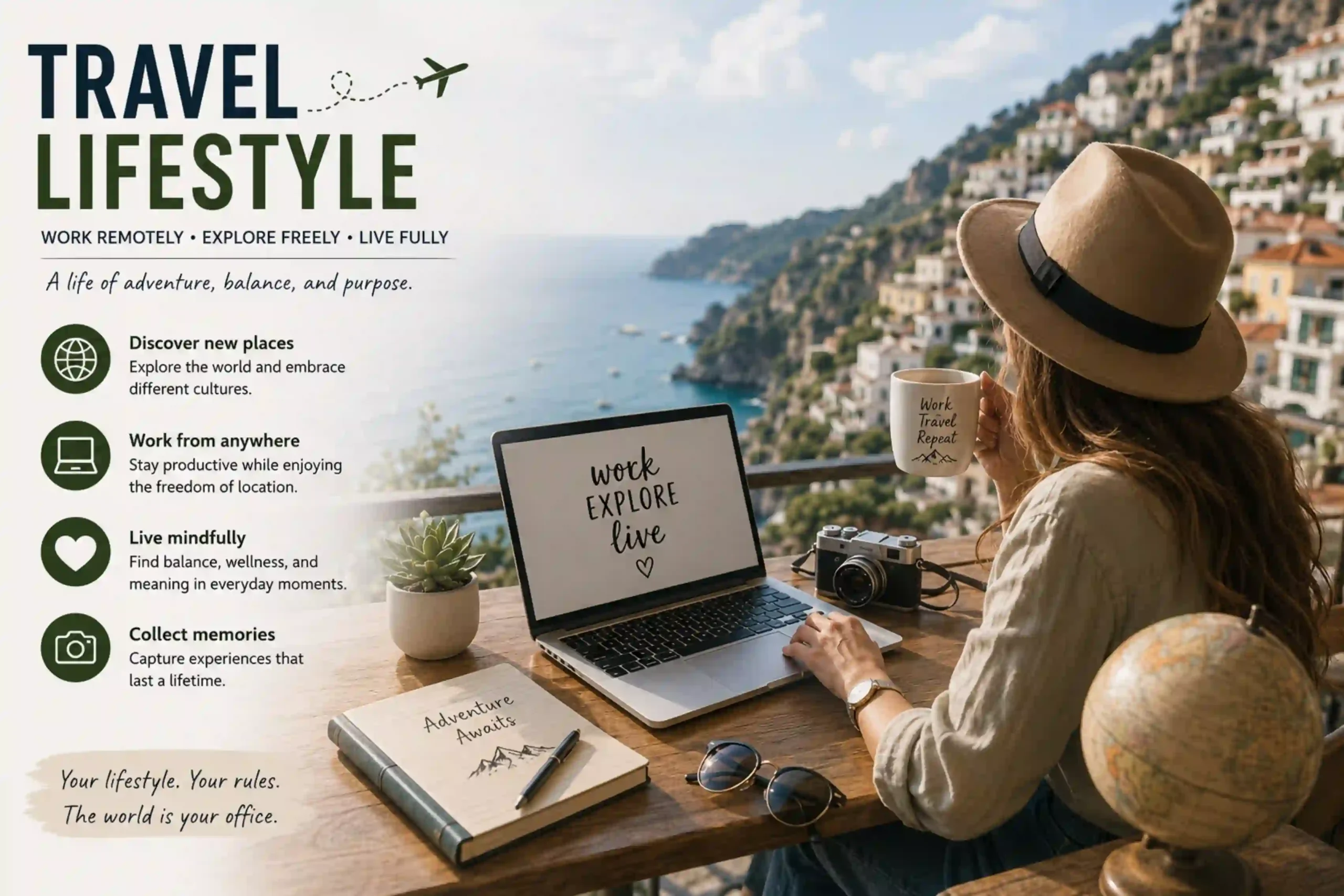
The travel lifestyle isn‘t just for vacations more. It‘s a lifestyle all of its own a mix of living a location independent life for the rest of your days while working remotely, budgeting intentionally, exploring solo, choosing eco-friendly options, and packing wisely.
What Is the Travel Lifestyle, Really?
Travel lifestyle was that- a “week at a time for a brief vacation, carry-on only” kind of thing. Not anymore.
Today it‘s about designing your entire life what you do for a living, how you spend your leisure, how you use your money around your ability to be mobile. It‘s about the romance of the barista in Lisbon who‘s actually an independent UX designer working remotely from Chicago. It‘s about the validation of the intrepid solo backpacker who has turned half a year in Southeast Asia into the ultimate life reboot. It‘s about the thrill of the family opt-ing for slow, conscious, greener trips instead of frantic, wasteful ones. It‘s about the employee who successfully negotiated 2 “work-from-anywhere” months per year instead of quitting.
There is no one way to do this, and that‘s really the point. Whether you go all-out and give up any single place to call home or take baby steps and move around for a year at a time while still maintaining ‘permanent’ residence, everyone in this lifestyle makes a transition. Travel is no longer “something you do,” it‘s “something you are.”
Important thing to remember: travel lifestyle is not a destination, but a collection of choices you make including how you work, how you spend, how you pack, and how you travel.
In this pillar series I’ll break down the six pillars that will make that lifestyle achievable for you: working from anywhere, managing your remote budget for the long haul, traveling internationally solo, practicing single-travel sustainability, traveling light & smart, and earning on the go. Imagine it as your resource for each pillar this series provides you with the fundamentals, pitfalls, and a tangible action step. If you want the comprehensive playbook for each pillar, I’ll direct you to the detailed guide.
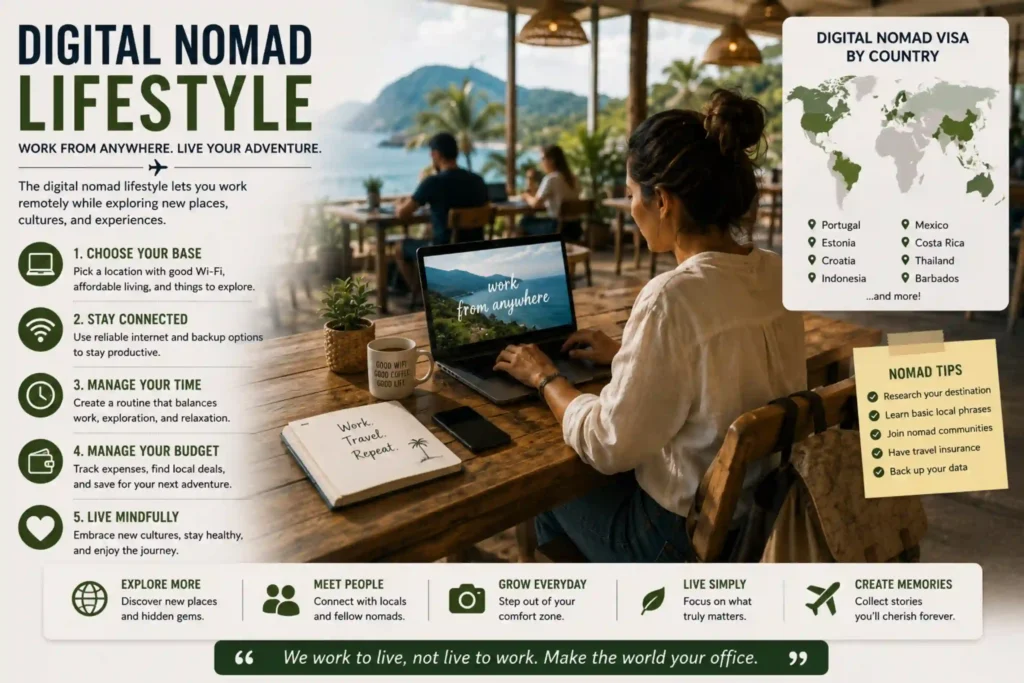
1. Digital Nomad Lifestyle: Working From Anywhere
Going digital nomad is like removing the anchor from your income. It is the starting point that makes much of the rest of the travel lifestyle affordable for the majority of individuals if you are not making money, everything else in this guide turns into a one-time adventure instead of a lifestyle.
What it actually takes:
- A source of income that could be conducted outside of the office (freelance, remote, online business)
- An established method: laptop, backup power bank, VPN and a plan for slow-internet days.
- A visa strategy more countries than ever provide some form of digital nomad visa (from Portugal to Indonesia to Costa Rica).
- Cash cushion a fund set aside to cover expenses for 3–6 months before going nomadic most seasoned nomads suggest 3–6 months of living costs saved up prior to departure.
- [Something to keep me grounded] a support network. Online communities, coworking spaces, or just calling up mates back home.
The three main paths into digital nomad life:
- Remote employee: Previes your existing position to include location benefits. It‘s the lowest risk; least uncertain, most steady income. But it provides you with less freedom/ control for the schedule.
- Freelancer: Deliver services (writing, design, web development, marketing, consulting, etc.) to clients. Greater flexibility, less income certainty, especially at year one.
- Business owner/creator. You have an online shop, coaching business or content business. Greatest likelihood of upside and freedom, but also greatest startup risk and slowest’ build up of income.
A realistic first 90 days:
- Weeks 1 4: Find a place to stay in one location, start your work schedule, check internet connection and time zone overlap with clients or boss
- 5–8 weeks: Get involved in coworking spaces and/or local nomad communities to develop local human networks and prevent loneliness
- Weeks 9–12: Re-evaluate can you keep this pace? Vary the number of nights in one place (every month or so, or more slowly) according to your real world feelings, not your website snapshot56]
2. Common mistake Thinking you have to quit your job. Many nomads are employed full time with a remote work agreement, they didn‘t start as entrepreneurs freelancing from scratch. Another mistake 1-2 months into nomad life that relying on traveling every other week as a full-time convenience is exhausting!
Mini summary: 80% of the digital nomad lifestyle seems to be logistics: internet connections, different time zones, visa requirements… Nail the logistics, and the freedom will come as a natural consequence.
Read More: Complete Digital Nomad Lifestyle Guide
2. Budget Travel Tips: Making the Lifestyle Financially Sustainable
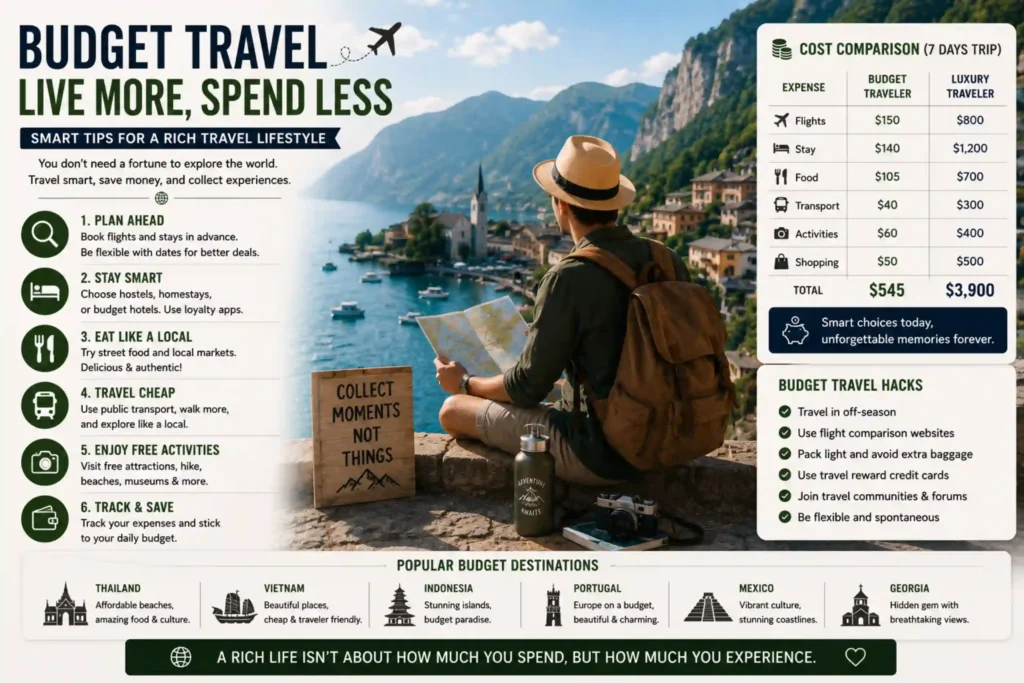
Long term travel also dies fast without some system of budgeting this isn’t about being tight, but about being smart with your money so that your travel lifestyle lasts way longer than a few months.
Core budget levers:
- Accommodation: By far, long-term rent and house-sitting were better deals than hotels after first week; savings were 40–60%. renting for a month was typically 20–30% cheaper than paying hotel nightly prices, on booking websites.
- Transport: Rather than utilizing long-distance flights (International/Transcontinental), utilizing regional budget airlines and overland travel (buses/trains) can be significantly cheaper. Purchase of regional flight tickets 6–8 weeks in advance provides a good compromise between cost and flexibility.
- Food: Home cooked food and local markets make a currency last far longer than eating out in tourist areas. Cooking 50% of your own food can slash your food budget by more than half.
- Timing 0 By traveling off-peak shoulder season (just before or after peak) 0 accommodation is reduced by a third- and yet the crowds are not as bad.
- Location arbitrage: Focusing on lower cost of living economies amplifies a small budget.
Building a simple travel budget framework:
| Category | % of Monthly Budget (Recommended) | Notes |
|---|---|---|
| Accommodation | 35–40% | Biggest lever Concentrate on monthly discounts first |
| Food | 15–20% | Combining the art of cooking with popular local eating habits. |
| Transportation (local + regional) | 10–15% | Budget airlines, buses, trains. is. |
| Activities/Experiences | 10–15% | 2-3 meaningful experiences rather than 10–15 small ones |
| Insurance & Health | 5–8% | Indispensable safety net |
| Buffer/Emergency | 10% | Covers surprises – changes in flight, medical needs, repairs to gear |
Most common error: Underestimation of ‘invisible costs’ SIM cards, travel insurance, visa costs and ATMs fees all quickly can amount to a lot, but are rarely figured in a basic mental estimation. Another common mistake is blanket budgeting what‘s a reasonable 7-day in SE Asia is hopelessly inadequate in Western Europe, unless you‘ve planned for it.
Practical tools: A straightforward spreadsheet or budgeting app that tracks everyday expenditure over a weekly limit will prove more efficient and helpful than planning the entire budget for the trip as a whole, given how traveling costs vary so greatly between the different regions you‘ll visit.
Mini overview: The sustainable travel budget is not about restriction. It‘s about understanding where your money is going so you can focus more on that which you value highly, and cut hard on that which isn‘t so important.
Read More: Budget Travel Tips & Hacks
3. Solo Travel: Exploring the World on Your Own Terms
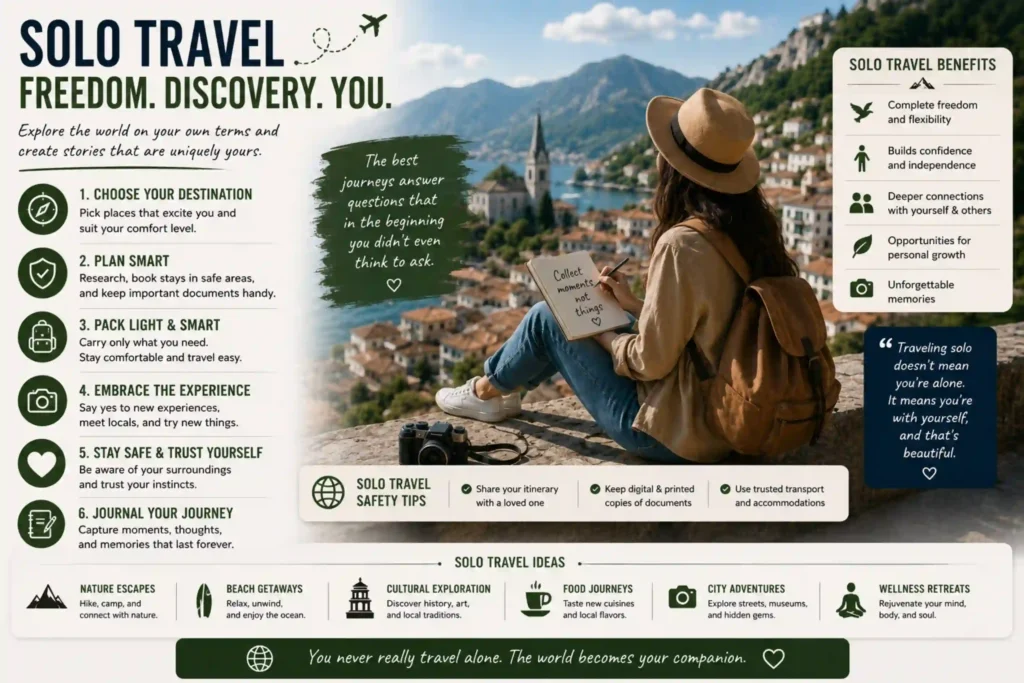
Solo travel represents the initial step into the whole travel lifestyle. In the case of an individual diverging from a public group travel, it is the moment they discover just how flexible, spontaneous and self-guided can mean.
Why people choose it:
- Complete control over pace, budget and itinerary you will not settle for a group where the food choices or the length of stay isn‘t flexible
- Faster social connections — solo travelers meet more people, not less, because they are more accessible and more inclined to reach out
- An authentic boost of confidence and independence that group travel more often than not failed to provide, from exploring unfamiliar cities to dealing with any surprises alone
- The freedom to change plans immediately without having to seek agreement from traveling friends;
Getting started: a basic model.
- Pick a “training wheels” place a well traveled, English friendly, safe city or area as your first solo trip destination, before venturing to more isolated or adventurous places
- Book a sociable first stay a hostel with a communal kitchen, a co-living space or a small guesthouse makes it a great deal easier to make friends during your first 48 hours
- Relaxed plan first 3 days, then freeform by arriving with a loose plan you will take some pressure off yourself, but you won‘t be stuck in a rigid schedule that no longer matches your travel reality.
- Tell someone you trust your whereabouts and general plans at home, and give them a simple itinerary to call on.
- Say yes to the first invitation the first group dinner or day trip invitation from other travelers is often where your loner trip will take a friendly turn.
Safety essentials:
- Research neighborhood safety beforehand and not after your arrival.
- Haveback-ups of significant documents, both on computer and paper: passport, insurance details etc.
- Trust your instincts over politeness – walking away from a situation that feels wrong can never be wrong.
- Learn a couple of local phrases: This influences the way the locals will treat you and does help in terms of safety.
Huge error: planning the whole trip hour by hour. Most successful solo travelers tend to have the first few days booked and booked solid, then leave the rest open to spontaneity – overplanning is an easy way to spoil what is great about solo travel to begin with.
In brief (not about being alone): Solo travel is more about going at your own pace. It‘s about meeting individuals, and keeping an open mind.
Read More: Solo Travel Guide for Beginners
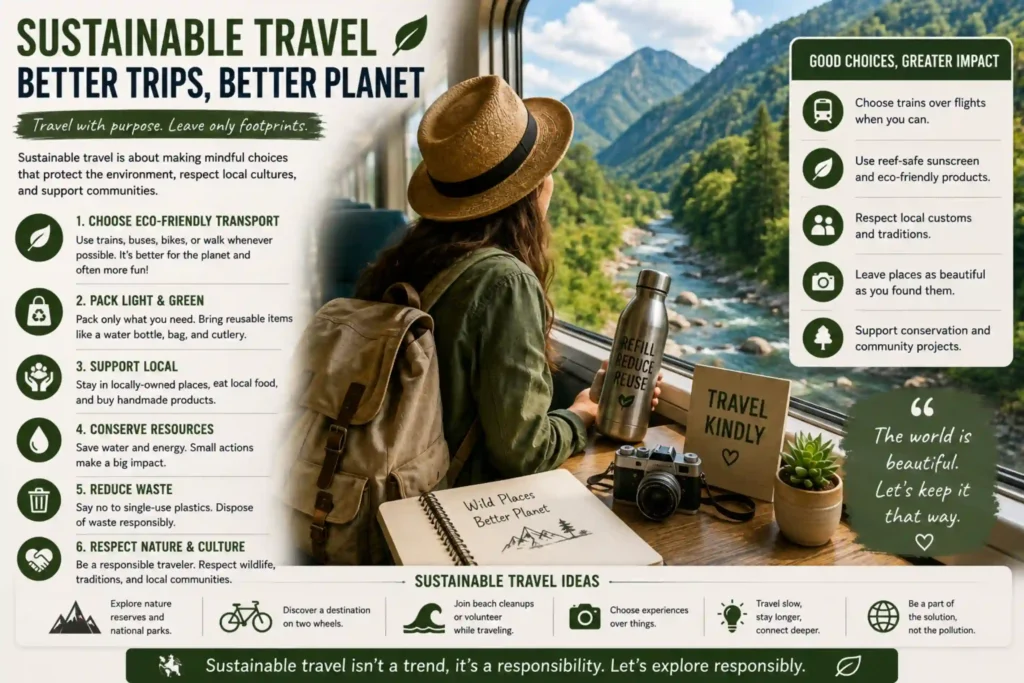
4. Sustainable Travel: Exploring Without Costing the Earth
With travel edging ever closer to lifestyle than occasional escapade, its environmental and social implications will matter, arguably, more. The sustainable travel option is quickly ceasing to be a niche phenomenon, and is increasingly seeking to be, a standard booking criterion.
What sustainable travel actually looks like:
- Opting for trains and buses instead of the short haul flights where achievable one short-haul flight can account for several times the emissions from the equivalent train.
- Traveling at a slower pace so that fewer places are visited for a longer period of time as opposed to many places for a brief period of time (slow travel) (which lowers transportation emissions and the risk of over-touristed locations)
- Supporting local, independent businesses rather than Multinational corporations, which would leave the money made from tourism.
- Booking eco-certified accommodation and tour operators, and actually investigating what the certifications stand for rather than simply assuming a “green” badge is trustworthy
- For example, within the mass of issues, you could choose to favor market solutions. Or reduce the use of disposable plastics by carrying reusable bottles, shopping bags and food containers while traveling.
A practical sustainability checklist:
- – [ ] Select direct flights and long-distance overland routes in preference to other options, when feasible.
- [ ] Select accommodations that appear to have visible sustainability efforts in their operations (energy, water, waste)
- [ ] Purchase from a local business rather than a transnational business.
- [ ] steer clear of animal tourism attractions that are exploitative.
- . Respect local culture, attire requirement and photography etiquette
- [ ] Use a reputable, certified program to compensate for unavoidable emissions
- [ ] Favor experiences that benefit local community members rather than stereotypical tourist attractions.
Example of a pie in the sky: little/medium effort you give up, and give up on the entire idea of sustainability. Issues such as using a reusable bottle, transportation, timing of travel), if made on a regular basis during a year of travel will impact far more on the environment than any “eco-travel” plans.
A warning on greenwashing: Not all “eco-lodge,” “sustainable tour” labels are accurate. Seek specific, substantiated claims (reduction of waste volumes, where energy is from, how much is sent back into community) instead of broad marketing language.
Mini summary: Sustainable travel is just about taking it slow and spending money locally as it is good for the environment; good for host communities; and usually makes for a more enriching journey.
Read More: Sustainable & Eco-Travel Guide
5. Travel Packing: Traveling Light, Traveling Smart
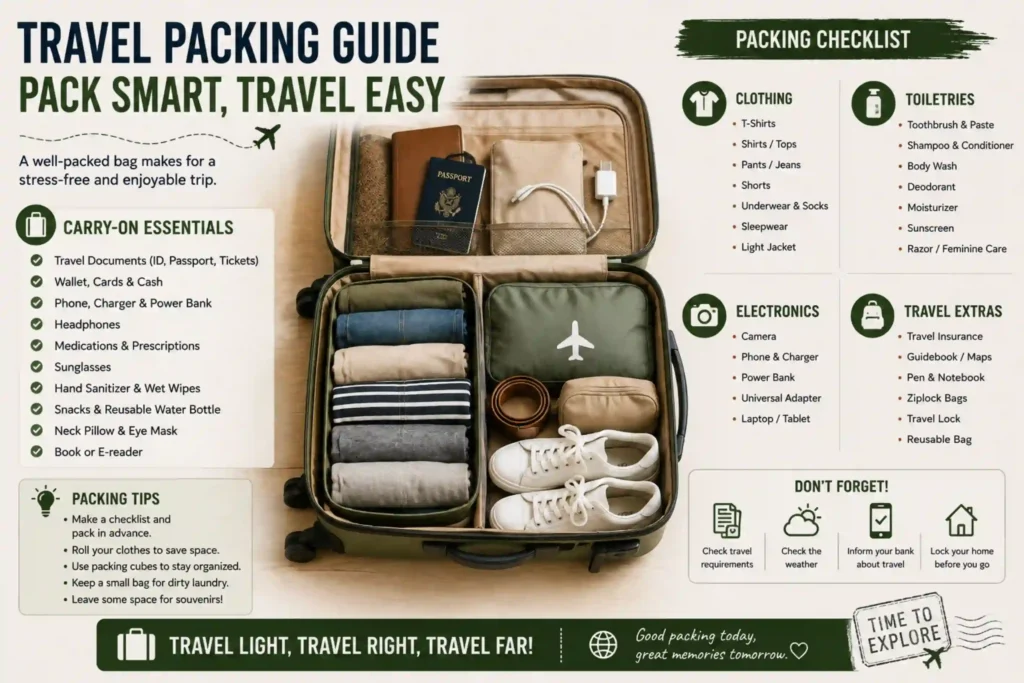
Nothing will dead-stop the travel lifestyle quicker than schlepping an overweight bag for months at a time. Packing is one of those skills that, the more you do it, the better you get at it you become more aware of what you really used after unpacking and what you brought “just in case.”
The core system:
- Capsule wardrobes: 5–7 versatile, mix-and-match pieces of clothing always win over a huge wardrobe. Neutral colors that mix and match reduce decision fatigue and washings.
- Carry-on first: A very-well packed carry-on completely eliminates the baggage-fee and the lost-luggage worries, and makes you prioritize truly necessary items.
- Technology must-haves: Universal plug adapter, portable recharger, and small packing cube system enable equipment to stay well organized and locate easily.
- Climate-adaptive packing: Travel with fewer clothes for each type of weather but more layers, e.g. a weightlight base layer, a mid layer, and one waterproof extra layer this will be more comfortable and less complicated in most climates than five separate outfits.
- Toiletries in solid or travel size versions: Solid shampoo bars, multi-purpose balms, and refillable travel bottles ease the weight burden at check-in and the “liquid restriction” at the security checkpoint.
A sample carry-on capsule packing list:
| Category | Items | Notes |
|---|---|---|
| Tops | 4–5 multi-purpose shirts | Fabrics chosen; once clamped; heat set; A fabric was selected that would be able to be heat set using the clamps. |
| Bottoms | 2 pants / shorts, 1 all purpose skirt or joggers | Calm colors, simple to smudged. |
| Outerwear | 1, a more packable jacket or layer a/ 1.0 | Weatherproof if you can. |
| Footwear | One walking shoe. One lightweight sandal. | Comfort in eschewing style. |
| Tech | Battery charges, adapters, battery banks, ear pieces, I am not sure. | All nine,box of9. Once that‘s opened keep all in one pocket of a specific bag. |
| Documents | Passport, copies, insurance details, cards | Digital + physical backup A backup that exists in digital and physical formats. For example, a digital backup maintained on the hard disk of a desktop computer, with a physical backup stored at another location separate from the first. |
| Toiletries | A but for solid soap/shampoo/size essentials for traveling | As far as is practical |
Typical mistake over-packing for “just in case” events that are infrequent most overpacking regret is due to items packed “in case of an occasion,” not equipment missed. Another typical mistake purchasing specialized travel gear for a first trip before testing what you already have.
Practical tip: Write down what you didn‘t use every time you travel. That list will be the quickest way to lighten your baggage for next time.
Mini summary: The lighter, the more spontaneous a travel lifestyle is possible — less logistics, bills and pain to move from destination to destination.
Read More: Best Travel Packing Guide
6. Working While Traveling: Making the Lifestyle Last
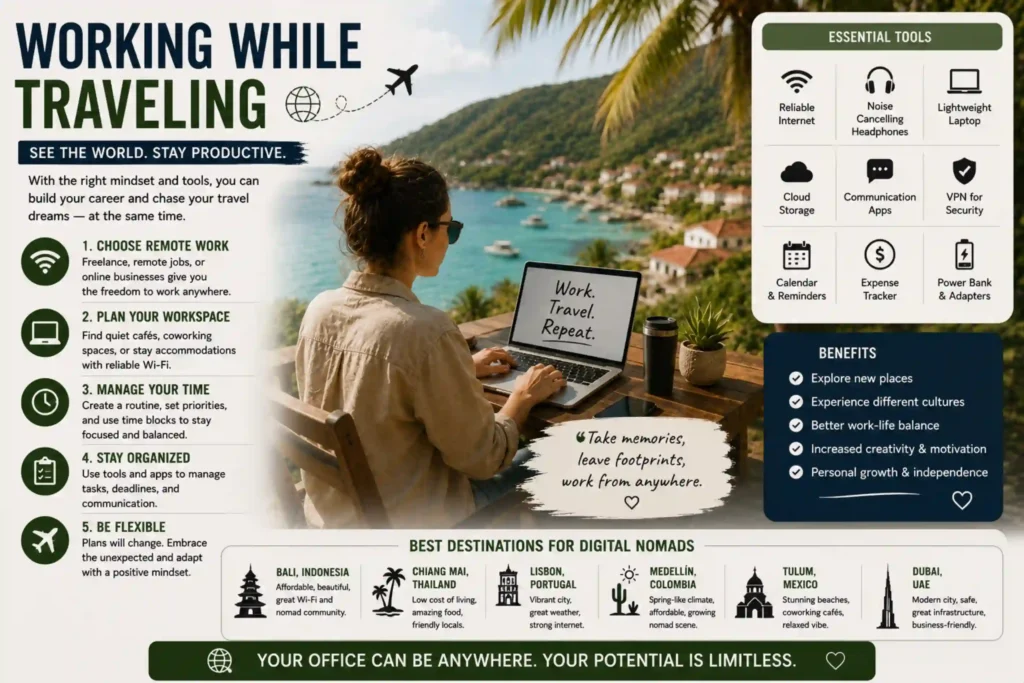
This is when the travel lifestyle becomes sustainable in the long run not a gap year or a long holiday, but a real way of life that can be repeated.
Ways people make it work:
- Home working: Full-time jobs that take place away from the traditional office setting. This now offered as a standard option by many employers for post-2024 employment, and is often the more lucrative and reliable way into the lifestyle.
- Freelancing: work off of a project or retainer model (writing, design, consulting, development). Must build a pipeline of clients one before I leave. Not after.
- Location free business: These are things that you can do online like ecommerce, coaching, producing content, producing digital products, etc. These tend to have the highest long term upside, but typically are the slowest to get to stable income.
- Seasonal/hybrid work Travel for several months followed by several months local, on-the-ground provides a less risky entry point for people who aren‘t ready to make a long-term commitment.
Designing a work rhythm that actually holds up:
- Factor your work time in with your most critical time zone overlap you might have to work at night in one country to do the same during the day for another.
- Select destinations based on their internet strength and the time zone don‘t just pick those solely on their travel appeal an amazing destination with awful WiFi is going to have a negative impact on your client or performance reviews.
- Build in recovery days, particularly following a long time in transit – attempting to work a full day immediately following an International flight just doesn‘t work: you need the break.
- Agree in advance with the client/employers on time frames for communication and availability, so travel days do not conveniently turn into unpaid overtime
Most common mistake: forgetting about time zone friction. A great deal of the “fail” nomad stories boil down to poor time-zone coordination with the boss or clients hitting deadlines, maintaining rapport, keeping appointments rather than lack of travel ability. Another mistake is selecting destinations not because of good internet or co working connections but because they are beautiful.
Mini summary: Traveling for work isn‘t to power-through every moment in exotic locations it is about creating a workflow that is sustainable across time zones, slow-WiFi days, and long journeys times.
Read More: Working While Traveling
Building Your Personal Travel Lifestyle Roadmap
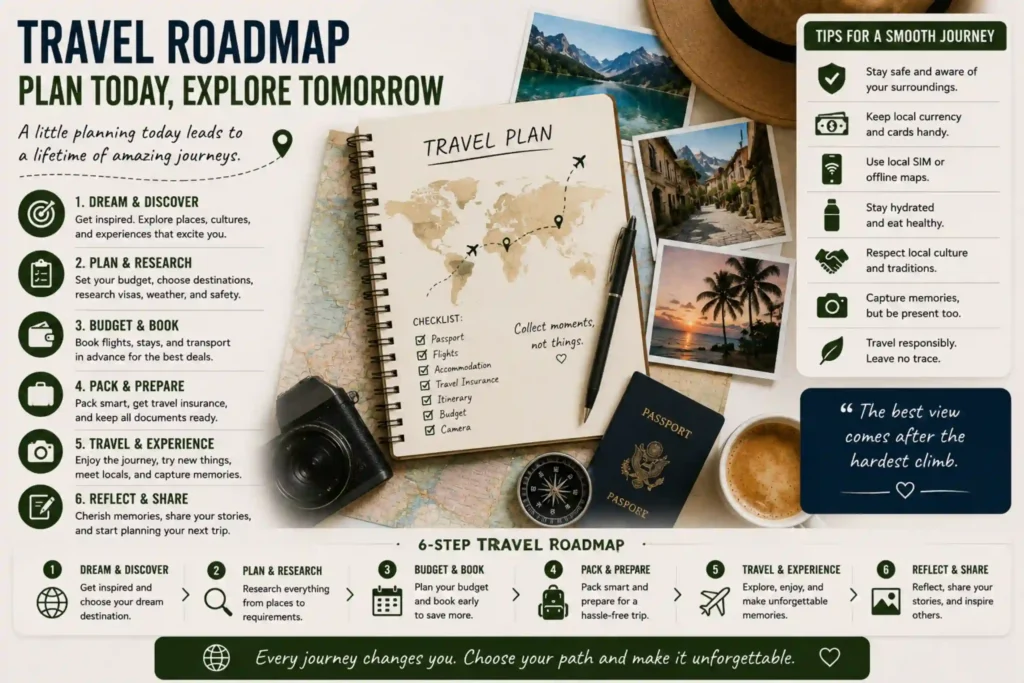
Most don‘t take all six pillars right off the bat and they shouldn‘t. A practical first step sequence could be as follows:
- Begin with the financial base establish saving for a budgeting system and emergency fund before setting out long term traveling.
- Test remote work compatibility. Negotiate a brief remote work trial with your current employer, or try out one freelancing gig, before jumping straight into a nomadic lifestyle.
- Take a solo trip. Even for a weekend or less that first solo experience gives one the confidence, the sense of adventure and the ability to get oneself out of sticky situations that the life takes.
- Pack for 2 weeks using the carry-on system then edit based on thins you used.
- Begin implementing one sustainable habit in each trip, instead of changing everything at once.
- Reconsider after 90 days give the first three months a test drive, not a lifetime employ.
The sequencing of this is more important than most guides will say. Going completely remote, sustainability-focused, ultra-minimalist, solo, with no trial period of any aspect of that is easily the number one most common cause of people going broke, burnt out, and quitting or going back to a more traditional lifestyle in less than six months.
A word on flexibility: Your plan is not set in stone. Many people begin with budget options, find they are more comfortable with the group experience than totally going it alone, or decide that a hybrid seasonal lifestyle three months traveling, nine months in place feels right rather than traveling full-time without a break. The sequence of six steps I laid out is a guideline, not a prescriptive process. Review it every couple of months and tweak it to match your experience, not some social media ideal of the lifestyle.
Resources worth setting up before you start:
- A separate travel savings account, not used for any other spend for easier budgeting to monitor
- A common document or application indicating the visa requirements, entry dates and the maximum stay length for the individual countries each is planning to visit.
- A backup communications plan (an international SIM or an eSIM, together with a messaging application that functions reliably across borders) so you‘re never completely unreachable in an emergency
- A straightforward, repeatable “arrival checklist” a SIM card, a local travel card, a trip to buy groceries, a scout around potential workspaces so that settling in takes a few hours instead of days
Travel Lifestyle by Life Stage
The travel lifestyle will come in various forms at different stages of life there‘s no one “correct” way to cultivate it.
In your 20s:
- Most risk averse, least fixed commitments the best opportunity to test freelancing, hostel-based batch travel, or a first remote-working trial.
- Typical style: hectic, cheap style of travel; with changing from place to place and a combination of hostels and social travel communities.
- Be aware of: losing time, risking burnout and not saving enough for emergency situations.
In your 30s and 40s:
- Often juggling work momentum, relationships, or emerging families with the possibility of greater mobility
- General model: slower pace, less places but more time in each, negotiated remote work than full freelancing, comfort.
- Be aware of: crises leading to career break when moving to freelance should be avoided by first testing remote work within current position
In your 50s and beyond:
- Often coming to it once past one‘s working peak, a little more flush but perhaps with a very different health and comfort angle.
- Common approach: elongated slow travel, house-sitting, sabbaticals or seasonal ‘snow bird’ style travel between two or three bases
- Notice how: as you get older, certain policies and coverage limits change considerably travel insurance gaps are best checked with specific research, as they are not always what you would expect.
For families:
- On the positive side, seems to be worldschooling or being away for a short period. More of a seasonal approach (sabbatical year) or breaks (school holidays) than a full time continuous experience.
- Reminder: destination choices should take into account (even more than usual) healthcare, safety issues, and school location considerations.
Mini summary: age/life stage does not alter the travel lifestyle in terms of possibility, it changes the shape we will take it in. The pillars can be used at any age/life stage just in a different order.
Travel Lifestyle Myths vs. Facts
| Myth | Fact |
|---|---|
| You have to be rich to be able to live this kind of life | Numerous nomads survive on a budget smaller than that of their former stationary life when one takes into account the expenses of travel and daily living. |
| Traveling alone is miserable. | Solo travelers tend to make faster, deeper connections than group travelers because they are more open to interacting with strangers. |
| Traveling sustainable has got a price | Everyday slow, local spending, and variety are more often than not, cheaper than turbo spent tourist circuit. |
| You should leave your employment. | Remote-flexible work is again a mainstream, lower-risk entrée into this lifestyle; |
| Traveliing light can come at a cost. You do not have as much comfort when you are travelling. | Current capsule systems address a lot more situations than almost any overstuffed piece of luggage |
| It‘s only for young, single people of course | Families, couples and careerists increasingly plan their traveling as a part of their life (via sabbaticals and telecommuting) over a long-term planning process. |
| The more destination the better life style. | More realistic experience and life stability were more likely when the travel conditions were slower and move numbers were higher. |
The Future of Travel Lifestyle (2026 and Beyond)
Expect three more peaks to keep building: new countries rolling out digital nomad visas, with fairer, more comprehensive tax obligations, sustainability becoming less a travel luxury and more a filter on major booking sites, and AI-enabled trip planning making solo budgeting, search, booking, and logistics far simpler, more doable. Coworking and coliving communities are spreading into more affordable, less crowded meta-cities, bringing the benefits of nomad tourism to many more than a few over-touristed metros.
Employers are also changing. Many more are codifying “work from anywhere” policies with rules about tax treatment, insurance coverage and limits to the length of stay in each country rather than leaving remote travel as an informal, don‘t-ask-don‘t-tell activity. In the next few years, such formalization will probably guarantee this lowest risk Pillar 1 presence method for employees who want to be nomads, eliminating the already slight reasons to refrain from the digital nomad label altogether.
In parallel, in many of the major destinations that are experiencing the strain of over-tourism, destination marketing boards are seeking to attract ‘slower-travel’ travelers with longer stays, thus preference is anticipated towards the slow travel experience as described in the previous section of this guide, in contrast to the popular short-term waves of mass tourism. Those travelers who are earliest to conform to this new promotional paradigm opting for depth of experience over breadth, few destinations over many may find that consumption costs can be reduced and, at the same time, become more resilient, than those who continue to seek to maximize country-years traveled per year.
FAQs
What is the travel lifestyle? It’s a way of living built around location flexibility — combining remote work, intentional budgeting, and travel as a regular part of life rather than an occasional vacation.
Do I need a lot of money to live a travel lifestyle? No. Many people sustain it on modest, well-managed budgets by choosing affordable destinations, long-term stays, and local spending over tourist-priced options.
Is solo travel safe for beginners? Yes, with preparation — research your destination, share your itinerary with someone at home, and choose traveler-friendly accommodations like hostels or co-living spaces to start.
How do I find remote work to support travel? Start with your current employer by asking about remote flexibility, then explore freelance platforms, remote job boards, or building a location-independent skill like writing, design, or development.
What’s the easiest way to travel more sustainably? Slow down. Staying longer in fewer places, using local transport, and supporting local businesses cuts your footprint more than any single “eco” purchase.
How do I pack for long-term travel? Build a small capsule wardrobe, stick to a carry-on where possible, and pack for layering rather than every possible scenario.
How much should I save before starting a travel lifestyle? Most experienced nomads recommend 3–6 months of expenses as a cushion before committing full-time, to cover income gaps, emergencies, and the learning curve of the first few months.
Can I live the travel lifestyle without quitting my job? Yes. Many people ease into it through remote-work arrangements, sabbaticals, or extended trips while keeping their current employer, rather than starting completely from scratch.
Final Conclusion
The travel lifestyle isn’t one path — it’s six, and most people who live it borrow a bit from each: a little digital nomad income, a solid budget system, some solo confidence, sustainable habits, smart packing, and a work rhythm that holds up on the road. It’s built through sequence and testing, not through jumping in all at once — start with the pillar that feels most within reach today, treat the first 90 days as a trial, and use the cluster guides linked above to go deeper into whichever piece you want to build next.