Time Management for Professionals: 2026 Productivity Guide
Published: August 12, 2026 Last Updated: August 12, 2026 Time management for professionals works best when the method matches
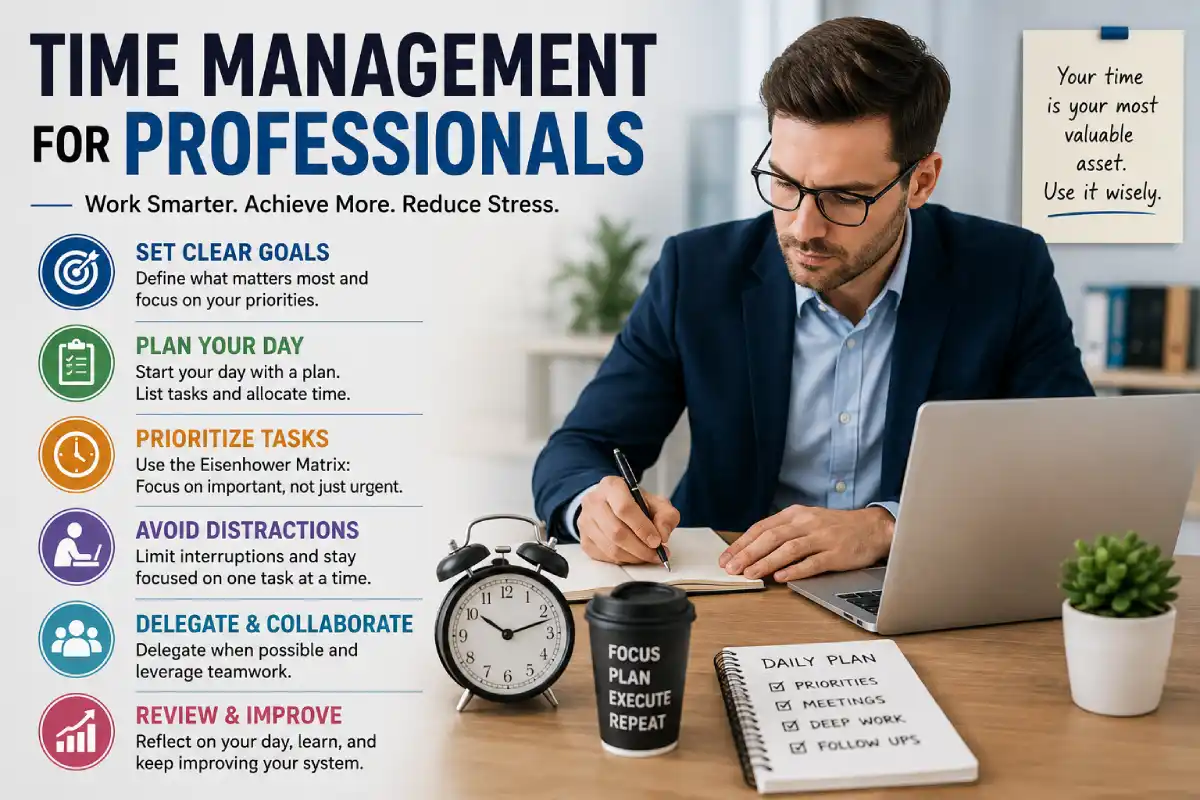
Time management for professionals works best when the method matches the problem — time blocking for control, Pomodoro for focus, a prioritization matrix for decision fatigue. This guide breaks down each technique, when to use it, and how to eliminate the time wasters quietly draining your workday.
If you‘ve sat through a week using the Pomodoro Technique, switched to time blocking the next, and still felt like you were running behind on Friday, the issue isn‘t willpower. Managing time as a professional most often fails not because of laziness, but because of misusing the improper technique for that particular challenge a method of focus won‘t resolve a prioritization issue, and a daily planning system won‘t correct for incessant interruptions.
What Time Management Actually Solves
Time management isn‘t trying to fit more into your day it‘s trying to spend a certain number of hours on the right things. All employees squander hours in essentially three areas ambiguous priorities, non-stop context-switching, and time-sink low-value activities. Three different solutions apply, which explains why one size fits all “productivity tip” doesn‘t.
Key takeaways:
- Time management is diagnostic, not universal – find the right tool for the shortcoming.
- Energy counts too, just as hours do. You can‘t put focus into every hour of the day.
- Short, simple, uniform systems are more effective than ambitious reforms that crash and burn in two weeks.
The Time Blocking Method
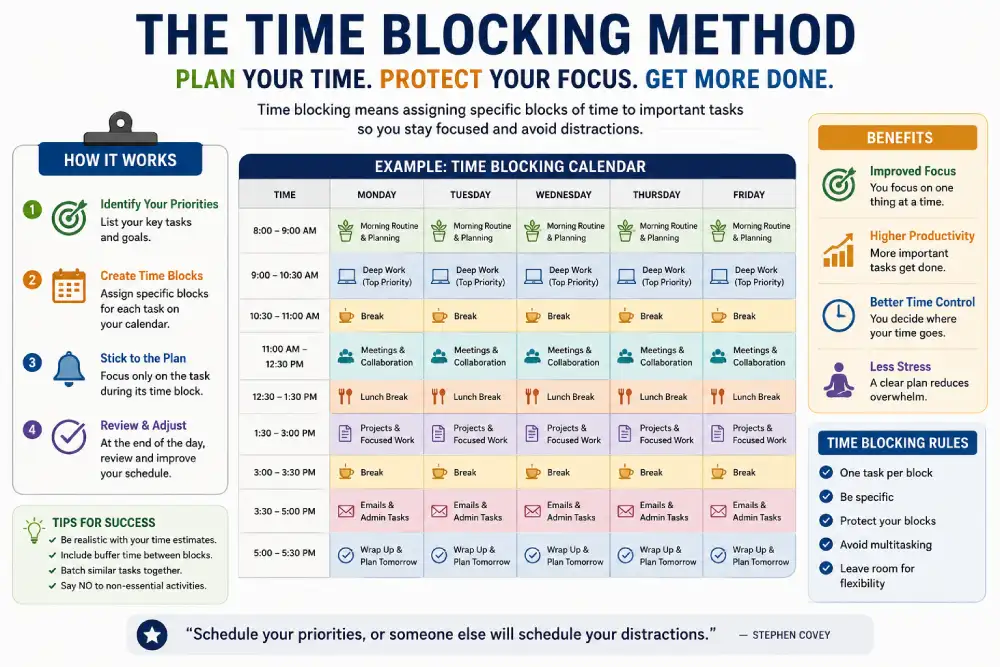
Time blocking is dedicating certain hours on your calendar to doing certain things as opposed to working from a reactive to-do list. Open your calendar, hold your most productive (usually morning) hours for your highest priority work, and batch meetings and admin tasks into the afternoon.
Best for: your own agenda this will work well for freelancers, founders and individual professionals who set their own schedule. Not optimal for: reactive jobs where meetings hit inboxes without warning, typical of client-facing and support roles.
The Pomodoro Technique
Pomodoro system involves working in 25-minutes session, separated by 5 mins breaks, with a longer pause between four sessions. The short timespan reduces the chance of procrastinating – all you have to do is keep going for 25mins.
Ideal for: writing, off line analysis. Not so ideal for: long loads of client calls, collaboration projects, or anything requiring creative flow where the timer would be breaking concentration.
Deep Work Strategy
Cal Newport made the concept of deep work popular defining it as investing long periods of distraction free to do work within a sort of cocoon unrelated to shallow work like reading, emailing, logistics. It‘s only two or three consecutive hours a day, not eight low-value hours of real shallow work.
Practical starting points:
- Schedule your deep work in your HIGHEST ENERGY hours, not your leftover hours.
- Disable notifications altogether while blocking mute them isn‘t sufficient.
- Treat deep work sessions as if they are appointments that cannot be changed and that are locked into your schedule.
The Prioritization Matrix
A prioritization matrix (typically the Eisenhower Matrix) categorizes the tasks of urgency and importance. The tasks are divided into four cells, do now, schedule, delegate, and eliminate. The majority of time-management failures are not due to lack of effort but to the fact that you tend to do the loudest thing instead of the most important.
How to use it:
- Make a list of all the things you have scheduled each week.
- Sort each item into either urgent/important, important/ not urgent, urgent/ not important, or neither.
- Do the first quarter right away, plan the second, batch or delegate the third, and delete the fourth.
Eliminating Time Wasters
Audit what is already eating your time before introducing a new system. Typical time wasters include unproductive meetings, relentless email/IM surveillance, and ill-defined next steps leading to task-switching.
Practical starting points:
- 3. Keep a record of how long you take to do things for three days (most people aren‘t aware of how much time they‘re actually wasting).
- Batch email and messages into a couple of defined windows rather than monitoring them all the time.
- Shorten or drop recurring meetings that don‘t require you to be at each one.
- Cap all low-value work with a timer to avoid Parkinson‘s Law, filler work will always expand to fit the available time.
Myth vs. Fact
Myth: “An awesome productivity app will solve my time management.” Fact: Tools are part of a system, not the system itself. If you have a prioritization problem, get a decision-making matrix, not a new timer.
Common Myth: “More methods equals more productivity” Fact: Rapidly trying to use all of the methods as fast as possible is the leading cause of professionals giving up on managing their time all together within weeks begin with a few and add to your system as you go along.
Common Mistakes Professionals Make
- Implementing a system designed for a different function time blocking rarely survives a meeting-intensive, reactive position.
- Tacking busyness as progress, rather than measurement of actual output to priorities.
- Disregarding your energy levels and planning to do deep work during the hours when your attention is most easily diverted.
- Applying all the techniques at the same time instead of trying one for a couple of weeks first.
USA vs. India: Different Time Pressures
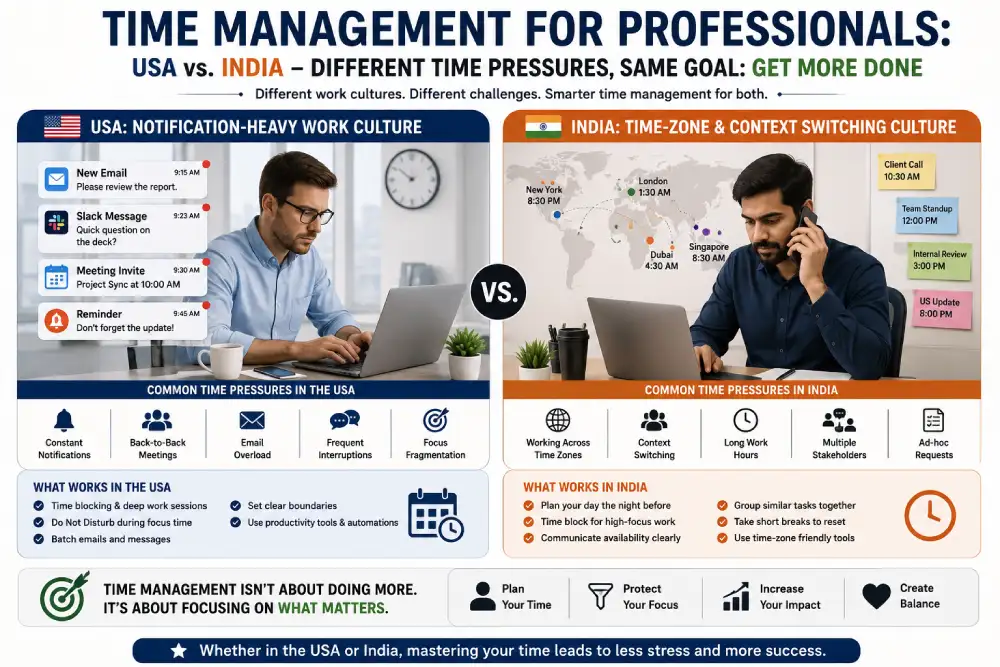
In the US, most time management issues are abouttoo many distractionsandthe expectation of a nearimmediate response(we‘re so busy!) : in India, particularly in IT and client services, the real stress is forced outside scheduling(going from time zone A to B, working to the clientdrivenhours). Time blocking is good where you own the calendar; where you don‘t, it isall about how you prioritize and set limits around “urgent” requests.
Conclusion
Managing our time as working professionals is not about searching for the “one best way” that will make everything better. It‘s about correctly identifying whether what is missing is priority-setting skills, concentration skills, or scheduling techniques — and then applying the method designed for that deficiency. Begin by utilizing a prioritization matrix to get things clear, then use time blocking or Pomodoro to safeguard the time necessary for those things, and then get rid of the timewasters that undermine them both.
FAQs
And what would be the best time management technique for working folk? There won‘t be one best technique time blocking is good for those who have mastery over their calendar, Pomodoro for those who avoid tasks that need focus, and a prioritization matrix for those who have difficulty in figuring out what matters.
Is it possible to combine Pomodoro and time blocking? You can most working professionals block time for deep work with Pomodoro work intervals inside your time block to maximize your focus.
On average, how long does it take to develop a time management habit? Most individuals require 3 to 4 weeks working with a single technique before trying another; changing too early does not allow any technique time to show its worth.
What is the greatest time sink for professionals? It‘s the perpetually interrupted focus due to alerts and unabsorbed email that seems to eat into more productive time than any single meeting or activity.
Can one realistically do this in reactive, meeting-daunting roles? It is tougher but I think it can still be valuable – allocate a block of time (say one or two hours) in your schedule that is likely to be protected (away from an ongoing meeting), and treat it as another fixed appointment.