Psoriasis Treatment Options: A Complete Guide
Published: July 21, 2026 Last Updated: July 21, 2026 If you‘ve been looking into psoriasis treatment options, you know
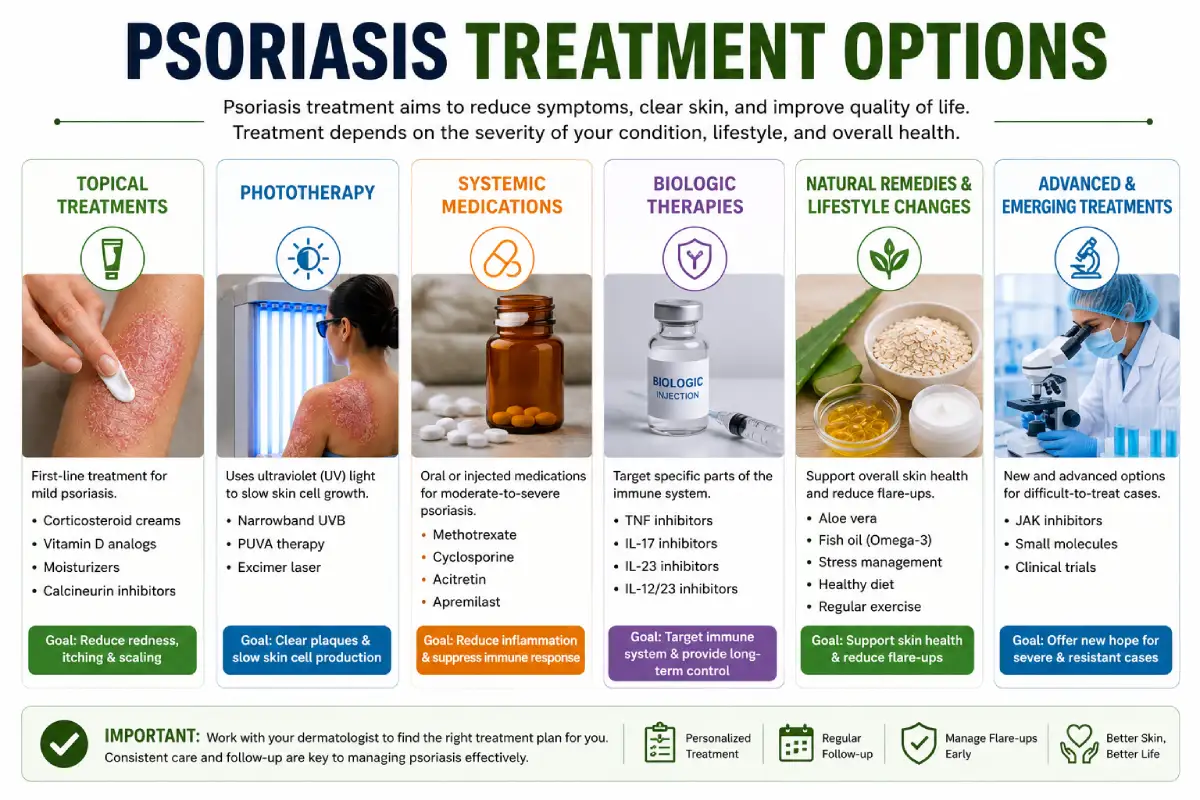
If you‘ve been looking into psoriasis treatment options, you know there‘s no one size fits all solution for psoriasis. It can be mild hardly at all or severe, and scratching your head over what will help will result in a much more effective discussion with your dermatologist.
This resource details at what severity psoriasis treatment is necessary, identifies when alternative remedies are actually good, and describes what you should expect to find at each step.
What Is Psoriasis
Is a long-term autoimmune disease where skin cells are produced more quickly than usual, causing thick, silvery or red patches on the skin as the cells build up faster than they are shed. It is not contagious, nor is it the result of poor hygiene; it results from activity of the immune system.
In some cases psoriasis can also involve the joints. This unwanted side effect related to psoriasis is known as psoriatic arthritis which is why dermatologists frequently inquire about joint pain or stiffness when considering treatment.
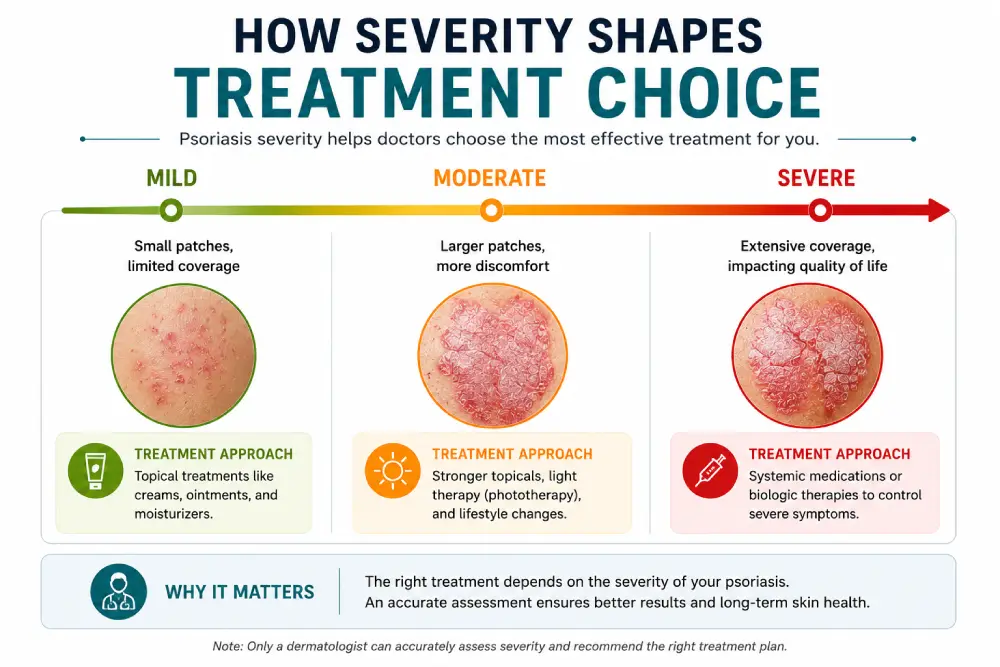
How Severity Shapes Treatment Choice
Psoriasis severity is typically measured by how much body surface area is affected:
- Mild usually confined to less than 3 5% of body surface area
- Moderate to severe generally > 5%; or whichever was thought to produce a significant impact on quality of life even if less.
Mild psoriasis can normally be treated with topical therapy only. Those with moderate-to-severe plaque psoriasis may need to receive phototherapy or systemic therapy as well, as topical creams alone are mainly ineffective in controlling general or persistent plaques.
Topical Treatments for Mild Psoriasis
For localized, mild psoriasis, topical options are usually the first line of treatment:
- Topical corticosteroids used to decrease inflammation and proliferation of skin cells
- Vitamin D analogues (e.g. calipodriol) to normalise skin cell production
- Preparation of coal tar and salicylic acid to decrease scaling
- The use of topical calcineurin inhibitors as steroid- sparing agents, for sensitive areas such as the face
Here, persistence is more important than potency since the majority of topical therapies require continuous application for several weeks before plaques become visibly clearer.
Phototherapy
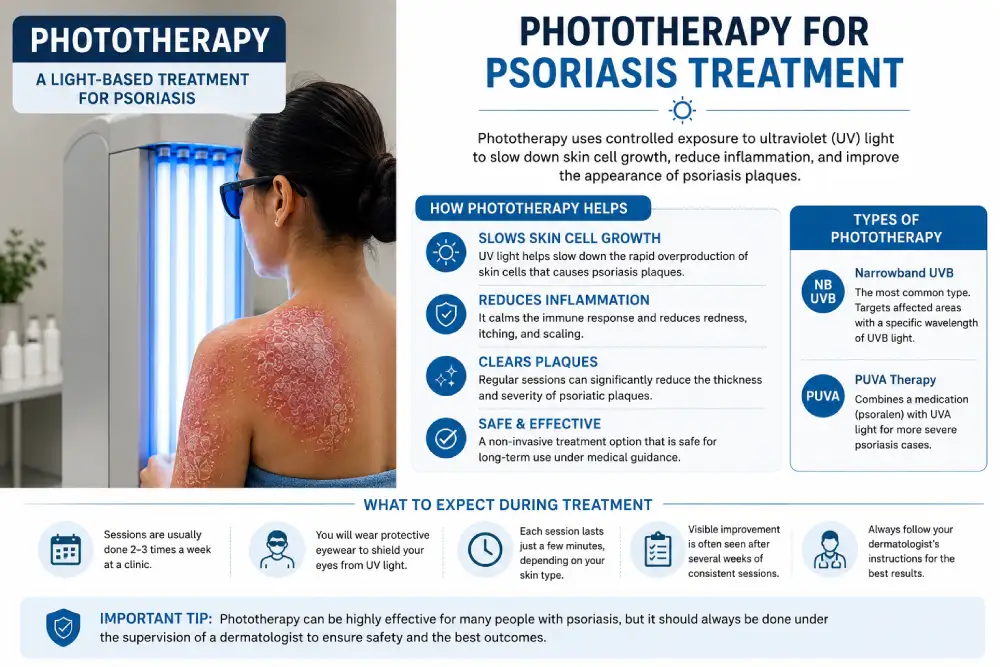
Phototherapy lights (artificial sunlight) such as narrowband UVB expose the skin to a specific dose of ultraviolet light. This reduces the rate at which the skin sheds itself and also reduces inflammation. It is used in more moderate psoriasis that has not improved with topical therapy or in people who want to avoid systemic drugs.
Phototherapy is accessible in different levels of availability based on your geographic location in large American and Indian cities, it is more accessible at dermatology clinics, however, regular appointment scheduling may be difficult for some patients.
Systemic and Biologic Treatments for Moderate-to-Severe Psoriasis
If psoriasis is extensive or causing a substantial impact on the patient life, systemic therapies are frequently required:
- Traditional systemic drugs such as methotrexate or cyclosporine which have a broad spectrum of activity on the immune system
- Oral treatments such as apremilast that target inflammatory pathways with a side-effect profile that differs from those of older systemic drugs.
- Biologics which interfere with specific elements of immune response to provide more targeted treatment with different individual response rates, commonly interfering with the IL-17, IL-23, or the TNF-alpha pathways,
Biologics have revolutionised the treatment of psoriasis over the last 10 years, with many patients achieving a good level of skin clearance. Individual response is variable and some people see a significant reduction in response over time. The following is a conversation for a dermatologist, as the choice of biologic is highly dependent on medical history, comorbidities and the presence of psoriatic arthritis.
Natural Remedies for Psoriasis
The approaches can also be helpful and are predominantly aimed at comfort and skin health evidence for most is limited compared to medical investigations:
- By moisturising frequently, using unscented creams will help to reduce the excess scaling and itching between flare ups
- Aloe Vera gel can be soothing for some people if you only have mild irritation.
- Omega-3 fatty acids (from fish oil or flaxseed) have some a slight anti-inflammatory properties
- Stress management is important because stress is a known trigger for psoriasis exacerbations
- Personal flares are more likely when known personal triggers are avoided consuming the ‘wrong’ infection, medication etc.
Natural remedies will yield the best results when used in conjunction with medical treatment, not as a substitution for this, particularly for sever,or moderate to severe psoriasis.
Common Mistakes in Psoriasis Treatment
- Stop topical treatment once plaques improve, which may reduce time between flares.
- Is treatment with natural remedies alone feasible for moderate-to-severe psoriasis
- Overlooking joint pains or stiffness that could indicate a psoriatic arthritis and led to a different treatment.
- Changing from one treatment to another too quickly before the first has had an opportunity to work.
- Missing dermatology follow-up after a biologic gets working if you still need further monitoring
Myth vs. Fact
Myth Psoriasis is a temporary condition. Fact: Psoriasis is an autoimmune disease that occurs due to increased skin cell production, as opposed to dryness.
Myth. Natural therapy can be used instead of medical management of psoriasis. Fact. Natural approaches may provide the skin with relief, while moderate to severe psoriasis requires topical, phototherapy or systemic therapy to maintain significant control.
Action Steps to Start Today
- Observe how many joints you have and how painful or stiff they are because this guides you to the most appropriate starting point for treatment
- Begins or continue a consistent fragrance free moisturizing regimen to stop scaling between flares
- Notice and monitor own triggers (e.g. stress, trauma to the skin, particular foods).
- Why do they need to see a dermatologist before starting topical therapy? Consider phototherapy or systemic options if topical therapy is not controlling symptoms.
- Any joint pain experienced should be discussed during dermatology appointments as this can alter management plan dramatically
Psoriasis treatment is not like the one size fits all approach. From natural topical creams, to phototherapy, and eventually targeted (not generic) biologics, the treatment spectrum depends on severity. When you know where your case is on the spectrum, and where natural remedies are actually helpful (rather than a waste of money) you can be in a much better position to work with your dermatologist for true, long-term control.
FAQs
Q: What is the best treatment for psoriasis?
A: Impossible to say mild psoriasis is often treated effectively with topical therapy, whereas moderate-to-severe psoriasis often requires phototherapy or biologic therapy before a significant response is achieved.
Q: Is psoriasis curable naturally?
A: No natural cures exist for psoriasis. Treatments can soothe the skin but are only really effective when used in conjunction with traditional treatment.
Q:Is there a relationship between psoriasis and joints?
A:Yes. Some patients who have psoriasis have psoriatic arthritis, which can involve the joints. That is why many dermatologists will ask about joint aches and pains during an examination.
Q. Does stress cause psoriasis to flare?
A. Yes, stress is a significant trigger for psoriasis and controlling stress can be an important part of a combined treatment regime.