Rebuilding Trust After Betrayal: A Couples Guide (2026)
Published: August 13, 2026 Last Updated: September 3, 2026 Rebuilding trust after betrayal isn’t a single conversation or apology

Rebuilding trust after betrayal isn’t a single conversation or apology — it’s a slow, consistent process built on transparency, accountability, and time. This guide breaks down what actually helps couples heal, what usually gets in the way, and when outside support makes the difference.
What Does Rebuilding Trust After Betrayal Actually Involve?
Rebuilding trust after infidelity or any other significant breach isn‘t a matter of one grand gesture or apology. It‘s a slow replacement of suspicion with reliable action.
Commonly, three things are happening simultaneously: the betrayed partner is allowing the partner who betrayed to take true responsibility, the betrayed partner is digesting what occurred without rushing either himself or his partner, and both partners are coming to an agreement about what the future of their relationship should look like.
A few honest truths worth sitting with:
- Trust doesn‘t come back to the same place, it comes back with new meaning.
- Recovery after your partner‘s cheating is not linear; there are set backs. They do not mean that you have failed.
- Both parties have work to do. The burdens are just different.
Why This Process Takes Longer Than People Expect
Betrayal not only messes with your feelings the moment it happens, but it also has long-term effects on how secure an individual feels in that relationship. For this reason, a quick-resolution approach or a predetermined timeline of “moving on” tends to be ineffective in most cases.
Also, research on couples healing from infidelity indicates that the betrayer‘s trustbuilding efforts are most effective when they are motivated by the partner‘s initiative rather than the pain victim‘s persistence.
Key takeaways:
- There‘s no one-size-fits-all rule some relationships take months, others years.
- The hurt partner asking questions and having doubts, even for the fourth or fifth time, is part of the healing process, not a punitive gesture.
- Progress is not the elimination of bad days; it is just the reduction of the number of bad days to fewer bad days.
Forgiveness in Relationships: What It Does and Doesn’t Mean
Forgiveness is required in all relationships and yet continues to be misunderstood. Forgiveness is not about forgetting, excusing the behavior, or saying you will never talk about it again.
What forgiveness actually is:
- A Freed in order not to have to punish, even while keeping in mind what happened
- A separate, personal process for the hurt partner‘s own peace, apart from the future of the relationship.
- Something can occur even if the couple chooses not to stay together in the end.
What it isn‘t:
- A need to re-trust immediately
- Just once… most of us forgive only a little at a time.
- Proof that the relation is instanceaneously held fixed straight away

What the Betraying Partner Needs to Do
Most of the advice concentrates totally on the healing of the injured partner. But the restoration of trust also hinges on what the partner who lost trust does next.
- Request answers to all questions, even if difficult, and not to sublimate ‘any uncomfortable disclosures’
- Offer transparency independently of the request information or disclosure provided on one‘s own initiative is more likely to foster trust than mandatorily required disclosure.
- This must be the first step. Cut off all the contact if it is possible.
- High standards Behave consistently even after the first few remorseful weeks
The value of a genuine apology, then, though appreciated is no replacement for months of dependability.
Trust Exercises Couples Can Use
Structured trust exercises in specific provide couples with something tangible to focus on instead of trusting in their will or good intentions.
- Daily check-ins – 5-10 minutes, no distractions, just “how are we today?”
- Confidence buildingphase perhaps- transparent communication practice — betraying partner self discloses their day/plans for an agreed period.
- Rebuilding journal,- that week each partner privately writes down one thing that felt safe than the other. This he then reports to the person and also writes it in the rebuilding notebook
- Scheduled ‘hard conversation’ time (so you don‘t ambush each other‘s every sudden non sequitur, 15 minutes to sit down with a bat and have crucial questions live.]
These aren‘t Band-Aids, they work because they in some way provide small, repeatable proof points that trust is being restored than just promised.
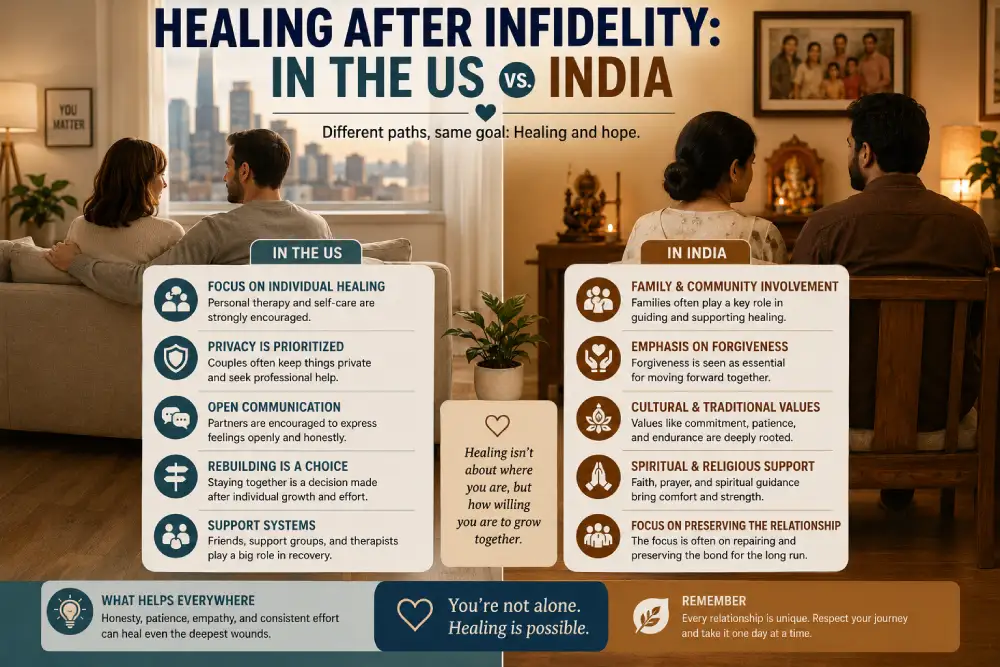
Healing After Infidelity in the US vs. India
How couples deals with this is also influencesd by the cultural contexts. In the United States, gender norms regarding infidelity often prevents the couples from discussing the issue with outsiders such topics are considered to be private between the two partners. The usual first step in dealing with infidelity is to seek couples therapy. The determined to stay or separation is finally left to the two couples.
In India, the presence of family can make the healing process more taxing, as maybe relatives will be aware of the affair, have something to say about it and push the partners in a particular direction, and the social taboo will make the tendency to take therapy more difficult. Couples tend to do better when they think within the relationship instead of with outsiders.
Neither context is easier the work of accountability, transparency, and time remains the same in both settings.
Myth vs. Fact
| Myth | Fact |
|---|---|
| If you genuinely forgive, you will completely forget. | Forgiveness & Memory The two were not tied together couples who had been healed clearly remembered but felt no longer captive to the past. |
| “REAL love is trustAgain right away” | Trust takes time (not n power alone, but evidence) to restore. |
| “Couples therapy indicates that the relationship is broken” | Therapy is a proactive tool in many strong couples’ troubleshoot arsenal, and is not just a last resort. |
| “if they truly loved you this wouldn‘t have happened” | Betrayal is complex and not easily understood as simply falling out of love. |
Common Mistakes Couples Make
- Penalizing “getting over it” with an artificial deadline, which serves to coerce an understandably hurt partner into concealing genuine emotion;
- The unfaithful partner responding defensively whenever she is repeatedly asked questions instead of being patient
- Barring couples counseling until the relationship has already hit a crisis point.
- The use of the idea of healing in a rather liberal, and perhaps naive way, for example, confusing the lack of conflict for, in fact, healing
When Rebuilding Trust Isn’t the Right Path
Sometimes people shouldn‘t be brought back into your life. That‘s a hard truth to state blatantly, but it is one I believe to be true. When cheating is part of a set of repetitive actions, when there is no true accountability, and when a partner refuses to carry through with the ongoing and consistent effort that is part of the process, leaving after betrayal may truly be what is best. That is not a failure. That is a different sort of respect.
For any situation requiring safety, coercion, or continued deception, you need a therapist or counselor.
FAQs
What is the time frame for regaining trust after an affair? There isn‘t a right time. In many cases, couples notice significant improvements in their relationship after six months to a year of working at it. However, in other cases, rebuilding trust took longer and recovery may not necessarily be a linear process.
Can a relationship recover from cheating without couples therapy? Some couples are able to regain trust without therapy, but couples therapy is very helpful, as it provides a safe, neutral environment where the couple can process the situation and rebuild communication.
Must we forgive to move on? No. Forgiveness is a private process that helps the forgiving individual; it is not something that one ‘must’ do to determine whether to stay or go.
What are good trust exercises for couples after betrayal? Daily check-ins, proactive transparency about daily plans, and scheduled time for difficult conversations are simple, repeatable exercises that help rebuild trust gradually.
How do you know if it is time to stay or go after betrayal? Trust in a pattern of confirmed responsibility, truthful response and lasting change in actions are indicators. They may be absent or betrayal may be an ongoing type of pattern you have been involved in. In such circumstances moving on will likely be in your best interests.
Final Conclusion
Rebuilding trust after betrayal takes a long time, is inconsistent, and doesn‘t usually read from a manual and that‘s OK, not a sign it isn‘t possible. What does matter is steadfast transparency from the partner who betrayed, patience with the process by the partner betrayed, and clarity about whether the both of them want to build the relationship again, or go to separate ways, after betrayal. The point is not an expedient resolution but an honest one. Revisiting our Healthy Relationships section to learn more about developing the little things that sustain a relationship.