How to Build Healthy Communication in Relationships (2026 Guide)
Published: August 6, 2026 Last Updated: August 7, 2026 Good communication in relationships is being able to say what
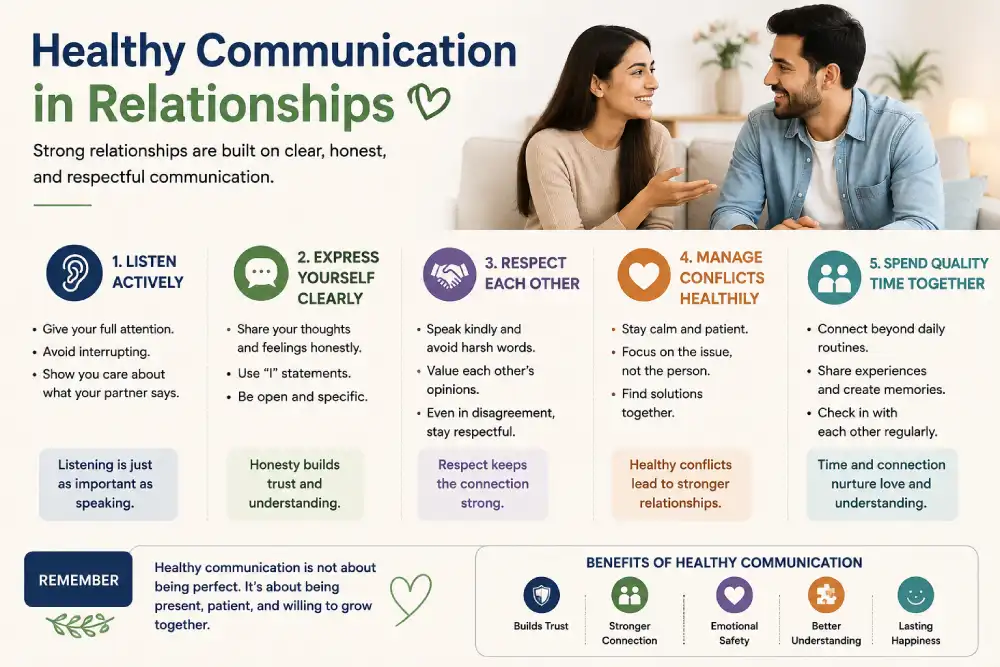
Good communication in relationships is being able to say what you feel and want, and really hear what your partner has to say – not dodging disputes, but dealing with disagreements in a constructive way. This guide includes Active listening for couples, effective communication methods, couples communication exercises and common communication mistakes to avoid (with couples in USA and India contexts).
What Is Healthy Communication in Relationships?
Healthy communication in relationships means covers what you say and how you listen. It means that both you and your partner can be honest about what you think and feel, and at the same time listen with an open mind and an attitude of acceptance, without blame and defensiveness or giving up.
This is a little different depending on where you are. In the US most relationship advice is to communicate your feelings directly and in the moment. In India, we communicate within the context of family interactions and social norms so a healthy relationship communicating is being able to be truthful with a partner avoiding the other person‘s pressures rather than going around them.
Why Healthy Communication Matters More in 2026
With digital distractions, busy schedules, and interruptions, it is more difficult than ever to have engaged conversations. In general, here is what couples who talk well do:
- Resolve conflict faster this too can be part of stopping issues from accumulating.
- Feel emotionally safe– each partner has the feeling of being actually listened to, instead of only being listened to/to the end.
- Cope as a group changes in your work life, problems at home, or health emergencies seem less overwhelming with other people to share them.
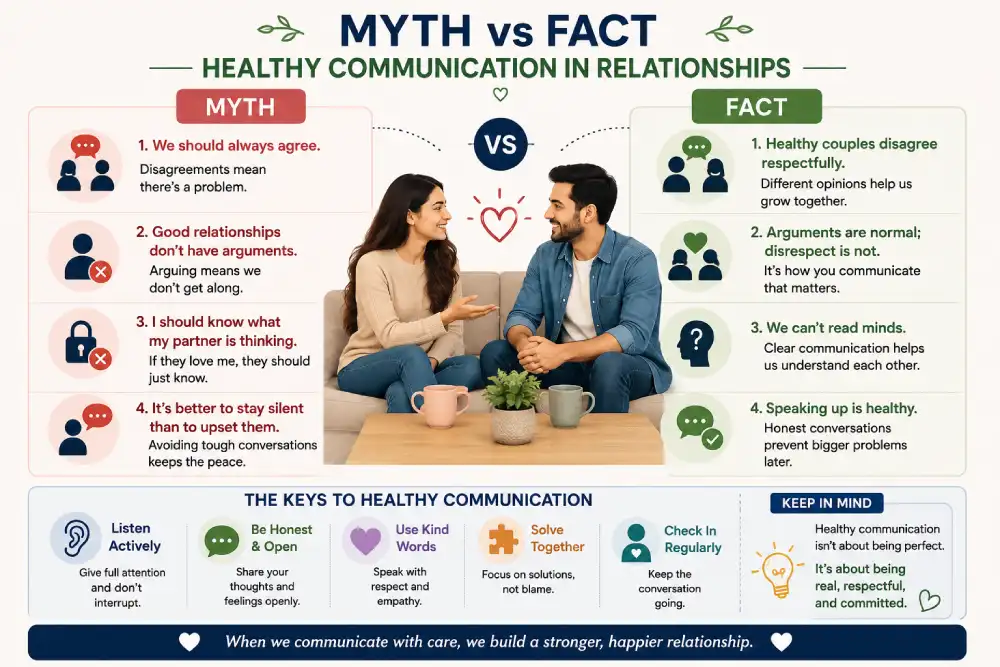
Healthy Communication: Myth vs Fact
| Myth | Fact |
|---|---|
| Never argue: Healthy couples don‘t argue. | Healthy couples fight, they just don‘t do it with disrespect (contempt) or (stonewalling). |
| Always answer exactly what you feel, instantly | Timing counts not a snap. Embody the higher, steady, well-selighted time rather than the reacting timelag. |
| Good communication is getting everyone to agree. | It is to understands it when there is no agreements. |
Core Communication Techniques for Couples
Active Listening for Couples
Active listening is the most emphasized skill in relationship research, and with good reason: most failures in communication occur as a result of one partner formulating a response, rather than listening.
- Turn your phone off during important conversations.
- Repeat what has just been said before giving your answer (“So you‘re saying…”):
- Ask a follow-up question to what was just said.
- Resist the temptation to hurl your own arguments back in her face when you hear something you vehemently disagree with.
Expressing Feelings Without Blame
The way you say it is often more important than what you say. Replacing blame language with feeling language is like altering the entire tone of the conversation.
- Further, replacing “You never listen” by “I experience being unheard when I am unwillingly interrupted”
- Replace “You‘re always late” by “I feel anxious when plans change last minute”
- Identify the emotion, then the particular context and not the individual .
3 Couples Communication Exercises to Try This Week
- The 15-Minute Check-In: Setting aside a weekly time to disconnect and individually check in to reflect and share about: “What is working for us right now, and what still needs to be improved?”
- The Mirror Exercise One person speaks for two minutes with no interruptions; the other repeats back what they hear before answering.
- The Daily Validation Habit (Done daily, we believe that simply telling your partner what you think he/she was feeling is a powerful release of stress. What is most helpful about this practice is that it presents many opportunities to do it. For example: Once a day, tell your partner he/she was feeling something they expressed, even something small, “That sounds like it was frustrating”)
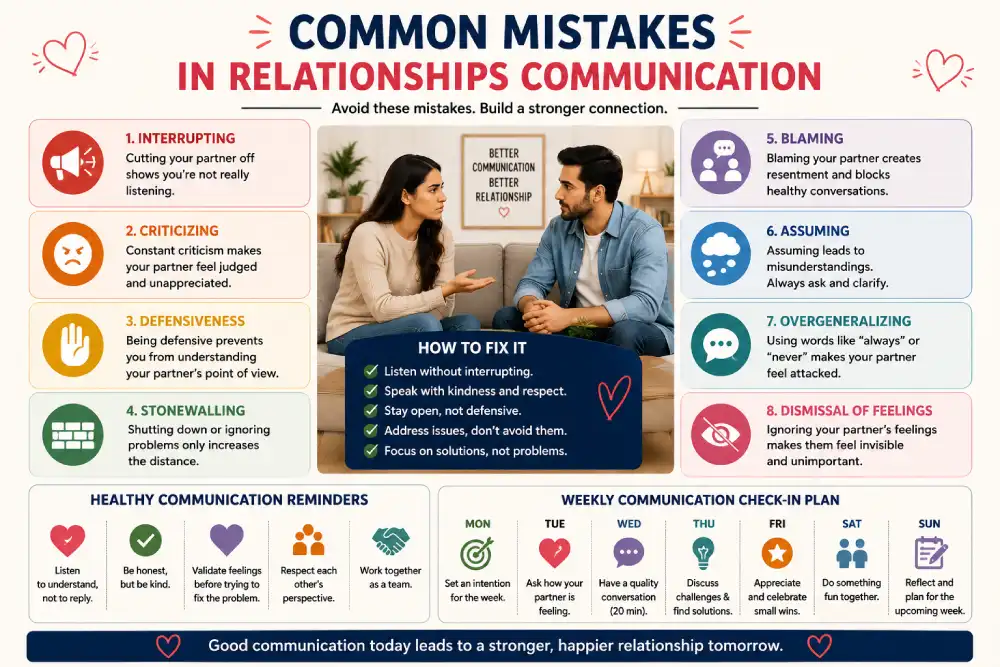
Common Communication Mistakes to Avoid
- Personal attack instead of issue critique instead of calling into question an action, calling into question the person who did it.
- Stonewalling isolate or go silent or incommunicado rather than engage.
- Expecting your partner to “just know” what you need without asking,
- Fighting when emotionally flooded –time-out is of the utmost importance; a discussion quickly degenerates when frustration and heart rate soar
Building the Habit: A Simple Weekly Check-In Plan
- Day 1: Set up a fixed weekly check-in time 15 min will do
- Days 2–6: While doing your errands or just before sleep keep track of whenever you had a moment where you were either practicing active listening or saying outloud what you were feeling instead of a blame statement.
- 8. Day 7: Conduct the check-in what was successful, what was unsuccessful, try one thing next week
Maintaining good communication in any relationship isn‘t a quick fix it‘s a learned routine between both parties, one open discussion at a time.
FAQs
Q1: But what is healthy communication really in relationships? It involves sincerity in sharing our feelings and openness to listen without blame or defensiveness not forsaking conflict but rather repairing the damage inflicted.
Q2: What does active listening mean to couples? It involves giving your partner your full attention as they speak, not interrupting or preparing your response, and repeating back what you heard before responding
What are easy couples communication activities to begin with? How about a once a week 15 minute check in, a mirroring exercise where one partner goes on uninterrupted for 3 minutes & a daily practice of validating one feeling your partner has expressed?
Q4: What communication errors should I try to avoid? Attacking your partners character and not their actions, unplugging from an argument (stonewalling), hoping for your partner to magically “know” what you want by snapping your fingers.
Question 5: Is the advice different for couples in India compared to the USA? The principles are similar, but in the USA the emphasis is often on the individual and one to one communication, in India good communication in a relationship involves discussing the relationship with the family together as a couple.
Conclusion
Healthy communication doesn‘t mean you and your partner should never have disagreements it means having disagreements without losing your trust in each other. Whether you and your American couple are learning to express yourselves directly or you and your Indian couple are learning to communicate without losing the connection with your family, the basic principles remain the same: listen to each other actively, communicate feelings without blame, and practice weekly. Begin with one activity from this guide; let healthy communication grow from there.