Healthy Relationships: The Complete Guide to Building Stronger Connections
Published: August 4, 2026 Last Updated: August 5, 2026 Eventually, nearly everyone asks some variation of the same question:

Eventually, nearly everyone asks some variation of the same question: is this okay? Perhaps it is following an argument that felt bigger than it should have. or, it is three months into dating someone and wondering if, by now, the butterflies are supposed to have subsided. Perhaps it is the 40 th night in a row of a video call instead of a meal across the table. Relationships challenge more uncertainty than almost anything else in life and most of what advice you find either purports to reduce it to a neat list, or spews jargon.
This handbook is a departure from that. Consider it your handy-dandy never leave home without it tucked in your wallet gps system. Instead of focusing on what people should do as couples, this guide will cover what actually defines a healthy relationship and the six main defining features of most relationship questions; how to love at every stage, communication, dating, long-distance love, warning signs, and fighting and trust. Each chapter summarizes the key points, provides an immediate application, and then tells you where to look for a full-length primer when you‘d like to learn even more!
First, I want to clearly state: I am not a professional therapist or counselor. If the topic we discuss here pertains to abuse, safety issues, or mental health crisis, please consult a professional. This guide can be very helpful in the much broader, much more common realm of everyday relationship health: communication, dating, distance, trust, where a linearly clearer paradigm offers true help. If anything I write here could possibly pertain to an abusive situation or safety concern, please contact the appropriate local advocates or professional.
What Actually Makes a Relationship Healthy?
A satisfying relationship is not a relationship in which there is no conflict, not one that is always fun and exciting, and not one where a person goes out and finds the “perfect” person. An agreeable relationship is one that follows a few steady patterns: both people do not feel disrespected, whether both people do not feel unsafe when being open and honest with each other, whether the both people take ownership for their part in problems, and whether the both people truly want the relationship to be successful – not clinging to it because ending it would be too painful.
Long-term couples researchers all agree that there are a handful of basic ingredients involved. These include trust, respect, honest communication, and “emotional safety” that feeling that you can be yourself, imperfections and all, without ridicule, punishment, or abandonment.
Key takeaways:
- A good relationship is a set of skills, not to be found by chance, or “the one”.
- The problem is not the conflict; the way it is managed and settled within the group during the conflict is.
- Emotional safety what trust, communication and intimacy are all based upon.
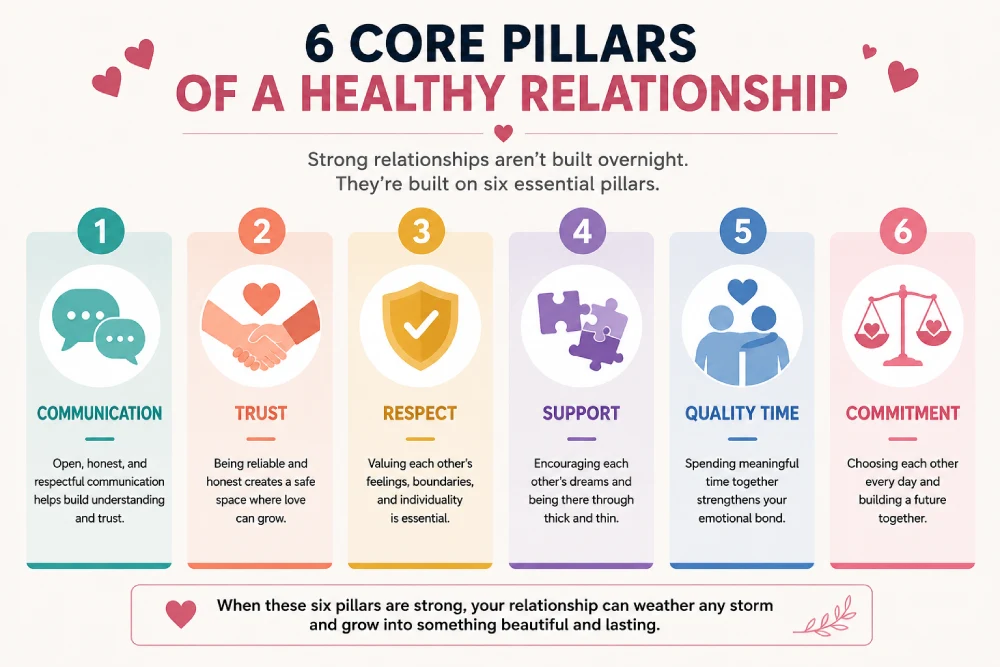
The Core Pillars of a Strong Relationship
The majority of relational research seems to agree upon a core set of pillars, regardless of the system by which it is being investigated. These doors are:
- Trust Having faith that your partner is truthful and cares about you.
- Honor appreciating and listening to your partner, respecting their boundaries, and being understanding and considerate of everything about them.
- Communication saying what you want and listening to your partner
- The emotional safety being able to allow oneself to be vulnerable
- Shared values – shared agreement rather than shared interest, what do you think is most important in life?
- Reciprocity (both individuals putting effort in, not one carrying the relationship)
Read More: [Relationship Advice for Every Stage: The Complete Guide]
Why Relationship Health Matters So Much
It‘s not just love it‘s health. An abundance of research shows that closeness in both our romantic and social lives is associated with decreased stress and enhanced health, while strained romantic relationships and instability have the opposite effect. Your relationships truly have a profound effect on your health.
This is one reason why “communication is key” appears in almost every relationship research piece and advice column ever published it isn‘t a cliché, it is the channel by which nearly every other problem in a relationship gets solved or exacerbated.
A Tale of Two Cultures: Relationships in the USA vs. India
The norms for relationships differ significantly between these two contexts and it is important to be explicit in naming both, rather than simply assume one or the other:
- In the USA, there is less of a structured approach relying on family and community to initiate dating, and relationships are generally discussed as between the two people and their ability to choose and care for each other through personal compatibility. Dating is generally equally directed by both parties, without as much family input.
- In India, most relationships are embedded in a larger web of family and social relationships even in favor- arranged personal-choice relationships, for example, family opinion, timelines and expectations still have a greater influence than I think they do for Western relationships. That‘s not an inherent warning sign or something that should be avoided; it‘s a different relationship ecology, and almost all the advice targeted for Western audiences (which is almost all of it in the case of guides and advice books) totally ignores it, losing a huge chunk of the actual context for any Indian reader.
The one for both markets: any good relationship, in whatever society it exists, demands communication and respect (which is to say, the same cultural pressures may be different but the skill set you need to get through them stay the same).
Relationship Advice for Every Stage
Relationship advice is not a universal panacea: what‘s helpful to the beginning dater won‘t be the same as what‘s helpful to the five-year committed dater.
Practical starting points by stage:
- Just beginning a new relationship: Prioritize discovering who they truly are, not just the tips and tricks gradual development matters more than initial excitement
- New relationship ( a few months in): begin forming good patterns of open communication well before they become ingrained
- Well established relationship: Continually check on level of needs being satisfied-relationships change,certain things that worked at three months may not work at three years.
- Long-term/married: Protect quality time intentionally stops happening autonomously once routine is established.
Mini summary: As a relationship evolves, so should the behaviors in that relationship because what‘s the current norm shouldn‘t be forever the same.
The Questions Worth Asking at Each Stage
Rather than generic advice, here‘s what‘s actually worth reflecting on at each point:
- Meeting someone early on in dating: is there compatibility between what they say and do? Do I experience being comfortable with them or does it feel like I am performing an altered version of myself?
- Reincipiate relationship:newWhat brings individual differences to this new relationship?Can the two of us disagree without it affecting the way we will treat each other in the future?Is one of us putting more energy into the plans, the talking, and the effort?
- Our now-known pattern of relationship: Do our individual needs and expectations change and have we discussed that, or just assumed that the other person will realize? Are we interested in each other or just coasting?
- Long term/married: Are we consciously setting aside time for one another? Or are we just living off of the inertia of the life we‘ve built together? When was the last time we talked about anything that wasn‘t about schedules or what needs to be done?
A Common Mistake: Comparing Your Relationship to a Highlight Reel
Social media, and the hype around “relationship goals”, give a false measuring stick. You‘re only ever witnessing a tiny fraction of the relationship that five second clip where everything is perfect. Comparing your normal, everyday, sometimes-frustrating relationship to someone else‘s highly curated relationship is one of the most common, and least helpful, reasons for feelings of relationship dissatisfaction.
Read More (Additional learning materials): [Relationship Advice for Every StageThe Complete Guide]
Communication in Relationships
If there‘s only one predictive of relationship success that would be communication not lack of disagreement, but how to move through disagreement without harm to the relationship.
Practical starting points:
- Begin all requests or suggestions with a positive statement (e.g., I appreciate when you…. Introduce a request with something like Such as…. then put a in your immediate request). Instead of saying “You always..,” say “I felt hurt when…”
- Practice active listening Listen with intent to understand, not preparation to reply.
- Take care of minor problems before they turn into objections.
- Learn your partner‘s mode of communication and love language and don‘t assume that theirs is the standard.
A well-known statistic cited by relationship researcher John Gottman is that healthy couples are able to sustain a ratio of 5 to 1 positive to negative sentiments: warmth and affirmation even outperform defect during arguments.
Mini summary: Communication doesn‘t mean we never argue – it means we argue in such a way that at the end we both feel heard.
Budget Tip: Communication Is Free
Rare in our society where so many relationship “fixes” are hammered out into a product or experience is the ability to improve relationship through communication skill. There is no cost other than your time and focus to do a weekly 15 minute “no cell or other distractions during the time” check-in that asks simply, “how are we doing?”
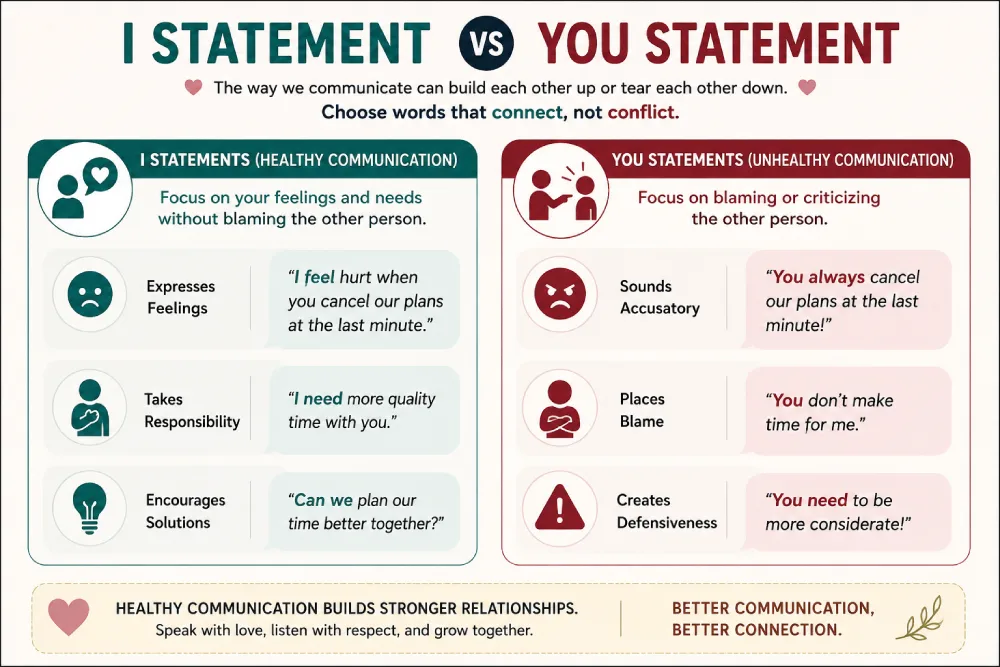
📖 Read More: [Communication in Relationships: The Complete Framework]
Healthy Dating: From First Date to Committed Partner
The place where relationship patterns first begin to emerge is dating and therefore one of the best places to establish practices that will lead to healthy relationships in the future.
Practical starting points:
- Notice if there‘s a mismatch between people‘s words & actions; over time, will do what they say not what they first say.
- Maintain early indicated low pressure and public till been trusted
- Don‘t overlook minor irregularities believing they will disappear patterns tend to become more pronounced, not smaller, over time.
- Use dating apps wisely: wherever possible assure you are on the same site, try to meet in a public place, probably for the early dates, and inform a friend what you are doing.
Mini summary: Healthy Dating isn‘t looking for perfection with no warning signs after the first date it‘s learning how to be honest with your attention as the relationship unfolds, rather than blind to what you‘re seeing.
Common Mistake
One of the most common dating mistakes is “future-faking” yourself determining that a person is “the one” because of what they might be in the future, rather than for who they currently are, and dismissing inconsistencies because you‘ve already fallen in love with the future version of what could be.
Read More: [Healthy Dating: From First Date to Lifelong Partner]
Navigating Dating Apps Safely and Realistically
The dating apps is now among the most common means for people to meet, although has its own dynamics (which would need to be named explicitly:
- Checkup before getting all involved. Video call prior to face to face and a public place to meet for the very first date are some easy, low maintenance safety habits worth making non-negotiable.
- Watch out for “love bombing” so much over-the-top flattery at the beginning, rapid expressions of desire, etc. a mismatched dose of passion early on is more likely to be a form of mind game than genuine connection.
- Manage “choice overload.” Constant swiping can trick you into thinking that there‘s always another option just one swipe away, making it difficult to get involved with someone worth investing actual attention. Give each good match your undivided attention and love.
- Significant inconsistencies in a profile should be given equal weight. Older looking profile pictures, blurry, cluttered or confusing profile details or refusals to video chat before meeting should be flagged up rather than excused.

Dating Across Cultures and Family Expectations (USA + India)
Market norms and expectations around dating vary in very impactful ways. In the US, where the market is highly put together by individuals, there are very few formal family checkpoints along the journey. In India, even in the handful of metro markets where the dating-app industry is nascent, by the time a couple becomes serious they will (perhaps reluctantly) still often come to an eventual family discussion (this is regardless of whether the couple met on their own or were most-introduced). Neither is right or wrong, but it is ultimately far better for both partners to be open with each other up front about their own expectations and limitations, rather than assuming general rules around dating that may not be accurate.
Long Distance Relationships: Making It Work
Long distance relationships (LDRs) have long had a reputation for being doomed but the research isn‘t quite so black and white. Basic research that has compared long distance to geographically close relationships has found no significant difference between the two groups in terms of relationship satisfaction, intimacy, trust or commitment; in other words, the variable isn‘t the distance, it seems to be how the couple handles it.
Practical starting points:
- Communicate proactively, not only in response to problems ongoing communication avoids having small crosses between partners fester in the absence of dialogue
- Establish a broad, achievable time-frame or plan for closing the gap- open-ended LDRs are always more difficult to maintain than goal-oriented ones
- Build shared rituals even over a distance: a weekly video call date, watching a film or show together over the internet or a joint calendar of forthcoming visits.
- Build trust instead of monitoring trust built through communication holds; trust enforced through supervision destroys it.
Mini summary: Long distance relationships do not break down because of the distance. They do well or poorly because of the same factors as any relationship but more explicitly challenged in terms of communication and trust.
A Note on LDR Statistics
So you will find “58% of long-distance relationships last” (or similar) over and over again across dozens of sites- it turns out that this number actually comes from a single 2018 marketing survey (not a peer-reviewed research paper) conducted for a consumer-products brand, so while it is perhaps not outright false, it‘s certainly less reliable than you‘d assume. The more solid, research-based point that people could take away is more positive: there‘s a number of academic studies out there that have shown long-distance couples are just as happy, trusting, and intimate as geographically close couples- and, in some cases, more so- as long as they communicate deliberately, which there‘s no doubt that long-distancecouchersdo.
Troubleshooting: “I Don’t Know If We Can Make It Work”
Distance is allowing you to begin to see the problem as it really is so you can sort it out. But this is not necessarily a failure of the relationship another step away from doom and seeing the relationship as hopeless. It is perhaps a good time to be able to separate out the issue of loneliness due to distance (which is a normal part of long distance relationships and one that theirs are very used to handling) and an underlying issue of lacking compatibility/trust that they can‘t much ignore now. Communication is uneasy and one sided: “they feels like I am asking them all the time” then it is worth looking at this more closely without assuming it is your fault due to the distance.

📖 Read More: [Long Distance Relationships: Making It Work]
Relationship Red Flags (and Green Flags)
Red flag culture has become so popular online that it sometimes becomes counterproductive; it could lead to mischaracterizing completely normal relationship problems as a disorder.
Genuine red flags to take seriously:
- The same pattern of persistent lying or distorting of the facts.
- Tried to do things to you to make you think you were going mad even blaming you for the problems happening to you.
- Running your time, money and choices
- Refuse to admit or apologize for a clearly painful behavior
- Trends of passing the buck rather than accepting responsibility.
Green flags worth recognizing and valuing:
- Corporate integrity, consistency between words and actions [over time], as people expect…
- A real interest in your life, your point of view, your boundaries.
- See you having your own friends/interest clearly.
- Ready to apologize and actually change behavior, words are not enough.
Mini recap: one single awkward second or disagreement alone isn‘t a warning sign but if it‘s part of a larger pattern of behavior that undermines trust, safety, or autonomy, it is.
Common Mistake: Treating Every Difference as a Red Flag
Some mismatches are not red flags,they‘re simply parts of a normal lack of compatibility or cultural miscommunication, and are unrelated to character issues. While redflag literacy can be helpful, if overapplied, it can cause us to see “normal, expected relationship scuffing” as something more troubling than it really is, spawning a different type of relationship anxiety.
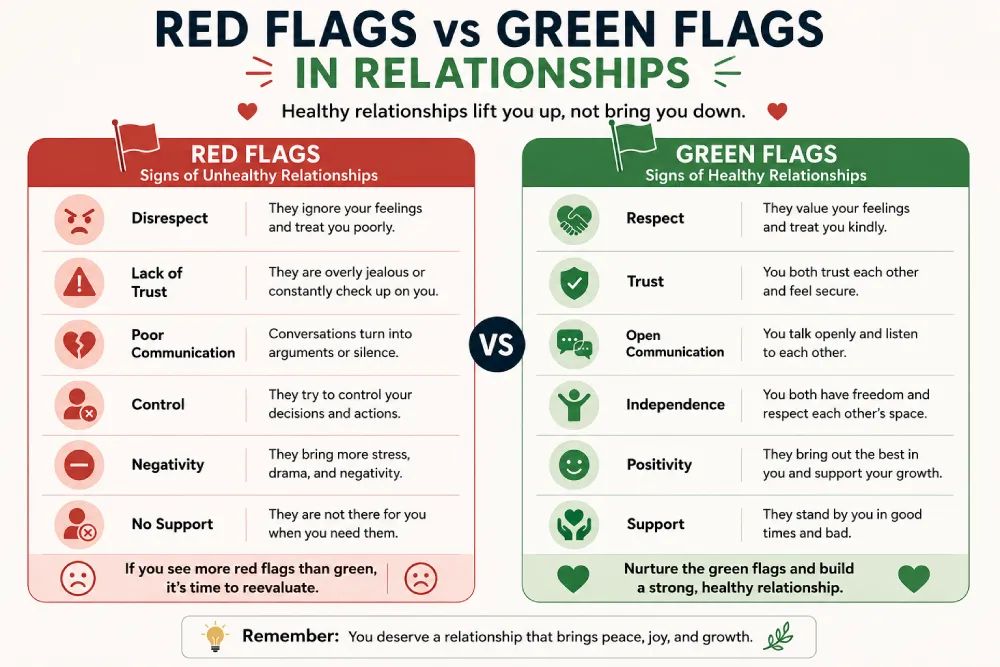
📖 Read More: [Relationship Red Flags (and Green Flags) Explained]
Conflict and Trust: Repairing and Strengthening Your Bond
Every relationship has conflict, just the fact that there is a disagreement is not a red flag; it is about the resolution of those disagreements whether or not they leave each individual feeling like they have been heard or not.
Practical starting points:
- Defuse problems early and speak to them quickly rather than ignoring them until they become a major blowup
- Address the behavior or situation. Do not make vague personality judgments (“this annoyed me” vs. “you‘re always like that”).
- Reconstruction of trust, once it‘s been broken requires ongoing transparency and follow-through, not just one dramatic gesture.
- Identify the point at which the issue has escalated beyond your abilities to resolve together and seek professional intervention.
Mini summary: Good conflict doesn‘t destroy a solid relationship — bad or avoided conflict does.
When to Consider Professional Support
There are a few clues that outside help (couples counseling) might really make a difference: when the same arguments keep coming up and never being resolved; when you feel more and more unheard or misunderstood even outside of arguments; when you feel trust has been broken and there‘s no one feeling that they can handle it alone or here you can handle it on your own. Asking for outside help is NOT a sign of failure- it often is what makes the difference between a quietly dying relationship and one that has a real shot to recover.
See Also: [Conflict & Trust: Restoring and Deepening the Connection]
Relationships and Family Involvement (A Note for Indian Readers)
More indicative, perhaps, of how little this type of material exists in Western relationship products is the fact that this one is almost entirely absent despite being one of the most authentic, every-day realities of a large number of Indian couples dealing with family involvement and influence in their relationship (whether that concerns the issues of parental preferences in choosing a mate, or living in a joint family, or giving precedence to the couple’s needs against those of the family).
Practical starting points:
- Agreed boundaries as a couple first, then introduce them to family as a couple-not as a “couple against the rest”.
- Learn to differentiate between family input that deserves serious consideration and pressure that contradicts the health of your relationship.
- Respectfully communicate to family in a way he/she can understand; communicate to family where he/she can hear you, rather than avoiding it altogether
- Know that the ability to navigate family relationships gracefully is a relationship skill. Remember that you and your partner manage it together how you do it may be more important than the result.
Mini summary: Having to have family around isn‘t automatically a warning sign or a burden it is just a tangible factor, which plenty of relationships need to accept by having a stated approach to rather than ignore.
Relationships Beyond Romance: Friendships and Family
All of these, speech, boundaries, trust, conflict repair, are just as relevant to friendships and family relationships as they are to romantic ones! In fact, many people originally learn these skills in friendships, where the stakes are a lot lower, and then adapt them to a romantic relationship.
Practical starting points:
- Use the same advice about much sooner addressing small issues with friends, as resentment can quietly gather ground for years without a single word.
- Please remember, healthy boundaries with your family are a skill, not a betrayal, and you won‘t have to justify ’‘no’’ to something as much.
- Make a conscious effort to invest in your friend‘s adult friendships because they aren‘t automatic like school ones; adult friendships require the same effort as it takes to maintain a long term romantic relationship.
Mini summary: “Relationship health” = a skill set that is transferable – not a thing that only pertains to primary partnerships.
Digital-Age Relationship Challenges
A missing chunk that nearly every competing guide overlooks: the impact of smart phones, social media, and 24/7 connectivity on relationships in any context that any earlier breed of relationship book could have foreseen.
Practical starting points:
- Designate phone-free periods during quality time together even 30 minutes of undivided attention makes a lot of difference
- Attention to the proportion of relationship comparison that takes place via social media, and how skewed that comparison tends to be.
- Address digital boundaries directly (how we use social media, how often you expect to hear from someone, what seems over the top vs. normal) rather than assuming we have the same standards for communication.
- Have video-chat sessions and shared activities on the computer strategically in a long distance relationship – but don‘t use too much screen time in face-to-face visits as a replacement for more meaningful conversations.
Mini summary: What‘s changed is not the critical needs of relationships but merely the ease of ignoring them while appearing to be busy and involved, •.
Understanding Attachment Styles
Arguably the most helpful (and suddenly “hip”) way of making sense of relationship patterns is through attachment theory; first studied in children but then expanded to adult romantic relationships. It illustrates how (for example) distance, conflict and uncertainty can evoke dramatically different reactions in individuals.
The four commonly described attachment styles:
- Secure: Comfy with intimacy and autonomy; tends to have faith in partners and be candid about desires.
- Anxious-preoccupied: seeks intimacy and approval, and is often preoccupied with thoughts that a partner will or has left.
- Dismissive-avoidant: Has an intense need for independence and may find it difficult to deal with intimacy or reliance on others.
- Fearful-avoidant: Craves intimacy but worried about getting hurt, may create imbalance where partner pushes and pulls away or runs away
Practical starting points:
- Understanding your own attachment style helps you to understand your normal responses when in conflict, distant, or uncertain and not to justify them to yourself by saying, “That‘s just the way I am. I can‘t change.
- Knowing an attachment style (rather than criticizing it) more often than not defuses conflict, because most of the “why do they always do that” moments really are attachment, not callousness
- Attachment styles are not permanent repeated, positive, secure relationships may lead someone to develop more positive attachment style over time.
Mini summary: Your attachment style is not a life sentence: it‘s a beginning explanation of why you and your partner show up in the relationship the way you do.
Love Languages: A Quick Primer
Developed by relationship counselor Gary Chapman, the love languages model can describe the various ways a person may naturally give and receive affection. It‘s often a mismatch (rather than incompatibility) between people‘s love languages that explains a surprising number of “they just don‘t seem to care” mix-ups.
The five commonly cited love languages:
- Words of affirmation verbal expressions of positive remarks, praise, encouragement.
- Quality time — undistracted, dedicated attention
- Acts of service doing helpful things for a partner
- Physical Touch – a means of expressing love through physical contact
- Gifts nice little things or not too expensive.
Practical starting points:
- Discover your own main love language and provide the information to your partner directly. Do not expect them to be able to figure this out.
- Ask them the same question, and try hard to love them in the language their receiving bank receives best, not just the one you naturally speak.
- Keep in mind that this is a useful framework, not a hard science – most folks like a little bit of everything, with maybe one or two that are especially applicable.
Mini summary: Much of the “they don‘t show they care” frustration really is a translation problem, not a caring problem – learning to speak your partner‘s love language has more to do with overcoming it than most people realize
Breakups and Moving On
Not every relationship guide discusses ‘break-ups,’ but they‘re a common and sometimes very helpful part of relationship life and how a person deals with a break-up can be quite revealing about their general relationship abilities.
Practical starting points:
- Allow yourself to mourn a relationship, even if the ending wasn‘t wrong missed and right can coexist.
- Don‘t make big decisions such as getting back together, going into a rebound relationship for instance, in the first emotionally raw weeks.
- Be truthful about identifying any cycle within the relationship after the pain has subsided. Do not romanticize (say that it was beautiful, right, or perfect) or demonize (say it should not have happened).
- Depend on your wider support network leaving your home and going to friends or family, and consulting a therapist if that helps rather than withdrawing
Mini summary: A breakup with dignity and a lot of honest reflection can teach more about a successful relationship than a relationship that is easy ever could.
Relationships and Mental Health
Relationship health and mental health are intricately linked both ways. An unhealthy relationship impacts wellbeing, and wellbeing influences how someone is in a relationship.
Practical starting points:
- Acknowledge that both individuals in the relationship carry stress, baggage and mental loads into the relationship relationship struggles are sometimes external to the relationship.
- You can support a partner‘s mental health but do not try to be their therapist sometimes just being there and encouraging someone along the way is enough, professional help is there if needed.
- Protect your own well being too; a relationship in which you feel daily like yourself has to be seriously looked at – preferably with someone else‘s perspective beside you.
- If a partner is experiencing a mental health problem, seek expert guidance rather than health advice articles on the relationship (including this guide) to replace medical treatment.
Mini summary: A good relationship will contribute to the wellbeing of both partners it is not meant to provide the individual‘s mental health stability.
Relationships by the Numbers
A quick-reference snapshot of the research behind this guide:
| Metric | Figure |
|---|---|
| Adults in the US who are currently in a Long Distance Relationship | ~14 million |
| Couples who went through the often long distance stage at any time during their relationship | ~75% |
| Most common challenge for long-distance couples | Loneliness (~66%) |
| Proportion of LDV arguments due to miscommunication | ~47% |
| Gottman Institute also reports a positive-to-negative ratio between interactions in relationships that are successful. | 5:1 |
| Couples who mention communication problems among their reasons for attending counseling. | Is frequently specified as a leading cause, by numerous relationship-support websites. |
These numbers lead to the same conclusion throughout this whole guidesaying that distance, disagreement, and even doubt, are all natural to relationships. What matters is whether both people are in consistent contact and participating; the challenges themselves are never necessarily what led to the relationship‘s failure.
Common Myths About Relationships
| Myth | Fact |
|---|---|
| “Healthy relationships don’t have conflict” | Conflict is normal; what matters is how it’s resolved |
| “If it were right, it would be easy” | Even strong relationships require ongoing effort — ease isn’t the measure of health |
| “Long distance relationships don’t work” | Research shows LDRs can match or exceed geographically close relationships in satisfaction and trust |
| “You’ll just know when you meet ‘the one'” | Compatibility is revealed through consistent behavior over time, not instant certainty |
| “A few red flags early on will resolve themselves” | Patterns tend to intensify, not disappear, without direct change |
| “Jealousy is proof of love” | Occasional mild jealousy is human, but frequent jealousy is more often linked to insecurity or control than genuine care |
Common Mistakes People Make
- Not confronting difficult issues to “keep the peace” which tends to postpone and expand the conflict.
- It is unrealistic to require your partner to fulfill all your emotional needs your relationship cannot substitute your friends, interests, and larger network of support.
- Mistaking intensity for intimacy – the pick-up of early attractions and the feeling of being emotionally secure over the long term are connected, yetnot identical.
- Tracking keeping score on who did what or how many times apologized usually backfires. It is more likely to undermine the goodwill then work toward solving the real problem
- Waiting until a crisis When is the best time to set up communication systems? Before you need them desperately.
Building Relationship Rituals That Last
Everday rituals small, recurring acts are often more meaningful for long-term relationship satisfaction than dramatic(ic) displays: they foster availability and consistency that supports the identity of the relationship.
Practical starting points:
- A weekly ritual that‘s just for you two a certain dinner, a walk, a TV show you always watch together. Provides a sense of stability without too much effort or planning
- Be intentional about marking relationship milestones, even small ones. If not done, they are likely to go unrecognized and uncelebrated.
- Building small daily habits of appreciation a positive “thank you” for something concrete,. not, for example, just noticing someone‘s greatness
- Revisit and revise rituals: as we change, so do our rituals. Something that worked when raising kids, with your move, or a busy period with your career may need to be tweeked, not thrown out altogether.
Mini summary: Concatenated used to get “we should spend more time together” from an abstraction/intent to an automatic reality week after week.
Where to Start: A Relationship Health Check-In
If you take one tool away from this book, this is it: once a month (or once a quarter, at minimum), sit down with your partner and ask yourself and your partner these three questions: Do I feel heard? Do I feel respected? Do I feel like this relationship is going somewhere I want to go? When both of you give honest answers to these three questions, you will find that virtually every relationship problem shows up way before it blows up, in dating relationships, committed partnerships, and even close friendships.
The Future of Relationship Health
Expect several shifts to continue through 2026 and beyond:
- Growing cadre of young couples viewing couples therapy and relationship coaching as proactive rather than reactive solutions, rather than last resorts
- Increasing recognition of attachment styles as a widely accepted model of relationship dynamics, transferring from therapy circles into everyday discussion
- The red-flags more sophisticated literacy and, a correction to the original oversimplification where this idea of red-flag culture as a reflection of a practical kind of pattern recognition, becomes a something approaching value-oriented useful pattern recognition, the good red-flags, if you will, that is compared to the bad red-flag understanding, that‘s my [impression]. Predecessors the concept of pre-red-flags, the etymology of red-flags, the more sophisticated red-flag literacy…
- Perpetual normalization of long distance relationships due to: apart from the fact that a large amount of work is done from home, the increasing trend of global education and the emergence of global dating services targeted towards these circumstances.
- Greater focus on digital boundaries in relationships, as partners intentionally discuss how they will use phones, social media and maintain an always-on presence.
Final Thoughts
A healthy relationship is never a search for someone that doesn‘t cause tension, someone that is “easy” from the start, something that will fit right away. It requires the consistent effort of unglamorous actions showing up, communicating openly and honestly, repairing tension instead of avoiding it, and recognizing what‘s “normal relationship tension” and what is actually a pattern.
At the end of the day, if I may leave you with one thing to take away from all of this, it is this: Your relationship health is a practice, not an endpoint to be reached once and kept for eternity. The couples, friends, and families that last for decades are not the ones that avoid challenges at all costs they‘re the ones who regularly return to what grounded healthy relationships in the first place: communication, respect, trust, and the indulgence and willingness to nurture their relationships through the inevitable ups and downs.
It‘s also important to keep in mind that no rule, checklist, or framework will ever definitively tell you if a given relationship is right or wrong for you that decision belongs to the two people involved in said relationship, and is best arrived at by honest introspection, the reassurance of a reliable friend or loved one or expert, and, when you hit a wall that doesn‘t seem to budge, a coach or counselor. The thing this guide can do is provide a little more clarity about what you‘re noticing, and serve as a reminder that most things that feel complicated, bewildering, or hopeless in relationships are more normal, more common, and more manageable than we realize in the moment.