Personal Development: Your Complete Guide to Self-Growth and Success
Published: August 20, 2026 Last Updated: August 28, 2026 if your Most people don’t wake up one day and
if your Most people don’t wake up one day and decide to transform their entire life. Real growth usually starts smaller than that — a frustrating Monday, a missed goal, a moment of comparing yourself to someone else’s highlight reel. That quiet discomfort is often the first sign that you’re ready for personal development: the ongoing process of building better habits, sharper skills, stronger confidence, and a clearer sense of direction.
If you‘ve searched for ‘personal development’ you might be hoping that you won‘t find yet another generic 100 tips that you‘ll completely forget in a day‘s time. You want to find something that makes sense you want a reliable starting point whether you‘re a college student in Bengaluru facing a career dilemma or a working professional in Chicago trying to get back those two hours of your evening.
This is it the most comprehensive guide to self-development we can build. It‘s an excellent place to begin, a road map among a forest of confusion. We will go through the five core self-growth areas habits and practices of self-improvement, personal development strategies, productivity, confidence and goal setting and each time, provide links to a more advanced guide if you feel prepared to continue.
What Is Personal Development, Really?
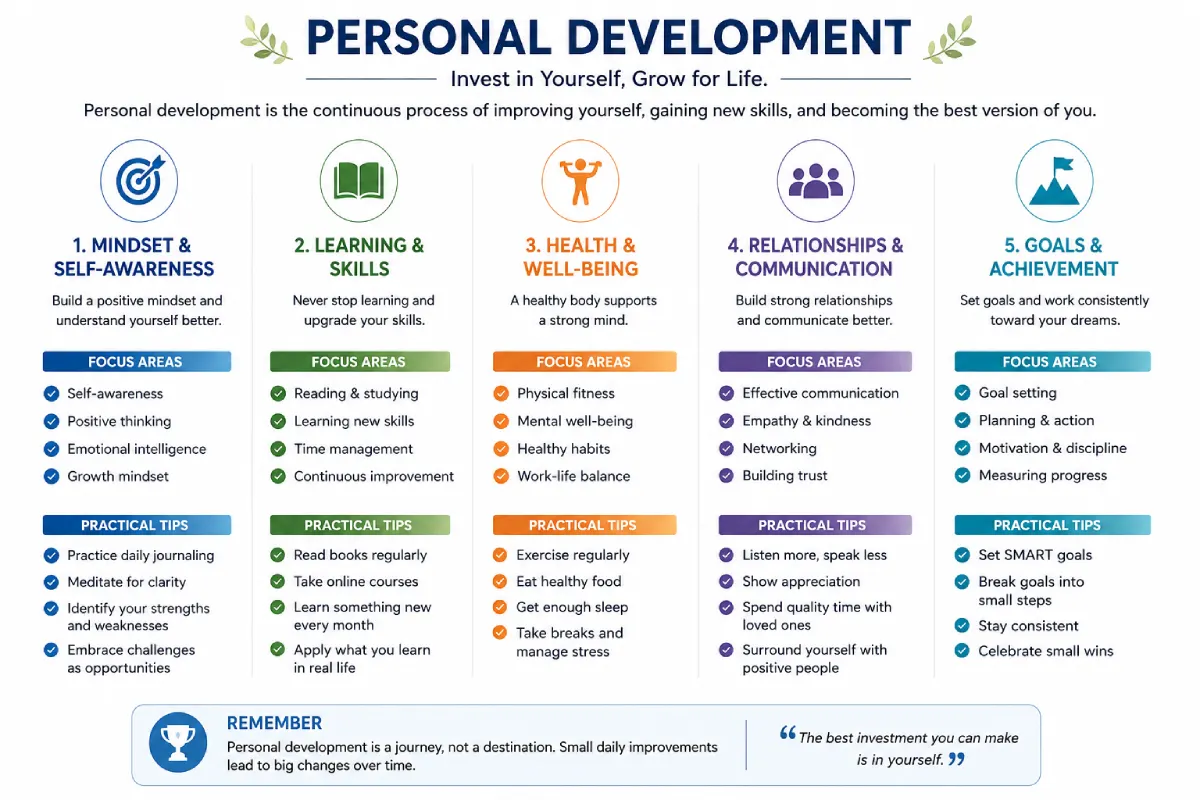
Personal development is the conscious pursuit of becoming better in all aspects of your life including knowledge, skills, mindset, health and relationships over a period of time. It is not a one-time activity it is a series of small choices.
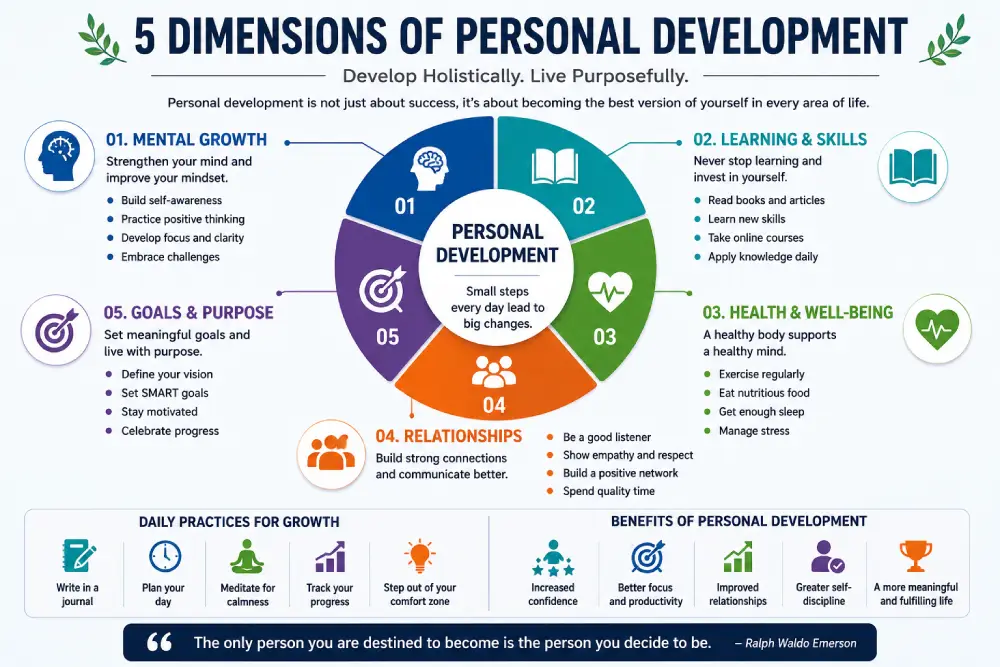
Psychologists often break it into five overlapping dimensions:
- Mental your ability to think, learn, and deal with problems.
- Emotional how you deal with feelings, stress, and self- confidence
- Physical Energy, sleep, and habits to help everything else.
- Social relationships, communication, and borders
- Professionals skills, career development and output
Main lesson: you don‘t need to attack all five simultaneously. The majority of individuals receive their quickest results by selecting one facet, creating inertia in that area, and allowing it to naturally aid the others.
Why it matters even more in 2026: Hybrid work, relentless pings, and more frequent AI-dictated career resets, mean that self-direction is more crucial than ever. No one is going to give you a path to advancement anymore the burden (and the benefit) is all yours. And again, that‘s fine. It makes the techniques in this booklet relevant whether you‘re a student trying to practice studying, a new parent seeking to safeguard a flicker of me-time, or a mid-career profesional demoting to something else.
The best place to start then: Personal development isn‘t about becoming someone new. It‘s about eliminating the drag between who you are today and who you can be one habit, one goal, one honest conversation with yourself at a time.
Common Mistakes People Make When Starting Out
- Trying to fix everything all at once. Changing sleep, diet, career and relationship in a single month nearly always implodes within a few weeks. Choose one lever.
- Copying someone else‘s routine hand and hand. That 5 am wake up may or may not work for you, just as it does for someone else. The key is to find a system that aligns with your own energy wavelengths.
- Evaluating progress just by results. Deciding on the basis of the final deadline (getting the promotion, completing the book) rather than the process wins those small victories we need to keep going.
- Giving up at the first sign of a miss. one missed workout, one missed journal entry, is a blip. Allowing one to trigger thoughts like the plan is no good, that is what truly takes you off the road to success.
Self-Improvement Tips: Small Habits That Actually Compound
Self-development is doomed if you think of it as one big dramatic gesture a 30-day extreme challenge that quietly fades away in week two. What actually works is less sexy: smaller shifts, repeated so often they become who you are.
A few habits that consistently show up in research and real-world coaching practice:
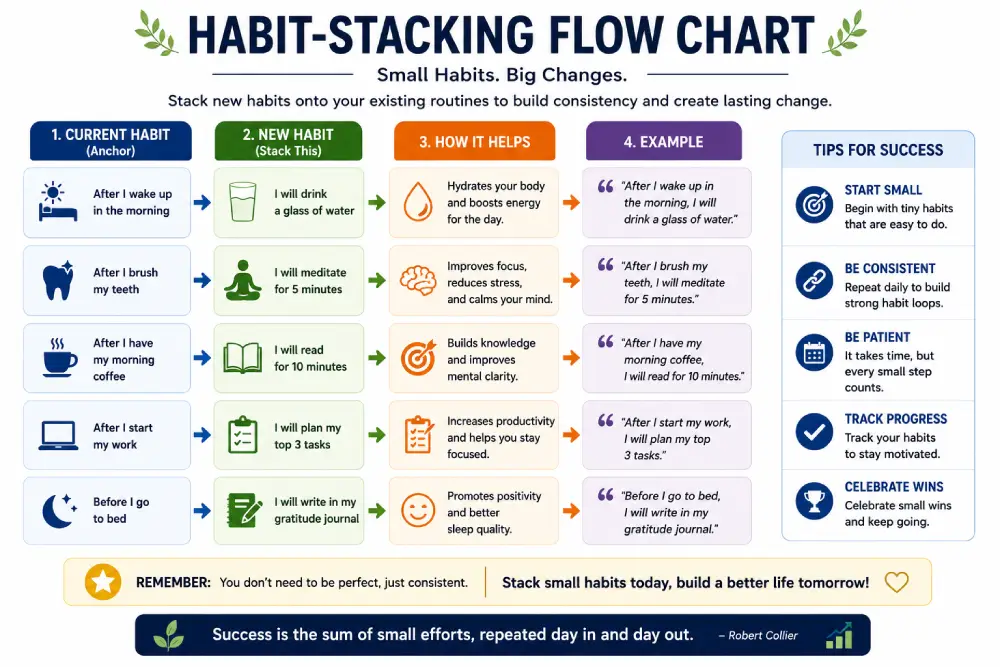
- The willpower required is less if you add a new habit to an existing habit ( For when I brush my teeth I will write 3 lines in my journal). Habit stacking.
- The two-minute rule begin a habit in an absurdly small form (Ex. a single page or one push-up) that you can accomplish without resistance outperforms relying on motivation.
- Weekly reviews – 15 minutes every Sunday reflecting on what worked and what didn‘t keeps habits real rather than aspirational.
- Environment design leaving your phone in a different room when you work, or setting out your gym clothes the night before can do much more to influence your behavior than willpower.
Real-world implementation: Use the same two-word resolution, except say “wear my shoes and go for 5 minutes.“99% of days that 5 minutes escalates into 20. For the difficult days, you stick to the streak–and that streak becomes identity. It‘s not like the smalltackler is that we think it will be easier to see resultsit‘s that we think it will be easier to start and that initial push is nearly universally where issues arise when trying to achieve any goal.
A Simple 4-Week Starter Plan
- Week 1: Choose one habit stack and one two-minute habit. Keep track of each day by writing it on a piece of paper or using some easy application..
- Week 2: Add a five-minute weekly review every Sunday. Record what component made the habit easier or more difficult that week.
- Week 3: Implement environment design around the new habit (place a book on the nightstand, leave a pair of running shoes by the door) instead of depending on willpower.
- Week 4: Add a second tiny habit on top of the first one since the first one is dully embedded in the way you go.
Troubleshooting: “I Keep Falling Off Track”
When a habit continually backslides, there‘s about a threefold cause: the habit is just too large to begin with (make it smaller), the cue isn‘t stable (attach it to something that occurs every single day without fail), or the environment is sabotaging you (remove friction, don‘t just add motivation). Willpower is an ineffective long-term strategy design always trumps discipline.
Mini summary: Self-improvement isn‘t a matter of intensity it‘s a matter of design. Make your habits small enough to hold up during your worst.
📖 Read More: Self-Improvement Habits for 2026 Full Guide
Personal Growth Strategies: Building a Growth Mindset
“Personal growth strategies” is a much more general phrase than simply habits that‘s really just a new way of thinking about struggles and setbacks. This is the point at which the idea of a growth mindset the idea that we can all improve through effort becomes genuinely valuable:
People with a strong growth orientation tend to share a few patterns:
- The view is that failure is data, not self (“that approach didn‘t work” rather than “I‘m not good at this”)
- They crave feedback, rather than shy away from it10.
- They establish learning goals (“improving in public speaking”) and performance goals (“delivering this specific presentation successfully”).
- They seek out people who will challenge them, not simply confirm their worldview.
Myth vs Fact
| Myth | Fact |
|---|---|
| “Some individuals are innately successful” | “Most visible achievement is the outcome of uneventful repetition over years.” |
| “The desire to grow must be there.” | Discipline and systems are always better than motivation (which can change in a day). |
| K.K also said “I think this is exactly what personal growth is about. Constantly criticizing yourself.” | Growth and development are fostered more by gentleness toward the self than by beatings by the self. |
Practical illustration: If a work presentation bombs, a growth mindset reads not as “I‘m incapable of delivering presentations,” but as “I spent too little time practicing the transitions. Next time I‘ll address precisely that.” The same failure, a vastly different course of action.
Develop the habit of reflection Growth is not so much achieved as allowed to develop when growth-minded thinking is repeatedly practiced. Developing the growth mindset requires continuous exercises in reflection, such as a brief end-of-day reflection: “what did I learn today and how would I do it differently?” this approach is even more effective than journaling in training our mind to seek lessons for growth, not results. Over the long haul, this lone practice transforms failure into knowledge no longer a judgment of who you are, but an instruction to make a better decision.
Regional note (USA & India): In the fast-paced, competitive worlds of academics and careers from India‘s engineering entrance exams to the American corporate rat race the culture of comparisons can subtly drain away at a growth mindset. The solution is not to go cold turkey on comparisons; it is to compare yourself against yourself far more frequently than you compare yourself to others.
Mini summary: Growth is determined less by talent and more by how you interpret setbacks. If you change your interpretations about them, the course will change with it.
Also read in this section: Top Personal Development titles to Grow a Growth Mindset
Productivity Habits: Getting More Done Without Burning Out
Productivity tips on the internet tend to equate busyness with effectiveness. Actual productivity doesn‘t involve achieving more; it involves conserving your energy for the handful of things that truly matter.
A few productivity systems worth understanding (you don‘t need all of them pick one):
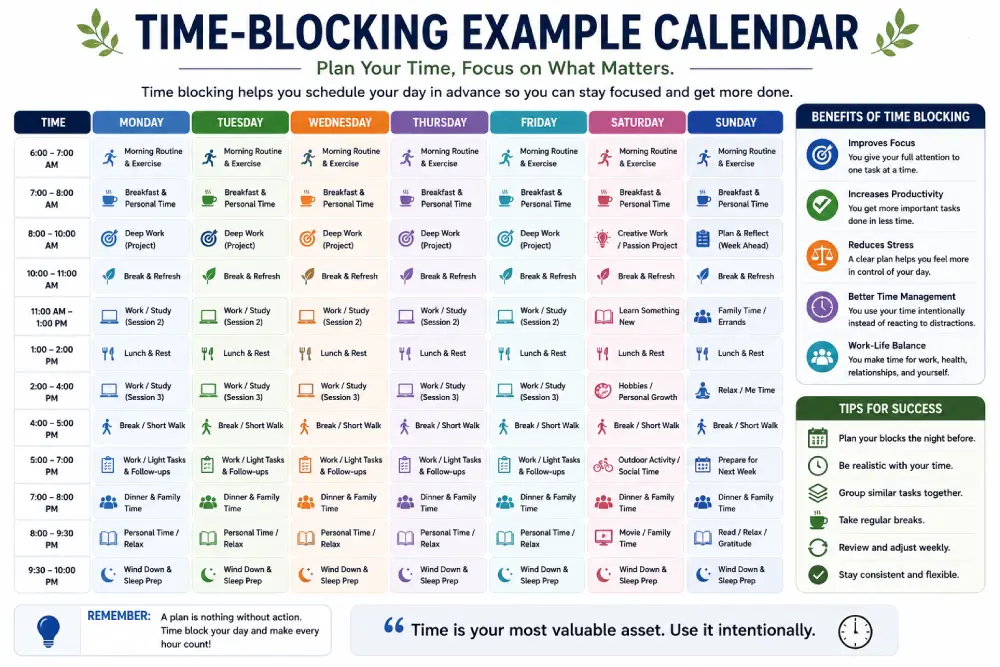
- Time blocking Zeroing out on specific tasks for a given hour, rather than a vast to-do list. Great for folks who have a combination of deep work/interruption-heavy meetings.
- The Eisehower Matrix dividing tasks into quadrants based on urgency and importance, in order to cease confusing urgent with important.
- Pomodoro technique – Working in sharp 25-minute doses, with breaks between, good for those prone to distraction.
- Single-tasking that is, intentionally doing only one thing at a time has been conclusively proven to compromise the quality and speed of work, even when people perceive that they are being faster.
Quick comparison table
| System | Best For | Downside |
|---|---|---|
| Time Blocking | Individuals who have multiple fixed schedules/appointments | Needs discipline for block protection |
| Eisenhower Matrix | Individuals overwhelmed with a diversity of tasks | Needs to be re-prioritized frequently |
| Pomodoro | Individuals with Attention/Distraction problems | Can feel inelastic for creative deep work. |
Practical example: Replace a 20-item to-do list with choosing 3 most important things to get done the night before. Most days, completing those 3 things is more beneficial than completing the entire list.
How to Choose the Right System for You
Not every system works for every schedule. If you have an erratic schedule with a ton of meetings, time blocking provides a doable structure without having to sit down for two-hour stretches. And problem is a long, undifferentiated to-do list, The Eisenhower Matrix clarifies what really needs to be tackled today. If distraction is what keeps you from doing anything, Pomodoro‘s short sprints make the starting point a little less daunting.
Typical error: changing systems every month or so because nothing “feels right”. No single productivity method is perfect. The trick is identifying an imperfect system you‘ll stick with for at least 6 months, not 6 days.
Digital Tools Worth Considering
You don‘t need a complicated tech stack to get things done. A calendar app that helps you time-blocked, a notes app or notepad that helps you make a daily top-3, and a habit tracker (paper or an app) is enough for most people. What AI tools are really useful for 2026 is slashing boring, low-value busywork doing the first draft of a bunch of emails, creating synopsises of big texts, collecting notes for you so you can channel your psychological energy into the serious work.
Mini summary: Productivity is not a matter of getting more done; it is about guarding the time for what really counts, and is also about getting honest about what doesn‘t count.
Read More: Productivity Systems That Work Full Comparison Chart
Confidence Building: Rewiring Self-Doubt
Self-confidence isn‘t a personality…it‘s more of a skill that needs to be built through repeated evidence of your handling of life. This is why strengthener tips of just “positive attitude” don‘t work: nothing happens if you just say“yes” in your mind.
What tends to work better:
- Competence before confidence — which always comes after competence, not before it. Improve in that smallish thing, and the confidence will follow.
- Small, tangible wins – keeping track of even small victories (a difficult conversation going well, sticking to a workout schedule) creates a concrete evidence base.
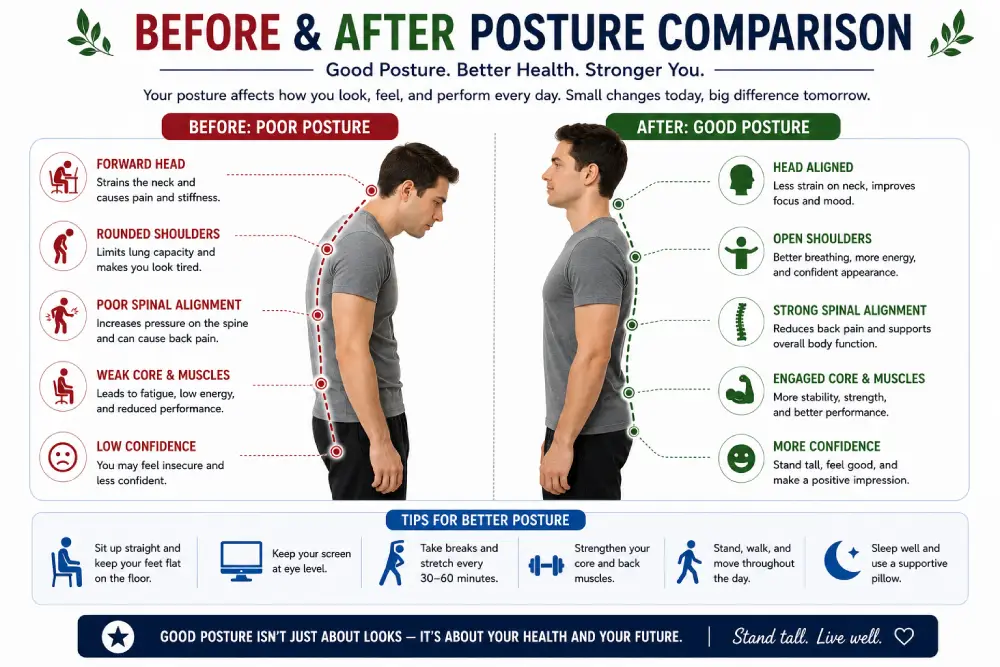
- Your body language and your posture – whether you stand proud and tall or slump and slouch – have a measurable impact not only on your outward appearance but on how confident you feel.
- Reconsider comparison social media comparison is arguably the biggest silent confidence drain. Limiting or reframing it as inspiration for growth rather than competition can help counteract damage.
Myth vs Fact
| Myth | Fact |
|---|---|
| “Confident people can do a job without getting nervous” | Most confident people are still anxious that‘s just how they‘ve learned to behave in spite of it. |
| ‘Don‘t believe in yourself until after you‘ve done it., and ‘Confidence comes before you‘re ready’ | Use Confidence more often after preparation and small repeated action. |
Real-world example: Before a tense occasion an interview, a presentation, your first day in an unfamiliar gym write the details of three time you coped with something tough in the past. This is not a self-esteem booster. You are merely establishing an evidence file for your brain to draw from.
Where Low Confidence Usually Comes From
The thing about low confidence is that it usually doesn‘t just come from a vacuum it‘s influenced by early discouragement (harsh criticisms, comparison to siblings or classmates, etc.), a series of failures that are internalized as personal flaws, or even just failure to engage in experiences that enhance and develop it (such as speaking up, trying something new as an adult, or developing a new competence). Identifying the origins is not a blame game, but just a realization that confidence is a learned behavior.
A Simple Weekly Confidence Practice
- Monday: Quickly jot down one thing you‘re feeling a little anxious about this week.
- Midweek: The most minimal variation of that action which can be performed (write that email, pose the question, have one voice contribution in the meeting).
- Friday: Record what actually happened rather than what you were afraid would happen. More often than not the difference between the two is the real lesson.
The same routine would be applied over several months, forming another silent evidence file to rely on.
Mini summary: Confidence is not inherit, it is developed. repeated brief demonstrations of ability have all the power you need.
📖 Read More: Building Self-Confidence Exercises & Mindset Shifts
Goal Setting: Turning Vague Wishes Into Real Progress
The wishes like “I want to get healthier” or “I want to be more successful” are not goals. They are too fuzzy to be work toward. Good goal setting makes a fuzzy wish measurable, manageable and achievable.
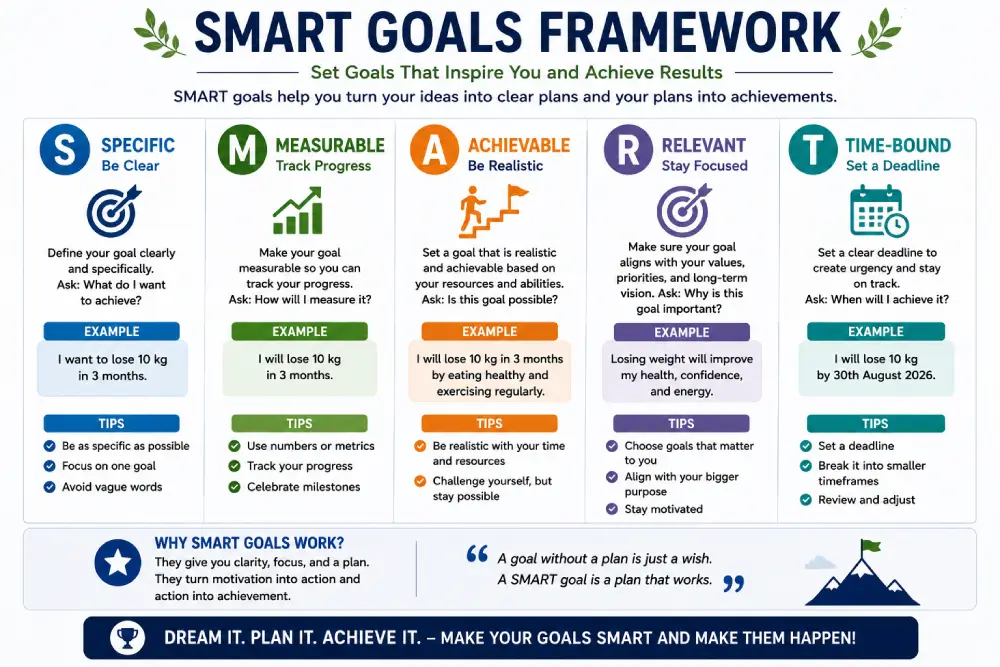
Most popular of all is SMART goals: Specific, Measurable, Achievable, Relevant, Time-bound. But the framework itself is inadequate; your success depends on:
- Divide large objectives into weekly tasks. An aim such as ‘write a book’ is overwhelming. ‘Write 300 words, four days a week’ is realistic.
- Track more process, not outcomes. Tracking whether you appeared (did I write today?) is more motivating from day-to-day (I kept my streak going today!) than tracking a far outcome (I finished the book!).
- Create task identity focused goals in addition to outcome goals. An identity statement such as ” I am a person who writes everyday” will be easier to persist with than, ” I want to complete a book” as the former focuses on ongoing self-development, whereas the latter is only concerned with an end result.
- Monthly review and correction. The goals articulated in January have a high probability that they won‘t be holding the same form by December that‘s a good thing.
Example for inspiration: rather than “get more healthy this year” be more specific, time-related and small enough that you could genuinely begin today: “walk for 20 mins 5 days/week for next 8 weeks – log it in a habit app”.
Why Most New Year’s Resolutions Fail
Any resolution fails for one of these three reasons: it is either too vague (“be healthier” or “volunteer more”), too enormous to begin without intimidation (“run a marathon” with no history of running), or disconnected from a system that makes it possible (no calendar block, no tracking, no accountability). Address any one of these three and you greatly enhance your ability to follow through.
A Simple Goal-Setting Worksheet Structure
- Outcome goal : What does doing well in 90 days mean? (Specific and quantifiable.)
- Process goal: What is the weekly activity that brings you there? (An activity totally within your control.)
- Challenge: What is probably going to get in the way time, energy, encouragement, cash?
- If-then plan: “if [obstacle occurs] then I will [specific response]”. Deciding how to respond to obstacles beforehand takes away the burden of making that decision in the moment.
Regional note: Certainly in India the family/academic pressure can make a person‘s own goal seem okay. In the US, a system can end up with the test getting so optimized that reaching the goal becomes hopeless. Solution in both cases: fewer goals, shorter review period, repeated.
Mini summary: The ones that actually get completed are seldom the “big ones” they are the ones chopped into mini bites to survive a hectic, fallible week.
📖 Read More: Goal Setting & Achievement Step-by-Step Framework
Continuous Learning: Staying Relevant in 2026
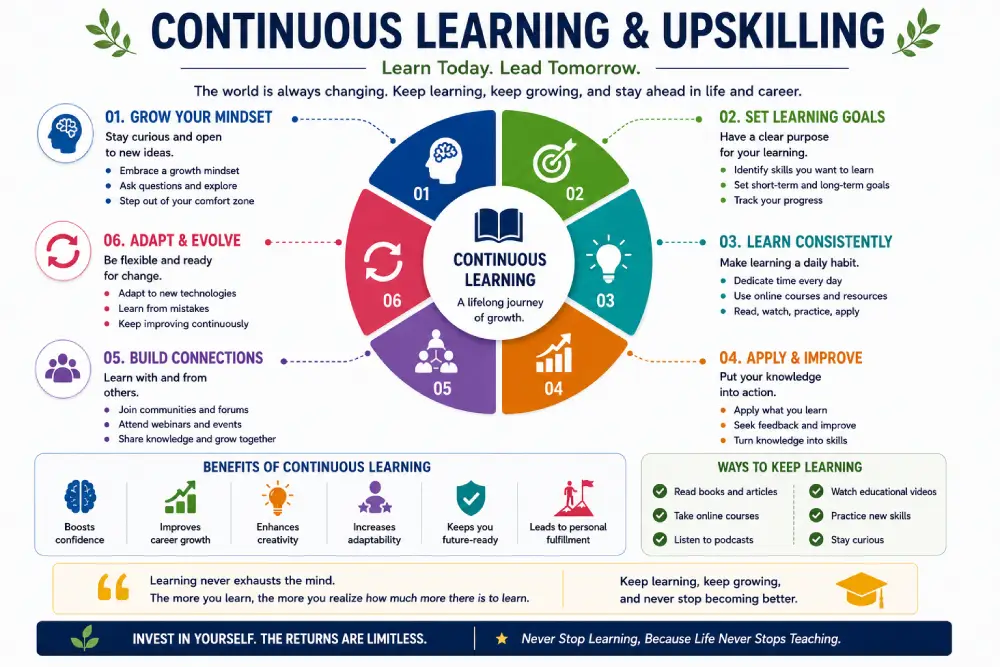
Almost any field has seen such a rapid pace of change be it AI tools or evolving job requirements that learning on the job has stopped being a ‘bonus’ and become a career requirement. This applies whether you‘re a student in India facing stiff competition or a worker in the US restructuring around AI.
Practical ways to build a learning habit that sticks:
- Micro-learning beats marathon learning 20 minutes a day beats a single 5-hour weekend binge that is unlikely to be repeated.
- Skill stacking: having two decent skills (say, writing + basic data analysis) is often more valuable in your career than investing that time to be world‘s best in just one.
- Cost-effective and Free skills development resources websites, YouTube tutorials and community based learning enable employees to upskill without any costs involved.
- Teach what you learn explaining to someone else what you are learning (or putting it to paper) is faster at bringing weaknesses (gaps) in your knowledge to the surface than reading over it.
Practical example: Skip the costly, year long certification you may not complete and try instead to find a free two-week course on that One skill you know you will need next at work. Momentum counts more than pieces of paper early on.
Choosing What to Learn Next
With almost unlimited courses at your fingertips, the more difficult question isn‘t frequently “how do I learn” it‘s more often “what‘s actually worth learning right now”. One effective way to screen is, does this skill add to an existing strength (to stack skills), does it eliminate a current bottleneck in your work, or is it just curiosity? All three are worth learning for… but you should learn at the right depth and pace, otherwise you chase all the popular trends.
Mini summary: In 2026, relevance has nothing to do with a singular major credential. It has to do with a low friction learning habit you can build and maintain for years on end.
Read More Continuous Learning & Upskilling Tools & Techniques
Personal Development at Work vs. Personal Life
A question that frequently arises: is personal development a “work” activity or a “life” activity? It‘s not as clear-cut as many people think.
Skills such as confidence and productivityare obvious in both realms the habits of evidencing that allow you to voice your opinion in the office will also be the habits of evidencing that allow you to establish a boundary with your sister. The goal-setting frameworks used to pursue a fitness goal will work just as well to pursue a career goal. That‘s a relief! You don‘t need two different systems one for “life you” and one for “work you” you just need one habit-tracking practice, one weekly review, and one goal-setting framework:
That said, a few distinctions are worth keeping in mind:
- Workplace wellness programs (including those at US companies and Indian IT firms) often get you access to organized benefits mentors, study fund, life health app, etc. better to utilize than recreate for yourself.
- Personal goals generally require a greater level of self accountability, since there‘s nobody to supervise or review performance, who will call you to task on whether or not you kept your journal entries for the evening.
- Boundaries matter both ways. Career-oriented individual growth may gradually push out sleep and friends and family if done unmindfully – guarding inalienable personal time is a career development skill.
The best way is to see growing oneself and growing the business as one and not as two cows fighting over the same phone.
The Future of Personal Development
A few shifts are worth watching as personal development evolves through 2026 and beyond:
- AI as a personal coach, not a substitute for reflection AI has the potential to help with your reflection practice. Nowadays, we see AI used to copy-and-paste journal entries, to recommend small behavioural changes, or to reign in hard conversations by role-playing them is advance. But the reflection still has to come from the individual.
- Micro-credentials over long degrees. Credentials that are shorter and stackable are gaining more credibility in the real world particularly in the fast-evolving worlds of data, design and digital marketing.
- Mental health was integrated with productivity. No longer would someone rush, crash, and fight to come out the other side now the new paradigm is creating systems that make the experience of rest, recovery, focus, and sleep an integral (not antagonistic) part of the same system.
- From community to crowd. Solo self-growth is evolving into accountability groups, cohort-based classes, and fellow ship learning because it’s easier to uphold habits if someone else is tracking your attendance.
A Simple Starting Checklist
If that all seemed a bit overwhelming to take in then here‘s the “getting started” version. Choose one of the below to do this week, none of the five:
- [ ]1-2..Pick one two-minute habit and make it a part of your current routine.
- ( ) Clearly identify one specific, time-bound goal using the outcome+ process goal guidelines.
- [ ] Do one little but somehow not so comfortable job create oneself a confidence “proof file”
- [ ] Schedule one 60–90 minutes of dedicated work on your calendar this week
- [ ] Invest 15 minutes or less per week, maybe daily, in mastering a skill that eases a key bottleneck.
Come back to this list again in a month. I‘ll bet just one small change has made the next task even easier already.
Bringing It All Together
Observe how these five spheres are not standalone. The easy habits of self improvement leads to having the discipline to establish attainable goals. Goals lead to little victories build momentum and confidence. Confidence leads to the commitment to show up to time and energy demanding work. Productivty ensures time and energy for continual self development.
There‘s no need to conquer all five this month, or even this year. Choose from the list above whichever one had you thinking “yes, that‘s where I‘m stuck” and begin there. There‘s no rush in self-growth; consistency is key.
FAQs
What does personal development mean in simple terms? Personal development, in simple terms, is developing yourself through the years in your habits, mindsets, skills, and confidence to become a better person.
How can I do it if I don‘t know where to begin?That‘s it.Choose a single thing habits, confidence, productivity, goals and try just one easy, repeatable action.
How long before your personal development results become visible? For the majority of people, small mindset changes are evidenced within weeks, but for substantial change to occur, it will likely take between 3–6 months of persistence.
What are good beginner personal development habits? Journaling, an easy-to-do daily morning routine, weekly review of goals, and 10–15 minutes of reading daily are favorite beginner habits with substantial long-term payoff.
Does this sound like personal development? How is it similar to self-help? It overlaps, but also has some additional factors like systems of productivity, skills and careers.
How does a goal differ from a habit? A goal is a particular thing you want to happen, with a clear beginning and ending. By contrast, a habit is a behavior you keep repeating, usually indefinitely. Most goals are fairly easy to achieve with the right supporting habits.
Is personal development applicable to career advancement? Yes productivity systems, continuous learning, and boosting self-esteem contribute directly to career advancement in the form of getting promoted, making a career switch, and communicating effectively.
How do I engineer my behavior to consistently work on myself when I am so busy in life? These things are best designed so you can pull them down to fit in your busiest week, not your perfect week (smaller consistency trumps flailing intensity).
Final Conclusion
Never say “I‘ve improved enough” as personal development should be an ongoing journey. The 5 areas we look at here personal improvement routines, personal development, productivity, confidence, and goal setting are interconnected rather than a set of discrete boxes to tick.
Begin with a single change. Focus on a single habit, a single goal, or a single self-confidence exercise from this book. Spend two weeks dedicated to that one self-improvement effort before you evaluate it. That‘s how actual, genuine self-improvement occurs over the long term; not by attempting to change everything at once, but simply by making one improvement in your life after another.
Hopefully, the one thing you take away from the above is this: No need to have everything figured out before you begin. The seemingly “successful” life whether it be in career, confidence, or body that most assume arrived in a flash was instead accumulated through the countless ordinary weeks in between. The finally-“more confident”, “more in control”, “more capable” version of yourself is not just around the corner; rather, it is being created in the next small choice you make today and then again in the next and the next until it no longer feels like work.
Visit the Complete Personal Development hub for comprehensive guides on habits, life goal setting, confidence, productivity, book recommendations, how to learn anything, and more.