Holistic Health and Wellness: Simple Practices That Actually Work
Published: June 3, 2026 Last Updated: June 16, 2026 No need to feel out of sorts! You are not

No need to feel out of sorts! You are not alone. That‘s why in the US & India alone, the search for holistic health and wellness has skyrocketed. In other words, it‘s about being proactive about your overall lifestyle.
And no…it doesn‘t mean quitting medicine or deactivating all your accounts.
It suggests paying as much attention as possible to yourself, your mental health and wellness, and your living space.
What Is Holistic Health, Really?
Whole body health is the concept that physical health cannot be isolated from mental, emotional and possibly the social health as well. As defined by the World Health Organization, refers to ‘a state of complete physical, mental and social well-being’.
Now that is a much broader definition than most of us hear.
Practically speaking, it means analyzing the root causes of the headaches instead of taking painkillers every time. It means finding the root cause of your energy drains instead of compensating.
Why People Are Turning to Natural Wellness Methods
Today, people are noisy, fast, and busy. Stress is the norm. Sleep is sometimes. And everything seems to be happening at once.
Natural wellness approaches are meant to bridge the gaps left behind by traditional healthcare chronic fatigue, anxiety, gut problems, skin flare-ups, hormone imbalance. These are not always the conditions you can get a prescription for, but they are conditions you can get lifestyle change for.
A few reasons people are making the switch:
- Had enough of treating one problem, and the other one cropping up in another form.
- Seeking far into prevention rather than just treatment
-
Wanting to feel in control of their health
- Looking for practices that will ground them in their culture (most relevant in India).
The Core Pillars of Holistic Healing Techniques
These are the basics. You don‘t need every one of these on day one but knowing about each will help you decide where to get started.
1. Mind-Body Wellness: The Connection That Changes Everything
We have an impact on our body by how we think long-term stress increases cortisol. Cortisol throws off sleep, digestion, hormones, immunity. It leads to a chain reaction.
Mind-body wellness practices interrupt that cycle. Some of the most effective include:
- Meditation all 10 minutes of it each day reduces cortisol and sharpens attention
- Breathwork (Pranayama) – slow, deep breathing. Engages the parasympathetic nervous system and sends a message to your body that everything is OK.
- Yoga is one of the most effective fitness and wellness routines, combining movement, breath, and mental focus, with evidence from clinical trials for reducing anxiety and chronic pain.
- Journaling provides an outlet for upset feelings with writing before they manifest as physical symptoms.
2. Natural Health Remedies That Have Stood the Test of Time
After pharmaceuticals, humans healed with plants, food, and rest. A good number of those natural health remedies of old have been proven so by recent research.
Some that consistently show results:
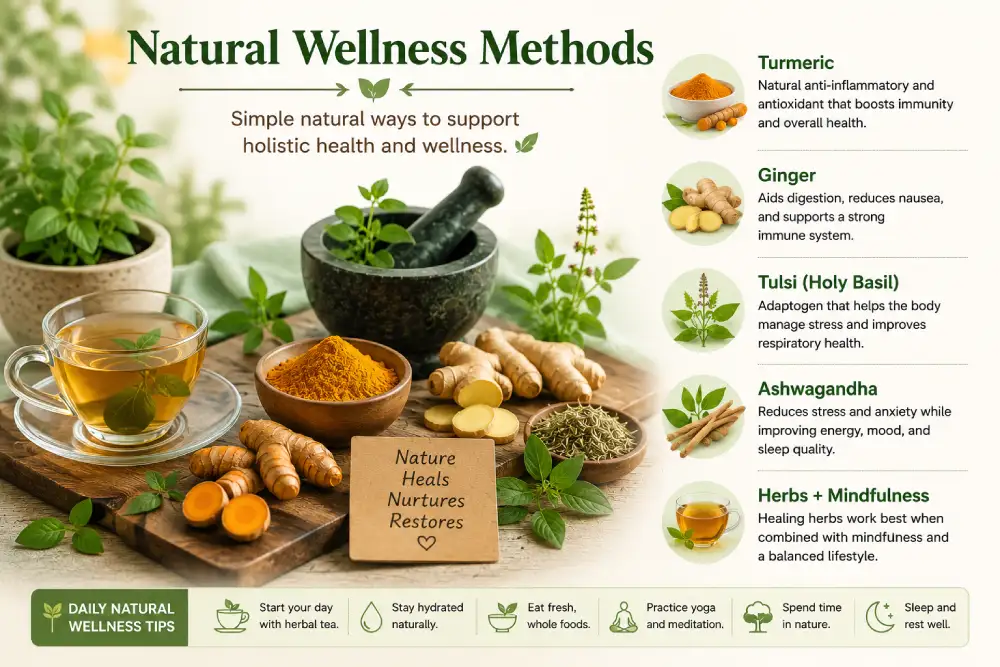
- Turmeric (Curcumin) anti-inflammatory used in Ayurveda. It has a long history of use for joint disease as well as for gut health.
- Ashwagandha an adaptogen the body uses to control stress; common in Indian medicine and increasingly popular among American consumers as another wellness supplement.
- Ginger digestion, nausea, and inflammation
- Holy Basil (Tulsi) is widely used in Indian homes and is believed to promote mental clarity, and positive effects with regards to immunity, and stamina.
- Magnesium More than 50 percent of Americans are deficient in magnesium. It is crucial for sleep, muscle relaxation, and emotional well-being.
This isn‘t a substitute for medical attention. It‘s an integrative part of a lifestyle that allows you to nourish your body consistently between visits with your doctor.
3. Alternative Wellness Therapies Worth Knowing About
Different types of wellness therapies may be on a spectrum from mainstream (acupuncture, massage), to more alternative or undiscovered or ‘mysterious’ (sound healing, energy work). Here is a realistic assessment of the more established practices:
| Therapy | What It Helps | Evidence Level |
|---|---|---|
| Acupuncture | Chronic pain, migraines, stress | Strong |
| Massage Therapy | Muscle tension, sleep, anxiety | Strong |
| Aromatherapy | Mood, mild stress relief | Moderate |
| Reflexology | Relaxation, circulation | Emerging |
| Sound Healing | Stress reduction, focus | Early-stage |
In India, Ayurveda and Siddha medicine are centuries old over 3,000 years in practice in their native land and they’re finally being embraced by modern wellness practices as centuries old wisdom understood all along: that the whole person heals.
4. Holistic Nutrition: Food as Your First Medicine
We are what we eat. It determines your energy, your skin, your hormones, the health of your gut and your brain.
Nutrition and healthy eating isn’t about fad diets—it’s about nourishing your body with whole foods:
-
Eating whole, minimally processed foods
- Being mindful of the way you eat(taking your time, without distractions, relaxed)
- Took seasonal, local fruit and vegetables
- For me to realize that what is heaven for one is homemade hell for another.
In India, traditional Indian cuisine full of spices, pulses and fermented foods is ideally suited to holistic principles. In the US, the trend is away from processed foods in favor of wholefoods.
5. Sleep and Rest as Active Healing
Many ignore it altogether. Nutrition, advanced nutrition, preventative and sports medicine treat it on the same level as nourishment as an absolute fundamental.
Deep sleep promotes tissue repair, memory consolidation, blood glucose homeostasis, and brain waste clearing (by the glymphatic system yes, your brain cleans itself at night).
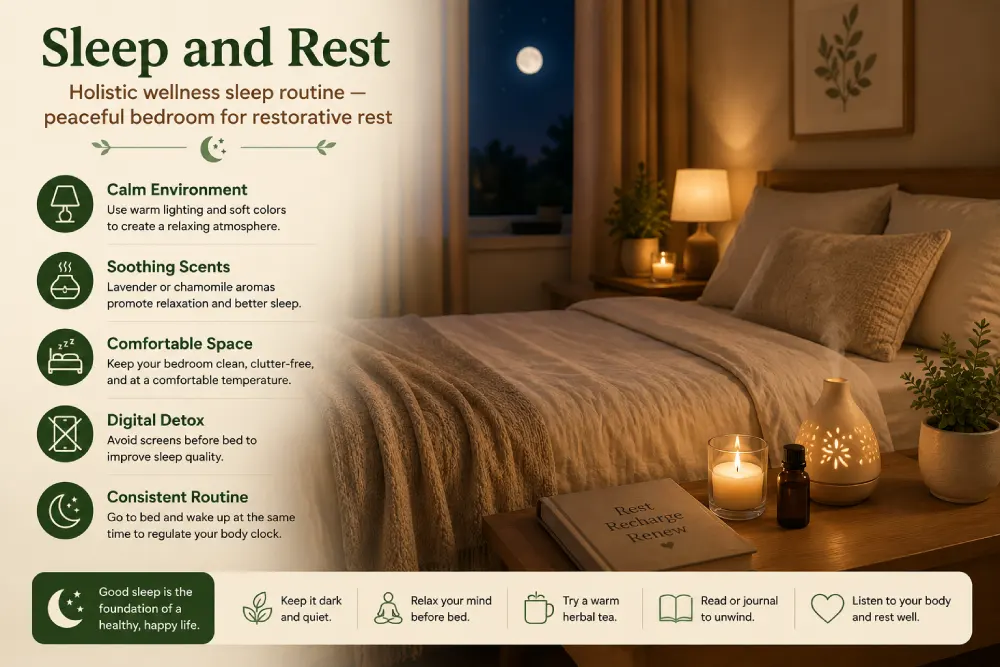
Simple habits that improve sleep quality:
- No screens for 1 hour before sleep
- Regular sleep and wake patterns (including weekends).
- The room temperature (bottled at 65–68 f / 18–20 c )
- Ashwagandha or magnesium glycinate prior to sleep (please check with your medical physician first)
Common Myths About Holistic Wellness
Myth: To be truly holistic is to go off medicines. Fact: not at all, the good combination of the two is perfect. holistic practices endorse regular treatment, they do not support life threatening diseases.
Myth: It‘s costly. Fact: Plenty of the most useful methods are free breath work, moving your body, sleeping well, writing in a journal.
Myth: It‘s just a craze. Fact: Yoga, Ayurveda, herbal medicine have been around for thousands of years. The ‘craziness’ is Western culture largely just catching up.
Practical Tips to Start Your Holistic Wellness Journey
You don‘t need a complete lifestyle overhaul. Start here:
- Choose an activity to do before logging onto your phone in the morning a quick stretch or deep breathing.
- Have one anti-inflammatory food (turmeric in chai, ginger in water) during daily meals
- Track your energy levels for one week identify any connection to meals, sleep, or stress
- Get outside everyday even 20 minutes of natural sunlight keeps your circadian rhythm and disposition balanced: I personally bet if you looked at the weather report and packed an umbrella everyday you would be taking a daily step toward good health.
- Lower a source of chronic stress, a responsibility, an addiction, or a distraction.
Holistic Health for the Modern Indian and American Lifestyle
Wellness can mean a lot of things; not all definitions are everywhere.
In India, we already have a cultural structure, Ayurveda, yoga, eating with the seasons, caring for family. The problem is how to modernize it keeping its soul intact. India City dwellers are gradually resuming traditional values and overlaying them with modern science.
In the USA the movement is about deprogramming hustle culture, taking it slow, and back to basics. The huge attention of adaptogens, functional foods, breathwork and integrative medicine.
Either is fine. The end result is that you will experience life feeling good forget just functional.
Final Thoughts
Holistic health and wellness is a lifestyle an ongoing process. It is the many small choices you make each day: what you eat; the way you breathe, the way you sleep, and the way you deal with stress.
You do not have to change everything at once. Choose one thing. Do it well. Then starting building up from there.
Your body knows how to heal; holistic wellness just keeps it that way.