Formal Outfit Ideas for Women: Dress Codes Explained
Published: September 26, 2026 Last Updated: September 26, 2026 The fastest way to find good formal outfit ideas is
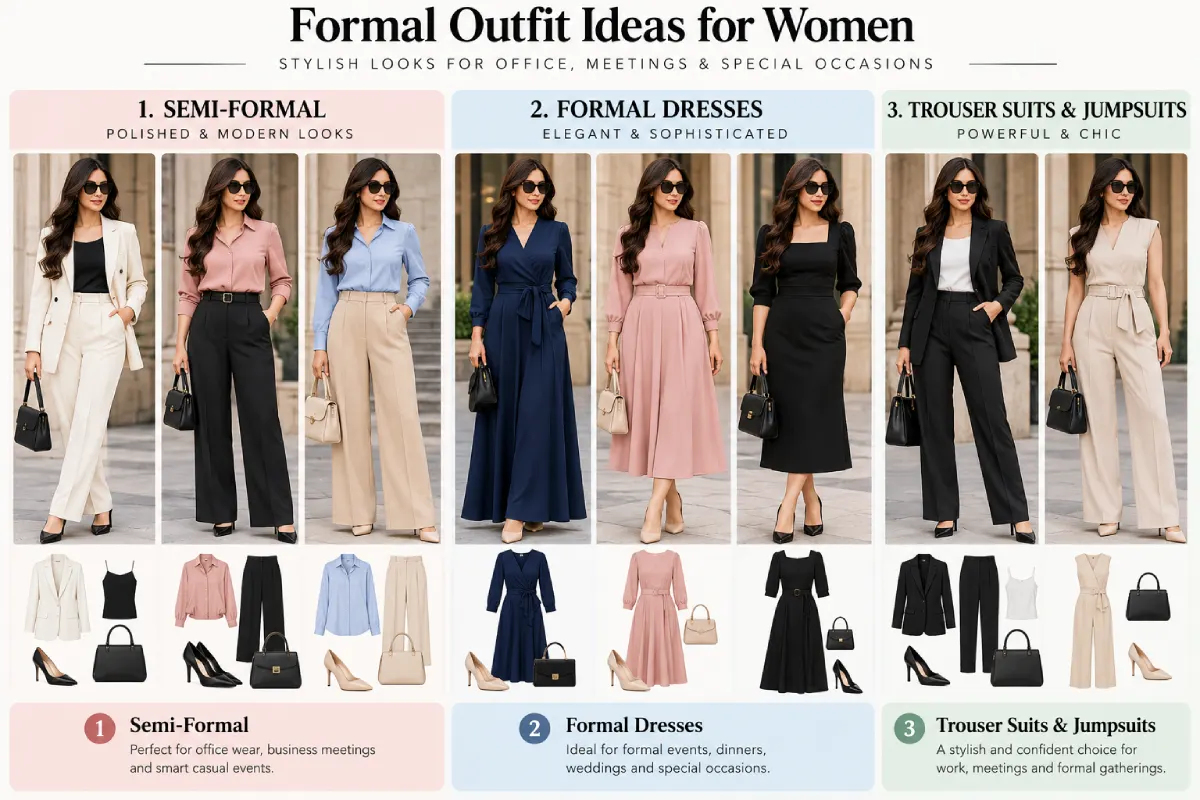
The fastest way to find good formal outfit ideas is to work backward from the exact dress code on your invitation, not from a generic idea of “formal.” Cocktail attire, semi-formal, black tie optional and black tie all expect different things — dress length, fabric, and how dressed-up your shoes and jewelry should be all shift with the code. This guide breaks down what each dress code actually means, what to wear for it (gowns, cocktail dresses, trouser suits or jumpsuits all have a place depending on the code), and how to adjust for venue, weather and cultural context.
Good formal outfit ideas start with one question most people skip: what does the dress code on the invitation actually mean? “Formal,” “black tie optional” and “semi-formal” all sound similar, but each one sets a different expectation for dress length, fabric and how dressed-up your accessories should be. Getting the code right matters more than finding the “perfect” dress — an elegant outfit that’s pitched at the wrong formality level still reads as a miss. Here’s how to decode the most common formal dress codes and build the right outfit for each.
Check What Formal Means on Your Invitation
Formal dress codes generally sit on a scale, from least to most formal:
- Semi-formal / cocktail attire — knee-length or midi dresses, dressy separates, or a tailored jumpsuit. Heels or dressy flats. This is the code for most evening weddings, work galas, and upscale dinners.
- Black tie optional — one notch above cocktail attire. (cite index=”38-1″>The word “optional” specifically tells guests that formal evening dress is welcome but not required, giving three acceptable answers: a floor-length gown, a formal midi or tea-length dress, or an elevated cocktail dress in an evening fabric like satin, velvet or silk</cite>. This is the code that causes the most confusion, because it deliberately doesn’t specify one answer.
- Black tie — the strictest common formal code. A floor-length gown is the traditional expectation, though a very elegant, dark-toned cocktail dress in luxurious fabric can work for less traditional events. Jewelry tends to be more deliberate and fewer pieces, worn well.
If the invitation doesn’t state a dress code explicitly, look at the venue, time of day and other context clues (an evening wedding at a formal venue implies more formality than a daytime garden reception, even without a stated code). When genuinely unsure, it’s reasonable to ask the host directly — this is a normal question, not an awkward one.
Formal Evening Dresses and Separates
For codes that call for a dress, three formats cover almost every formal scenario:
- Floor-length gowns — the default for black tie and a safe choice for black tie optional. Simpler, solid-colour gowns in jewel tones or classic black/navy are the most versatile; heavy embellishment suits black tie specifically more than semi-formal settings.
- Midi or tea-length dresses — a strong choice for black tie optional and the top end of semi-formal, especially in structured or evening-appropriate fabrics (satin, velvet, silk, crepe) rather than daytime cottons.
- Cocktail dresses — knee-length, the standard for semi-formal and cocktail-attire events, and acceptable for black tie optional when elevated with the right fabric and accessories.
Dressy separates (a formal top with a floor-length or midi skirt) work at the semi-formal to black-tie-optional level and give more flexibility than a single dress, particularly useful if the top and bottom need to fit differently.
Trouser Suits and Jumpsuits for Formal Occasions
Trouser suits and jumpsuits are legitimate formal options at every level except strict black tie, where a gown remains the more traditional expectation.
A well-tailored trouser suit in a formal fabric (satin, wool crepe, or a structured blend) works for semi-formal and black tie optional events, and reads as intentional rather than “a substitute for a dress” when the fit is precise and the fabric has some formality to it — a daytime work suit fabric doesn’t cross over to evening formal without a fabric or styling change.
Jumpsuits follow a similar rule. (cite index=”41-1″>Formal jumpsuits work well for black tie optional specifically when they’re tailored, made in a rich fabric, and finished with details like ruffles or embellishment, paired with strappy heels and a clutch</cite>. A casual jumpsuit fabric (cotton, linen) does not read as formal regardless of accessories — the fabric upgrade is what does the formal work here, the same as it is for dresses.

Coordinate Shoes, Jewelry and Layers
Formal accessorising follows a fairly consistent logic across codes: the more formal the dress code, the more restrained and deliberate the jewelry, and the smaller the bag.
- Shoes — heels are the default expectation at every formal level; flats read as too casual for black tie and black tie optional specifically, though elegant flats can work for daytime semi-formal events.
- Jewelry — for black tie and black tie optional, one statement piece (a necklace or earrings, not both at full volume) plus simple accompanying pieces reads more polished than multiple bold pieces competing for attention. Semi-formal allows more flexibility to layer jewelry.
- Bags — small clutches or evening bags are standard for black tie and black tie optional; a slightly larger structured bag is acceptable for semi-formal or cocktail-attire events.
- Layers — a tailored blazer or wrap works at the semi-formal level; for black tie optional and black tie, a fitted evening coat, wrap, or shawl is more in keeping with the formality than a casual jacket.
Adjust for Venue, Weather and Cultural Expectations
The dress code sets the baseline, but venue, weather and cultural context still shape the final decision.
Venue and season: An outdoor formal event (garden, beach) calls for fabrics that handle uneven ground and weather — a floor-length gown with a manageable hem, or a midi length, tends to work better outdoors than a dress with a long train. Winter formal events allow richer fabrics (velvet, heavier satin) and a proper coat or wrap; summer formal events favour lighter silks and chiffons even at the same dress-code level.
Cultural and regional context: In India, formal invitations often specify or imply ethnic formal wear (a formal saree, an anarkali, or a heavily embroidered lehenga) alongside or instead of Western formal dress codes, particularly for weddings and festive events — when in doubt, checking with the host or other guests about whether ethnic or Western formal wear (or both) is expected is worthwhile, since “black tie” conventions don’t automatically map onto every regional event type. In the US, Western dress-code conventions (cocktail, black tie optional, black tie) are the more consistent default across most formal invitations.
FAQs
What is the difference between semi-formal and black tie optional? Semi-formal typically means knee-length or midi dresses, dressy separates, or a tailored jumpsuit — one notch below black tie optional. Black tie optional sits between semi-formal and black tie, giving guests the choice of a floor-length gown, a formal midi, or an elevated cocktail dress in an evening fabric.
Can I wear a jumpsuit to a formal event? Yes, at most formality levels short of strict black tie, where a gown remains the more traditional choice. A tailored jumpsuit in a formal fabric such as satin or crepe, styled with heels and a clutch, works well for semi-formal and black tie optional events.
Is it acceptable to wear flats to a formal event? Elegant flats can work for daytime semi-formal events, but heels are the general expectation for black tie and black tie optional specifically, where flats tend to read as too casual for the code.
What should I wear if the invitation doesn’t state a dress code? Look at the venue, time of day, and type of event for clues — an evening event at a formal venue implies more dress-up than a daytime casual gathering. If it’s still unclear, asking the host directly is a normal and appropriate question.
Do formal dress codes work the same way in India as in the US? Not exactly. US formal invitations tend to follow consistent Western dress-code conventions (cocktail, black tie optional, black tie). In India, formal events — especially weddings — often expect or allow ethnic formal wear such as a saree, anarkali or lehenga alongside or instead of Western formal dress, so it’s worth confirming with the host which is expected.
FINAL CONCLUSION
Strong formal outfit ideas start with decoding the dress code correctly, not with picking a dress first and hoping it fits the occasion. Once you know whether an invitation calls for semi-formal, black tie optional or black tie, the rest of the decision — gown versus cocktail dress versus tailored suit or jumpsuit, and how dressed-up to go with shoes and jewelry — becomes much more straightforward. For the wider method behind building any outfit well, from anchor pieces to proportion to finishing touches, the Outfit Styling Guide picks up where this dress-code guide leaves off.