Strength Training for Beginners: 2026 Step-by-Step Program
Published: September 2, 2026 Last Updated: September 3, 2026 Step into a gym for the first time or even
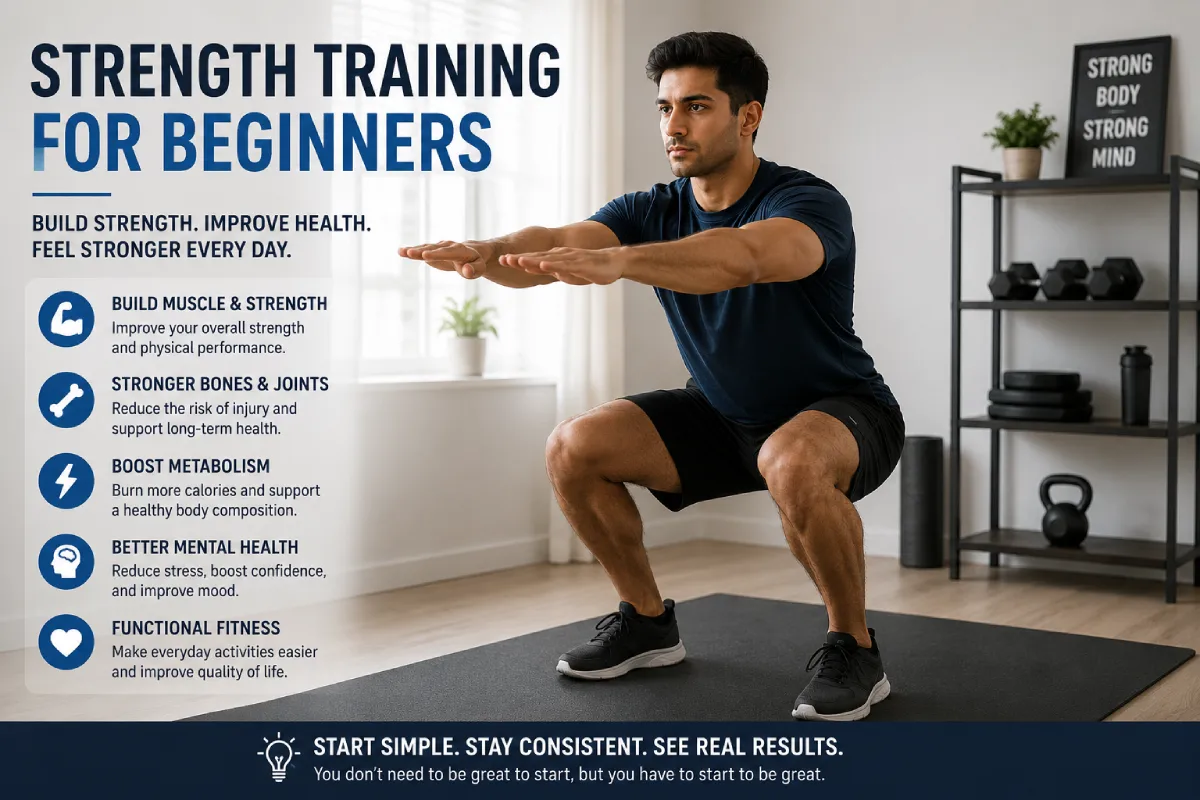
Step into a gym for the first time or even open an app to learn how to work out and it can be an intimidating experience. Barbells, machines, and people who seem to have the process nailed. Strength training for beginners is one of the easiest areas of fitness to master because it all boils down to only four movement patterns practiced regularly.
The Simplest, Most Effective Workout Program will delete all of the surrounding clutter and give you a simple place to start, whether training on your own with a pair of dumbbells or beginning with your first gym visit.
Why Strength Training Matters (Beyond Looking Toned)
Weight training isn‘t just muscle-on-top-of-muscle. It also preserves bone density, elevates your resting metabolic rate and keeps you functionally strong as you get old – lifting heavy bags of shopping, going upstairs, standing up unassisted from the floor.
Key benefits:
- Gains muscle and prevents loss of muscle when dieting
- Enhances bone density, which becomes increasingly important with age
- Increases resting metabolism, due to high muscle density that requires more energy to maintaing then fat
- Optimizes everyday function as well as for gym399.
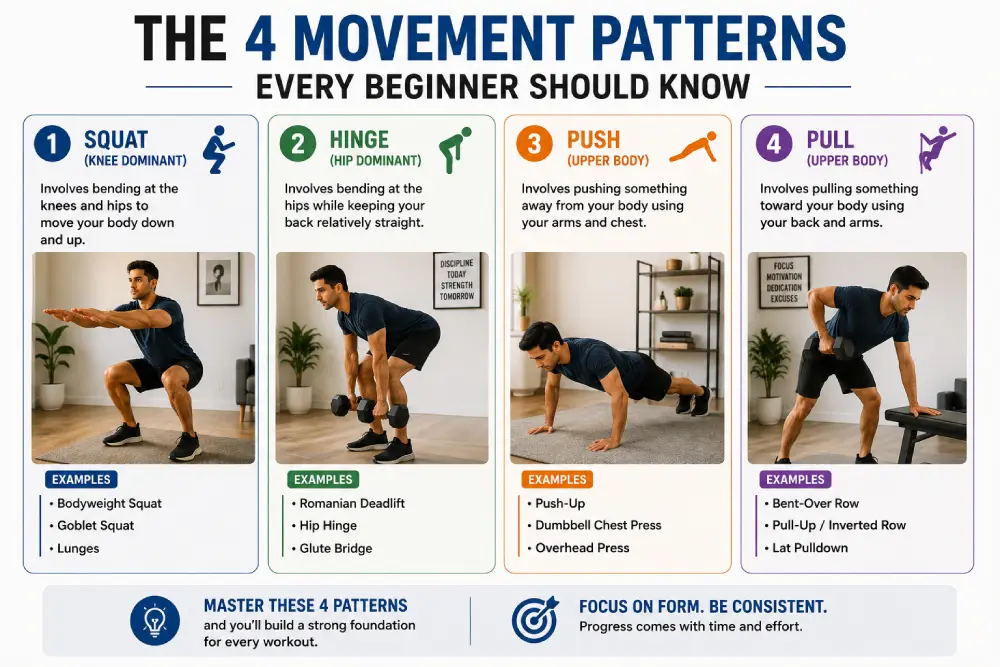
The 4 Movement Patterns Every Beginner Should Know
Nearly every effective strength program is built on these four patterns:
- Squat-bodyweight exercise or variation: bodyweight squat, goblet squat, leg press
- Hinge – deadlift pattern, glute bridge, or Romanian deadlift with a light weight.
- Push push-up, dumbbell shoulder press, bench press
- Pull dumbbell row, resistance band row, or assisted pull-up
Master them four and you have a base, that will take you through many years of training and the sessions just get heavier and heavier for a long time.
Myth vs. Fact: Beginner Strength Training
| Myth | Fact |
|---|---|
| “Women get bulky from lifting weights.” | Visible bulk demands a very specific, intentional training and eating regiment most strength training results in lean muscle and definition. |
| “To begin, you‘ll need some form of membership.” | Beginners strength can be built with only bodyweight and an adjustable pair of dumbbells. |
| ‘The more DOMS, the more effective of a workout it was.” | You cannot measure improvement through soreness. It is through the way you can perform, in a disciplined, consistent fashion. |
| Beginers need complex. programs. | The basics, done simply and well, beat the complicated by First Year. |
Compound Exercises: Why They Come First
Compound exercises target several muscles and joints through a movement: squat, pushups, rowing, rather than an isolation movement: bicep curl. Compound exercises are more efficient for the beginner, developed strength through these movements faster than isolation exercise.
Best compound exercises to start with:
- Bodyweight or goblet squat. Although bodyweight exercises are often viewed as the first step in a training program, the squat is considered one of the main lifts of Olympic lifting. The squat can be performed with no added weight for beginners.
- Push-up or dumbbells chest press.
- Dumbbell row (bent-over or single-arm)
- Glute bridge or Romanian deadlift
- Plank (for core stability, supporting every other lift)
Isolation exercises (directs like the tricep extensions or the lateral raises) have their place later but not where a beginner shouldn‘t be wasting valuable training time.
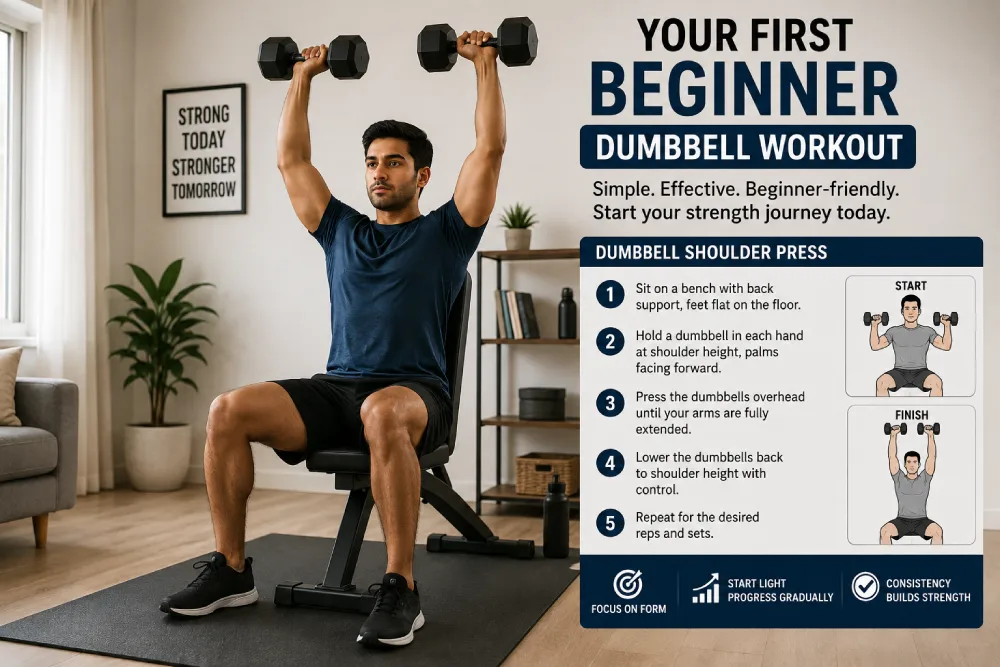
Your First Beginner Dumbbell Workout
If you are transitioning from body weight to light dumbbells, here is a full-body dumbbell workout to begin with, 2–3 times per week:
- Goblet squats (3×10–12)
- Dumbbell shoulder press (do these while lying down) 3 sets of 8–10 repetitions
- Dumbbell rows 3 sets of 10–12 repetitions per side
- Romanian deadlifts (lite weight) 3 sets of 10 repetitions
- Plank hold 3 sets of 20–30 seconds
Refresh 60–90seconds between sets. If you haven‘t got dumbbells yet, all the moves listed above have a bodyweight version that you can begin with.
Understanding Progressive Overload (Without the Jargon)
Progressive overload just involves slowly increasing the demands you‘re placing on your muscles over time more reps, more weight, better form, etc. If you don‘t do it, there‘s nothing forcing your body to adapt and make progress.
How to apply it as a beginner:
- Week 1–2: avoid overloading, emphasis only on technique (use light weight / body weight only)
- Once you are able to do 12–15 repetitions with good technique, increase the load a little bit.
- If no weight is given, then it is possible to lengthen up tempo, or introduce a rest at the point of maximum difficulty.
- Keep a general record of your workouts even just noting repetitions and weights gives you a good guide for your next training session.
This is the key concept in beginner weightlifting not the exercises, but the step up in stress overweeks and months.
A Simple Weekly Strength Training Routine
| Day | Focus |
|---|---|
| Monday | Full range of motion strength (squat, push, pull) |
| Tuesday | Take a rest or go for a light walk. |
| Wednesday | Optimizing total-body strength, do more repetitions or use a lighter weight |
| Thursday | Rest or mobility : Enjoy your 24 hours of freedom. |
| Friday | Max pulls-sq ( total-body strength/hard (ignore the other lifts)). |
| Saturday | No optional light cardio or activity. |
| Sunday | Rest |
3 sessions per week, with a day break in between each, is more than sufficient to experience visible beginner progression – or “beginner gains,” a certainly faster response to strength and muscle growth than nearly every single training block afterward.
Common Beginner Mistakes
- Weight: Skip form. More weight is useless if the technique falters, using lighter loads and executing the movement correctly develops strength more swiftly and safely.
- Working the same muscles every day. Muscles require at least 24 hours between training.
- Insisting on aches and pains. You should never be too sore to walk after a workout. If you are, you‘ve gone past the point of good workout and reached the point of overtraining.
- Copying sophisticated programs. A routine designed for someone years into training is not scaled for week one.
- Not following the four basic patterns. By randomly choosing exercises over time, you will get less out of your program than if you stick to training squat, hinge, push, and pull.
When to Add More Weight or Complexity
In order to go up, you must be able to do your current weight with good form for 12-15 reps if you are not there yet. Then, you can make small increases (like 2.5-5 lbs.) and allow your form to catch up and progress again. This slow process will keep you safe joints and develop a solid strength base that will not fail you in a few weeks.
This is pretty much the bottom line for beginning strength training: you learn the four patterns, keep the movements very basic, use a little progressive overload at a slow rate, and keep at it for a few months. That‘s it. That‘s all there is to the program everything else is adjustments and fine-tuning.
FAQs
How does a total novice get started? Grab the bodyweight or light dumbbell equivalents of squat, push, pull, hinge movements, do them 2–3 times per week, and learn how to do them correctly first.
Can I begin a strength program without a gym or even a set of dumbbells? While there are a few very limited bodyweight exercises (e.g., L-sit) that only the strongest beginners will be able to progress further, you do not need equipment for a great strength routine.
What compound exercises are most suitable for beginners? Perfect choices include squats, press-ups, dumbbell rows and Romanian deadlifts these will tax a number of different muscle groups, resulting in the development of interconnected strength.
So what is “progressive overload” and why is it important? Progressive overload is more reps, more weight, or more control over a period of time that‘s what makes your muscles continue to adapt to challenge after challenge.
How often should a beginner strength train? Three days a week, with rest days between, is generally sufficient beginner progress.
Will strength training make me bulky? No, not unless you have a particular, targeted training and diet plan. A lot of beginner strength training comprises a lot of lean muscle and definition..
Final Conclusion
Strength training for beginners is not grabbing the heaviest weights on your first day…it‘s learning 4 simple movement patterns, selecting some compound movements that work and chasing progressive overload slowly but surely. Use the beginner dumbbells workout above 3 times per week and then wait a few months to see. Advanced styles can wait.