Best Home Workouts (No Equipment) for 2026
Published: September 2, 2026 Last Updated: September 3, 2026 If you’ve typed “home workout no equipment” into Google and
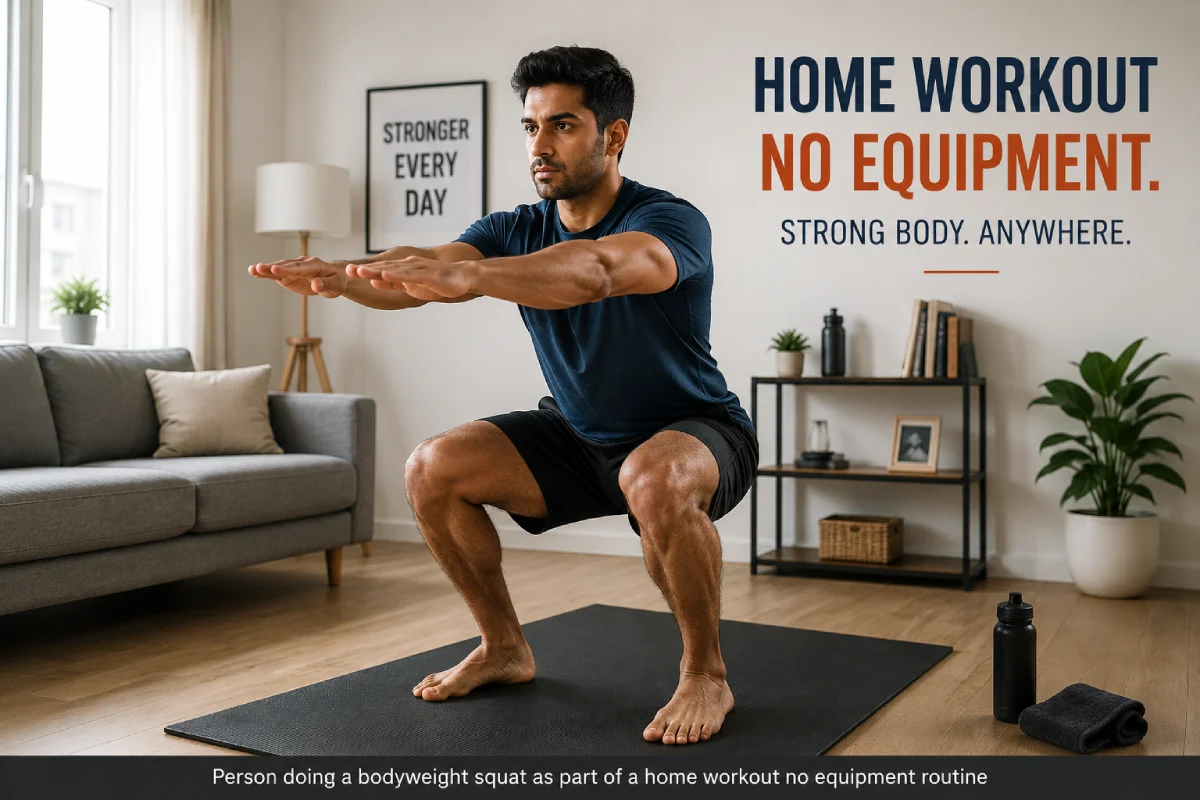
If you’ve typed “home workout no equipment” into Google and tried to decide whether or not you‘ve simply got to keep that gym membership you can actually do it. Bodyweight training is not an inferior version of ‘proper’ training. Done consistently and properly it will get you strong, fit and confident in your first 6-12 months.
Here is the problem. The reason the great majority of people fall off the wagon after only a short while is not because bodyweight training doesn‘t work, but because they didn‘t have a structure to follow. Let‘s put that right.
Why No-Equipment Workouts Actually Work
The body already offers significant resistance to muscles which can be used for strength training, especially at the early stages. The effects of push ups, sit ups and planks are similar to gym machines, it is just the effect of gravity and the load of the body rather than a bar bell.
Key benefits:
- None at all from the love of nature, from the see and be seen, from the lack of a chauffeur‘s chief, from the need of a paid chauffeur.
- Works takes place in a hotel room, a dorm, or a 6×6 ft corner of an apartment.
- Reduced likelihood of injury for novices versus jumping into loaded weight.
- Develops basic strength and movement control prior to having any external resistance.
This is just as important to the person in Mumbai dealing with monsoon humidity as it is to the person in a walk-up in New York with no elevator and no room for gear.
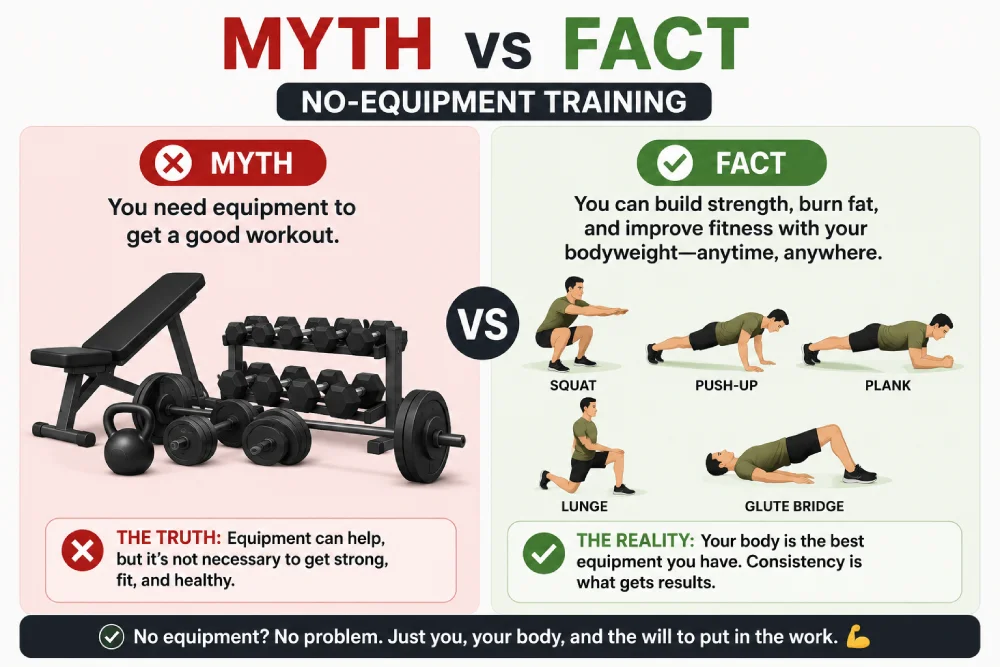
Myth vs. Fact: No-Equipment Training
| Myth | Fact |
|---|---|
| “Without weights, you don‘t have true strength.” | Bodyweight training develops real-world strength, particularly at the beginner and intermediate levels. |
| “Using no equipment to workout is not for muscle, but for weight loss.” | Improvement of muscle definition through push-up and squat progressions takes months. |
| “you require a good amount of free room for training at home.” | Most bodyweight exercises can be executed on less than 6 feet of floor space. |
| There is no limit to bodyweight training. | It stalls after 6-12 months unless you apply resistance, change the tempo or use single limb versions. |
The Core Bodyweight Exercises Everyone Should Know
These form the backbone of nearly every effective beginner home workout:
- Squats – gives you powerful legs & glutes; the foundation of virtually any lower-body session
- Push-ups (knee push-ups are a perfectly acceptable regression) chest, shoulders, triceps
- Plank hold core stability, with focused lower back added protection
- Glute bridges – strengthens gluteal muscles and hamstrings. Particularly good if you work at a computer all day or sit most of the time.
- Jumping jacks or marching in spot effective, equipment free bursts of cardio
A Simple No-Equipment Starter Circuit
Repeat this circuit 2–3 rounds, resting 60–90 seconds between rounds:
- 10 bodyweight squats, deliberate and slow, with a brief rest before returning to the standing position
- 8 push ups (any make are fine i.e. knee‘s push) 8 push-ups (any make are fine i.e. knees push)
- Plank hold for 20 sec.
- 10 glute bridges
- Two minutes of jump up and down or another type of jumping jack. 30 seconds of marching on the spot.
This is enough for a small–space workout in its own right it‘ll fit into nearly any bedroom, hostel, or living-room corner on either side of the world.
HIIT at Home: A No-Equipment Option
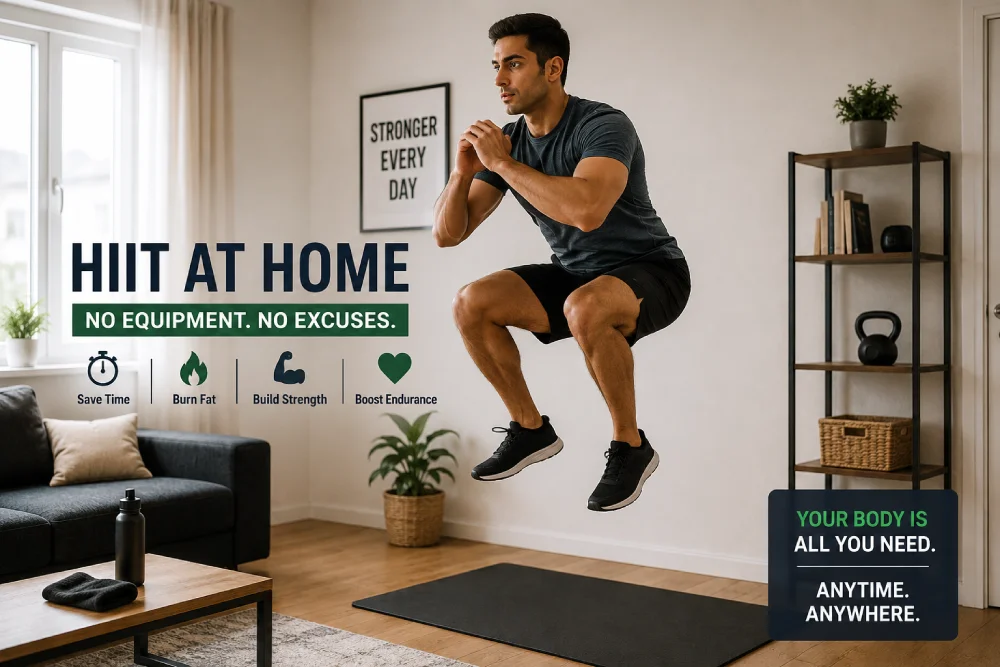
If your goal is to burn calories and gain fitness and not necessarily strength, then a short HIIT at home session can be tacked onto the circuit above (or stand alone).
Simple 12-minute format:
- 40 seconds of work/20 seconds of rest, per movement
- The timers etc,: Calisthenics set, unless you have equipment available then you will set up: Jump squats, mountain climbers, push ups, high knees
- Again, then only repeat the full 3600 rotation 3 times.
As HIIT is high intensity, it‘s best not to perform it daily so 2–3 times a week should be enough. Rest days are just as important as working out.
Common Mistakes to Avoid
- Not warming up-. A mere five minutes of aerobic activity could significantly lessen injury risk.
- chasing soreness. Extremely sore muscles are not necessarily a sign that the workout was good, rather it might be indicated that the muscles have been pushed to hard, to fast.
- Repeat the same circuit endlessly. After 10 squats becomes comfortable, increase reps, slow down the tempo, or introduce single leg options before assuming you need weights.
- Working out 7 days a week everyday. When Muscles heal after working out, not during working out.
- Copying complex workflows. A program designed for someone a year into training isn‘t adapted to week one.
Making It Work in the USA and India
Lack of space: Inhabitans of Indian cities face the same running out of space as those in US metropoliss most of these moves could be done on a piece of room/space less than a yoga mat.
Climate: In India, no-equipment at-home training is a viable strategy to apportion out one’s workout to not be in the middle of a 4-6pm summer furnace. In the US, it removes the ‘get in the car and drive to the gym’ friction that wrecks winter consistency.
Time pressure. Long commute in Bangalore, long work hours in the US, a 15–20 minute workout without the need for any equipment ensures the one major excuse doesn‘t exist anymore! ‘Time is the issue.’
How to Progress Once It Gets Easy
There is a true limit to body weight training, and reaching this actually indicates you are gaining strength when:
- Reduce the speed (use a tempo of 3–4 seconds per repetition instead of 1)
- Add some pauses on the hardest point of the movement.
- Move on to single-limb differences (single-leg glute bridge, push-up with one arm).
- Increase the circuit‘s repetitions before introducing external weight
A Sample Weekly Structure
| Day | Focus |
|---|---|
| Monday | Body circuit 2 (above) |
| Tuesday | Sessions of HIIT, 12 minutes |
| Wednesday | Rest or mild stretching. |
| Thursday | Full body circuit, add 1 rounds |
| Friday | Walking/Active recovery. |
| Saturday | During the HBOT. Or fun activity . |
| Sunday | Rest |
This structure targets strength and cardiovascular health without requiring you to spend an hour a day at it even consistency beats intensity, hands down.
A home no-equipment workout isn‘t second best: in the vast majority of cases it‘s actually the smartest place for complete beginners to begin. Learn the fundamentals; stick at it for 3 or 4 months, and you‘ll actually have a pretty good base to build off before you have to consider the gym or a dumbbell.
FAQs
Can I really get fit with just bodyweight workouts and without the use of a gym? Yes. Body weight training can provide an effective way to enhance strength, cardio-respiratory endurance and overall muscle tone during the first 6 – 12 months without equipment.
What is the most effective no-equipment workout for a beginner? An example is a circuit of squat, push-ups, plank, and glute bridge, repeated 2–3 rounds, 3-4 times a week.
Is HIIT at home actually effective without equipment? Yes body weight HIIT such as jump squats and mountain climbers can get your heart rate up and calories burning in just 10-15 minutes.
30. How much space should I have for a no-gym workout. The majority of bodyweight or weighted bodyweight exercises can be performed on less than 6ft of floor space which makes it suitable for small apartments in the US and India.
What‘s next once bodyweight exercises become too easy? Slow down repetitions, incorporate isometric pauses, make the exercises single-limb and/or perform more rounds instead of weighting up.
How often should I do an no-equipment workout? Once or twice a day, 3–4 day a week is enough to get noticeable beginner improvement with strength circuits and HIIT.
Final Conclusion
A home workout no equipment routine is one of the most practical, sustainable ways to start getting fit in 2026 — no membership, no commute, no gear required. Master the core bodyweight moves, layer in HIIT when you want more calorie burn, stay consistent for a few months, and you’ll build a real foundation of strength before you ever need a gym. Start with the circuit above today; everything else can wait.