Daily Wellness: Simple Habits for a Healthier Everyday Life
Published: August 19, 2026 Last Updated: August 28, 2026 If you‘ve ever gone to bed and wake up feeling
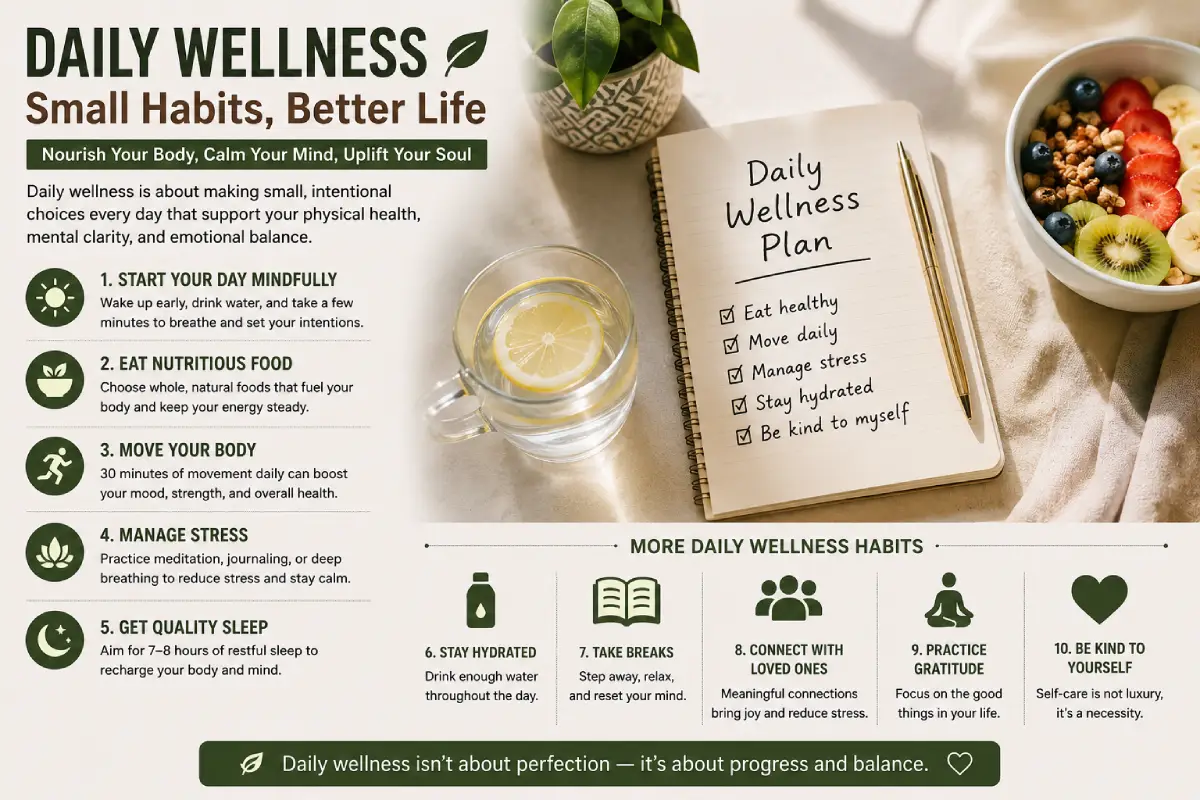
If you‘ve ever gone to bed and wake up feeling cloudy, tired or a little off with no idea why then you already grasp how important daily wellness is over any one workout or monthly spa day. Daily wellness is not a life-altering spectacle. It‘s constructed from a series of tiny, repeatable choices you make every single day to how you wake up, what you drink, how you sleep, what you fuel your gut with, and how you tend to your mind. Nail those small things reliably and everything else energy, mood, skin, focus falls into place.
Here at Cultones, we chat with folks all over the US and India who‘re sick of the wellness tips that sound perfect on Instagram, but go out the window by midweek. So this isn‘t focused on perfection. This is about creating a sustainable daily wellness regimen that withstands the realities of mornings, deadlines, and everything else life throws at us; one habit a day.
This is what we‘re covering: your routine, water, sleep, digestion, intention/mind & body work, and keeping track so it sticks. Each part covers what you really need to know & how to dive deeper if you like.
What Is Daily Wellness?
Prioritizing Well-Being on a Day-to-Day Basis Taking small daily actions to make your body‘s daily rhythm a little better instead of putting it off and saving the “great” things for a day when you will “really” do them; simple, nice, everyday tasks that became routine.
It‘s not the equivalent of having a one-off treat to yourself (a spa day or a weekend detox) a lifestyle of daily wellness is everyday, routinized. It‘s the kind of thing you can do on a Tuesday, not just on your holiday. Consider it the difference between having one good meal, and eating well most days for a year. The latter makes a tangible difference to how you feel.
Key takeaways:
- Constant wellness=many small steps, rather than occasional individual leaps.
- It actually affects four domains physical, mental, emotional, and social wellbeing.
- Consistency is more important than intensity a 10-minute daily habit beats a 2-hour weekend ritual
- It should bend to your life, not burden your life
A real world example: Rather than “I‘m going to do an hour workout every day,” healthy habits day to day are: 10 minutes of physical activity every day, a glass of water before your afternoon coffee, and bed at 11 in the evening even three very simple things that really are doable.
Quick summary: Daily wellness is a bunch of small habits, not one big change. The six pillars below morning routine, hydration, sleep, gut health, mind-body balance and tracking are where to begin.
This occasional explicitly outlines each of the pillars. For the overall program, see our [Healthy Morning Routine Pillars], [Better Sleep Routine Pillars], and [Gut Health Daily Habits Pillars] deep dive articles linked here and here.
Healthy Morning Habits That Set the Tone for Your Day
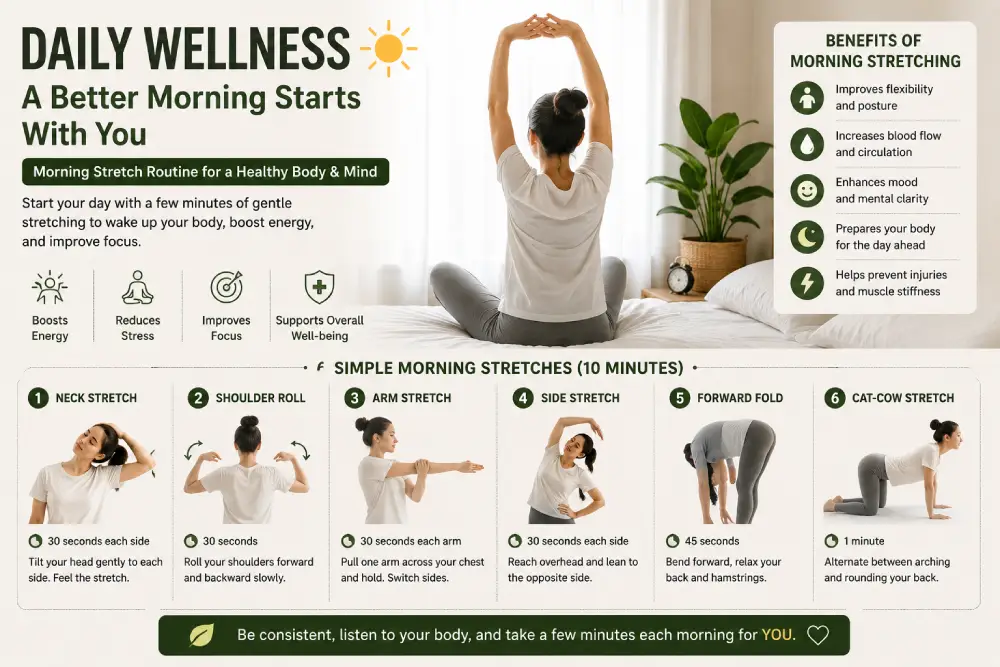
How you begin the first 30 – 60 minutes of your day affects your energy, concentration, and overall mood for the rest of the day. This is the most-googled keyword entryway to wellness and for good reason, mornings are the one part of the day you can actually manage before the world does it for you.
A well-being routine for each day doesn‘t have to be grabbing your alarm clock at 5 AM and doing a one-hour ritual. 4-1“An health and well-being routine is essentially a daily program that weaves healthy behaviors in areas of movement, sleep, eating, and taking care of ourselves.” and mornings are just most convenient place to do it.
Key takeaways:
- The first hour of your day has an outsized effect on stress hormones. And focus.
- A balanced morning routine is one that is. Short, Repitiouseffortless;, and easy to ‘stick to.
- Light, movement and hydration are the three most powerful morning levers.
Practical tips:
- Get in natural sunlight within 30 minutes of waking. The morning sunlight will help to keep your circadian rhythm on track, influencing your day time energy and sleeping at night.
- Delay caffeine for 1 to 1½ hours. This allows people to remove that energy dip that people often say they get from coffee.
- Take a break before you get into your scrolling/alert checking routine. Just 5 minutes of stretching or a quick walk can reduce stress hormones better than opening those alerts first thing in the morning.
- First hydrate then caffeinate. Drink a glass of water when you get up to counteract the mild dehydration caused while you sleep.
- Pick one “anchor habit” (not five). These days, starting the process of creating a 10-step morning ritual overnight is the number one reason that morning rituals don‘t last longer than a week.
Typical mistake: Stealing a Fancy 15-step “morning routine” from Instagram/online while any normal person would choose 2-3 habits that actually fit your lifestyle and job.
Mini summary: Do not try to implement a rigid checklist. Choose a few anchor habits that are short and light-and-movement based, then attach two or three of them to form a sustainable morning routine.
Read More: [Complete Healthy Morning Routine Guide →]
Hydration Habits: The Foundation of Daily Wellness
But the most undervalued is hydrations because it is unseeable. Unlike feeling hungry or thirsty, a slightly dehydrated state does not immediately signal itself. However, it affects you in a multitude of ways and can be summed up as feeling tired, having headaches, struggling to focus, and suffering from sallow complexion.
Key takeaways:
- Even minimal dehydration (eg 1–2% of BW in fluid loss) can affect mood and to some extent concentration13.
- The water question depends on climate important to note for most of the publication time of Indian summer and for most instances when a US reader is in a dry winter climate, an elevation, or a humid region.
- Electrolytes are required in addition to water. Electrolytes are important during heat, exercise, and illness.
Practical tips:
- Adopt a “bookend” approach- one glass of water on first awakening, one just before you are ready for sleep. These will be your two essential hydration placeholders.
- Place a water bottle somewhere you will see it during the day. Seeing your water bottle is one of the greatest (least talked about) triggers for drinking more water.
- Add electrolytes on super hot or sweaty days. Plain water isn‘t sufficient if you‘re sweating out sodium (like you would in Indian summers, or if you‘re outdoors)
- Eat your water. Within a diet, cucumber, watermelon, oranges, and soups are all very good sources of fluids.
- Be on the lookout for sneaky dehydrators excess caffeine, alcohol, and air conditioning all boost your fluid requirements.
Myth versus Fact: Myth: you must drink 8 glasses of water every day. Fact: Everyone‘s fluid needs are different depending on their body size, level of activity, the weather or whether they are eating or not. The “8 glasses” advice is a general guideline rather than a specific rule.
Mini mini summary: Water intake is a daily health foundation that is so underestimated. Visible steps (not necessarily perfection in measurement) are the ones that help make it a lifelong, everyday practice.
Read More: [Complete Hydration & Wellness Habits Guide →]

Sleep Wellness: Why Rest Is Non-Negotiable
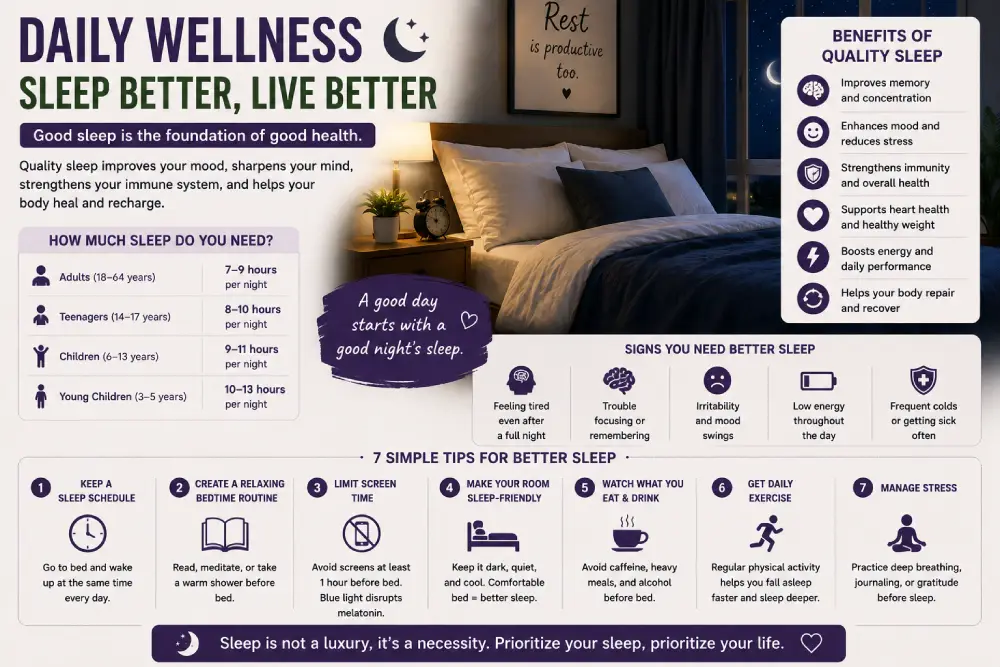
Supplements and exercise cannot ever “out supplement or out exercise or out journal” bad sleep. Sleep health is probably the only all-essays top-to-bottom system that you can influence dramatically on a daily basis, because sleep hormones modulate everything else they regulate-mood, appetite, your immune system, your skin, your memory processing.
Key takeaways:
- Sleep quality is important as well as sleep time broken up 8 hours of sleep may feel more tiring than solid 7 hours of sleep
- Pre-sleep (screen) exposure is one of the most common (and most amenable) mechanisms of sleep disruption
- Maintaining a regular sleep-wake schedule is more beneficial to health than sleeping at a “preferable” time.
Practical tips:
- Anchor your wake up time, not your bed time. Waking up at a fixed time each day (including weekends) will help the circadian rhythm better than fixating on a bed time.
- Set aside a 30-minute relaxing buffer, lower the lights, avoid the technology, do a soothing task such as reading, gentle exercise.
- Ensure your sleeping environment is cool and dark. A decrease in temperature is a natural cue for sleep.
- Block out excess food and alcohol prior to sleeping. These tend to disturb and fragment rest even if they do make one fall asleep more rapidly.
- If not asleep within 20 minutes, get up. Worrying in bed trains your brain to associate the bed with being awake.
Troubleshooting: If your sleeping 7–8 hours but waking up exhausted, the culprit is probably quality of sleep computer screen light late at night, alcohol, or an inconsistent wake-up time rather than amount of sleep.
Mini summary: Focus on being consistent and eliminating a wind-down routine, rather than going after the “perfect” number of hours. Sleep wellness is the increased factor to every other wellness habit.
Read More: [Complete Better Sleep Routines Guide →]
Gut Health Routine: The Inside-Out Approach to Wellness
Achieving healthy gut has gone from being a potentially trendy, “exciting” topic, to being much more relevant in consumer‘s everyday lives and that makes good sense. Your digestive system isn‘t only concerned with processing the food you eat, but also has huge implications for immunity, mood regulation (gut-brain axis) and skin clarity hence why gut health appeals to consumer that are interested in beauty-and-lifestyle topics.
Key takeaways:
- A daily routine of gut health requires no daily diet that is restrictive, but requires a daily diet rich in variety
- The link between the gut and brain, therefore, goes to show how your gut health can impact your mood and stress resilience.
- Bloating and sluggish digestion are defined as signs of hurry-up eating and not enough fiber – not the sign of intolerance.
Practical tips:
- Slow down and try to be food free when you eat. Chewing makes all the difference as digestion begins here. How fast we eat remains one of the most common causes of bloating that is ignored.
- Introduce one fermented food everyday: yogurt, curd, kefir, kimchi or idli/dosa batter (a widespread fermented Indian food) will promote a healthy microbiome in the gut.
- First and foremost, focus on variety of fiber, not amount. 20 different plant foods in a week will support greater microbiome diversity than volume of the same few foods.
- Stick to regular mealtimes. As with food choices, irregular meal times can have a significantimpact on gut rhythm.
- Mindfully control stress. Ongoing stress has observable effects on gut function. The pathway it affects is known as the gut-brain axis. This is the point at which physical and mental health practices meet.
Common oversight: Spending a fortune on probiotic supplements without first trying the fundamentals fiber, fermented foods, water intake and mealtime ambiance.
Mini summary: The routine is a “daily commitment” not a 7 day “reset”, with the devil being in the details. Small and consistent choices are good for health, and they beat out fad short-term solutions.
Read More: [Complete Gut Health Daily Habits Guide →]

Mind-Body Wellness Practices for Balance
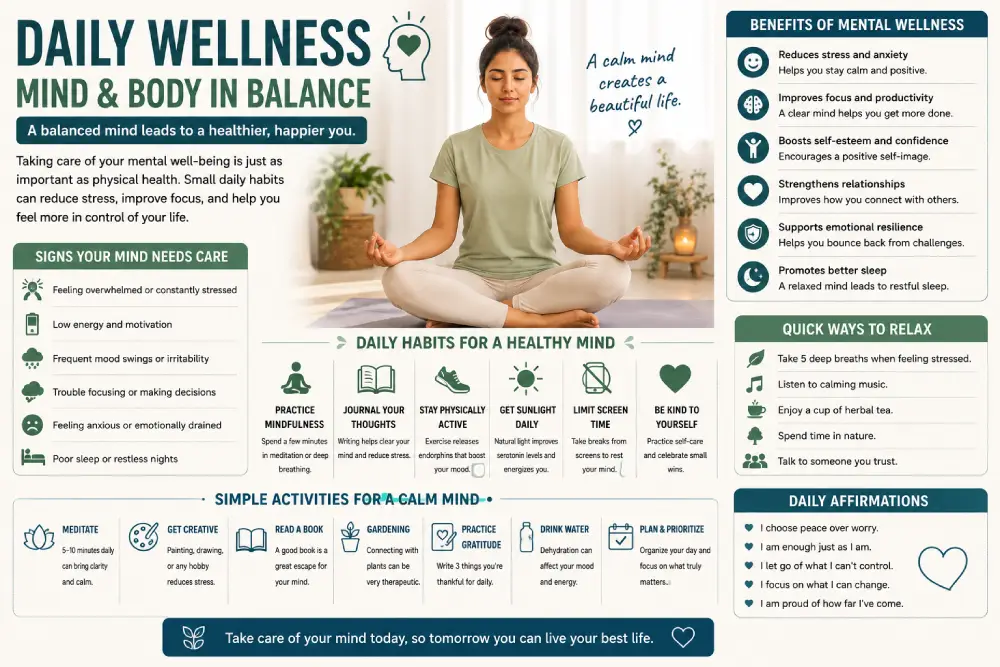
Physical habits can only take us so far without a recognition of the mental and emotional aspect of health. It is the mind body connection breath work, attention, exercise, and emotions where the idea of a “healthy routine” can lead to feeling healthy.
Key takeaways:
- Stress is not only psychological, it can also physically impact sleep, digestion and skin.
- Mind-body practices don‘t necessarily have to be half an hour of meditation. In fact, a study even showed that doing simply focused breathing for as little as 3-5 minutes had measurable calming effects. (2)
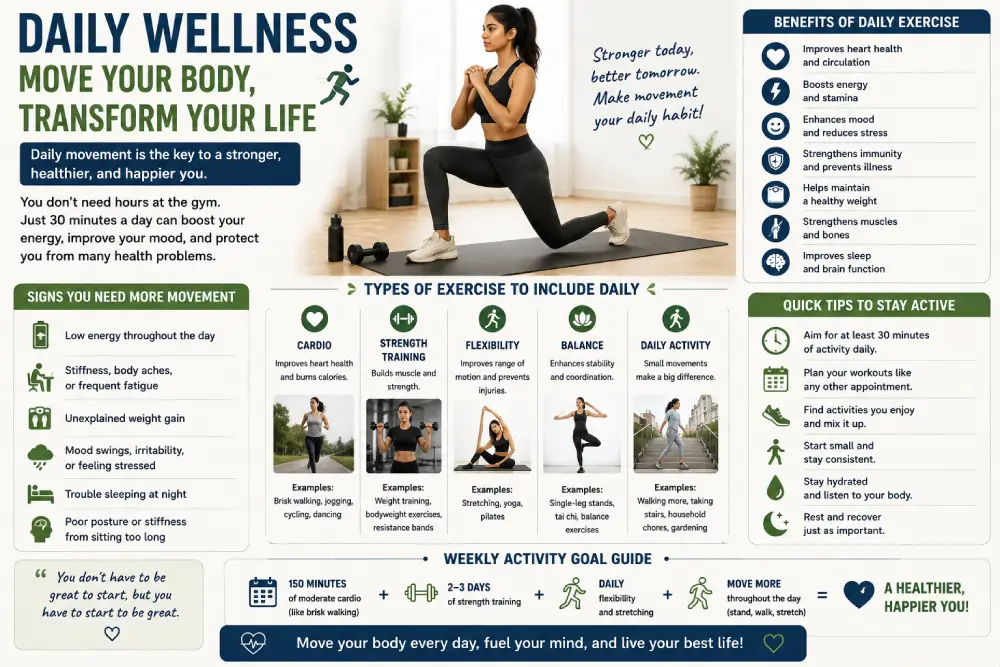
- Movement (not only sports/training activities) is one of the most effective daily stress reducers.
Practical tips:
- Use the try box breathing breathe in for 4, hold for 4, breathe out for 4, hold for 4 when you‘re feeling anxious. You can do it at your desk.
- Inclusive of “micro-movement” breaks every 90 minutes take a 2-minute stretch or walk, for body and mind.
- Use single processing in small doses, take a walk or a meal by putting your phone way even for a moment gives your nervous system some real downtime.
- Morming the stressor aloud or in writing. Merely assigning a name to an emotion (“I‘m feeling overwhelmed!”) has been shown to weaken it.
- Avoid daily no-input periods 10 min without music, screens or talking allows your mind to have a break.
Real experience note: a lot of individuals say a quick walk every day without the phone improves their mental wellbeing more than once a week yoga and this is so even in stressful areas, because frequency still beats intensity here.
Mini summary: mind-body wellness is focused on small, repeatable regulation practices; not epic, time-consuming rituals. Minutes a day is preferable to hours a week.
Read More: [Complete Mind-Body Wellness Practices Guide →]
Wellness Tracking & Journaling: Measuring What Matters
You can‘t improve what you don‘t notice. Wellness tracking and journaling make unconscious conditions (“I‘m tired today”) tangible (“I‘m tired today when I sleep less than 6 hours and I skip my breakfast”) which is what ultimately makes habit transformation happen.
Key takeaways:
- Tracking works best when it‘s easy 3 pieces of data crushes 15 you drop after a week
- Journaling has so many uses, not just coping with mental health issues. It can also be a very effective way to track your energy, sleep and mood and identify what causes changes in these.
- The point is not perfect data, but enough consciousness to influence your everyday decisions.
Practical tips:
- Track 3 simple thing a day, how long you sleep, how many gallons of water you drink, and your mood/energy level 1-10. This won‘t take long to do and will allow you to identify trends.
- If you are new to journaling, use a simple end-of-day journal prompt What gave me energy today? What drained it? instead of open-ended free writing.
- Review weekly, not daily. Daily numbers are noisy; every week‘s patterns are where the useful info reveals itself.
- Choose one, and use it consistently a notes application, a journal, or a health and wellness application‘s data changing between tools unloads your data and breaks your streak.
- Pay attention to the behaviors, not just the results. For example, “Have I been drinking enough water today?” is a more useful question than “Do I feel good today?”.
Mini summary: tracking makes daily wellness no longer a matter of guessing but of feedback. Don‘t make it so complicated that you‘ll never stick to it.
Read More: [Complete Wellness Tracking & Journaling Guide →]
Common Mistakes in Daily Wellness Routines
Even well-intentioned routines fail for predictable reasons. Here are the most common ones:
- Having too many new habits to add at once. Introducing five new habits in a week will almost never result in success for all five.
- Imitating another person‘s routine verbatim. An alarm clock set to 5 a.m. might be feasible for a remote worker who doesn‘t work night shifts, but it could be entirely impractical for a parent or someone who has a long daily commute.
- All-or-nothing attitude to healthiness. One cheat day can lead to the dam falling: “after this ‘failure’, I might as well give up”.
- Going to campus and ignoring sleep as you optimize everything else. No matter how much water, supplements, or pre-sleep planning you do, you cannot make up for chronic sleep debt.
- Over-tracking. Attempting to track 15 different metrics every day will lead to tracking burn-out within the first month.
Myth vs. Fact: Daily Wellness Edition
| Myth | Fact |
|---|---|
| Wellness comes with a hefty price tag | Nearly all of the most influential daily habits from the wellness perspective (sleep, hydration, movement) are available for you at no charge! |
| 5 a.m. wake-up time for optimal “wellness” mention | Wake time consistency is more important than whatever time it happens to be. |
| Eat a greater amount of supplements = eat better gut health | Most supplements: not nearly as significant as fiber, fermented foods, and eating speed |
| Journaling was no help for mental health it was actually detrimental. | Monitoring sleep, hydration, and energy levels is beneficial for making health-related choices as well |
| One day off throws everything out of whack. | The key thing is to be consistent over weeks and months – not every day. |
Building Your Personalized Daily Wellness Routine (Step-by-Step)
- First, choose one of the six pillars to work on morning routine, hydration, sleep, gut health, mind-body connection or tracking. Do not attempt all six at the same time.
- Choose one anchor habits of that pillar e.g., “water before coffee” rather than a five-step morning ritual.
- Attach it to an existing habit (habit stacking) e.g., “after I brush my teeth, I have a glass of water”.
- Track it for 7 days by keeping a simple yes/no log.
- Introduce the next habit after the first one has become second nature (typically 2–4 weeks).
- Revisit on a monthly rather than daily basis-. Change it depending on what you are actually capable of doing at the time in terms of your schedule, season of the year and your energy levels.
Which is why daily wellness is most effective when viewed as a system, not just as one article: each of the pillars above has a separate detailed guide focused on the specifics complete routines, troubleshooting, region-specific tips for US/Indian lifestyles.
The Future of Daily Wellness (2026 Trends)
- More bespoke than one-size-fits-all health routines devices and apps make now require each user to access highly individualized hydration, sleep and movement recommendations.
- Gut-skin-mind linkage becomes more popular as people regard gut health as part of beauty and mind.
- Micro-wellness over marathon rituals more 5–10 minute daily practices over giant weekend rituals, in synch with more hectic, broken schedules.
- Regional and seasonal content on wellness growing need for hydration and skin care advice in certain regions (such as Indian monsoon/summer vs. US winter dryness etc.),
- Simplify wellness tracking shift from a dashboard (lots of data and charts) to simple 2–3 metric tracking that people will live with.
Final Thoughts
Daily wellness is not about perfection. It is about selecting a few habits around each of these 6 pillars- morning routine, hydration, sleep, gut health, mind-body, and tracking- then integrating those into your current, imperfect daily life. Begin with just one anchor habit. Keep the tracking simple. Before moving on to another, let the first habit become second nature. That is the way to really, permanently create a daily wellness practice- not over the course of a weekend, but over your lifetime.
FAQs
Q: What is a daily wellness routine? A: A thoughtfully designed, sustainable, low-maintenance collection of daily habits concerning movement, hydration, sleep, nutrition, and mental health, practiced daily to achieve significant and positive impact on wellbeing.
Q: What amount of water should I drink every day? A: On average, it is advised to drink about 8 glasses (about 2–3 liters) a day, but this is individual: for example, in tropical and humid climates more water will be required.
Q: What are some simple morning practices for health as a beginner? A: Do these three as a basic morning practice to establish your habit: 1. Get natural light in the first hour 2. Have 1-2 glasses of water before any caffeine 3. Do 5-10 minutes of movement, before using your phone.
Q how can I improve my gut health naturally without supplements? A slow eating, taking 1 fermented food or a tablespoon of live yoghurt or kefir, adding diversity of fibres and having similar timings of meal every day.
Q: How long will it take to develop a new habit? A: Most people discover it takes anywhere from 3 to 8 weeks to develop a new habit to the point of seeming automatic, with the exact time frame depending on the specifics of the new habit.
Q: Which is the best time to keep the record of the wellness (Daily or weekly)? A: Record the data (sleep water and mood) daily but analyze weekly, as the daily data are random and the weekly data show what is really working.
FINAL CONCLUSION
This pillar page establishes cultones.com as the definitive resource for “daily wellness” by addressing it in its entirety (morning routines, drinks, rest, gut health, mind-body coordination, and logging), while reserving comprehensive, practical granularity for the 6 cluster articles it links out to. Publish the pillar first, then publish the cluster articles out in priority order (Morning Routine and Sleep Routines first, as they generate the most searches), linking back to this hub, and between each other (1–2 equivalently prioritized sibling clusters), forming a cohesive, interconnected topical authority.