Remote Work-Life Balance Tips That Actually Work in 2026
Published: August 13, 2026 Last Updated: August 28, 2026 Remote work-life balance doesn’t come from flexibility alone — it
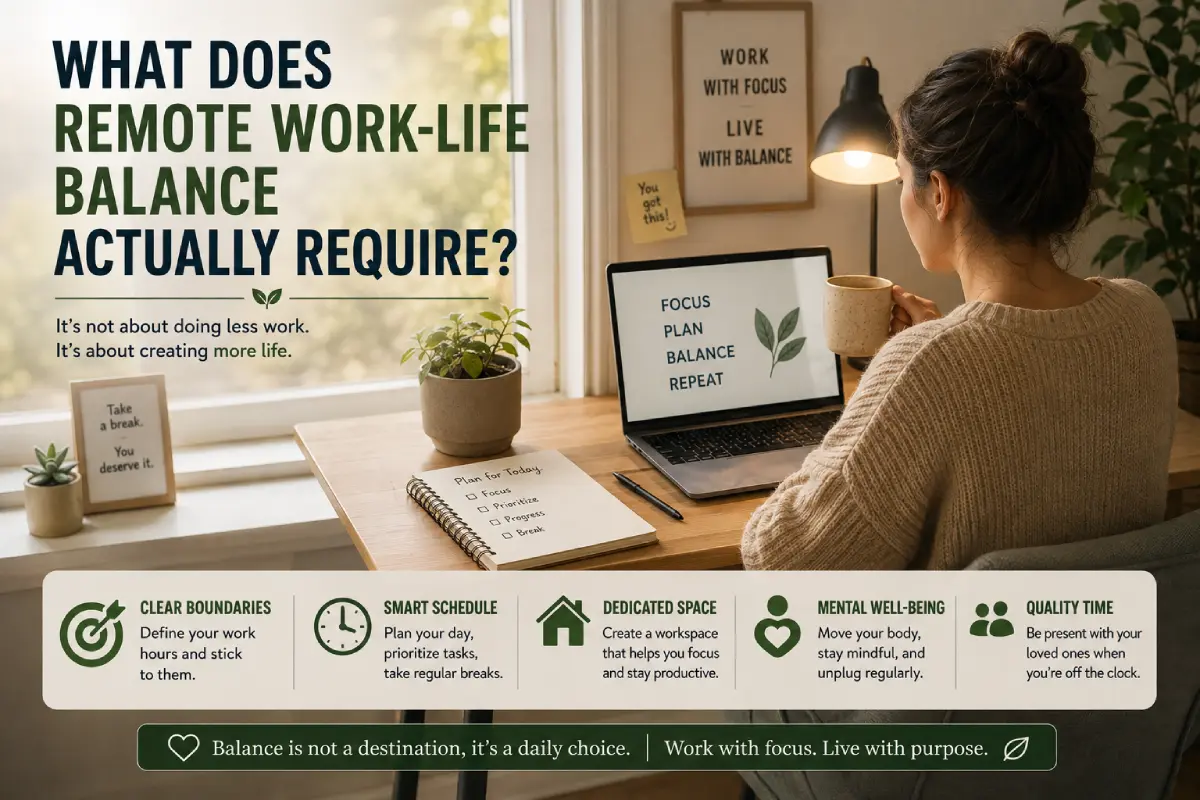
Remote work-life balance doesn’t come from flexibility alone — it comes from rebuilding the boundaries an office used to give you for free. This guide covers real routines, home office boundaries, and ways to avoid isolation, so remote work actually feels sustainable.
What Remote Work-Life Balance Actually Requires
Remote work-life balance is not something that naturally comes with flexibility it‘s something that you need to recreate intentionally. An office provides a wall between life and work: a commute, a time to stop work, a door that separates you from the space that is now your life. Working from home takes all of that away, which is why flexibility without intention generally makes work-life balance more challenging.
And remote workers (who have the most flexibility of all work arrangements) also consistently rank as some of the most burned out workers. The answer isn‘t less flexibility but finding the structure that the office provided in your life.
Key takeaways:
- Focus too much on flexibility benefits without demarcations can lead to the tendency of an increase in work.
- The aim is to meticulously cover the walk/stop signals that were given for free by a factory.
- A good way of working from home is more important than a good home office.
Building a Work From Home Routine That Sticks
A static routine does just what a commute used to; it indicates to your brain when work begins and when it‘s truly finished.
Practical starting points:
- Clock: BEGIN your day the same every time even if it‘s only a 10-minute walk or a coffee ritual before opening up your computer.
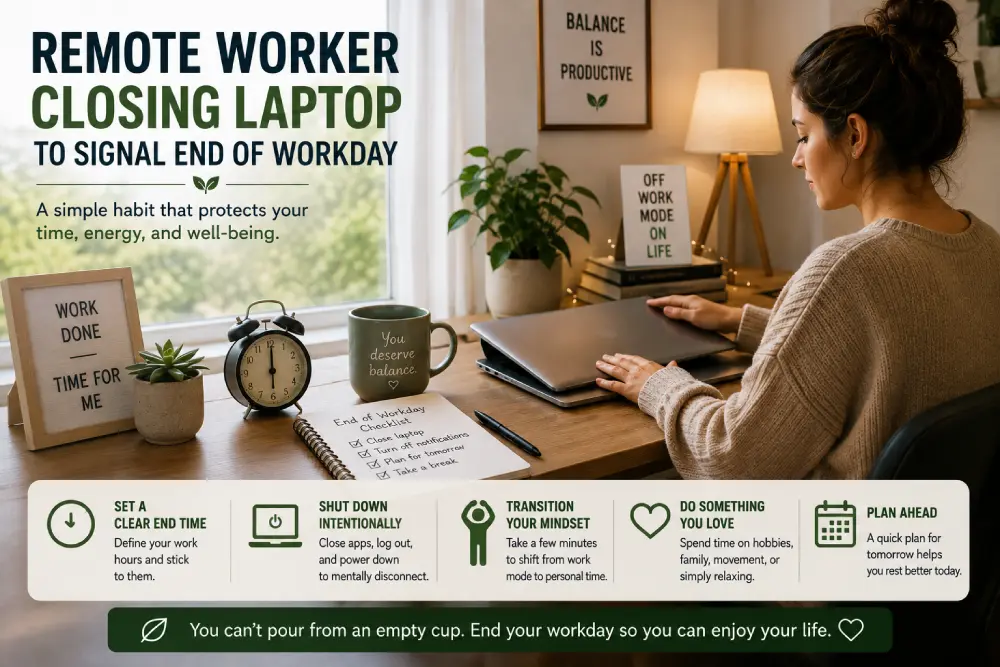
- Create a consistent “shutdown” practice a4 shutting down your laptop,moving rooms,taking a brief walk so your brain knows the day is over.
- Don‘t work where you kick back. Even a corner desk can make a difference.
- Maintain consistent start/stop times. even though it is tempting to have flexible hours due to working remotely.
Mini summary: The way you are doing the routine is more important than a schedule predictability is what really keeps your balance.
Home Office Boundaries That Actually Hold
Boundaries are what make a routine work when there are a million details on every plate. Without boundaries “just this once” will soon be life as we knew it.
- Establish working hours and make them transparent “Offline after 6pm” is more effective than dropping hints about being available
- Use physical signals to show you‘re busy especially in a shared environment a closed door, headphones, or a small “in meeting” sign for your family or roommates.
- Identify and utilize boundaries be consistent with the use of boundaries if anyone can negotiate a boundary, you have no boundary. Accept exceptions sometimes exceptions to boundaries expedite the collapse of boundaries faster than having no boundaries.
- Keep work and personal notifications separated where you can so that picking up your phone doesn‘t automatically mean picking up work.
Common error: Equating elaborating on home office boundary with an explanation. Boundaries are achieved by maintaining firm boundaries repeatedly, not just with a good message.
Remote Work Productivity Without Burning Out
Productivity and balance are not opposites; in fact, obsessing about getting productivity without a sense of limits is exactly what causes the imbalances that lead to burnout.
- Rather engage in focused work, such as 25-minute work cycles with brief breaks, rather than in often-counterproductive long unrefined stacks.
- Check emails and messages in batches at designated times instead of responding to them all day long.
- Use your most productive times for your most important work, and reserve your lower-quality time for less demanding tasks.
- Question “urgent” messages.31 Most could be delayed for a few hours without any real consequences.
Mini summary: Defined hours with quality work in the mix is where sustainable productivity is coming from.
Hybrid Work Schedule: A Different Balance Challenge
A hybrid schedule, however, has its own imbalance, as jumping back and forth between home and office days may be physically and mentally more exhausting than either in isolation if not consciously mitigated.
- Know beforehand which days are better for focused, often solitary, work (such as working at home) and which are better for collaboration, usually at the office, instead of making the choice on the day.
- Maintain a regular schedule on both types of days – sudden changes disrupt the stability that maintains balance
- Use your office days purposefully for meetings and networking, keep your home days sacred for focused work
- Make sure your team is clear on your hybrid work routine too so that expectations don‘t normalize “always on, always at work”.
How to Avoid Isolation in Remote Work
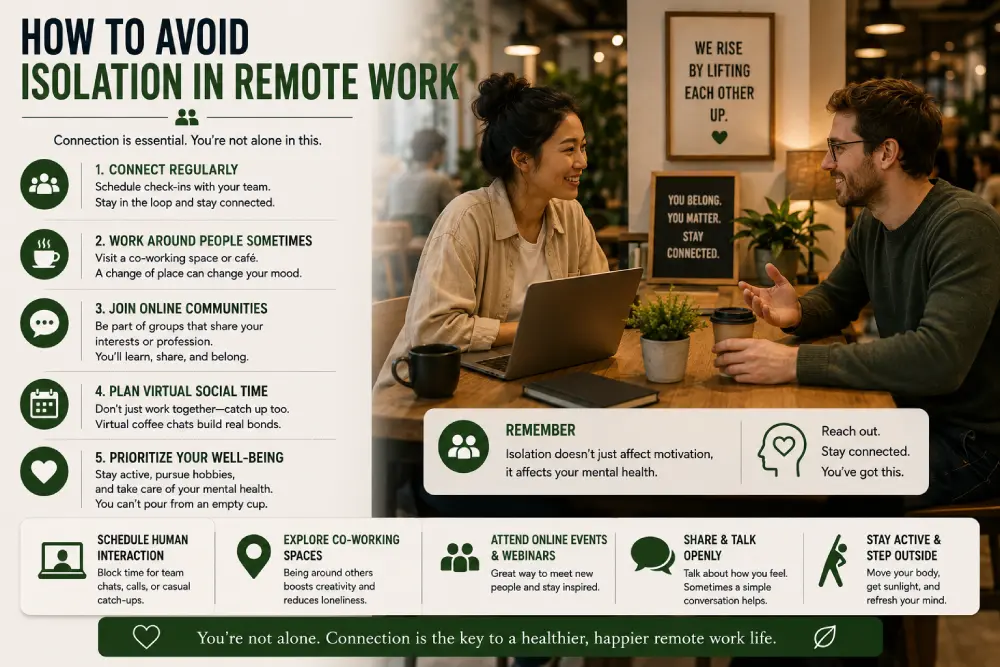
Solitude is arguably among the greatest health hazards associated with telecommuting, yet it is seldom discussed with other productivity tips.
- Build in opportunities for non-work social contact on a regular basis grab a coffee, do a co-working hour or have a weekly call with a friend.
- O Use video calls on purpose for team check-ins, not just as a replacement for asynchronous text.
- Leave the house at least once a day even for a short time. Isolation will cause things to get worse more quickly indoors.
- If your company is flexible at all, consider switching between occasional co-working spaces and in-person meetups every couple of months to mitigate remote-related losses
Mini summary: Avoiding loneliness isn‘t something “nice to have” loneliness left unchecked is one of the top drivers of remote worker burnout.
Remote and Hybrid Work: USA vs. India
In the US, lax norms on right-to-disconnect make it more a matter of cultural pressure, rather than policy mandating availability, so most boundaries are negotiated by employees themselves.
In India, remote work demands are even higher given: the requirement of working sleepless night shifts to service Western clients; the high rates of burnout amongst IT and BPO employees in India; the working from home in co-habiting or joint-family situations means that there are few physical demarcations between work and home. Having a formal office space at home isn‘t feasible for most of the people reading here. Even having a defined corner at home, a consistent schedule, and signaling to family members when you are unavailable matter more.
Both venues are similar because they are underpinned by the same essential tools routine, boundaries and intentional social contact though the forces determining the imbalance appear to be different.
Myth vs. Fact
| Myth | Fact |
|---|---|
| Working remotely inherently increases the work/life balance | Of note, those employees working completely from home tend to rate greater burnout than those working on-site absent any intentional framework. |
| ‘You will need a dedicated home office for balance’ | A regular routine and clear boundaries are more important than the existence of an office. |
| “Being available all the time demonstrates dedication” | Vague boundaries tend to produce burn out, rather than better performance |
| Refine the point of “Hybrid work is easier than fully remote” in the context of year 3 student working from home as defined by the meme from the first question. | Hybrid schedules have its own imbalance if switch days are not planned carefully. |
Common Mistakes to Avoid
- Suffering in the isolation of our own home “just for today” until it is our permanent place.
- Without having had a shutdown ritual and just figuratively “going home” mentally “turned on” all night.
- Relying on flexibility as the sole knife edge to protect your time, without establishing firm boundaries.
- Pretending isolation isn‘t going to start impacting on mood or motivation.
FAQs
How can I maintain a healthier remote work-life balance? Establish a predictable work from home schedule with defined beginning and end times, establish boundaries within the home office space and live with others, and re-establish in-person social contacts that are no longer available at the office.
Why are remote workers more burned out, despite the flexibility?Flexibility eliminates the naturally given structure of an office. If no explicit boundaries are set, the work will tend to fill as much time as available.
How do I prevent loneliness when working from home? Arrange frequent social interaction which is unrelated to work; enable the team to see each other on video, and leave your house once a day, even if only for a few minutes.
What is unique about managing a hybrid schedule? Hybrid schedules tend to require planning around which days are better for individual work and which are better for teamwork as jumping back and forth between states without intention can be more taxing than being entirely remote or entirely in-office.
Must I have a dedicated office at home for work/life equilibrium? Not necessarily. Regular working hours coupled with limits made explicit are more important than an official ‘home office’ – even a modest corner of your den will do.
Final Conclusion
Work-life harmony while working remotely is not something you get because your day is free-flowing, it is a result of you intentionally recreating the structure an office used to hold in your life. A consistent work from home pattern, defined home office rules, regular social interaction, and a carefully planned hybrid work schedule will do more to create harmony than a flexible schedule by itself. Try one change to start establish a shutdown routine for yourself or one boundary you will be unwavering with and add others gradually. To learn more about how to preserve your time and energy in the workplace, read out complete Work-Life Balance guide.