How to Achieve True Work-Life Balance in 2026 (Practical Guide)
Published: August 6, 2026 Last Updated: August 7, 2026 Living a zero waste life means lightening your impact on
Living a zero waste life means lightening your impact on the planet by following the 5 Rs: refuse, reduce, reuse, recycle, rot and sending as little to landfill as possible (not to be zero trash). A complete zero waste guide with tips and swaps for beginners, zero waste kitchen checklist, list of reusable products, a 7 days trash free living plan for the US and for India.
What Does It Mean to Achieve Work Life Balance?
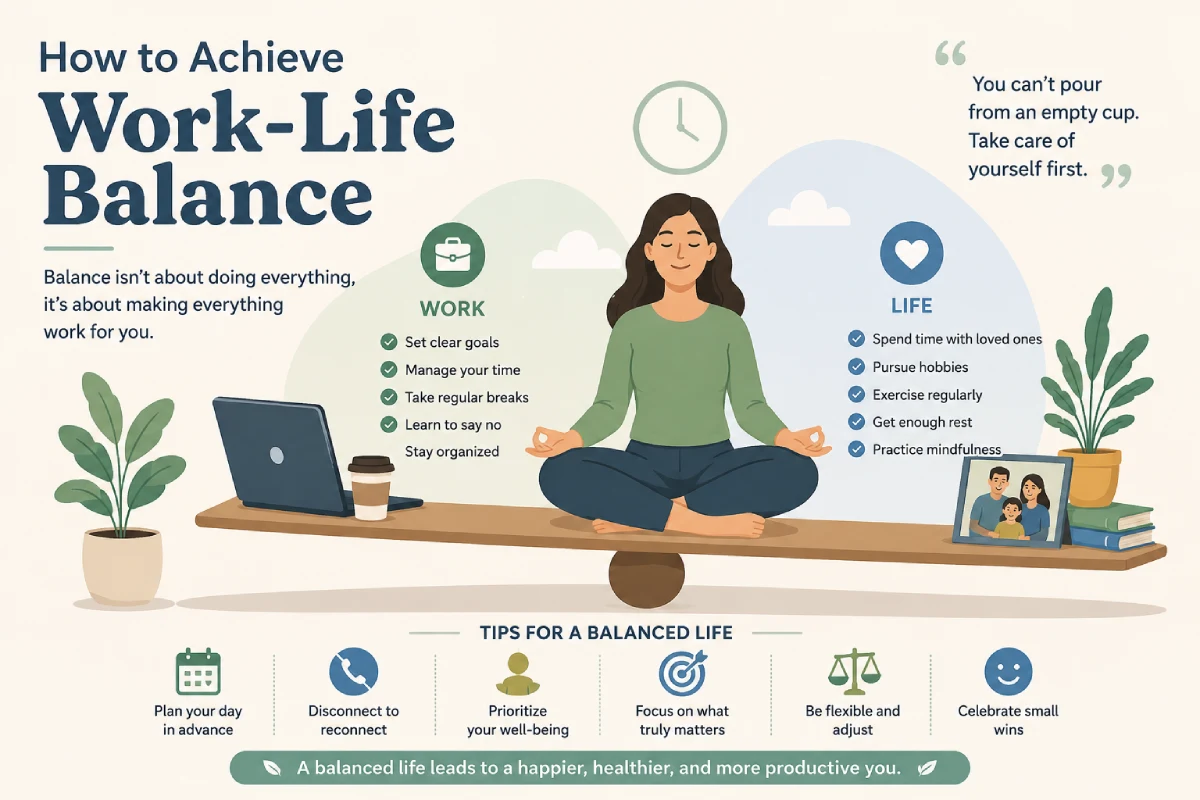
Figuring out how to work–life balance begins by realizing there is no perfect 50-50 mix. It’s on purpose. Your job is to separate your energy and time so work is not always competing with your health, family and sleep, and theminuteson.
Depending on your location, the advice changes. In the US most of the guidance is about carving out strict boundaries around hybrid and remote work time: set firm start-stop boundaries, cut down on after-hours Ping time. In India long commutes and joint-family living makes clear boundaries less about precise scheduling and more about preserving certain available blocks of time, since the home/work boundary tends to be naturally blurred.
Why Quality of Life at Work Matters More in 2026
The merge of hybrid schedules, AI-enabled roles, and the always-connected environment have blurred the boundaries of the ‘on’ and ‘off’ more than ever before. Those who safeguard the quality of life at work:
- Recover more quickly from stress–as rest can not be just squeezed into whatever time has been left over
- Do better at your job burnout chips away at concentration and judgment long before it becomes visible.
- You‘ll make a better show at home less time and effort at work means more for family and personal endeavors
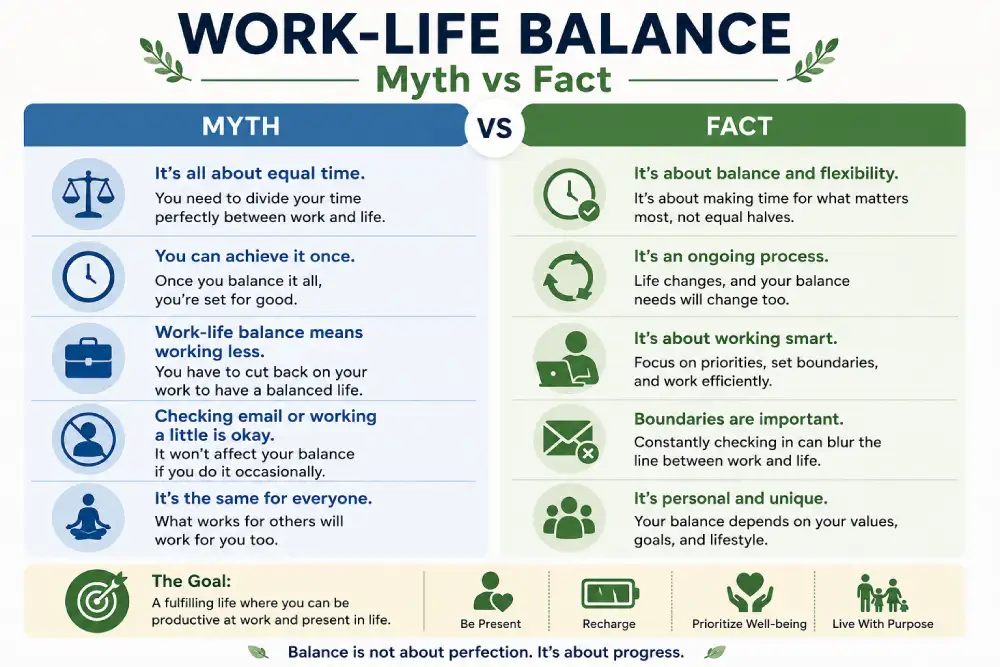
Work Life Balance: Myth vs Fact
| Myth | Fact |
|---|---|
| Balance is evenly split every day. | Balance is the ratio you move to, not a situation you “establish.” |
| More hours means more work. This rule applies whether you work for yourself or for an organization. | Always better results in time protected rest and concentration time |
| Quit your job. | Small boundary modifications similarly adding a hard shutdown time have a quantifiable impact. |
Healthy Work Habits That Actually Move the Needle
Most major life changes don’t last. The work habits that endure are small, repeatable ones.
- Reserve time on your calendar dedicated solely to focus work, prior to schedules becoming overwhelmed with meetings
- Mention taking a real lunch break away from your screen, not at your desk.
- Set a hard limit say no email after a certain hour and defend it.
- Get moving take a walk wherever you can for at least 20–30 minutes a day.
A Realistic Morning Routine for Professionals
A morning routine for a guy running a company isn‘t going to require an hour of meditation and a cold plunge, what it needs to do is be simple enough to be done even on the busiest of days.
- Wake up 15–20 minutes before your first commitinent, and not 2 hours.
- Do a grounding activity before looking at your phone (stretch, tea, journal)
- Prioritize your decisions: Review your day‘s top three priorities in the first five minutes of opening email
- Maintain the job so it is adaptable enough to get through a late night or an 8am meeting.
Unplugging From Work Without Guilt
Unplugging from work is less about a matter of willpower than establishing a distinct cue that the workday is over.
- Develop a shutdown ritual pay down your laptop or computer, write down tomorrow‘s favorite task, say a closing line.
- Switch off alerts that are not time sensitive after hours.
- Communicate your deadline to a colleague or manager so it feels natural and not as if you are avoiding the question.
- Replace scrolling with one screen-free wind-down activity
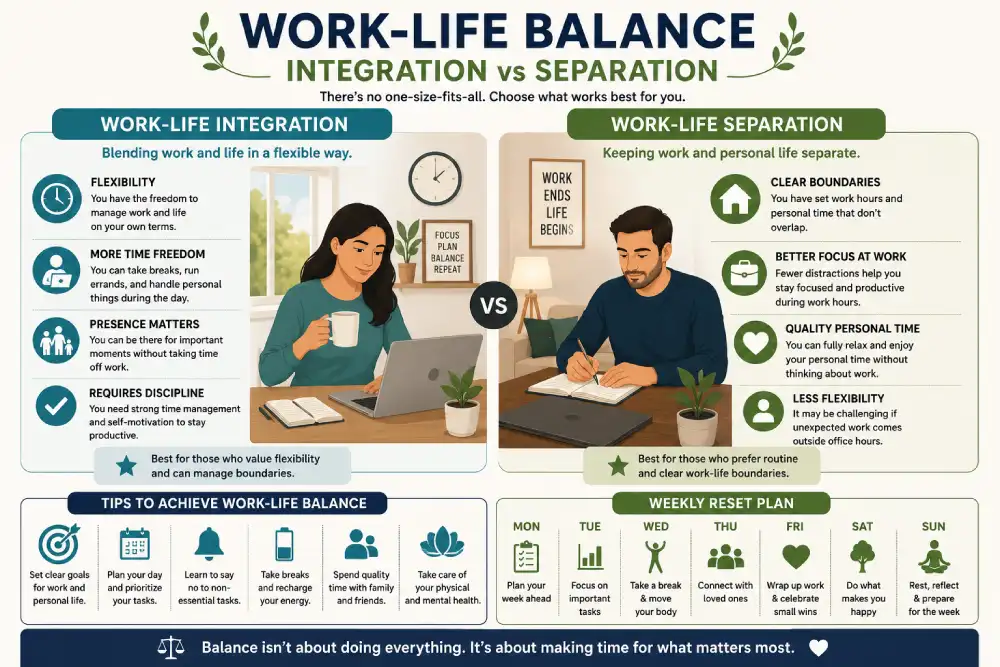
Work Life Integration vs Strict Separation — Which Fits You?
Could be right. Or wrong. Neither is both right or wrong, it just depends on your working environment.
- Strict separation can really only work if you‘re working set hours, if your commute neatly divides your workday, or if you have young children to pick up.
- Work life integration seem to work better among freelancers, founders and anyone else who has flexible hours and will appreciate the fact that mixing a few personal task in the middle of the workday (or vice versa) is more of a benefit than a friction.
Common Work-Life Balance Mistakes to Avoid
- Treating balance as a one-time fix instead of something you revisit as your workload or life changes
- Relying on willpower alone to unplug, instead of building a repeatable shutdown cue
- Copying someone else’s routine — a morning routine built for a remote freelancer won’t fit a long commute
- Ignoring small daily habits while waiting for a big vacation to “reset”
A Simple Weekly Reset Plan
- Monday: Set your one non-negotiable boundary for the week (a cutoff time, a lunch break, a focus block)
- Tuesday–Thursday: Practice your morning routine and shutdown ritual daily, even imperfectly
- Friday: Reflect — what worked, what didn’t, one adjustment for next week
Balance isn’t something you achieve once and keep forever — it’s a habit you keep calibrating as work and life shift around you.
FAQs
Q1: How do you actually achieve work life balance? By building small, repeatable habits — a protected morning routine, a clear shutdown ritual, and one firm boundary — rather than aiming for a perfect daily split.
Q2: What are healthy work habits that improve balance? Blocking time for deep-focus work, taking a real screen-free lunch break, moving your body daily, and protecting one hard boundary like an email cutoff time.
Q3: What does a good morning routine for professionals look like? One that’s realistic and repeatable — waking up slightly earlier, one grounding activity before checking your phone, and reviewing your top priorities before the day starts.
Q4: How do you unplug from work without feeling guilty? Build a clear shutdown ritual so your brain gets a consistent cue the workday is over, and communicate your cutoff time so it feels normal rather than avoidant.
Q5: Is work life integration better than strict separation? It depends on your schedule — separation suits fixed hours and predictable routines, while integration works better for freelancers or anyone with variable, unpredictable work hours.
Final Conclusion
Learning how to achieve work life balance isn’t about finding one perfect schedule — it’s about building small, repeatable habits and adjusting them as work and life shift. Whether you’re a professional in the US setting firmer digital boundaries or in India protecting specific windows of time around a longer commute, the same foundation applies: build a routine, protect one boundary, and revisit it weekly. Start with one habit from this guide, and let true balance build from there.