Work-Life Balance: Practical Strategies for a Healthier, Happier Life
Published: August 5, 2026 Last Updated: August 5, 2026 There is a certain kind of drain that doesn‘t lead
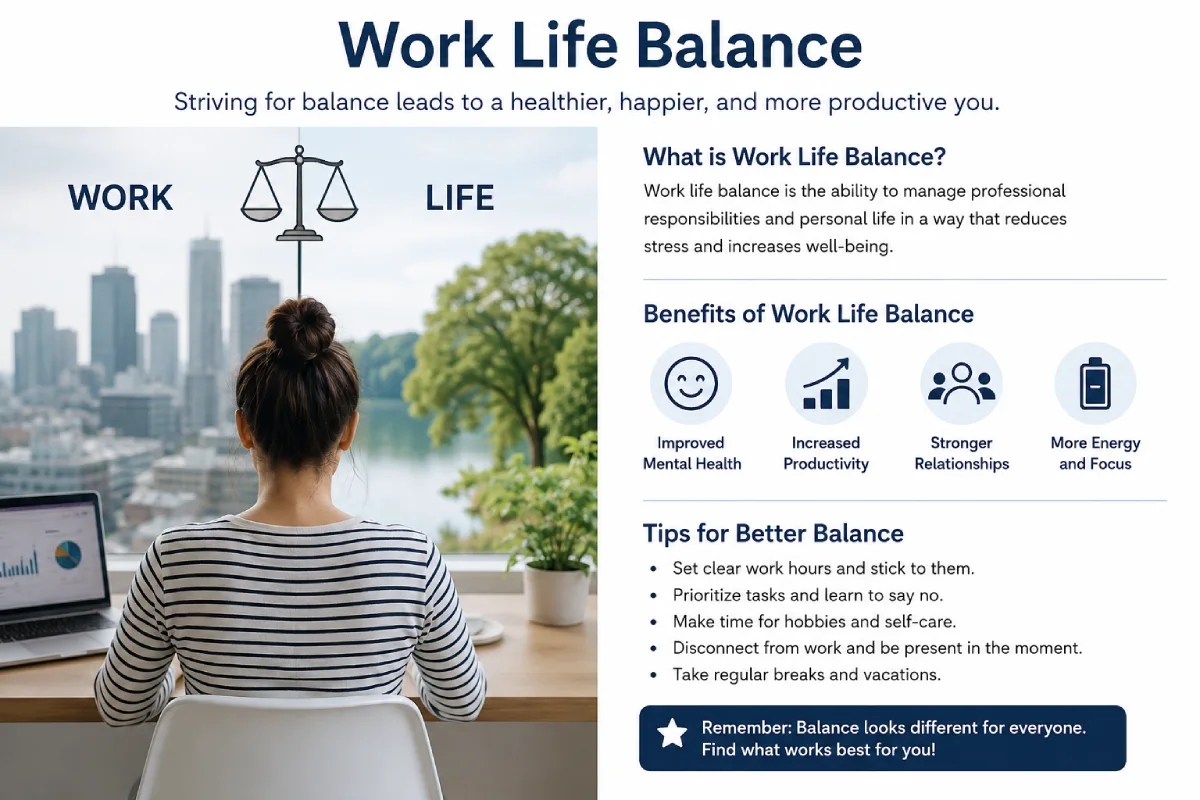
There is a certain kind of drain that doesn‘t lead to sleepiness. It leads to one more email to answer at 9pm “just to get through it”, lead to feeling guilty for shutting down after work at a relatively decent hour, lead to realizing you can‘t honestly remember the last weekend that felt like it belonged to you. If that sounds like you, you have friends global figures on burnout have increased rapidly over recent years, and in India directly, burnout amongst employees has increased from 58% in 2022 to 72% in 2025 one of the three fastest three-year rises at any place. Achieving a real ‘work life balance’ has become one of the most Googled and sought-after life goals and one of the most challenging to attain without a great deal of thought behind it.
This doesn‘t claim to be one more set of tips like “go for a walk” and “unplug on weekends.” Think of it as your road map, not your instruction book. We will focus on the what of work-life balance (not a perfect 50/50), why it is important, and the five core levers that control it creating balance, avoiding and recognizing burnout, establishing meaningful boundaries, managing time intentionally, and the unique hurdles of remote and hybrid work. Each chapter provides you with the highlights and one practical next step, along with a link to a comprehensive, detailed guide when you are ready to dig deeper.
What Work-Life Balance Actually Means
Work life balance is widely assumed to be equally dividing time if not, on the advice of many, dividing six liters of water through your life, between three buckets. However, in reality it is hardly ever the correct goal, nor easy to implement. A definition which is easier to apply is: Work life balance occurs when both the needs of the job and the personal life are being met “in such a way that neither one is consistently given inadequate attention.”
It is also important whether you mean “over the course of days” or “whilst approaching a decision”. Balance isn‘t net daily 50/50 – it‘s more like a moving average where a tough week at work is offset by a less stressful one, rather than every day being near equal.
Key takeaways:
- Balance is a continually adjusting calibration. It‘s not something you get once.
- It takes place over weeks and months, not hour by hour, Hour to hour, hour to hour.
- It‘s not about “equal time” it‘s about sustainable wellbeing for everyone involved.
- What a “balanced” life means will vary for the new parent, seasoned CEO, or recent graduate there is no one size fits all goal that everyone should strive to achieve.
Balance vs. Integration: Two Different Models
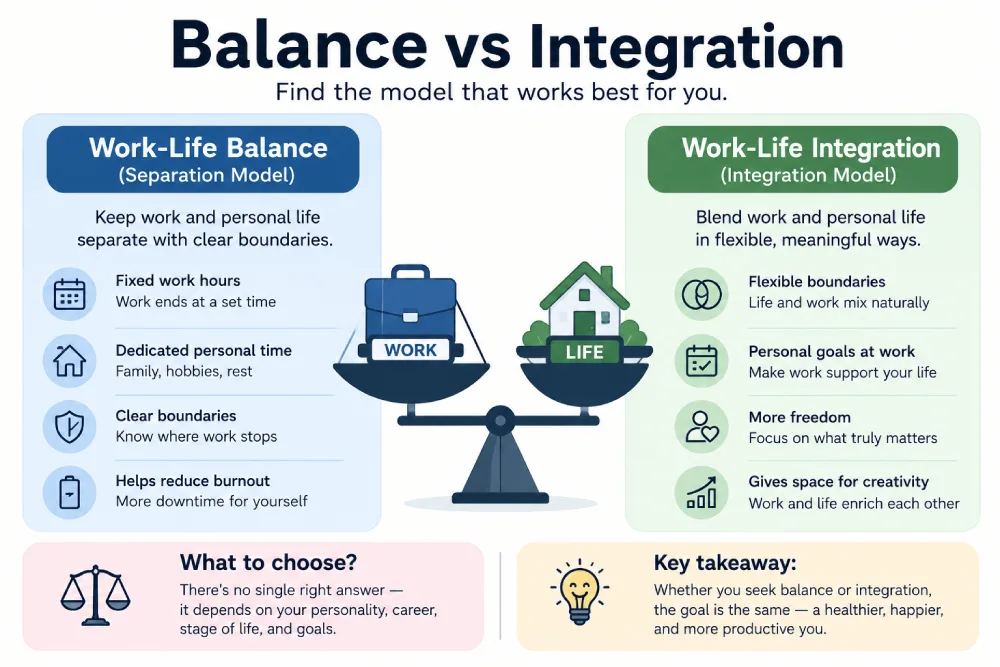
Not everyone requires the same model. A separation-based balance involves firm boundaries work is done during tight hours and life is sacred during other hours. An integration-based balance involves a more fluid hybrid such as leaving during work hours to pick your son up and catching up with work after hours. Neither is necessarily superior, but a separation model is not well suited for a job that requires a lot of flexibility, while an integrated model offers too little in the way of boundaries for jobs that are work-heavy and time intensive.
How to Tell Which Model Fits You
The easy way to know which model will fit best: work will have predictable beginning and end, and identifiable (though perhaps flexible) points of commencement and conclusion? Separation makes sense fixed work hours that were always supposed to end and not come back. Unpredictable work: (clients you have to work around across time zones, caregiving, irregular freelance income) would rather have a more integrated model flexible hours, built around clear, unbending core commitments less incentive to negotiate back to the separation model, that will likely irritate your clock more than flexible hours that just don’t necessarily start and stop when you want or need them to. Choose your model not because it sounds more “disciplined,” but because it makes sense for your work.
📖 Read More: [How to Achieve Work-Life Balance: Step-by-Step]
Why Work-Life Balance Matters So Much Right Now
This isn‘t simply a matter of worker‘s health and happiness, this is now the second-most-cited reason for job satisfaction and retention in multiple large workplace surveys, behind pay only. Healthy workers, who report a good balance of home and work, are known to be more productive than their overworked counterparts a welcome truth, given how frequently overwork is justified on the basis of results.
The price of neglecting it is tangible and measurable: burnout is projected to cost employers somewhere in the neighborhood of $4,000 to $20,000 annually in ways that could be quantified per employee, and an overhelming majority of that is due to presenteeism rather than absenteeism.
A Tale of Two Work Cultures: USA vs. India
Work-life balance pressures look meaningfully different depending on the market:
- In the US, the issue is a sort of “constantly connected” culture fueled by digital workers there is little in the way of concrete regulation mandating time off the grid (only a few states have attempted to propose right-to-disconnect stances), so it comes down to self-regulation or individual negotiations.
- In India, this pressure is further inflated by significant industry-specific overwork standards India’s IT or BPO sectors have among the highest burnout levels worldwide, fueled by extensive working hours, overnight schedules catering to Western clients, and a lack of corresponding staffing increases amid boom. Hustle culture is also more socially accepted in many Indian workplaces, making boundaries seem more risky at work even when truly necessary.
The throughline for both markets: the tools for constructing balance boundaries, time management, stresses of burnout are the same, but the resistance to applying them culturally varies, and to be honest, better to admit that than to, as an author, claim the advice applies equally everywhere.
How to Achieve Work-Life Balance: Where to Start
The most common reason work-life balance initiatives fail is attempting to deal with everything at once. So it‘s better to start with a simple audit:
Practical starting points:
- Actually keep a record for a week of all the time you are working and playing. You might be surprised at where the hours really add up.
- Pick 2–3 personal priorities (health, family, rest, hobbies, etc.) and check on an audit basis if your current time set up is actually safeguarding them or a belief that it will “work itself out.”.
- Begin with one simple change rather than ten a single sustainable shift (a set stop time, a protected morning routine) is better than an overreaching change that falls apart in two weeks.
- Check in with your strategy regularly what‘s really effective in the course of a typical season may no longer be during a high-pressure assignment or a new challenge.
- Get others who will be impacted by your schedule involved (a partner, roommate, family member) so alterations are received enthusiastically instead of secretly undermined by those not included in the planning.
Mini summary: True balance comes from honest measurement, not motivation obvious people-manipulation of a distribution of time and energy that you haven‘t actually viewed transparently in the mirror can‘t result in an effective fix. That fix will last far longer when the folks with whom you share your life have been pulled along for the journey.
Common Mistake
Thinking of work-life balance as aproblem to ‘solve.’ You‘ll notice every time someone gets back to a few good months of ‘balance’ again, they tend to have returned to the problem of ‘not balancing’ but stopped taking the approach of auditing because the approach is an ongoing balancing act not a problem to be solved irrevocably.
📖 Read More: [How to Achieve Work-Life Balance: Step-by-Step]
Burnout at Work: How to Recognize and Avoid It
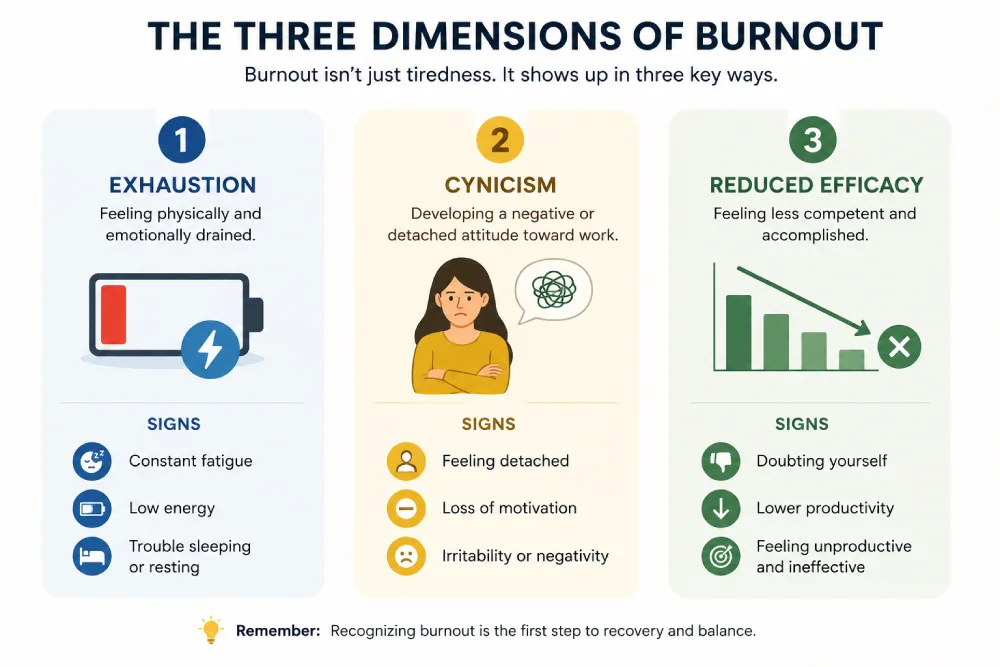
Burnout is more than just being tired. TheWorld Health Organization ( WHO) officially considers it an occupational phenomenon which is made up of three separate components: emotional exhaustion; cynicism or detachment from one‘s job; and a diminished sense of personal accomplishment.
Practical starting points:
- And get a jump on warning signs before they accumulate: the chronically exhausted feeling that no amount of sleep can fix, the emerging skeptical attitude about all the stuff you used to think was worthwhile, the slowly budding feeling that, who gives a shit.
- Tackle work load issues head on with a manager; don‘t wait until you are generally exhausted; be ready with information on where issues are and what you would like to see done; don‘t just say “I am exhausted”
- Beware of a false sense of protection recovery time you need to get away from the activity to recover from burnout.
- Be aware that burnout is often a system problem (unsustainable workload, bad management, unclear expectations), not just a personal resilience problem personal coping mechanisms are helpful, but they can‘t fully compensate for a truly unsustainable job
Mini summary: burnout is as much a workplace/workload issue as a personal one. Self-care isn‘t usually enough to resolve it on its own.
Burnout vs. Ordinary Tiredness
I would separate the two of them because they require different responses. Tiredness is temporary (common response to a weekend, good sleep or brief respite), doesn‘t fundamentally influence your attitude toward work (like burnout, it doesn‘t significantly improve with adequate rest), and is not usually associated with the physical symptoms that go along with burnout (disturbed sleep, appetite changes, frequent headaches). It‘s important to recognize it because responding to burnout with a ‘short-term’ attitude (I‘ll feel better after the weekend) is often a procrastination for effective intervention.
Budget Tip: The Cheapest Burnout Prevention Is Prevention
Treating early symptoms of fatigue, increased anxiety and sleep difficulty is way less time-consuming and costly than recovering from full burnout, which might take months and require a significant amount of time off work. Having that difficult conversation with your boss about workload at the first sign of trouble pays off in spades.
Read More: [Burnout at Work: How to prevent and identify it]
Setting Work Boundaries
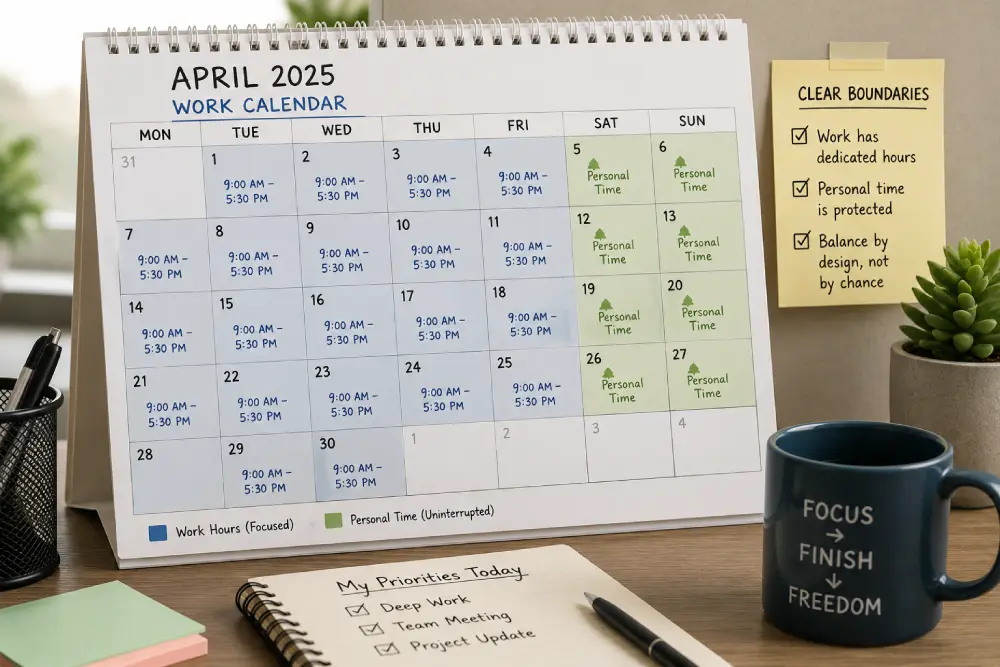
Boundaries are the instrument that enforces work-life balance on a daily basis. Without boundaries, good intentions generally don‘t make it to the weekend.
Practical starting points:
- Set particular working hours and inform your supervisor instead of unclear timetable.
- Say explictly, without guilt or apology “I‘m offline after 6pm and will respond first thing tomorrow,” etc. If you can‘t be explicit, just say nothing, the under-communication will be noticed
- There are no hard-and-fast rules. Just having boundaries with our clients is not enough. Boundaries need to be firm and consistent especially with our boss. Variability with our boss and clients quickly diminishes boundaries.
- Expect to have to work through some initial resistance to the new boundary this is normal. (It doesn‘t mean the boundary was necessarily wrong).
Mini summary: A local rule that is communicated explicitly and applied uniformly is a far better practice than one that is explained in detail and given irregular application, and is likely to win the respect of managers and peers over a period, not less.
Scripts Worth Having Ready
- For a manager who wants work done on the weekend: “I need this done well can I come in briefly tomorrow so I can focus on the most important aspects?”
- To a late night msn friend: “Saw this Will get it tomorrow morning.”
- When you yourself are about to “just quickly check”: “I can do this when I am next working without anything breaking”.
📖 Read More: [Setting Work Boundaries: Scripts and Strategies]
Time Management for a Better Work-Life Balance
Good time management is not about stuffing new things into an already packed time schedule but more about holding on to the right time schedule. Part of that right time schedule can include more personal bottom line.
Practical starting points:
- Dig into your calendar to carve out blocks of time to focus on work priorities and personal commitments. (A scheduled personal commitment is much less likely to be “pushed aside” by a work request.)
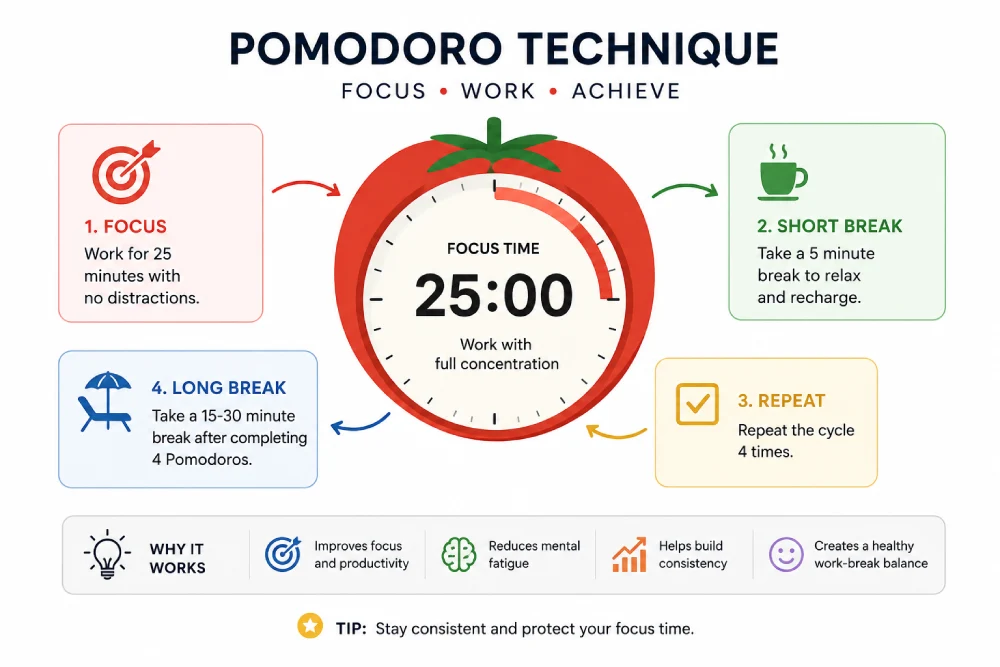
- Consider more systematic concentration methods such as the Pomodoro Technique – 25-minute intense work sessions interspersed with brief rest periods. This allows you to accomplish more in the same amount of time and lessens the feeling of constantly needing to increase your working hours.
- Recognize and eliminate low value time-drainsand eliminate meetings, minutes lost in checking email and checking notificationshour after hour. If it doesn‘t add tangible value, cut it out.
- Differentiate between urgent and important on a regular basis; most of your time-management failures occur by prioritizing the loudest task rather than the most significant.
Mini summary: it‘s not about being busy it‘s about using your finite hours just as deliberately as you would if they were infinite. Slightly but importantly distinct aim than “accomplish more.”
Common Mistake
Using a one size fits all productivity system that isn‘t actually targeted at the real problem to be solved. If a person is having trouble with the wrong next actions, a priorities audit is the right solution. If a person is having trouble with depletion of energy, no calendar trick will ultimately fix that.
📖 Read More: [Time Management for a Better Work-Life Balance]
Remote Work Balance: Staying Sane Without an Office
Going remote takes away the commute and gives you flexibility but also takes away the physical dividing line between work and home, which is a greater loss than most people anticipate. Several studies on remote workers notice a peculiar trend: employees working remotely only are most burned out of any arrangement, even though they have the most flexible schedule that is, more flexibility alone doesn‘t necessarily mean better balance unless you choose to rebuild the dividing lines consciously.
Practical starting points:
- Re-establish the boundary a commute used to give you if you had a quick walk, a particular “shutdown” ritual, or a change of rooms at the end of the workday your brain now understands that the workday is truly done
- Try to establish a designated place to work, even a small one where possible working from the same place you relax erodes the psychological barrier between the two.
- Create intentional social contact working alone has been identified as one of the most neglected potential health threats when working remotely, and it can increase the risks of burnout.
- Call out “people always being available” assumptions explicitly remote work tends to lead to a lot more offhours emails just because it‘s so easy to shoot those emails out14 but not more urgent ones.
Mini summary: If you want to work remotely, you have to replicate in a manual way the borders that a office used to give you automatically “the same job, just from home” is where most of the remote burnout springs from, without anyone noticing until you are so drained.
Troubleshooting: “I Have More Flexibility, But I Feel Less Balanced”
This is an experience that is both typical and truly confusing they would seem to provide more control over your schedule, they should help you balance your life…about it. In practice, it often result in your work starting to spread out quietly to fill all the time you have available, because there is no external cue (the officeclosing time, the walk to your car) to tell you that it‘s time to head home. Ah, but there‘s the problem. It isn‘t less flexibility you need, it‘s replacing the external structure with your own on your own terms.

Work-Life Balance for Managers and Leaders
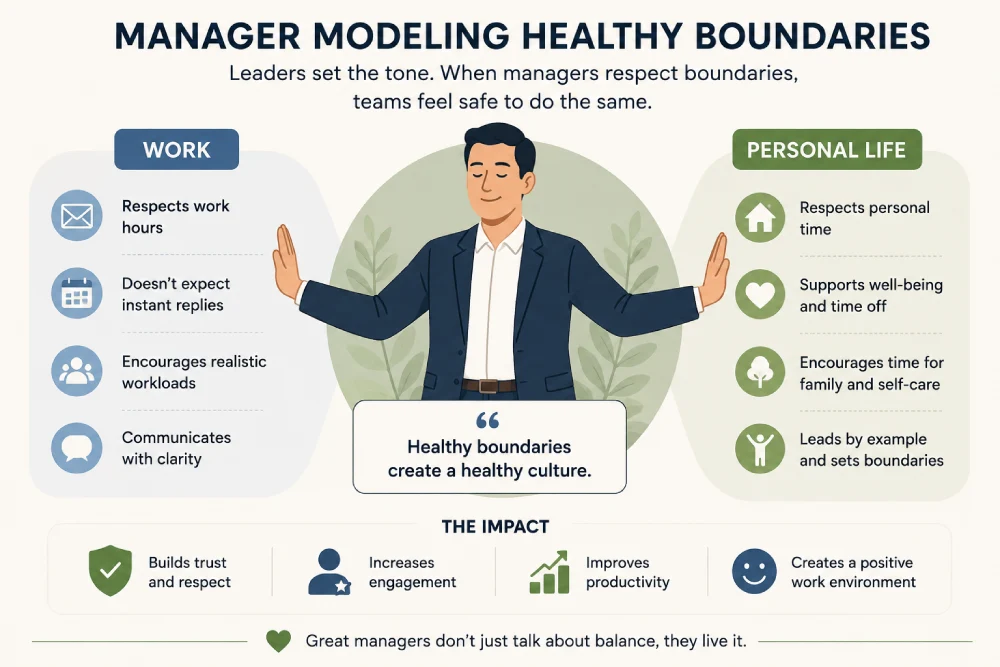
Balance is not just a personal challenge, it is also something managers consciously and unconsciously influence in their team as a whole. The way people generally perform in terms of engagement can be largely explained by the way a manager interacts with balance.
Practical starting points:
- Behave how you‘d like your team member (manager) to behave — sending dozens of e-mails at midnight, without having any such expectation, signals that working late hours is seen as the norm while whatever is stated explicitly is not
- Inquire about workload before someone asks for it to be lowered out of desperation.
- Protect focus time and reasonable hours structurally no-meeting blocks, respecting PTO fully, and not scheduling around it are structural solutions, not individual willpower.
- Be aware that a burned out supervisor can‘t derive sustainable balance for the team, this will require boundaries for the supervisor first not implementation downwards
Mini summary: It is not a wellness policy but the daily reality of a manager‘s own work life that influences the overall work/life balancing of a team.
A Common Blind Spot for New Managers
Many new managers may in fact inadvertently undermine the team‘s equilibrium while attempting to be helpful with a “she said it was OK” approach to unwieldy hours, enthusiastic sarcasm toward weekend email checking, and a defensive armor of being continually available/approachable. This is not usually intentional, but teams read behavior, not blueprints. A manager who says “don‘t feel pressured to reply outside of work hours” and pampers people who do sends a contradictory message that teams tend to close in on what‘s rewarded rather than what‘s publicized.
Read More: [Process of determining current level of balance, action plan to achieve desired balance, monitoring progress, and maintaining balance.]
Work-Life Balance Across Life Stages and Roles
Generic advice is usually given from the perspective of one single life stage, but the appropriate approach varies significantly based on where you are:
- Early career: A good boundary routine now will make it less difficult to establish later on, when “always available” becomes the unspoken rule
- Parents and caregivers: predictable schedules are always more important than variable schedules. Shared family calendars that document rather than just think about school pickups, appointments, caregiving are a huge also invisible source of stress reduction
- Individual Contributors versus managers ICs generally require stronger enforcement of their personal boundaries. Managers should be aware of their own boundaries as well as the boundaries they are establishing for others.
- Freelancers, entrepreneurs, contract workers: the stiff separation-based balance strategies more often cause conflict, rather than harmony an income-focused, project-centered pattern generally requires some “balance” of its own, this time in terms of steadiness of income flow and pace of work, rather than time.
Mini summary: Which work-life balance strategy you should employ ultimately is determined by your actual position and life stage original research for a salaried executive won‘t necessarily match up well with the pursuits of a freelancer or a stay-at-home parent.
Digital Boundaries and the Always-On Trap
A more fundamental, but often neglected cause for poor balance is not workload, but the wired-digital communication that has been piled up on it. Remote workers in particular report significantly greater burnout due to unsatisfied job-related use of digital means of communication separate from the amount of work.
Practical starting points:
- Disable unnecessary notifications even when not working thinking about what a notification might be takes more time than simply looking at a notification. (The cost is mental, the time is physical)
- Create two distinct communication pathways and two separate devices, if possible, so ‘checking your phone’ doesn‘t immediately translate to ‘checking your work’
- Create clear team rules about response-time expectations as most “urgent” messages are not actually urgent, they just feel that way because instant messaging creates the impression that instant responses are expected.
- Check email and messages in batches at fixed times rather than constantly throughout the day. This helps to concentrate your attention while managing the feeling of being interrupted all the time.
Mini summary: A lot of the current imbalance between work and life is actually a communication/norms issue posing as a workload issue – changing the norms alone can ease pressure to such an extent that taking more time off is never really necessary.
The Myth of “Urgent”
Here‘s a simple mental check you can do: Before responding to an after-hours message, consider whether you would actually consider the issue worth waiting for the next business day if you truly believed the sender was not available. you‘ll find that most messages here would still be reasonable to wait on for a day: they feel urgent not because of a lack of response time but because of a low time-it-requires waiting with respect to how easy they are to respond to. Training yourself and others, if you are in a position of management to confirm that task an email can be responded to in the moment, or must be responded to right now, will cut back a substantial fraction of the time people spend chained to their devices.
Work-Life Balance by the Numbers
A quick-reference snapshot of the data behind this guide:
| Metric | Figure |
|---|---|
| Currently Burning out American workers | ~55% |
| Burnout is most strongly associated with fully remote working, which has the highest associated burnout levels of any working pattern. | ~61% |
| Indian employees who experienced burnout at any time in their current job (2025) | About 72%, increased from 58% in 2022 |
| IT/BPO burnout rate in India: | ~68–75% |
| Online employees connect burnout directly to digital communication tools. | ~69% |
| Annual cost of burnout to the employer (per employee, per year, in $) | $4,000–$20,700 |
| Workers with more balance work harder, not less, according to respondents. | ~21% harder |
Hard facts reaffirm the central theme of this guide: the work-life balance crisis has worsened in the US as well as in India lately due to different work pressures but confronted by the same set of broad approaches, including boundaries, time priorities and trusting dialogues on one‘s workload.
Vacation, PTO, and the Guilt of Actually Using It
Time away from work and actually taking this time off is two completely different things; and the difference between the two is one of the more prevalent yet least addressed causes of poor work-life balance.
Practical starting points:
- Plan your time off long time in advance and reserve it the way you would reserve an important appointment and not make it flexible to cancel if work becomes demanding.
- Avoid Working While on Time off. Completely disconnect whenever feasible; checking email “just once a day” while away from work defeats the very purpose of taking vacation to refresh.
- Hand off responsibilities clearly when you leave, so that you have coverage, and you are not tempted to check in “just to make sure nothing‘s on fire.”
- A reminder that guilt arises when we take what is owed us may be a cue to explore, not an emotion to endure with stoicism persistent feelings of guilt about stopping to relax is indicative of an unhealthy environment, whether from inside or outside the institution.
Mini summary: unused or semi-use d PTO -not “cumulative- isn‘t just good illusion of commitment; it is piling up into ignored fatigue that will turn up elsewhere.
Physical Health: The Overlooked Foundation of Balance
Discussions of work-life balance are so often solely concerned with the schedule and the boundaries that they ignore the physical base that sustains the human energy necessary for getting through the day.
Practical starting points:
- Protect sleep. Make it non-negotiable. Don‘t keep a flexible sleep buffer that appears to decrease every time the day gets too long-be vigilant sleep debt adds up and has a say in every aspect of our stress tolerance and decision-making.
- Integrate movement into your day gradually into manageable steps rather than trying to commit to gym three times a week which will never happen a brisk walk between meetings sustains a healthy balance much longer term
- Observe the body signs of chronic overwork:. Tension headaches, disturbed sleep, fluctuations of appetite and low-grade fatigue can serve as early physical symptoms that should be treated seriously
- 30. Take your regular ‘treat’ snacks and meals as protected time, not as something you‘d do in between calls – snacking while working through calls deprives you of one of the few natural breathing spaces in an otherwise non-stop workday
Mini summary: Balancing with schedules and boundaries that disregard sleep, movement, and the fundamentals of bodily recovery quietly collapse over time.
Building a Personal Work-Life Balance Plan: A 30-Day Approach
Rather than overhauling everything at once, here‘s a realistic four-week on-ramp:
Week 1 Audit: Keep all your existing routines but monitor yourself for 1 week, recording in detail where and how you spend your time and energy. Make specific notes about where activities exhaust you more than the time they require, and what renews you.
Week 2 – One boundary: Establish one clear boundary an absolute stop time, a no-email-before-9am policy, or an absolutely protected lunch hour. Maintain that boundary for the entire week, no matter how much it strains.
Week 3 One structural fix Focus on one problem with time management or workload, such as: renegotiate deadline, take task off repeating list, block out hours in calendar for one goal.
Week 4 Revisit and grow: Go back to your Week 1 baseline. Just one boundary held, and one structural fix, would be a step forward. Select the next boundary to work on and repeat the process.
Mini summary: Long-lasting balance sits in layers, over 2 weeks, not in a single high-powered weekend of game planning that‘s not what this is all about.
Talking to Your Manager About Workload
The one work-life balance chat that may be most impactful for many is also the most easily avoided: a frank check-in with a boss around workload.
Practical starting points:
- Come equipped with details,not just a generalized feeling of drowning “three overlapping deadlines coming due this week and need to know what to get to first” is more useful than“totally stressed out”.
- Do not just escalate the problem present solutions (e.g. delegation, extending deadlines, getting extra help) together with the problem.
- Present it in terms of sustainable output rather than personal struggle the majority of managers react favorably to “I can‘t do this pace in the long haul” over a “this is hard on me” complaint.
- Record the workload conversations, and if this is not the first time – people tend to find it harder to ignore a pattern, than just one isolated conversation.
Mini summary: There are very few problems with workload that shouldn‘t be resolved without waiting by having a solution-focused-yourceiling conversation that most of us procrastinate on for surprisingly long period of time.
Common Myths About Work-Life Balance
| Myth | Fact |
|---|---|
| Balanced meant dividing everything equally every day. 50/50. | Balance is a rolling average over weeks and months, not a daily calculation. |
| It will be damaging to my career to set boundaries | Employers are increasingly aware of the importance of sustainable output and burnout prevention, and chronic overwork eventually affects performance. |
| The best thing about working remotely is() Which counterintuitive, since Thank you! | Remote workers have the highest reported burnout levels of any situation where boundaries aren‘t explicitly defined. |
| Something like-I just need a vacation to recover. | A one time break rarely cures burnout unless the workload or systemic problem is dealt with as well |
| “If I was more disciplined, I would have a better balance” | Balance is a structural and workload issue, not a willpower/personal-discipline issue |
Common Mistakes People Make
- Waiting until workload burnout is so intense that it triggers a serious crisis — much easier than recovering from it*
- Inconsistently setting limits i.e., establishing a limit but then allowing it to be broken is also a behavior that sends just such mixed signals.
- Mixing up busyness with achievement a busy schedule is not the same as making real headway on the things that truly count,
- Failure to renegotiate balance following a transition often requires more than a simple tweak, such as prior adjustment due a promotion, having a child or moving to new town: a true reset:P
- Treating flexibility as an alternative for structure that, especially when working at a distance, flexibility alone can turn into a boomerang.
A Note on Career Stage and Balance Guilt
One pattern that is worth calling out explicitly: the earlier you are in your career, the more likely it is that you feel the social pressure to demonstrate commitment with hours worked rather than results delivered and the more difficult it may be to set boundaries for fear of appearing lazy or unambitious. This social pressure is real, but I think it‘s worth distinguishing it from the evidence: sustainable output over years beats short bursts of unsustainable effort repeatedly, and those who have earned respect over years (early in their careers or ten years in) build exactly the boundary habits I have outlined here, whether early on or after recognizing the burnout that certainly accompanies burnout. Building them earlier even amidst real career pressure will in most cases be far less expensive than rebuilding them after burnout has already occurred.
Where to Start: A Simple Balance Audit
If you only copy one thing from this entire guide please make it this one. For one week, record two things in tandem while going about your days one, what you actually do with your time; and two, what it actually takes out of you in energy (two different things; for example, a quick task can still be incredibly Energoyack). At the end of the week, ask yourself does this accurately represent what I myself would have chosen with perfect intention? The difference between your actual week and the one you would have chosen is precisely where to begin.
The Future of Work-Life Balance
Expect several shifts to continue through 2026 and beyond:
- Right-to-disconnect momentum gaining, with more countries and companies formalizing after-hours boundaries as burnout costs become harder to ignore.
- Greater emphasis on “flexibility” as a measure of wellbeing, as evidence continues to emerge that structureless flexibility alone is not a consistently effective way of mitigating burnout.
- Manager training was based on modeling balance specifically, not generic policy adherence, as companies know the extent to which team norms are shaped by managerial behavior.
- Broadening the uptake of asynchronous communication norms, diminishing the ‘Stuck in the Always-On-ness’ that fuels much of digital age burnout
- Ongoing convergence of the US and Indian workplace practices as multi-national companies operating in both markets adopt increasingly similar wellbeing practices independent of the location along the contours of a global workplace.
Final Thoughts
Work life balance was never intended to be a one-and-done long-term plan and it isn’t. It’s a dynamic setting that adjusts to the circumstances of your career, your life cycle, and your life. It isn’t the ones who get it right and then walk away who last longest; it’s the ones who constantly auditor, re-calibrate, and accept the sometimes-challenging conversations they with clients and managers and, ultimately, themselves that result in boundaries.
If there‘s one thing to learn from all of the above, it‘s that balance is made through form and honesty not through determination. An actual enforced hard stop time, a clear and unapologetic stated limit, a workload discussion before you‘re totally overwhelmed – these gritty, repeated actions create the sustainable balance far more than one great dramatic change ever can.
It‘s also worth being frank that no personal productivity technique can truly compensate for a persistently unmanageable job or a persistently unsupportive manager. Where that is the case, the next step of value tends to be less about further refinement of your system and more about directly addressing workload, or if the situation doesn‘t change after sincere efforts, being honest about whether the job is even sustainable at all. Personal strategies for balance are best as an element of an adequately healthy environment not as band aids in an unhealthy one.