Best Self-Care Routine for Mental Health and Emotional Well-Being
Published: June 11, 2026 Last Updated: October 21, 2026 A self-care routine for mental health should include consistent sleep,

A self-care routine for mental health should include consistent sleep, daily movement, and 5–10 minutes of morning mindfulness or journaling. Limit passive screen time, protect your emotional boundaries, and build your routine gradually — starting with just one habit. Predictable daily rhythms reduce anxiety and depression by lowering decision fatigue and creating a sense of control. The most sustainable routines are realistic, flexible, and address physical, mental, and emotional well-being together.
If you‘ve been neglecting your mental health, you‘re in good company and a simple daily self-care routine for mental health could be the prefect place to start.
This isn‘t luxury. This isn‘t trips away on expensive retreats. It‘s about simple, repeatable habits you can do yourself to keep your mind safe before you hit the buffers.
Why Self-Care Matters for Mental Wellness
According to a study in the American Journal of Lifestyle Medicine, researchers discovered that the people with the least consistency in their daily lives showed huge increases in anxiety and depression. The research can be explained having routine days takes away the burden of decision-making and provides feeling of order.
In the US, over 1 in 3 Americans now will set a resolution related to their mental health now, an increase of 5% compared to this time last year. Despite this, some 57.8 million people still do not receive the appropriate treatment.
The situation is even more dire in India though where there are estimated to be between 80–90% of those that require mental health attention that fail to receive care, largely due to cultural silence and stigma, combined with limited access.
That‘s precisely why self-care isn‘t a choice. It‘s your first safeguard.
Read More: Mental Health and Wellness — The Complete Guide
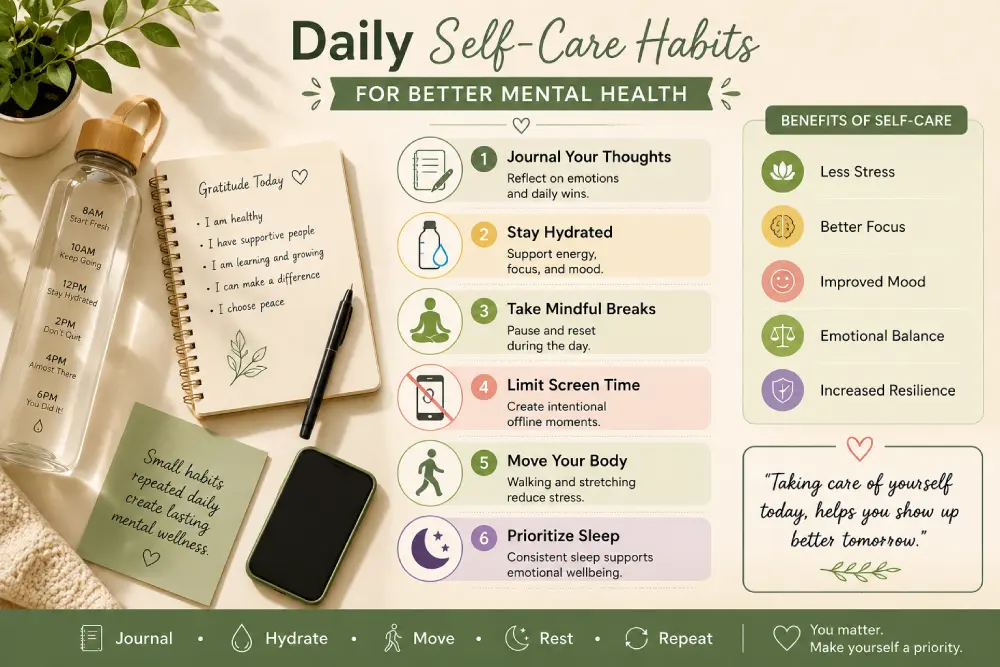
Daily Self-Care Habits That Support Mental Health
You don‘t require a 10-step programme. You require a few habits that you will actually stick to.
1. Prioritise Sleep Above Everything Lack of sleep doesn‘t just make you tired and run down; it messes with your head, making you more prone to feelings of anxiety and depression while negatively affecting your ability to make good choices. Wake up and go to bed at the same time every day, and give yourself the gift of sleep.
2. Move Your Body — Even Briefly Things like sleep, stress, movement, and nutrition all play a role in how we feel, both mentally and physically. You don’t need a gym. A 10-minute walk, stretching, or yoga at home counts. The goal is consistency, not intensity.
3. Mindful Mornings (5 10 Minutes) Begin every day with just 5 10 minutes. Practice gratitude journaling list three things you are grateful for. Add a few simple breath exercises or stretches at the end. These will help to fix your mindset before you get pulled in by the day‘s pressures.
4. Reduce passive scrolling Mindless phone usage especially in the early morning or late at night is one of the most widely overlooked causes of low-grade anxiety. An easy digital detox, however, does not require you to delete your apps; it simply asks you to limit your usage of them.
5. Protect Your Emotional Energy Saying yes to everything isn’t generous — it’s a quick route to resentment and burnout. Defining your emotional limits is not building walls. It’s creating structure that allows you to show up better for the people you care about.
Morning Routine for Better Mental Health
How you begin you morning affects you the whole day long. You don‘t need to take an hour and a half for your morning routine, even a few simple actions make a huge difference. Here‘s a practical 20-minute morning routine for well-being:
6:30AM- First 10 minutes without phone Wake up your nervous system slowly by not bombarding it with notifications and news.
6:40 AM 5 minutes of breath or stretch. Even box breathing: breathe in 4, hold 4, exhale 4, will significantly lower cortisol.
6:45AM– journal or state an intention. Write down one thing you are grateful for, and one thing you want to experience today. That‘s all.
6:50AM have a drink and nourishing food. Lack of breakfast causes unstable sugar levels & unhealthy mood. Anything as simple as a banana and a glass of water will do.
Would be repeatable. That‘s the point.
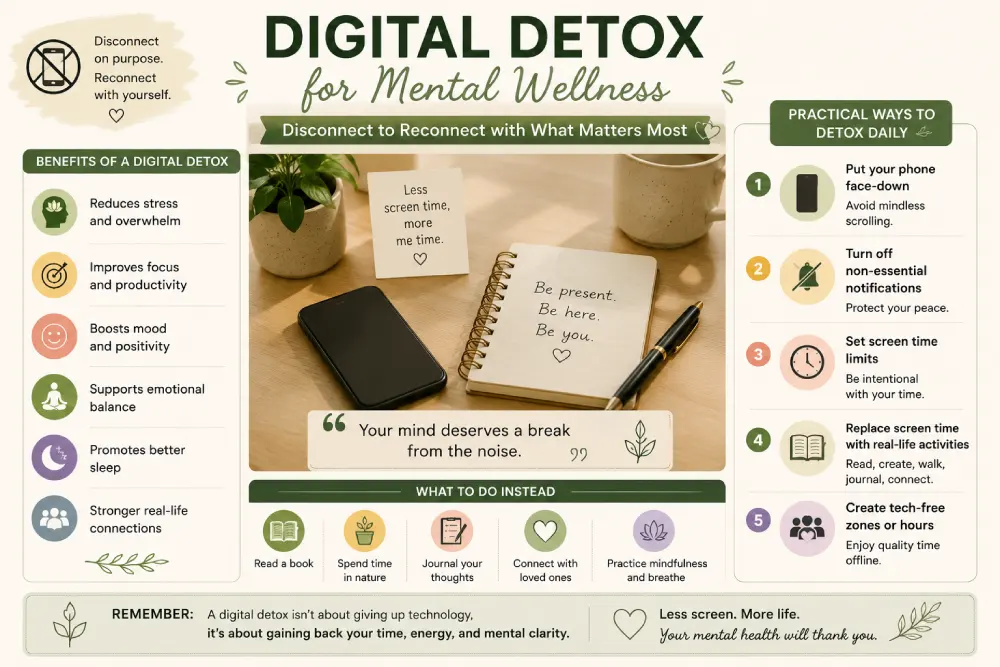
Digital Detox and Mental Wellness
It‘s not the screens that are the problem. It‘s never turning off the screen.
A few small shifts make a real difference:
- No phone in bed charge phone in another room, only bring down when needed.
- Set a half hour social-media time window in your day.
- Disables the notifications which do not need to be addressed as soon as possible at work or during the study time
- Swap late-night browsing sessions for reading a book, going for a walk, or listening to music.
In intensely stressful places metros in India; corporate offices in the US these are skills that fix your head in time for the onslaught of the day, and even a lunch hour spent doing breathing exercises and basking in the outdoor air does the trick.
How to Create a Sustainable Self-Care Plan
Most common reason self-care routines fail too much at once.
Begin with less than you think you can sustain. (Even a 5-minute morning breathing exercise is better than a high-pressure 60-minute stint that you are only able to keep up with for three days.) Schedule your wellness time on your calendar just as you would a doctor appointment.
A sustainable self-care plan has three qualities:
It‘s really realistic. Itworks in your real life – not your fantasy life.
It‘s flexible. missing a day doesn‘t mean starting from scratch. build in space for getting it back.
It addresses multiple areas. Your daily life should reflect physical vitality through activity and food, mental focus through mindfulness, and emotional equilibrium through contemplation and relationship.
Read More: Health and Wellness — The Full Pillar Guide
Conclusion
Investing in a self-care routine for mental health is among the most valuable investments you can make in yourself without requiring money, a gym membership, or most other free time. It does require time and dedication.
Begin by sleeping. Mix in exercise. Five minutes alone each morning before you hand your mind to a screen. Save your energy. Go slow.
Mental health is personal to all. We all work differently and that‘s no problem. What we want is that the routine is ours and not a perfect routine.
FAQ SECTION
Q1: What is a good self-care routine for mental health?
A good mental health self-care routine involves a healthy regimen of sleep, some daily exercise, 5–10 minute mindful meditation or journaling in the am, passive time on screens, and regular social contact with supportive people. Implement one new habit at a time.
Q2: How do I start a self-care routine when I’m already burnt out?
Beginning tiny just getting up and taking a deep breath in the morning, or going to bed 30 minutes early. Burnout indicates your ammo belt is empty you‘re not ready for more you‘re ready for less. Build up your toolbox accordingly.
Q3: Is self-care selfish?
Absolutely not. If I don‘t take care of myself I can‘t take care of others. Allow yourself to ignore your mental health and you will not be more productive or more generous you‘ll just be a broken-down and exhausted mess. Please take care of yourself.
Q4: What self-care habits are best for anxiety?
Proposed self-care habits that have evidence behind them for anxiety include regular sleep, consistent movement, guided breathing or mindfulness, avoidance of caffeine and alcohol, and decreasing time on social media that isn‘t necessary. For example, using a 5-minute mindful breathing practice each day has been shown to decrease cortisol levels.
Q5: How is self-care different in India vs the USA?
The emotional needs are the same, but the cultural norms and constructs are very different. Rest is often viewed as laziness and boundaries are often received negatively in a joint family or community setting in India. The US usually struggles with the culture of ‘being busy’ and over stretching. Either way, the initial and most difficult step is giving oneself permission to rest.
Q6: How long does it take to see results from a self-care routine?
People generally experience key shifts such as an uplift in their state of mind and feelings of vitality within 1 2 weeks of waking and moving on a regular basis. More pervasive internal shifts can take up to 4 8 weeks of regular practice.